消费品

Search documents
【每周经济观察】供需双向奔赴扩消费
Sou Hu Cai Jing· 2025-08-09 01:27
Core Insights - Consumption is not merely a transactional behavior; when consumption potential can be smoothly transformed into market orientation and supply can promptly respond to demand, China's economy will exhibit stronger resilience and vitality [2][5] - The government has prioritized boosting consumption and improving investment efficiency as key tasks for economic growth, especially in addressing the shortfalls in domestic demand [2][3] Group 1: Consumption Trends - The retail sales of consumer goods in China exceeded 24.55 trillion yuan in the first half of the year, with a cumulative growth of 5%, indicating a steady growth trend [2] - The contribution rate of final consumption to economic growth reached 52%, with the second quarter showing a contribution rate of 52.3%, reflecting the foundational role of consumption in economic development [2] Group 2: Consumption Drivers - The "old-for-new" consumption policy has significantly boosted sales, with over 1.7 trillion yuan in sales driven by this initiative, and notable growth in key categories such as home appliances and new energy vehicles [3] - Emerging consumption trends such as "IP + consumption" and "artificial intelligence + consumption" are gaining popularity, alongside a vibrant service consumption sector, highlighting the potential for growth in these areas [3][4] Group 3: Enhancing Consumption Capacity - To expand consumption, it is crucial to enhance residents' consumption capacity by steadily increasing disposable income, as there remains significant room for improvement in spending within the livelihood sector [4] - Targeted policy measures are needed to improve income distribution and promote social equity, which in turn can boost consumer willingness to spend [4] Group 4: Supply and Demand Dynamics - There is a need to cultivate new growth points in consumption by increasing the supply of quality goods and services, as consumer expectations for quality and personalized experiences continue to rise [4][5] - Optimizing the institutional environment for consumption is essential, particularly in addressing issues such as market segmentation and inconsistent quality standards, which hinder efficient supply-demand matching [5]


“两新”政策如何再加力?(锐财经)
Ren Min Ri Bao Hai Wai Ban· 2025-08-08 20:42
Core Insights - The "Two New" policy is being expanded to enhance its effectiveness in promoting consumption and investment in various sectors [2][3][8] Group 1: Policy Implementation and Support - The National Development and Reform Commission (NDRC) is enhancing the implementation mechanism of the "Two New" policy, focusing on key areas and improving support measures [2][8] - In 2024, 150 billion yuan will be allocated for long-term special bonds to support over 4,600 projects across 12 sectors, including industrial and environmental infrastructure [3] - By 2025, the funding for equipment updates will increase to 200 billion yuan, expanding to include electronic information and agricultural facilities [3] Group 2: Equipment Update and Market Growth - The equipment update market is projected to exceed 5 trillion yuan annually, with over 20 million units expected to be updated in key sectors by 2024 [4][5] - Investment in equipment purchasing is expected to grow by 17.3% year-on-year in the first half of 2025, with significant growth in related manufacturing sectors [4] Group 3: Consumer Goods Replacement - The "old-for-new" consumption policy has significant potential, with over 7 million passenger cars and 180 million household appliances exceeding their safe usage period [5][6] - In 2024, sales from the "old-for-new" policy in automotive, home appliances, and other categories are expected to exceed 1.3 trillion yuan, with 1.6 trillion yuan achieved by mid-2025 [6] Group 4: Funding and Efficiency - The third batch of 69 billion yuan for the "old-for-new" program has been allocated, with plans for a fourth batch to meet the annual target of 300 billion yuan [7] - The NDRC emphasizes the importance of timely fund allocation and balanced usage to ensure the smooth implementation of the "old-for-new" policy [7][8]
灵犀平台全量!种草直达正式上线!小红书商业基建再下一城
Sou Hu Cai Jing· 2025-08-08 11:05
Core Insights - The second "Grass Planting Awards" by Xiaohongshu showcased 533 case submissions from 395 brands across 85 industries, with Beike, beU, and Yike Da winning the top awards [1] - Beike saw a year-on-year increase of over 24 times in transaction volume on Xiaohongshu, contributing to its lead in media-generated leads [1] - New brands like Yike Da and beU have successfully leveraged Xiaohongshu for growth, with Yike Da achieving a total sales increase to 1 billion and beU's GMV growing by 43 million in the past year [1] Group 1: Xiaohongshu's Marketing Innovations - Xiaohongshu's "Lingxi" platform provides intelligent insights and metrics, allowing brands to better understand market trends and consumer opportunities [3][5] - The platform is now available for free to all registered brands, particularly benefiting small and medium-sized businesses [3] - The "Grass Planting Direct" feature was officially launched to enhance the efficiency of the marketing process, allowing brands to track and optimize their investments more effectively [10][12] Group 2: Brand Growth Strategies - Brands utilizing the "Lingxi" platform have reported significant growth, with Hisense's new product achieving over 80 million GMV in three months, largely attributed to insights from Lingxi [5][6] - The platform helps brands identify new market segments, such as the growing interest in gaming among TV consumers, allowing for targeted marketing strategies [6][7] - The combination of "Grass Planting" and "Grass Planting Direct" has proven to be an effective strategy, with brands experiencing a 28% improvement in ROI compared to traditional methods [10][12] Group 3: Market Trends and Consumer Insights - The awards highlighted a clear upward trend in consumer goods, lifestyle services, and internet content services, particularly among emerging brands [1] - The Lingxi platform's recent upgrades allow brands to measure brand awareness and reputation across various industries, enhancing their marketing strategies [9] - Brands are increasingly focused on understanding the effectiveness of their marketing efforts, shifting from "how to plant grass" to "how effective is the grass planting" [12]

“反内卷”养殖看点
2025-08-07 15:03
Summary of Conference Call Records Industry Overview - The conference call discusses the **pig farming industry** in the context of the "anti-involution" policy aimed at addressing low-price disorderly competition and promoting supply-side reforms [1][2][7]. Key Points and Arguments 1. **Anti-Involution Policy**: The policy aims to control basic production capacity, breeding sow inventory, and the weight of pigs at market release, thereby preventing drastic fluctuations in production and prices [1][8]. 2. **Supply-Side Reforms**: The reforms are expected to lead to an optimized supply structure in the pig farming industry, enhancing overall efficiency and resource conservation [1][3]. 3. **Economic Environment**: The current economic environment is characterized by a transition from financial re-inflation to food re-inflation, with significant changes in household savings and investment behaviors [4][5]. 4. **Inflation Understanding**: Inflation levels should be understood through both supply reform and demand stimulation, with a focus on supply-side adjustments before demand-side interventions [6]. 5. **PPI Impact**: A narrowing decline in the Producer Price Index (PPI) is anticipated to have a strong impact on asset allocation strategies [6]. Specific Measures in Pig Farming - The anti-involution measures include controlling the number of breeding sows, reducing the weight of pigs at market release, and timely reporting of production data [1][8]. - The goal is to prevent overproduction and stabilize prices, which is crucial for maintaining profitability in the sector [7][14]. Industry Challenges and Responses 1. **Overcapacity Issues**: The pig farming industry has faced overcapacity challenges, with a slow exit of outdated production capacity despite profitability since May 2024 [2][9]. 2. **Animal Health Industry**: The veterinary medicine and vaccine sectors are experiencing intense competition, with many companies reporting declining performance [2][10][16]. 3. **Market Dynamics**: The market for veterinary products is expected to improve as the anti-involution policy encourages innovation and higher standards for new product approvals [16][18]. Future Projections - The breeding sow inventory is expected to gradually decrease, impacting pig supply and prices in the second half of 2026 [14]. - Short-term price pressures are anticipated due to seasonal factors, but overall price stability is expected as supply adjustments take effect [15]. Investment Opportunities - Companies with efficiency advantages in pig farming and leading firms in the veterinary medicine sector are identified as having high investment value [19]. - Specific companies such as Keqian Bio, Ruipu Bio, and Huisheng Bio are highlighted as potential beneficiaries of the anti-involution policy [19]. Conclusion - The anti-involution policy is set to reshape the pig farming industry, addressing overcapacity and enhancing product quality while also impacting related sectors such as veterinary medicine. The overall economic environment and inflation dynamics will play a crucial role in shaping future market conditions and investment strategies [1][5][20].
大摩:本轮美股牛市要暂停了吗?
美股IPO· 2025-08-06 13:22
Core Viewpoint - Morgan Stanley suggests that the U.S. stock market may experience a phase adjustment in Q3, primarily due to the lagging impact of tariffs and the fluctuating policies of the Federal Reserve. However, the current bull market is not expected to end, with adjustments seen as opportunities for investment rather than a market termination [1][3][7]. Market Performance - Since the low in April, the S&P 500 index has rebounded over 26%. As Q3 approaches, concerns arise from weak non-farm employment data and inflation worries due to tariffs, leading to market uncertainty about the continuation of the bull market [3][4]. Bull Market Logic - The bull market's foundation is rooted in a V-shaped recovery of earnings revision breadth (ERB), which has rebounded from -25% in April to +10% currently. This indicator is crucial for confirming market bottoms and has historically led earnings surprise data [6]. Tariff Impact and Federal Reserve Policy - The impact of tariffs is expected to reflect in corporate earnings reports in Q3, particularly affecting consumer goods sectors with weak pricing power, while industrial firms that can pass on costs will be less affected. Labor market data adds to policy uncertainty, with the bond market pricing in an 88% chance of a Fed rate cut in September [9]. Earnings Growth and Fed Policy Outlook - Despite short-term risks, the outlook for the next 12 months remains bullish, supported by three main factors: increased certainty in earnings growth, with consensus predicting a 9% EPS growth for the S&P 500 in 2025 and 14% in 2026; the eventual shift in Fed policy towards rate cuts; and resilience in valuations and liquidity, with the S&P 500's dynamic P/E ratio remaining at reasonable levels [10].

斩获430亿大单,“AI制药第一股”晶泰控股成色几何?
Huan Qiu Lao Hu Cai Jing· 2025-08-06 13:03
Core Viewpoint - JingTai Holdings has secured a significant AI pharmaceutical collaboration with DoveTree, amounting to a total of $5.99 billion, marking a record in the "AI + Robotics" drug development sector [1][2]. Group 1: Financial Details - The deal includes an initial payment of $51 million, potential further payments of $49 million, and milestone payments of $5.89 billion, with additional royalties based on annual net sales [2]. - JingTai Holdings' market capitalization reached HKD 298.1 billion following the announcement, with a stock price increase of 12.42% [2]. - The company reported a revenue of RMB 266 million in 2024, surpassing the HKD 250 million threshold required to remove its "P" label under the Hong Kong Stock Exchange's special technology rules [5]. Group 2: Company Background - Founded in 2015 by three MIT postdoctoral researchers, JingTai Holdings is recognized as the first AI pharmaceutical company listed on the Hong Kong Stock Exchange [5]. - The company has attracted significant investment from major firms, including Tencent, Sequoia, and China Life, and has completed multiple funding rounds totaling over RMB 5 billion [7]. Group 3: Business Operations - JingTai Holdings operates primarily in drug discovery solutions and intelligent automation solutions, with the latter generating RMB 163 million in revenue in 2024, a growth of 87.8% [6]. - The company has expanded its business beyond AI pharmaceuticals into materials science, agriculture, and consumer goods, signing a five-year contract worth RMB 1 billion with GCL Group for AI model development in new energy materials [6]. Group 4: Strategic Investments - In 2024, JingTai Holdings acquired a 90% stake in Siwei Medical, aiming to integrate its ECG diagnostic data with AI technology for cardiovascular drug development [9]. - The company also completed the acquisition of Liverpool ChiroChem, enhancing its capabilities in automated chiral chemistry [9]. - JingTai Holdings has invested in several biotech firms, including Merda Bio, which has received orphan drug designation from the FDA for a candidate drug [10].
杨德龙:A股两融余额时隔十年重回2万亿 这轮牛市氛围越来越浓
Xin Lang Ji Jin· 2025-08-06 07:33
Economic Growth - China's GDP grew by 5.3% year-on-year in the first half of the year, surpassing the government's target of around 5% for the full year [1] - Domestic demand contributed 68.8% to GDP growth, with consumption alone accounting for 52%, indicating a strong consumer-driven economy [2] Consumption and Policy Measures - The government issued 1.3 trillion yuan in long-term special bonds, with 300 billion yuan allocated for consumer goods replacement programs, leading to over 30% sales growth in related products [2] - New policies, including childcare subsidies and free preschool education, aim to boost birth rates and subsequently increase consumption in related sectors [2] Inflation and Economic Policy - The Consumer Price Index (CPI) was -0.1% and the Producer Price Index (PPI) was around -3% in the first half, indicating deflationary pressures [3] - The government aims for a CPI growth target of around 2%, suggesting more proactive fiscal and monetary policies to stimulate demand and moderate inflation [3] Market Trends - The humanoid robot sector is expected to grow significantly, with a projected market size of nearly 38 billion yuan by 2030 and a compound annual growth rate of over 61% from 2024 to 2036 [5] - Recent adjustments in the humanoid robot market have created a favorable environment for investment, with signs of renewed interest and potential for significant returns [5] Stock Market Activity - The A-share market saw a notable increase in margin trading, surpassing 2 trillion yuan for the first time in nearly a decade, reflecting investor optimism [6] - Hong Kong stocks experienced substantial inflows, with southbound funds net buying 820 billion HKD, indicating strong demand from mainland investors [7]
【省工业和信息化厅】陕西组织遴选2025年工业精品
Shan Xi Ri Bao· 2025-08-05 00:07
Core Points - The Shaanxi Provincial Department of Industry and Information Technology is organizing the selection of high-quality industrial products for 2025 to enhance product quality and promote innovation-driven development [1] - The selection will focus on areas such as high-end equipment, new materials, consumer product upgrades, and electronic information innovation, while also considering traditional industry transformation and emerging industry cultivation [1] Group 1: Selection Criteria - Each enterprise can only submit one product project, and must be a registered industrial enterprise in the province with independent legal status [1] - Eligible enterprises must have a good operational and financial status, with no major safety, environmental, or quality incidents in the past three years, and no negative credit records [1] - Products must have leading technical performance indicators in their category, high brand recognition, clear intellectual property rights, reliable quality, and good economic and social benefits [1] Group 2: Application Process - The application process consists of three main steps: enterprise application, departmental recommendation, and expert review [2] - Enterprises must submit relevant application materials and a written application to their respective municipal or district industry and information departments [2] - The provincial department will organize experts to review the submitted materials, determine the selection list, and publicly announce it after confirming there are no objections [2]
以标准提升牵引设备更新和消费品以旧换新成效初显
news flash· 2025-08-04 03:04
Core Insights - The implementation of the "Standard Upgrading to Support High-Quality Economic Development" and "Standard Enhancement for Equipment Renewal and Consumer Goods Replacement Action Plan" has shown initial positive results after monitoring nearly 200 items for over three months [1] Group 1: Impact on Consumer Goods - Over 16,900 product categories have been produced according to standards, with more than 1,500 testing institutions involved [1] - New standards have led to the emergence of popular consumer products such as digital showerheads and smart temperature-changing toilets, with over 50 million home renovation orders in kitchen and bathroom sectors this year [1] - The introduction of 3,000 new types of smart toilets reflects the growing trend in consumer preferences [1] Group 2: Impact on Manufacturing Industry - Standards like "Lithium-ion Batteries for Energy Storage" have accelerated the iteration and upgrade of storage products, with over 120 capacity projects in the energy storage supply chain established this year [1] - There have been 59 new overseas storage orders, indicating a growing international demand for these products [1] Group 3: Safety Standards Enhancement - New national standards for portable and wheeled fire extinguishers have added classifications for D-class (metal fires) and F-class (cooking fires), improving the ability to handle more complex fire scenarios [1] - The average monthly download of the portable fire extinguisher national standard exceeds 5,000, with over 240 companies producing according to the new standards [1] - E-commerce platform sales of household fire extinguishers have increased by 65% in the first quarter, enhancing fire safety capabilities in buildings, restaurants, and households [1]
2025全球独角兽榜苏州上榜企业排行榜(附榜单)
Sou Hu Cai Jing· 2025-08-04 02:14
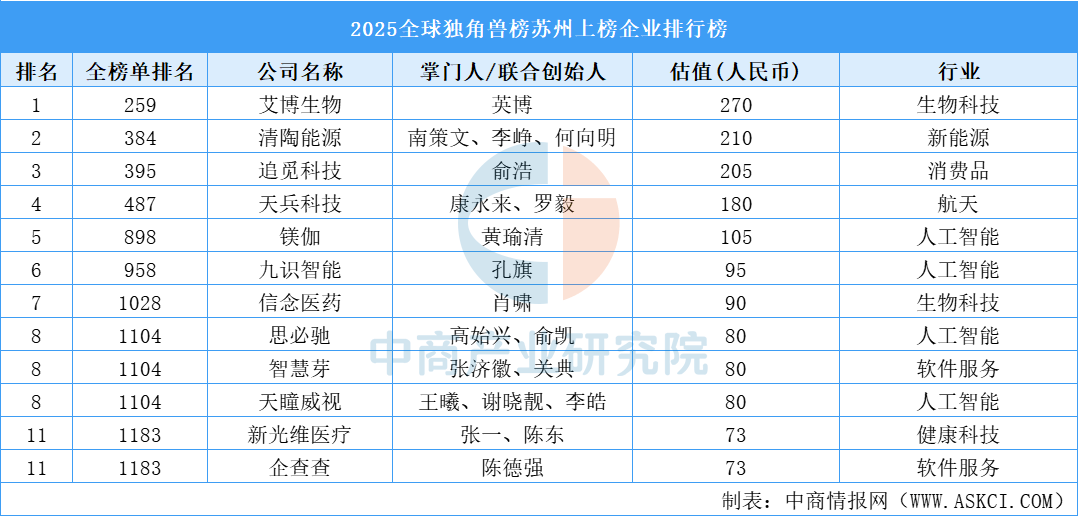
艾博生物估值最高达270亿元,位居榜首。清陶能源、追觅科技排名第二和第三,估值分别为210亿元、205亿元。天兵科技、镁伽估值超百亿。 | | | | 2025全球独角兽榜苏州上榜企业排行榜 | | | | --- | --- | --- | --- | --- | --- | | 排名 | 全榜单排名 | 公司名称 | 掌门人/联合创始人 | 估值(人民币) | 行业 | | l | 259 | 艾博生物 | 英博 | 270 | 生物科技 | | 2 | 384 | 清陶能源 | 南策文、李峥、何向明 | 210 | 新能源 | | 3 | 395 | 追觉科技 | 前浩 | 205 | 消费品 | | র্ব | 487 | 天兵科技 | 康永来、岁数 | 180 | 航天 | | 5 | 898 | 镁伽 | 黄瑜清 | 105 | 人工智能 | | 6 | 058 | 九识智能 | 孔旗 | 95 | 人工智能 | | 7 | 1028 | 信念医药 | 肖啸 | 90 | 生物科技 | | 8 | 1104 | 思必驰 | 、高始兴、俞凯十六六日 | 80 | 人工智能 | | 8 | 1104 ...