生猪养殖

Search documents
农林牧渔行业周报:保障措施落地催化牛价上涨,看好牧业景气周期-20260111
SINOLINK SECURITIES· 2026-01-11 13:09
Investment Rating - The report does not explicitly state an investment rating for the agricultural sector, but it implies a cautious outlook on certain segments, particularly in pig farming and poultry [62]. Core Insights - The agricultural sector index has shown a slight increase of 0.98% week-on-week, but it has underperformed compared to major indices like the Shanghai Composite [12][14]. - In the pig farming sector, prices are currently stabilizing at a low level, with expectations of further declines due to weak supply and demand dynamics [21]. - The poultry sector is experiencing pressure on prices, particularly for white feather chickens, while yellow feather chickens are showing signs of recovery due to improved demand [32]. - The beef market is expected to see price increases as it enters the consumption peak season, while dairy prices are stabilizing after a period of decline [40]. - The planting sector is facing tight supply and demand conditions, with potential price increases for corn and soybeans anticipated due to external uncertainties and domestic policy support [43][44]. - The feed and aquaculture sectors are showing stable prices, with certain seafood prices trending upwards [51]. Summary by Sections Pig Farming - As of January 9, the national average price for commodity pigs is 12.63 yuan/kg, with a week-on-week increase of 1.36%. The average weight of pigs at market is 128.54 kg, showing a slight decrease [20][21]. - The sector is expected to face further price declines due to weak demand and supply conditions, with a focus on reducing production capacity amid ongoing losses [21][22]. Poultry Farming - The average price for white feather chickens is 7.64 yuan/kg, reflecting a week-on-week decrease of 1.04%. The profitability of poultry farming is under pressure, but there are signs of improvement for yellow feather chickens due to better demand [30][32]. Livestock - The price of live cattle in Shandong is 26.58 yuan/kg, stable week-on-week but up 14.62% year-on-year. The beef market is expected to strengthen as it enters the peak consumption season [40]. - Dairy prices are stabilizing, with average purchase prices for raw milk at 3.03 yuan/kg, while the industry is still facing significant financial pressure [40]. Planting Sector - Domestic corn prices are at 2250 yuan/ton, with expectations of tight supply conditions leading to potential price increases. The soybean market is also showing upward trends [43][44]. - The planting sector is stabilizing at a low point, with potential improvements expected if there are significant reductions in crop yields [44]. Feed and Aquaculture - Feed prices are stable, with pig feed at 3.34 yuan/kg and poultry feed at 3.45 yuan/kg. Aquaculture prices are also stable, with notable increases in certain seafood products [51].

法国发生禽流感疫情,引种再度收紧:农林牧渔
Huafu Securities· 2026-01-11 12:18
Investment Rating - The industry rating is "Outperform the Market" [4][68]. Core Insights - The report highlights fluctuations in pig prices, with a focus on supply rhythm changes. As of January 9, the pig price was 12.58 CNY/kg, showing a week-on-week decrease of 0.09 CNY/kg. The report notes that the northern farming sector is experiencing tight supply due to previous overselling and disease impacts, while southern enterprises are increasing output, leading to weaker price adjustments [2][9][30]. - In the beef sector, calf prices are rising, and import restrictions on beef are expected to support long-term price increases. As of January 9, the price for fattening bulls was 25.51 CNY/kg, up 0.08% week-on-week, while calf prices reached 32.41 CNY/kg, up 2.43% week-on-week. The report anticipates a tightening supply of beef in the coming years due to a decrease in breeding cows [3][34]. - The poultry sector is affected by an outbreak of avian influenza in France, leading to tightened breeding imports. The price for white feather broilers was 7.64 CNY/kg as of January 9, down 0.08% week-on-week. The report suggests that the ongoing restrictions on imports may lead to a contraction in upstream capacity [3][41][45]. Summary by Sections Swine Industry - Pig prices are currently experiencing fluctuations, with a noted decrease in average weight of pigs being marketed. The average weight as of January 8 was 128.54 kg, down 0.12 kg week-on-week. The report indicates that the industry is facing losses, and capacity reduction policies are expected to continue, potentially leading to a long-term increase in pig prices [2][11][30]. - The average daily slaughter volume for the week was 189,800 pigs, reflecting a week-on-week decrease of 5.13%. The report also mentions a decrease in frozen product inventory rates, which stood at 19.48% as of January 8, down 2.06 percentage points week-on-week [11][30]. Beef Industry - The report indicates that calf prices are on the rise due to increased demand from breeding farms. The long-term outlook for beef prices is positive, supported by import restrictions on beef that will limit supply [3][34]. Poultry Industry - The report notes that the outbreak of avian influenza has led to a halt in the pricing of broiler chicks, with current prices for white feather broilers slightly down. The ongoing restrictions on imports are expected to impact upstream production capacity [3][41][45]. Dairy Industry - The report states that raw milk prices are currently at a low point, with the price as of January 2 being 3.03 CNY/kg, unchanged week-on-week. The ongoing losses in the dairy sector are expected to lead to continued capacity reduction, with a potential stabilization of prices in 2026 [3][35]. Seed Industry - The report discusses the strengthening of intellectual property protection in the seed industry, highlighting recent cases that aim to combat infringement and improve market order. This regulatory environment is expected to support the revitalization of the seed industry [52].
生猪:累库确认,短期仍未见释放驱动
Guo Tai Jun An Qi Huo· 2026-01-11 10:07
Group 1: Report Investment Rating - No relevant information provided Group 2: Core Views - This week (1.5 - 1.11), the spot price of live pigs showed a strong - side oscillation. The price of 20KG piglets in Henan was 23.2 yuan/kg (last week: 21.75 yuan/kg), the price of live pigs in Henan was 12.98 yuan/kg (last week: 12.45 yuan/kg), and the price of 50KG binary sows nationwide was 1556 yuan/head (last week: 1546 yuan/head). The supply was tight due to slow resumption of group slaughter and strong reluctance of retail farmers to sell, while the demand side had negative feedback as downstream entered the loss stage after New Year's Day. The average slaughter weight nationwide was 124.38KG (last week: 124.19KG), a 0.15% MoM increase [1]. - The futures price of live pigs oscillated. The highest price of the LH2603 contract this week was 11925 yuan/ton, the lowest was 11610 yuan/ton, and the closing price was 11770 yuan/ton (last week: 11795 yuan/ton). The basis of the LH2603 contract was 1030 yuan/ton (last week: 655 yuan/ton) [2]. - Next week (1.12 - 1.18), the spot price of live pigs will oscillate weakly. The overall slaughter progress in December was fast, leading to a shortage of pigs in the social group after the Winter Solstice, which drove up the reluctance to sell. Coupled with the entry of secondary fattening, the spot price rose sharply. After the New Year's Day holiday, the negative feedback from the downstream was obvious, and the spot price accelerated its decline. After the holiday, due to the reduction in enterprise slaughter and the reluctance to sell in the social aspect, inventory accumulation occurred again. From the supply perspective, according to the piglet data, the supply will enter a continuous incremental stage until March 2026. There have been multiple rounds of inventory - accumulation sentiment. In October, secondary fattening intervened, the overall supply progress in November was slow, and the weight did not decline significantly in December, so the supply pressure was not effectively relieved. From the demand perspective, the low price in October stimulated demand and increased the enthusiasm for warehousing, and secondary fattening continued to enter the market, which exceeded market expectations but also pre - empted the speculative demand increment for re - inventory accumulation. After the temperature drop in December, the demand for curing and regular demand increased, and the slaughter volume continued to rise. In general, the group continued to accumulate inventory in early January, the weight - reduction plan was postponed, and the feed data increased again, indicating that the social aspect was also under pressure. In mid - January, the demand will enter a vacuum period, and it is expected to be under pressure [3]. - In the futures market, the price of the LH2603 contract closed at 11770 yuan/ton on January 9th. In early January, enterprises reduced the slaughter volume, the weight increased, the social aspect was forced to accumulate inventory, the feed data increased again, the downstream losses were obvious, the negative feedback suppressed the slaughter volume, and inventory accumulation was confirmed. The weight - reduction plan before the Spring Festival has not been implemented, and the pressure is postponed. The negative expectations will continue to suppress the near - term contracts. In October, the losses of piglets stimulated the elimination of productive sows, and the continuous rise in piglet prices drove the repair of the far - end price center. The far - end has entered the stage of expected trading, and attention should be paid to setting stop - loss and take - profit levels. The short - term support level for the LH2603 contract is 11000 yuan/ton, and the pressure level is 12000 yuan/ton [4]. Group 3: Summary by Directory 1. Market Data - This week, the basis was 1030 yuan/ton, and the LH2603 - LH2605 spread was - 445 yuan/ton [9]. 2. Supply - This week's average weight was 124.38KG (last week: 124.19KG). In November, the pork output was 5.46 million tons, a 2.6% MoM decrease; the pork import was 60,500 tons, a 14.16% MoM decrease [13]. 3. Price - No specific summarized price information other than those mentioned above 4. Demand - No specific summarized demand information other than those mentioned above
农林牧渔行业周报:春节备货尚未启动,下游利润仍待修复-20260111
KAIYUAN SECURITIES· 2026-01-11 08:15
Investment Rating - The industry investment rating is "Positive" (maintained) [1] Core Insights - The report indicates that the pork price has slightly declined but remains supported by high slaughter volumes and increased breeding activity. The pre-Spring Festival stocking has not yet started, and downstream profits are still in need of recovery. The average price of live pigs as of January 9, 2026, is 12.58 CNY/kg, showing a week-on-week decrease of 0.09 CNY/kg and a year-on-year decrease of 3.36 CNY/kg. The industry gross white price difference is 3.85 CNY/kg, which has decreased by 0.13 CNY/kg week-on-week and 1.46 CNY/kg year-on-year, indicating potential for recovery as stocking begins [5][14]. Summary by Sections Weekly Observation - The report notes that the pre-Spring Festival stocking has not yet started, and downstream profits are still in need of recovery. The average price of live pigs is 12.58 CNY/kg, with a week-on-week decrease of 0.09 CNY/kg and a year-on-year decrease of 3.36 CNY/kg. The industry gross white price difference is 3.85 CNY/kg, indicating potential for recovery as stocking begins [5][14]. Market Performance - From January 5 to January 9, the agricultural sector underperformed the market by 2.84 percentage points. The Shanghai Composite Index rose by 3.82%, while the agricultural index increased by 0.98%. The fishery sector led the gains, with notable increases in stocks such as Dahu Co. (+17.83%), Zhongshui Fishery (+16.07%), and Biological Co. (+15.46%) [7][20][24]. Key News - The Ministry of Agriculture and Rural Affairs reported a 98% compliance rate in the national agricultural product quality safety monitoring for 2025. Additionally, the central reserve of frozen pork will initiate a two-way rotation with an outflow and storage volume of 17,800 tons each [6][26]. Price Tracking - As of January 9, 2026, the average price of live pigs is 12.63 CNY/kg, down 0.13 CNY/kg from the previous week. The average price of piglets is 20.39 CNY/kg, up 0.95 CNY/kg week-on-week. The average price of white strips of meat is 16.85 CNY/kg, showing a slight increase of 0.05 CNY/kg [8][28].


猪价持续“磨底” 企业借期货工具破周期之困
经济观察报· 2026-01-11 04:40
Core Viewpoint - The article discusses the transformation of pig farming enterprises from passive risk management to active risk management through the establishment of professional futures teams and refined hedging operations in response to ongoing price pressures in the pig market [2][4]. Group 1: Market Overview - In 2025, the pig market faced significant challenges, with average prices significantly lower than in 2023 and 2024, reaching a low of 11 yuan/kg in October, leading to deep industry losses [2][4]. - The average price of lean pigs in 2025 was 13.80 yuan/kg, with a downward trend observed throughout the year, particularly after mid-September when prices fell below the industry cost line [4]. - The overall pig farming industry has experienced four complete cycles of the "pig cycle" since 2006, with the current phase being the most painful "bottoming" stage of the fifth cycle [2]. Group 2: Supply and Demand Dynamics - In 2025, the total pig output is expected to reach 747 million heads, a year-on-year increase of 6.4%, with pork production exceeding 60 million tons for the first time [5]. - The average PSY (pigs weaned per sow per year) increased from 21 in 2024 to 26 in 2025, enhancing the supply capacity by 23.8% under the same breeding stock [5]. - Demand for pork is declining due to macroeconomic factors affecting consumer willingness, with traditional peak seasons seeing a 10%-15% year-on-year decrease in consumption [5]. Group 3: Financial Performance of Companies - Leading companies like Muyuan Foods reported a total sales volume of 77.981 million pigs in 2025, an increase of 6.379 million heads from 2024, but total sales revenue decreased by approximately 3.4 billion yuan due to lower average selling prices [6]. - The cost of pig farming is currently estimated to be between 12 and 13 yuan/kg, with top companies achieving lower costs through management advantages [4]. Group 4: Risk Management Strategies - Companies are increasingly adopting futures hedging as a critical strategy for risk management, moving away from traditional sales models that do not guarantee stable profits [8][9]. - Futures hedging has become a normalized part of operations, focusing on locking in profits rather than speculative trading [9][11]. - The implementation of futures contracts allows companies to stabilize their profits and manage risks effectively, as demonstrated by various companies' experiences in the market [10][12].



补税还是免税?罗牛山陷4000万元涉税“拉锯战”!
Shen Zhen Shang Bao· 2026-01-10 09:56
Core Viewpoint - The company, Roniushan, is facing a tax dispute exceeding 40 million yuan, with its administrative review application rejected by the tax authority [1][2]. Tax Dispute - The Haikou City Meilan District Tax Bureau has determined that the company should pay 40.54 million yuan in corporate income tax related to the equity disposal during the restructuring of Hainan Rural Commercial Bank [2]. - The company disagrees with this tax authority's assessment, arguing that the equity disposal is eligible for tax exemption policies and should not incur additional tax payments [2]. - The company has applied for an administrative review after securing a tax guarantee, but the tax bureau has refused to accept the application [3]. Legal Actions - The company plans to file an administrative lawsuit against the decision of the Haikou City Tax Bureau regarding the rejection of its administrative review application [3]. Financial Impact - The tax matter will not involve retrospective adjustments according to the relevant accounting standards, but the potential tax payment will affect the company's profit and loss for the fiscal year 2025 [3]. - The exact impact on the net profit attributable to shareholders will be determined based on audited financial statements [3]. Sales Performance - In December 2025, the company sold 58,600 pigs, representing a 10.46% decrease month-on-month and an 11.46% decrease year-on-year, with sales revenue of 99.62 million yuan, down 10.55% month-on-month and 25.55% year-on-year [3]. - For the entire year of 2025, the company sold 685,600 pigs, a slight decrease of 0.75% year-on-year, with total sales revenue of 1.244 billion yuan, down 4.74% year-on-year [3]. Financial Results - For the first three quarters of 2025, the company reported revenue of 1.629 billion yuan, a year-on-year decline of 34.67%, and a net profit attributable to shareholders of 2.7993 million yuan, down 99.18% year-on-year [4]. - The decline in revenue and net profit is attributed to pressures on both of the company's main business segments, with reduced income from real estate and low prices in the pig farming sector [4]. Market Position - As of January 9, the company's stock price was 8.55 yuan per share, with a total market capitalization of 9.845 billion yuan [5].


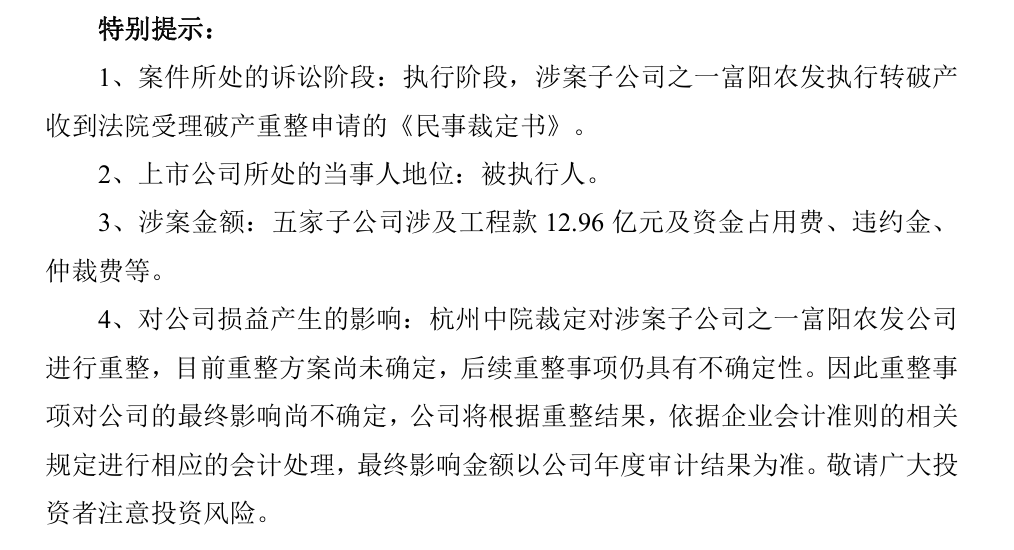
涉案金额近13亿元!天邦食品陷合同纠纷,涉案子公司之一被破产重整
Shen Zhen Shang Bao· 2026-01-10 07:54
Group 1 - The core point of the article is that Tianbang Food (002124) has disclosed significant arbitration and litigation developments, including the acceptance of a bankruptcy reorganization application for its subsidiary, Fuyang Nongfa [1][3] - Zhejiang Construction Investment Group (002761) initiated arbitration against Tianbang Food's subsidiaries due to construction contract disputes, involving a total of 1.296 billion yuan in claims [1][3] - Tianbang Food's five subsidiaries are liable for debts, and the court has accepted the bankruptcy reorganization application for Fuyang Nongfa, which has negative net assets and lacks the ability to repay debts [3] Group 2 - As of the announcement date, Tianbang Food and its subsidiaries have incurred approximately 151 million yuan in undisclosed small lawsuits and arbitrations over the past twelve months, representing 4.12% of the company's audited net assets for 2024 [4] - In the first three quarters of 2025, Tianbang Food reported revenues of 6.719 billion yuan, a decrease of 5.98% year-on-year, and a net profit of 260 million yuan, down 80.65% year-on-year [5] - The company sold 6.6635 million pigs in 2025, generating sales revenue of 7.959 billion yuan, with an average selling price of 14.65 yuan per kilogram, reflecting year-on-year changes of 11.21%, -8.95%, and -17.85% respectively [5]

猪价持续“磨底” 企业借期货工具破周期之困
Jing Ji Guan Cha Bao· 2026-01-10 04:57
Core Viewpoint - The Chinese pig market faced significant challenges in 2025, characterized by a prolonged downturn in prices, deepening losses for pig farming enterprises, and a shift towards proactive risk management strategies in response to ongoing supply-demand imbalances and regulatory pressures [1][2][3]. Group 1: Market Conditions - In 2025, the average price of lean pigs was 13.80 yuan/kg, with prices dropping significantly, reaching as low as 11 yuan/kg in October, marking a period of deep losses for the industry [2][4]. - The overall pig output in 2025 was projected at 747 million heads, a year-on-year increase of 6.4%, with pork production exceeding 60 million tons for the first time [3]. - The average PSY (pigs weaned per sow per year) increased from 21 in 2024 to 26 in 2025, enhancing the supply capacity and exacerbating the supply pressure [3]. Group 2: Financial Performance - Leading company Muyuan Foods sold 77.981 million pigs in 2025, an increase of 6.379 million from 2024, but its total sales revenue fell to 132.811 billion yuan, a decrease of approximately 3.4 billion yuan from the previous year due to lower sales prices [4]. - By December 2025, self-breeding and external purchasing models faced significant losses, with average losses of 62 yuan per head for self-breeding and 210 yuan per head for purchased piglets [2]. Group 3: Risk Management Strategies - Companies are increasingly adopting proactive risk management strategies, including forming specialized futures teams and implementing detailed hedging operations to mitigate the impacts of price volatility [1][5]. - Futures hedging has become a critical component of business operations, allowing companies to lock in profits and stabilize earnings despite low market prices [6][8]. - The participation of over 3,000 industry clients in pig futures trading indicates a growing trend towards using futures as a risk management tool, with 24 out of 32 major pig enterprises engaging in futures transactions [7][8].
猪价有望延续季节性温和反弹
Jing Ji Ri Bao· 2026-01-09 21:55
Core Viewpoint - After several months of decline, pig prices in China showed a mild recovery by the end of 2025, with the Dalian Commodity Exchange's main contract for live pig futures rising by 6.45% from its lowest point in early December [1] Group 1: Price Trends - National pig prices reached a low point in mid-December 2025, followed by a three-week rebound, with prices increasing from 12.13 yuan per kilogram in December to 12.61 yuan in January 2026, a month-on-month increase of 3.4% [1] - National pork prices also saw a decline from 23.89 yuan per kilogram in early October 2025 to 22.48 yuan in the last week of December, before rebounding to 22.80 yuan in January 2026, reflecting a month-on-month increase of 1.4% [1] Group 2: Supply and Demand Dynamics - Weak demand has put pressure on pig prices, with excess production capacity contributing to the low prices [2] - The number of slaughtered pigs from January to November 2025 reached 36.246 million, a significant year-on-year increase of 19.3%, indicating a substantial rise in supply [2] - Consumer demand for pork remained weak throughout 2025, with traditional holiday stockpiling having limited impact on consumption [2] Group 3: Market Outlook - Experts predict a seasonal mild rebound in pig prices before the Spring Festival, but the extent of this rebound is expected to be limited [3] - The supply of live pigs is expected to remain ample, which fundamentally restricts the potential for price increases [3] - The recent rebound in pork prices is viewed as a temporary holiday effect, with limited long-term impact on overall market trends [3] Group 4: Industry Recommendations - The industry is currently in a phase of balancing high production capacity and seasonal demand recovery [4] - To enhance risk resilience, producers are advised to manage their output strategically and focus on long-term efficiency improvements [4] - Recommendations include optimizing breeding efficiency, controlling costs, and gradually reducing production capacity to improve profitability [4]
养猪业供需失衡 全产业链布局成关键
Zhong Guo Jing Ying Bao· 2026-01-09 20:14
Core Viewpoint - The pig farming industry in China is experiencing a prolonged period of low prices and losses due to supply-demand imbalances, with a shift towards fine-tuned operations expected in the future [2][6]. Supply and Demand Imbalance - The industry is currently facing losses primarily due to high production capacity, with the number of breeding sows remaining elevated at 39.9 million as of October 2025, which is 102.3% of the normal level [4]. - The average price of live pigs was reported at 12.25 yuan/kg as of December 28, 2025, still below the breakeven cost of 14 yuan/kg [2]. Price Trends and Profitability - The average price of live pigs for the entire year of 2025 is projected to be between 13.9 and 14 yuan/kg, with significant price drops observed from August onwards [3]. - By December 26, 2025, the losses for self-breeding and purchased pig farming were reported at -130 yuan/head and -163 yuan/head, respectively [3]. Production Capacity and Adjustments - The number of breeding sows has decreased by approximately 400,000 from a peak of 4.39 million in December 2022, but the current level remains high [4]. - Despite efforts to reduce production capacity, the pace of adjustment has been slow, with major companies like Wens Foodstuffs and Zhengbang Technology already meeting their annual output targets by November 2025 [5]. Cost Reduction and Efficiency - Companies are focusing on cost reduction and efficiency improvements, with some achieving significant reductions in production costs, such as Muyuan Foods at 11.3 yuan/kg and Wens Foodstuffs at 12.2-12.4 yuan/kg [8]. - The industry consensus indicates that relying solely on scale is no longer sufficient for profit growth, leading to a transition towards a micro-profit era [9]. Industry Trends and Future Outlook - The industry is expected to undergo a transformation towards sustainable development, emphasizing collaboration across the supply chain, including feed production, breeding, and processing [10]. - The involvement of large agricultural groups and cross-industry capital is anticipated to intensify competition and capacity expansion in the short term, while promoting modernization and stability in the long term [10].