私募信贷

Search documents
能源、必选消费和美债领涨2026!华尔街的“AI交易”被“AI颠覆”了
Hua Er Jie Jian Wen· 2026-02-14 01:49
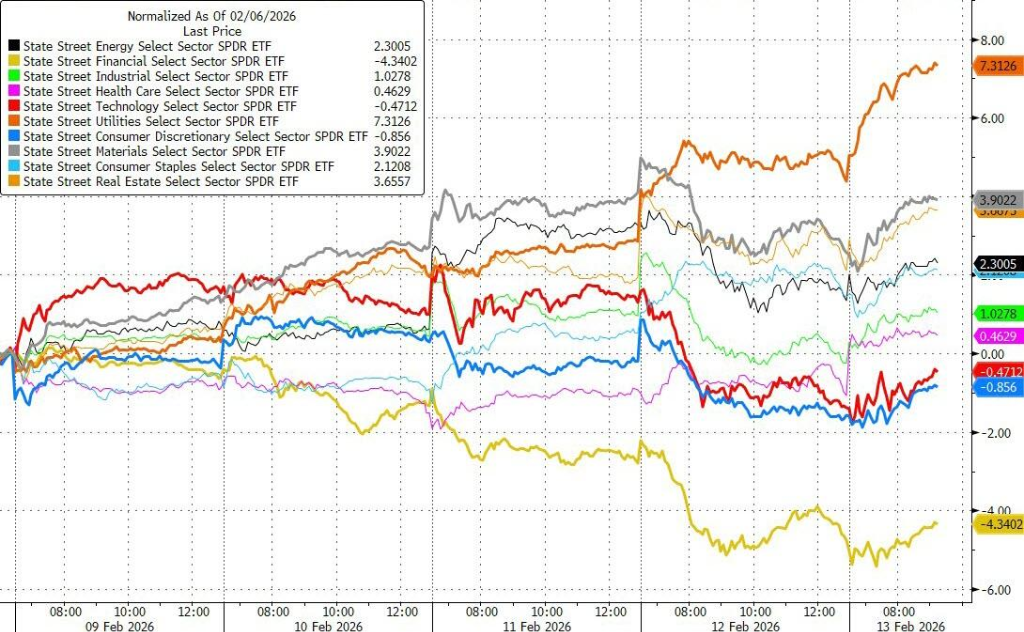
Core Viewpoint - AI, initially seen as a strong investment theme for the year, has shifted to a source of market uncertainty, particularly impacting light-asset companies that may be replaced by AI technology [1][4]. Group 1: Market Performance - The S&P 500 index experienced its worst performance since November until a rebound occurred following mild inflation data on Friday [1]. - The utility sector outperformed as a safe haven against AI impacts, while the financial sector was the worst performer of the week [2]. - Wall Street's previously confident bets have failed over six weeks, with cash allocations at a historic low and hedge levels at their lowest since 2018 [3]. Group 2: AI Impact and Investor Sentiment - Investors are questioning the return timelines on large capital expenditures by tech giants and whether remaining cash can continue to support stock buybacks [4]. - The sentiment is that more stocks have been harmed by AI than benefited, leading to concerns about potential contagion effects across sectors [4]. - The market is undergoing a repricing, particularly in the software industry, raising fears of broader impacts [4]. Group 3: Market Volatility - Two forces are exacerbating volatility in the U.S. stock market: low cash allocations and interconnected leveraged positions that can trigger widespread sell-offs [5]. - The VIX index recently surpassed the critical 20 mark, indicating rising market pressure despite not showing panic signals [6]. - The put-call ratio has surged since January, reflecting increased hedging activity among investors [9][10]. Group 4: Investment Strategy Adjustments - Despite current volatility, the S&P 500 remains near historical highs, and credit spreads are at ten-year lows, indicating that a market collapse has not yet occurred [9]. - There has been a significant inflow of $3.6 billion into ETFs tracking high shareholder return companies this month, suggesting a shift in investment focus [10].

美国私募信贷市场,还安全么?
Huafu Securities· 2026-02-12 04:34
Group 1: Private Credit Market Overview - The private credit market in the U.S. has grown to nearly $1.3 trillion, accounting for about 10% of total commercial bank credit as of 2023[3] - Private credit primarily serves small and medium-sized enterprises (SMEs), with non-bank investors like pension funds and insurance companies participating through private credit funds and Business Development Companies (BDCs)[3] - BDCs are required to disclose data regularly, providing a window into the private credit market, with BDCs managing assets that have tripled since 2020[19] Group 2: Credit Quality and Returns - Cash flows for many mid-sized companies are recovering post-rate cuts, but BDC shareholder returns are declining due to lower profitability and mandatory profit distribution requirements[4] - The average dividend coverage ratio for publicly traded BDCs fell from 1.34 in mid-2023 to 1.08 by September 2025, indicating weakened ability to cover dividends[4] - Non-accrual investments in BDCs have increased from 0.8% in 2022 to over 1.2% by Q3 2025, suggesting rising credit risk[4] Group 3: Rising Default Risks - Credit rating agencies report an upward trend in default rates within the private credit market, with "invisible defaults" also on the rise, indicating hidden risks[5] - The software and healthcare sectors are particularly vulnerable, with software companies facing high leverage and potential disruption from AI advancements[5] - Nearly 14% of commercial real estate loans are in negative equity, raising concerns about the stability of this sector[5]
从“软件末日论”到坏账阴霾 私募信贷与BDC正在遭遇“连坐式”恐慌抛售
智通财经网· 2026-02-06 14:21
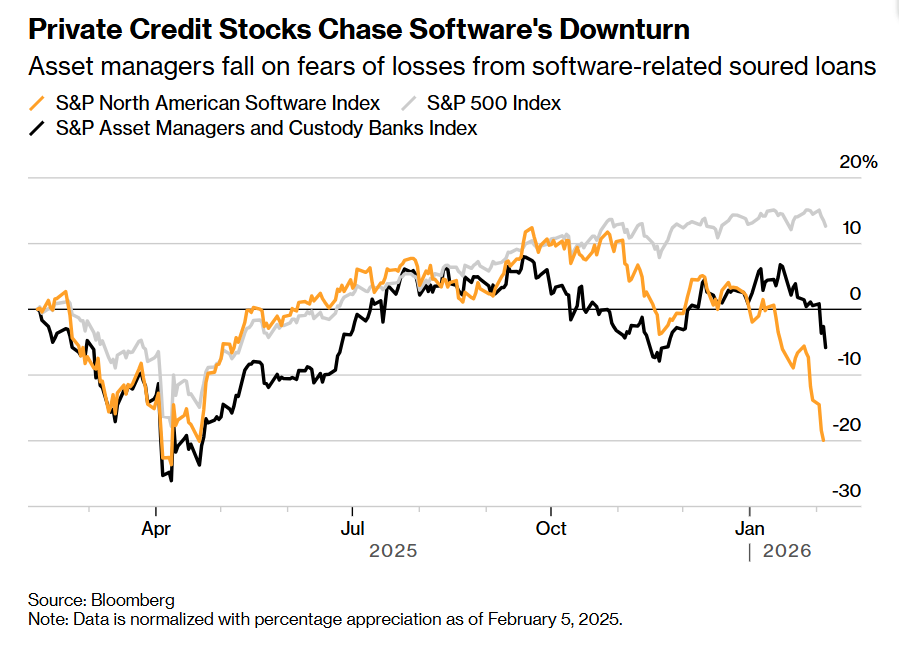
"软件类股票的抛售,带动了持有它们的金融公司,尤其是那些带杠杆的金融公司们的股票抛售。"Nationwide首席市场策略师马 克·哈克特(Mark Hackett)表示。"这轮抛售的强度被交易过于拥挤且多头势力退场的特性进一步放大。" 软件股暴跌,BDC与私募信贷类金融公司股价随之暴跌 以科技股为主的纳斯达克100指数本周势将录得自4月初以来最差单周表现;当时,美国总统唐纳德·特朗普(Donald Trump)推出的 大范围关税在全球市场引发混乱。这一冲击也蔓延至市场其他领域,金融板块中的部分领域遭受重创。一个资产管理公司指标 本周下跌逾6%,景顺全球上市私募股权ETF(Invesco Global Listed Private Equity ETF)下跌超过7%,两者都势将录得自4月以来最 差单周表现。与此同时,VanEck BDC Income ETF本周下跌5.6%,这将是其自10月以来最大周跌幅。 智通财经APP获悉,本周始于科技板块的全球股市暴跌,正迅速吞噬那些大规模投资并向被认为面临人工智能发展风险的软件 制造商们放贷的私募信贷类金融公司。另类资产管理公司、投资银行以及商业发展公司(BDC)都在遭 ...
软件崩盘的“蝴蝶效应”:BDC→私募信贷→金融板块?
Hua Er Jie Jian Wen· 2026-02-06 10:28
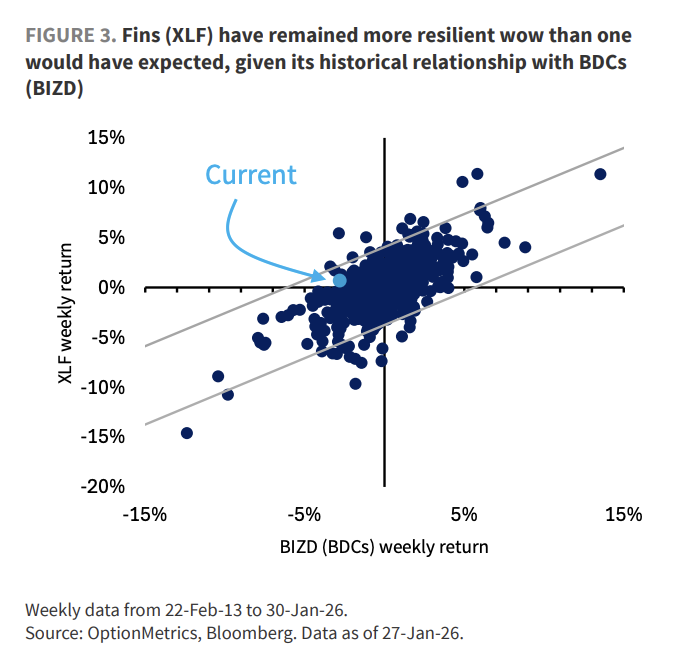
Group 1 - The core viewpoint of the report is that the significant decline in the software industry is transmitting risks to the private credit market through Business Development Companies (BDCs) [1][2] - BDCs have a high concentration of risk exposure in the software sector, accounting for approximately 20% of their portfolios, making them vulnerable to the recent downturn in software stock prices [2] - The software sector has experienced a cumulative decline of about 21% year-to-date, leading to a notable deterioration in the quality of underlying assets [1][2] Group 2 - Financial ETFs and high-yield bond ETFs show a persistent and significant statistical correlation with private credit returns, indicating that the financial sector has not fully priced in the potential risks from the software sector's decline [2] - Despite the weakening BDC index, financial ETFs remain relatively strong, suggesting a possible lag in market adjustments to the emerging risks [2] Group 3 - The report highlights a structural divergence in market volatility pricing, with commodity asset volatility at historically high levels, while fixed income and financial sector volatility remains at historically low levels [4] - The implied volatility for commodities like U.S. crude oil, silver, and gold ETFs is at the 99%-100% historical percentile, reflecting strong market pricing of geopolitical risks and currency devaluation expectations [4] Group 4 - Current market sentiment indicators show extreme polarization, with bearish sentiment concentrated in small-cap and technology sectors, while assets like gold and natural gas exhibit strong bullish expectations [5] - The skewness in options pricing indicates that the cost of downside protection for the Nasdaq 100 and materials sector is significantly high, while oil and gas options are priced more moderately [6] Group 5 - The report identifies high-quality hedging tools for different asset classes, suggesting that high-yield bonds and financial sector put options offer optimal risk-reward ratios for hedging against global equity market risks [7] - For large-cap tech stock downside risks, high-yield bonds and investment-grade corporate bonds provide effective protection, while for commodities, high-yield bonds and energy sector ETFs are recommended [7] Group 6 - The commodity sector is under significant pressure, with its volatility and term structure Z-scores notably above long-term averages, indicating that market pressures are far beyond normal levels [8] - Cross-asset correlations are currently at a high level of 73%, suggesting that the diversification effect of asset allocation is diminishing, while internal correlations within the U.S. stock market remain at a historical low of 2% [8]

软件股暴跌或成下一轮信贷危机导火索?
Hua Er Jie Jian Wen· 2026-02-04 14:18
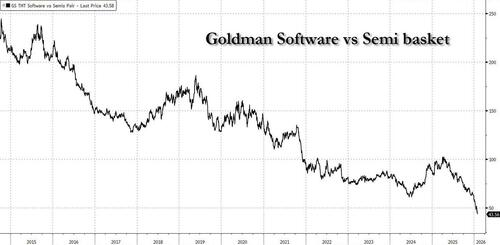
华尔街分析人士警告,BDC持有的巨额软件债务可能成为引发下一轮信贷危机的潜在导火索,这一隐 忧已开始在市场中显现。 BDC是私募信贷市场重要组成部分的商业发展公司(Business Development Company,简称BDC),专 门为中小型企业(通常是私有企业)提供资金,手里持有大量软件公司的债务(约占其投资组合的 16%)。而随着软件行业面临前所未有的抛售潮,BDC正面临严峻的资产减值风险。 据摩根大通信贷分析师 Kabir Caprihan2月3日发布的最新报告,尽管BDC管理层在过去一年多里持续评 估软件业敞口,但在近期软件贷款价格下跌且BDC股价重挫后,市场情绪急剧恶化。高盛的数据显 示,软件板块在过去12个交易日中有9日下跌,正测试关键支撑位,且长期表现相对于半导体板块已是 一场"史诗级灾难"。 导致这一崩溃的原因主要集中在人工智能技术的颠覆性威胁上。高盛客户指出,Anthropic 推出的新代 理功能以及部分AI相关公司每股收益(EPS)的下滑(如 Publicis 和 IT),加剧了市场恐慌。投资者担 忧AI可能是软件公司的终结者,这种恐慌情绪导致被视为软件即服务(SaaS)主要贷款方 ...
报道称软件股敞口巨大,美国PE公司遭遇新一轮抛售
Hua Er Jie Jian Wen· 2026-02-03 01:53
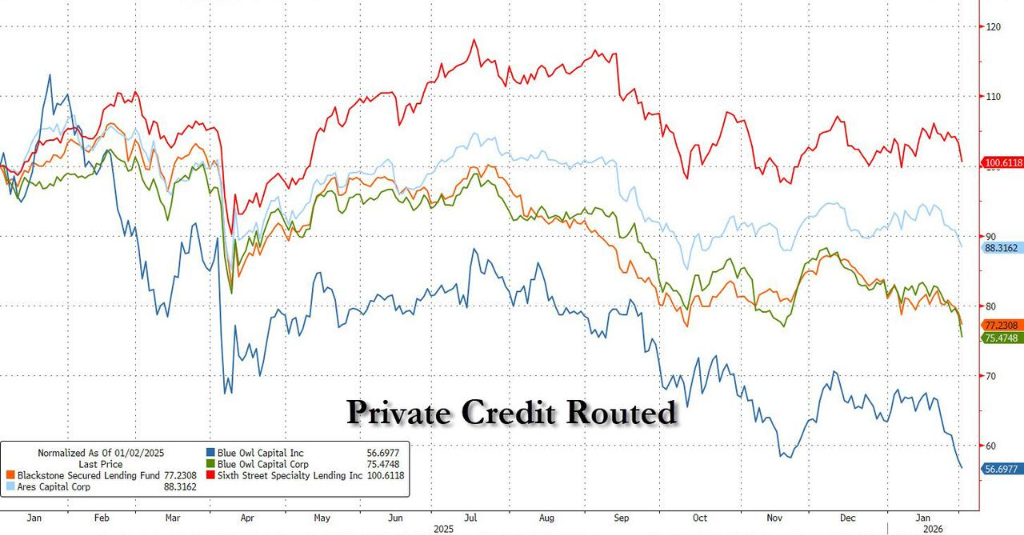
Core Viewpoint - The software industry is facing significant risks, leading to a sell-off of U.S. publicly traded private equity (PE) and business development companies (BDC) due to concerns over the valuation of billions in private software debt [1][5]. Group 1: Market Reaction - On February 3, following reports from Goldman Sachs and Barclays, there was a notable sell-off in the market, with Blue Owl Capital's stock dropping approximately 5% and other industry leaders like Ares Capital and Sixth Street Specialty Lending declining over 3% [2]. - A report from Goldman Sachs indicated that hedge funds are rapidly rotating out of software stocks, marking the highest net sell-off in the tech sector since September 2024, with software stocks leading the decline [4]. Group 2: Impact on Private Credit Institutions - The sell-off has severely impacted private credit institutions that finance software companies, with a software stock index plummeting 15% in January, the largest monthly drop since October 2008 [5]. - Barclays analysts highlighted that software constitutes about 20% of BDC portfolios, making them particularly sensitive to declines in software equity and credit valuations, with total exposure estimated at $100 billion [7]. Group 3: Concerns Over Default Rates - UBS strategists warned that if AI leads to the large-scale elimination of traditional software companies, default rates in U.S. private credit could soar to as high as 13% [9]. - Apollo Global Management has already begun reducing its software exposure from 20% to below 10%, indicating a cautious approach towards the software sector [9]. Group 4: Market Sentiment and Analyst Opinions - Despite the prevailing panic, some analysts believe the market may be overreacting, as there is no new fundamental information to justify the declines [12]. - Recent negative news, including significant withdrawals from funds like Blue Owl and TCP Capital Corp., has heightened investor anxiety ahead of the earnings season, leading to a preemptive market downturn [12].
预警频发仍难阻热钱涌入! 私募信贷“螳螂论”下巨头吸金超百亿
Zhi Tong Cai Jing· 2026-01-20 06:01
Core Insights - Despite increasing warnings about relaxed loan approval standards and rising borrower pressures, demand for private credit remains strong [1][3] - The private credit market has evolved into a multi-trillion dollar industry, becoming a core allocation for institutional investors [3][5] Group 1: Market Dynamics - The case of First Brands Group highlighted the accumulation of aggressive debt structures under a prolonged period of loose financing [1] - JPMorgan's CEO Jamie Dimon warned that risks in private credit are "lurking in plain sight," suggesting potential widespread issues if economic conditions worsen [1] - Despite reports of over $7 billion in withdrawals from major Wall Street firms, capital continues to flow into private credit funds, with KKR raising $2.5 billion for its second Asian credit opportunities fund [1][2] Group 2: Investor Behavior - Institutional investors, including pension funds and insurance companies, have shifted their view of private credit from a niche alternative to a long-term portfolio component [3] - The demand for private credit is supported by structural factors, including ongoing financing needs from mid-sized companies and infrastructure developers [3][4] Group 3: Pressure Signals - Goldman Sachs warned that high interest rates are increasing borrowing costs, with approximately 15% of borrowers unable to generate sufficient cash to cover interest payments [7] - The impact of high interest rates is expected to permeate balance sheets, potentially deteriorating the credit quality of both high and low-quality borrowers by 2026 [8] - There are significant differences in leverage and borrower pressures across markets, with the Asian private credit market being less saturated compared to the U.S. and Europe [8]


关于2026年的四个猜想和三十八张图
虎嗅APP· 2026-01-07 00:56
Core Viewpoint - The article discusses the investment landscape in 2025, highlighting a year of significant growth across various asset classes, with exceptions in digital currencies, government bonds, and oil. The author reflects on the unpredictability of market movements and the challenges in making accurate predictions in such a dynamic environment [4][5]. Group 1: Economic and Market Trends - The Chinese government aims to reduce local government hidden debt from 14.3 trillion RMB to 7 trillion RMB by the end of 2025, indicating progress in debt management [6]. - China achieved a trade surplus of 1 trillion USD in 2025, a significant increase compared to previous years, where a quarterly surplus now matches the annual surplus of a decade ago [10]. - The prices of major commodities, excluding oil, have risen, alleviating the "no profit prosperity" situation for upstream and midstream manufacturing sectors [13]. Group 2: Geopolitical Influences - The external environment has shifted dramatically, with the U.S. under Trump's administration becoming more aggressive in foreign policy, impacting China's focus on external challenges [7][8]. - The article notes a divergence in industrial strategies between China and the U.S., particularly in sectors like semiconductors and AI, with China rapidly advancing in domestic production capabilities [15][16]. Group 3: AI and Employment Concerns - A significant prediction is made regarding a potential backlash against AI in the U.S., driven by concerns over job losses and the concentration of wealth among tech oligarchs [22][23]. - The article references a report by Bernie Sanders, highlighting the potential for AI to displace nearly 100 million jobs in the U.S. over the next decade, raising ethical and economic concerns about the future of work [24][25]. Group 4: Private Equity and Credit Markets - The private equity and private credit markets in the U.S. have grown significantly, with 72% of non-financial corporate loans now sourced from private markets, indicating a shift away from traditional public financing [46][54]. - The article warns of potential bubbles forming in private credit markets, where valuation practices may obscure true risks, similar to conditions leading up to the 2008 financial crisis [66][76]. Group 5: Chinese Household Savings and Stock Market Dynamics - Chinese households have accumulated 48.7 trillion RMB in excess savings from 2022 to 2024, driven by a decline in real estate investment and low returns on traditional savings [81][82]. - There is a growing possibility that these savings will flow into the stock market, particularly through insurance companies, as they seek better returns amid low interest rates [88][90]. Group 6: Foreign Investment and Perceptions of China - The article highlights a disconnect between Western investors and the current realities of the Chinese market, with many foreign entities lacking a nuanced understanding of China's economic landscape [109][110]. - It suggests that a shift in perception may occur in 2026, potentially driven by improved economic indicators or a favorable shift in the global investment climate [119][120].

超额回报光环褪色、银行业“反击”,私募信贷热潮正在降温
Zhi Tong Cai Jing· 2025-12-30 11:43
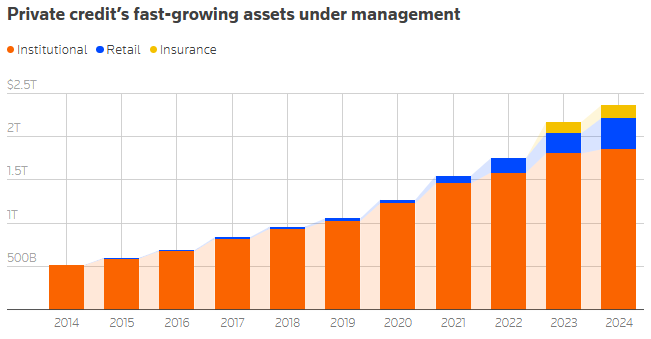
Core Viewpoint - The private credit industry, once distinct for its unique advantages, is increasingly resembling the public credit market, leading to a decline in return rates as banks recover and direct lending institutions invest heavily in retail tools [1][9]. Group 1: Industry Growth and Trends - The private credit industry's asset size has steadily grown to $2.4 trillion by 2024, with traditional closed-end funds raising $113 billion in the first half of 2025 [2]. - New funding sources, such as perpetual funds like Blackstone's BCRED, are rapidly gaining popularity, raising $48 billion in the first half of 2025, accounting for 40% of inflows into traditional institutional funds [2]. - The pursuit of retail funds is expected to continue, with estimates suggesting that individual wealth allocated to private credit could grow nearly fourfold to $1.5 trillion by 2029 [2]. Group 2: Challenges and Market Dynamics - A significant amount of raised capital, amounting to $543 billion, remains uninvested as of the end of 2024, indicating challenges in finding suitable investment opportunities [5]. - The additional premium that direct lending institutions charge over publicly issued bonds is under pressure, having halved in Europe to just over 1 percentage point, and sometimes even lower in the U.S. [8]. - Private credit is becoming a common financing tool in traditional acquisition markets, with borrowers increasingly leveraging competition between markets and lenders [9]. Group 3: Evolving Financing Structures - Direct lending institutions are adapting by offering more flexible loan structures, such as installment loans, to attract borrowers like private equity firms [8]. - Private credit managers are exploring new growth areas, with firms like Blue Owl becoming key players in financing AI assets, while Apollo utilizes its insurance arm to provide tailored financing to higher-rated companies [8]. - The lines between private and traditional credit are blurring, with retail fund growth potentially narrowing the gap and leading to a world of lower returns and higher liquidity [9].
降息周期冲击,美国私募信贷上市基金迎来五年最差表现
Hua Er Jie Jian Wen· 2025-12-29 13:53
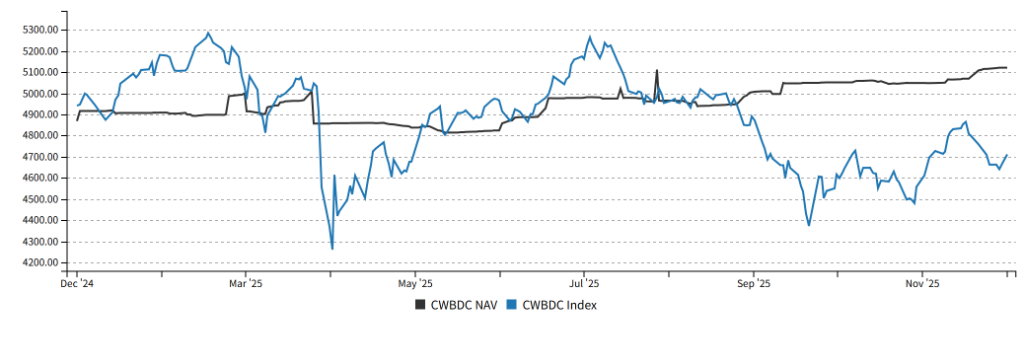
Core Insights - The performance of U.S. listed Business Development Companies (BDCs) has significantly lagged behind the S&P 500 index, marking the worst annual performance since 2020, prompting investors to reassess the outlook for this asset class within the $1.7 trillion private credit market [1][3] Group 1: Performance and Market Sentiment - The Cliffwater BDC Index, tracking 41 direct lending investment tools, has declined approximately 6.6% as of December 24, contrasting sharply with the S&P 500's rise of about 18.1% during the same period [1] - The shift in market sentiment has directly impacted investor confidence and capital flows, with some large funds facing increased redemption requests, leading to a reassessment of return expectations [3][4] - The traditional double-digit return era for BDCs may be coming to an end, with expectations shifting towards mid-to-high single-digit returns [3][4] Group 2: Investor Concerns and Fund Dynamics - The underperformance of BDCs has raised widespread skepticism among investors regarding the ability of large, widely distributed investment tools to maintain past return levels [4] - Despite stable fundraising for non-traded private credit funds, redemption requests are increasing for some large institutions, indicating growing investor concerns [4][5] - Blue Owl's BDC product faced redemption requests exceeding 5% of its net asset value, while Blackstone Private Credit Fund anticipated redemption requests of 4.5% of its net asset value for Q4 [5] Group 3: Future Outlook and Structural Changes - With the Federal Reserve expected to continue lowering interest rates, private credit managers must convince investors that their BDCs remain worthwhile investments [6] - The average spread for private credit transactions has narrowed from 650 basis points in Q1 2023 to below 500 basis points, leading to a decline in expected returns [6] - There is a shift towards launching interval funds, which allow for continuous financing and provide better liquidity for investors compared to traditional BDCs [6][7] Group 4: Market Pressures and Short Selling - The weak performance of the BDC market has attracted short sellers, with total short positions on 47 publicly traded BDCs reaching approximately $1.83 billion, a 38% increase from the previous year [8] - There is a rising trend in payment-in-kind (PIK) debt income within BDCs, indicating potential cash flow issues for borrowers, with PIK debt income reaching 7.9% in Q3 [9] - The increasing scrutiny and pressure in the market highlight the importance of management choices during periods of credit weakness [9]