
镍矿开采

Search documents
未知机构:印尼或缩减镍矿开采配额推升镍价1月19日的最新解读明确印尼因财-20260120
未知机构· 2026-01-20 02:20
Summary of Key Points from Conference Call Industry Overview - The focus is on the nickel mining industry in Indonesia, which is undergoing significant policy changes due to fiscal pressures faced by the government [1][2]. Core Insights and Arguments - Indonesia's nickel policy has shifted from "resource for investment" to "fiscal revenue enhancement" due to financial constraints [1][2]. - The government plans to drastically reduce the mining quota for 2026 to between 250-260 million tons, which is expected to increase costs across the industry [1][2]. - This policy change is anticipated to fundamentally alter the global nickel surplus situation, moving nickel prices away from a cost-based pricing model [1][2]. - The new price center for nickel is projected to be above $18,000 per ton, which will create profit opportunities for companies with low-cost smelting capacities in Indonesia [1][2]. Additional Important Content - The introduction of taxes on by-product cobalt is part of the strategy to elevate industry costs [1][2].
不锈钢:盘面锚定矿端矛盾,镍铁跟涨支撑重心:镍:印尼言论反复扰动,镍价宽幅震荡运行
Guo Tai Jun An Qi Huo· 2026-01-18 09:06
1. Report Industry Investment Rating No relevant content provided. 2. Core Views of the Report - The nickel price is expected to fluctuate widely in the short - term policy vacuum period due to the confrontation between industrial and secondary market funds. The key to breaking the deadlock lies in the implementation of Indonesian policies in the first quarter, especially the quota policy. For trading, it is recommended to consider options, and pay attention to structural opportunities. [4][5] - For stainless steel, the expectation of increased supply and weak demand in the off - season exerts pressure, while the cost center moves up due to the increase in ferronickel cost. Attention should be paid to the variables in Indonesian nickel ore policies. [6] 3. Summary by Related Catalogs 3.1 News Affecting the Nickel Market - **Quota Event**: On January 8, the Indonesian Ministry of Energy and Mineral Resources stated that the quota would be adjusted according to industry demand. On January 14, it was mentioned that the target might be cut to 260 million tons of nickel ore quota. The policy for 2026 is still under review, and it is expected that specific policies will be clarified in the first quarter. If the 260 - million - ton quota is implemented, it may lead to a shortage in the ore end and impact high inventories. [1] - **伴生 Mineral Event**: Indonesia wants to include associated minerals such as cobalt in the pricing and taxation system. If cobalt is priced, the direct cost of pyrometallurgy and hydrometallurgy may increase by about 5% - 10%. [2] - **违规 Fine Event**: Multiple companies in Indonesia are facing potential fines of about 80.2 trillion Indonesian rupiah for illegal occupation of forest land. The final fine may be lower than the initial estimate. If the fine is implemented, it may indirectly lead to higher ore prices. [2] - **Other Events**: In early 2026, Vale suspended its nickel mining business but later resumed normal operations after obtaining the 2026 mining quota approval. It is speculated that Indonesia may favor hydrometallurgical projects. [3] 3.2 Market Outlook 3.2.1 Nickel - Industrial players focus on the weak fundamentals of nickel, with over - supply pressure and expectations of low - cost hydrometallurgical production. They mainly adopt a strategy of selling at high prices for hedging. Secondary market funds expect policy changes in Indonesia and tend to go long at low prices in the long - term. In the short - term, nickel prices are expected to fluctuate widely, and the key lies in the implementation of Indonesian policies in the first quarter. [4][5] 3.2.2 Stainless Steel - The expectation of increased supply and weak demand in the off - season puts pressure on stainless steel. However, the increase in ferronickel cost due to various factors in Indonesia may push up the cost of stainless steel. The cost logic may cause the stainless steel price to oscillate with a higher center, but the marginal increase in supply and weak demand still have a drag effect. [6] 3.3 Inventory Tracking - **Refined Nickel**: On January 15, China's refined nickel social inventory decreased by 102 tons to 60,587 tons. LME nickel inventory increased by 942 tons to 285,732 tons. [7] - **新能源**: On January 16, the inventory days of upstream, downstream, and integrated production lines of SMM nickel sulfate increased slightly month - on - month. The precursor inventory and ternary material inventory also increased month - on - month. [7] - **Nickel - Iron - Stainless Steel**: On January 15, the full - industry chain inventory of SMM nickel - iron decreased by 2% month - on - month to 131,000 metal tons. Stainless steel factory inventory decreased in December, and the social inventory of stainless steel decreased week - on - week on January 15. [7] 3.4 Market News - Indonesia has suspended issuing new smelting licenses through the OSS platform for projects producing certain nickel - related products. [8] - China's Ministry of Commerce and General Administration of Customs have implemented export license management for some steel products since January 1, 2026. [8] - The Indonesian Nickel Miners Association revealed that the Ministry of Energy and Mineral Resources would revise the benchmark price formula for nickel ore commodities in early 2026, including treating cobalt as an independent commodity for royalty collection. [8] - The Indonesian government plans to significantly reduce the 2026 nickel ore production target from 379 million tons to 250 million tons. [10]
港股异动 | 印尼镍矿配额扰动再起 力勤资源(02245)涨超11% 中伟新材(02579)涨超9%
Zhi Tong Cai Jing· 2026-01-15 02:13
Group 1 - Nickel industry stocks rose in early trading, with Liqin Resources (02245) up 11.22% to HKD 25.78, Zhongwei New Materials (02579) up 9.14% to HKD 39.16, and Xinjiang Xinxin Mining (03833) up 4.63% to HKD 2.94 [1] - The price of nickel on the London Metal Exchange closed at 18,785, an increase of 6.7%, while the Shanghai nickel futures closed at 148,930, up 5.6% [1] - Indonesia is expected to approve a nickel ore production quota of approximately 260 million tons by 2026, according to local media citing mining officials [1] Group 2 - CITIC Futures anticipates that the theoretical demand for nickel ore in Indonesia will exceed the currently proposed target of 260 million wet tons by approximately 15% in 2026, as it is a period of concentrated release of new capacity for Indonesian hydrometallurgical (HPAL) projects [1] - If this demand projection materializes, it could lead to significant tightening expectations in the market [1]
建信期货镍日报-20260114
Jian Xin Qi Huo· 2026-01-14 02:22
Group 1: Report Information - Report Name: Nickel Daily Report [1] - Date: January 14, 2026 [2] - Research Team: Nonferrous Metals Research Team [3] - Researchers: Yu Feifei, Zhang Ping, Peng Jinglin [3] Group 2: Investment Rating - No investment rating is provided in the report. Group 3: Core Views - On January 13, the nickel price declined and adjusted following the sector. The main contract closed down 2.21% at 138,450 yuan/ton, and the total open interest decreased by more than 11,000 lots to 400,000 lots [8]. - The prices of other products in the industry chain continued to rise. On January 13, the NPI quotation increased by 9.5 to 980.5 yuan/nickel point, and the nickel salt price increased by 150 to 32,850 yuan/ton [8]. - In the medium term, the nickel price is expected to rise in the context of global resource competition and policy disturbances in Indonesia, gradually moving out of the bottom area [8]. - The statement from the Indonesian Ministry of Energy and Mineral Resources has alleviated market concerns about supply shortages, but the Indonesian government may continue to hype the situation, and the nickel price is expected to have significant upward elasticity before the policy is finalized, with high market volatility [8]. Group 4: Market Review and Operation Suggestions - On January 13, the nickel price dropped with the sector. The main contract closed at 138,450 yuan/ton, down 2.21%, and the total open interest decreased by over 11,000 lots to 400,000 lots [8]. - The prices of other products in the industry chain rose. The NPI quotation increased by 9.5 to 980.5 yuan/nickel point, and the nickel salt price increased by 150 to 32,850 yuan/ton [8]. - In the medium term, the nickel price may rise due to global resource competition and Indonesian policy disturbances [8]. - The statement from the Indonesian Ministry of Energy and Mineral Resources has eased supply shortage concerns, but the government may still hype the situation, and the nickel price is likely to be highly volatile before the policy is determined. Caution is advised, and risk control is necessary [8]. Group 5: Industry News - The Indonesian Ministry of Energy and Mineral Resources plans to use the 2026 Work Plan and Budget (RKAB) to align mineral production with domestic industrial demand, setting the nickel production target at around 290 million tons to match smelter capacity [9]. - The government aims to adjust production quotas for nickel and coal to prevent global oversupply, stabilize falling prices, and protect national resource reserves [9]. - The Indonesian Nickel Miners Association (APNI) is worried that production may drop to 250 million tons, but the government says the data is still being integrated to ensure the profitability of the downstream industry without heavy reliance on imports [10]. - Due to the lack of government approval for the 2026 Work Plan (RKAB), PT Vale Indonesia has suspended its nickel mining operations, but management expects the license to be approved soon, and the temporary suspension is not expected to affect the long - term sustainability of the joint venture. The impact on market supply and demand is relatively limited [10]. - The Indonesian Nickel Smelters Association estimates that the domestic nickel smelting industry's nickel ore demand in 2026 will be about 340 - 350 million tons [10].
深度下行空间已十分有限 镍价底部特征显现
Zhong Guo Chan Ye Jing Ji Xin Xi Wang· 2026-01-09 01:08
Core Viewpoint - The nickel market is experiencing a downturn, with prices hitting new lows due to a combination of oversupply and policy changes from Indonesia, the largest nickel supplier [1][3][4]. Group 1: Market Dynamics - Copper and aluminum prices are reaching new highs, while nickel prices are declining, indicating a divergence in the non-ferrous metals market [1]. - Nickel production in China is projected to reach approximately 360,000 tons from January to November 2025, marking a significant year-on-year increase of 19.34% [2]. - Global nickel inventories have surpassed 310,000 tons by early December 2025, with an increase of over 100,000 tons throughout the year, indicating a high inventory level [2]. Group 2: Cost and Pricing Pressure - Nickel prices have fallen below the cost of purchasing raw materials and some integrated processes, leading to a lack of strong cost support for current price levels [2]. - The lowest production costs in the industry continue to decline, anchoring market prices to these lower levels amid oversupply [2]. Group 3: Policy Variables - Indonesia's potential policy changes could significantly impact future nickel supply, with mining quotas expected to decrease from 379 million tons in 2025 to approximately 250 million tons in 2026 [3]. - Proposed adjustments to pricing and tax regulations in Indonesia may increase mining costs, as cobalt and other by-products will be treated as independent commodities subject to royalties [3]. - The market is highly sensitive to any potential supply reductions from Indonesia, which could lead to a rapid price rebound based on rising cost expectations [3]. Group 4: Future Outlook - The potential for further declines in nickel prices appears limited, with a preliminary bottom possibly established [4]. - Future market direction will heavily depend on the final outcomes of Indonesia's mining quota approvals and the implementation of related tax policies [4].
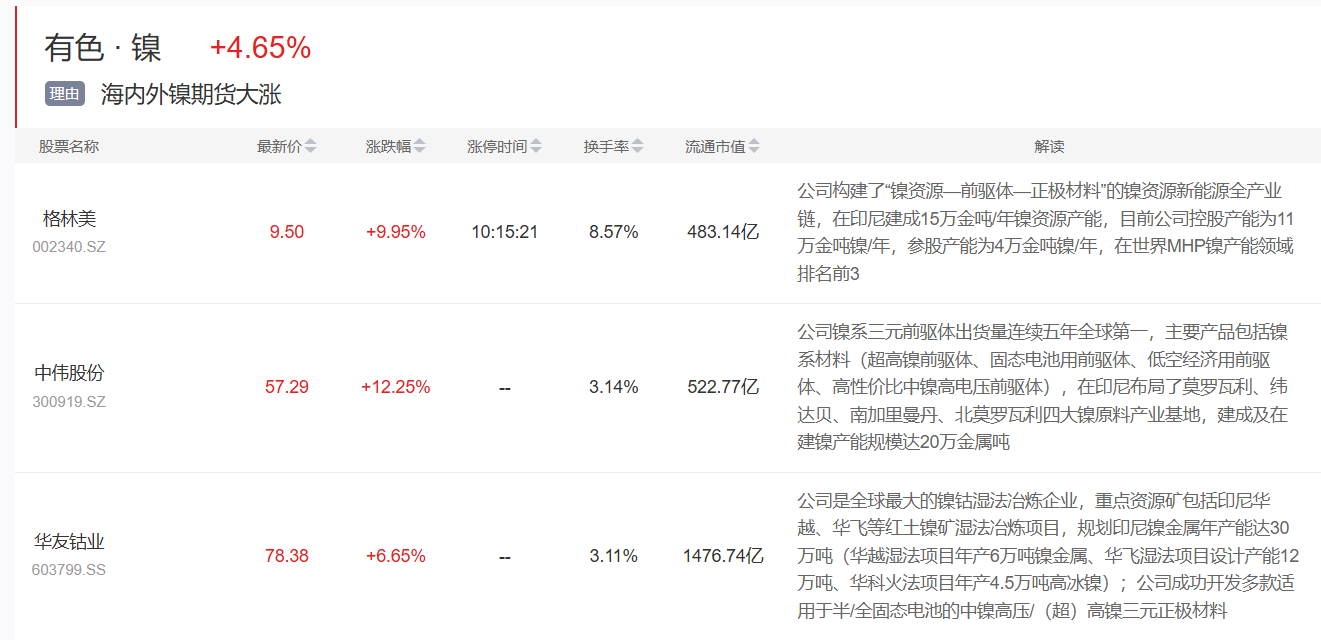
【大涨解读】有色镍:供给收缩预期+地缘政治催化,全球有色镍期货大涨,机构看好供需再平衡下的估值修复
Xuan Gu Bao· 2026-01-07 02:23
Core Viewpoint - The nickel sector experienced a significant surge on January 7, with major companies like China First Heavy Industries and Greeenmei hitting their daily limit, indicating strong market sentiment and potential investment opportunities in the sector [1]. Group 1: Market Performance - The nickel sector index rose by 4.65%, reflecting a robust performance across various companies [2]. - Notable stock performances included Greeenmei, which increased by 9.95% to a price of 9.50, and Zhongwei Co., which surged by 12.25% to 57.29 [2]. - Other companies such as Huayou Cobalt and Shengtun Mining also saw significant gains, contributing to the overall positive market trend [1][2]. Group 2: Supply and Demand Dynamics - The recent price increase in nickel is attributed to reduced nickel mining quotas in Indonesia and a shift in macroeconomic sentiment towards liquidity, with the LME nickel price reaching a peak of $18,785, marking a nearly 9% increase [3][4]. - Indonesia's Vale has suspended nickel mining operations due to unapproved work plans, heightening expectations of supply constraints in the market [3]. - The International Nickel Study Group (INSG) projects global nickel demand to reach 3.82 million tons in 2026, while production is expected to be 4.09 million tons, indicating a potential supply-demand reversal due to a forecasted reduction of 200,000 to 300,000 tons in Indonesian output [4]. Group 3: Long-term Industry Outlook - The long-term outlook for the nickel sector remains optimistic, driven by increasing demand from electric vehicles and energy storage applications [5]. - Supply constraints are expected to persist, with fluctuations in production from major nickel-producing countries like Chile further tightening supply [5]. - The anticipated easing of monetary policy by the Federal Reserve in 2026 is expected to support metal prices, with nickel prices likely to continue their upward trajectory [5].


镍日报-20260107
Jian Xin Qi Huo· 2026-01-07 01:42
Group 1: Report Information - Report Type: Nickel Daily Report [1] - Date: January 7, 2026 [2] - Research Team: Nonferrous Metals Research Team [3] - Researchers: Yu Feifei, Zhang Ping, Peng Jinglin [3] Group 2: Investment Rating - No investment rating information provided. Group 3: Core View - The macro - atmosphere is positive. Due to intensified global resource competition, nickel prices continued to rise on the 6th, surging 4.13% and approaching the phased high of 140,000 yuan/ton. Total positions increased slightly by 3,889 lots to 360,000 lots. Nickel price increases drove up prices of other products in the industry chain. The NPI quote increased by 6.5 to 936.5 yuan/nickel point on the 6th, and nickel salt prices increased by 500 to 28,700 yuan/ton. The rebound of LME nickel prices will also drive up the spot cost of nickel salts. The market is highly volatile, and participation should be cautious [7]. Group 4: Market Review and Operation Suggestions - Macro - atmosphere is positive. Global resource competition is intensifying, and nickel prices continued to rise on the 6th, up 4.13% and approaching 140,000 yuan/ton. Total positions increased slightly by 3,889 lots to 360,000 lots. The increase in nickel prices drove up prices of other products in the industry chain. The NPI quote increased by 6.5 to 936.5 yuan/nickel point on the 6th, and nickel salt prices increased by 500 to 28,700 yuan/ton. The rebound of LME nickel prices will drive up the spot cost of nickel salts. The market is highly volatile before the RKAB quota decision is finalized, and participation should be cautious [7]. Group 5: Industry News - The Indonesian Ministry of Energy and Mineral Resources (ESDM) stated that the 2026 RKAB will be used as a strategic tool to align mineral production with domestic industrial demand, setting the nickel production target at about 290 million tons to match smelter capacity. The adjustment of production quotas for nickel and coal aims to prevent global oversupply, stabilize falling prices, and protect national resource reserves. Although the APNI is worried that production may drop to 250 million tons, the government says the data is still being integrated [8][10]. - Due to the non - approval of the 2026 RKAB, PT Vale Indonesia has suspended its nickel mining operations. However, management expects the license to be approved soon, and the temporary suspension will not affect the long - term operational sustainability of the joint venture. The approval delay only temporarily affects the Pomalaa and Bahodopi nickel projects, while the Sorowako mine and the integrated RKEF project are still operating normally, so the impact on market supply and demand is relatively limited [10]. - The Indonesian Nickel Smelters Association estimates that the domestic nickel smelting industry's nickel ore demand in 2026 will be about 340 - 350 million tons [10].
海外供给再现收缩预期,下游新能源需求稳定,海内外镍期货大涨
Xuan Gu Bao· 2026-01-06 23:17
Group 1 - Nickel prices surged over 10% on the London Metal Exchange (LME), reaching a peak of $18,545 per ton, marking the largest intraday increase since 2022, with a cumulative rise of over 20% in the past two weeks [1] - The core logic behind the price increase is the strengthening expectation of supply contraction, driven by the suspension of nickel mining activities by Indonesia's Vale due to unapproved annual work plans [1] - The Indonesian government plans to reduce nickel mining quotas by 250 million tons by 2026, which has intensified supply constraint expectations, significantly boosting market sentiment [1] Group 2 - According to Fangzheng Securities, the suspension of nickel mining by Vale and the Indonesian government's quota reduction plan are expected to accelerate the supply-demand rebalancing in the nickel industry [2] - The long-term upward trend for industrial metals remains intact, supported by supply shortages in copper and expectations of mid-term easing from the Federal Reserve, with nickel benefiting from supply contraction and renewable energy demand [2] - The rise in nickel prices will directly benefit nickel mining, smelting, and nickel-cobalt new material companies, while also exerting cost pressure on downstream industries such as stainless steel and new energy batteries [2] Group 3 - Company Greenme focuses on the recycling and manufacturing of new energy battery materials, possessing nickel resource recovery and smelting capacity, and has established stable cooperation with downstream battery enterprises [3] - Company Huaxin Environmental's subsidiary, Anhui Huaxin Jintong Environmental Technology Co., Ltd., primarily produces cathode copper from black copper refining, along with gold, silver, and nickel products [3]
镍、不锈钢月度策略报告-20260105
Guang Da Qi Huo· 2026-01-05 05:51
1. Report Industry Investment Rating - No relevant information provided 2. Core Viewpoints of the Report - The news indicates that the planned nickel ore production in Indonesia in 2026 may drop significantly compared to 2025, and the Indonesian government plans to revise the mineral benchmark price calculation formula for nickel commodities. In addition, Vale Indonesia has suspended nickel ore mining due to the unapproved production plan. Fundamentally, the domestic trade price and premium of nickel ore are basically stable. The weekly nickel - iron transaction price has increased, and the contraction of stainless - steel supply and the strengthening of prices have accelerated inventory depletion. The raw material price is stronger than the finished product, the theoretical profit of nickel sulfate has turned negative, the prices of nickel, cobalt, and lithium have all strengthened, the demand has weakened, and the terminal is facing cost pressure. Influenced by the news, the stock and commodity markets resonate, and the nickel price strengthens, but the actual implementation situation is unknown, so market sentiment should be monitored [3][4]. 3. Summary According to the Table of Contents 3.1 Price - In the month, the price of Shanghai Nickel increased by 12.6%, and the price of LME Nickel increased by 12.5%. The price of nickel ore was stable, and the prices of products in other links of the industrial chain all strengthened [5]. 3.2 Base Price Difference, Spread & Import Profit and Loss - Relevant charts such as the seasonal chart of Shanghai Nickel basis, the price difference between the active and continuous 3 - month contracts of Shanghai Nickel, and the Shanghai - London ratio are presented, but no specific data analysis is provided [5][7]. 3.3 Inventory - During the week, the LME inventory decreased by 414 tons to 255,282 tons; the Shanghai Nickel inventory decreased by 132 tons to 37,666 tons, the social inventory increased by 556 tons to 58,920 tons, and the bonded - area inventory remained at 2,200 tons [5][13]. 3.4 Supply 3.4.1 Nickel Ore - The premium of Indonesian nickel ore remained at $25.5 per wet ton, and the premium of 1.5% nickel ore from the Philippines increased by $1 per wet ton to $9.0 per wet ton [5][19]. 3.4.2 Refined Nickel - In January 2026, the production of refined nickel is expected to increase by 35.8% month - on - month to 37,200 tons [5][21]. 3.4.3 Ferronickel - In January 2026, the domestic ferronickel production decreased by 1% month - on - month to 21,000 nickel tons; the tender/transaction price increased, and a steel mill in South China inquired about high - nickel ferronickel at 910 yuan per nickel (including tax at the hatch bottom) [5][23]. 3.4.4 Intermediate Products - The spot average prices of MHP and nickel matte increased, and the trading activity increased [5][26]. 3.4.5 Nickel Sulfate - The cost of nickel sulfate increased, and the immediate profit of nickel sulfate was in the red [5][31]. 3.4.6 Scrap Stainless Steel - Relevant charts about the usage and proportion of 300 - series and 200 - series scrap stainless - steel enterprises in China are presented, but no specific data analysis is provided [38][39]. 3.4.7 Primary Nickel - Relevant charts about domestic primary nickel production and estimated net imports of primary nickel are presented, but no specific data analysis is provided [41][42]. 3.5 Demand 3.5.1 New Energy - In January 2026, the production of ternary precursors is expected to decrease by 2% month - on - month to 83,260 tons; the production of ternary materials is expected to decrease by 4.43% month - on - month to 78,180 tons; the production of ternary power batteries is expected to decrease by 6.15% month - on - month to 28.7 GWh. The Passenger Car Association expects that the auto market will have a good start in January 2026, and new - energy vehicles are expected to have a slight increase of 5% in the first quarter, with a 36% decrease compared to the fourth quarter of 2025 [5][47][56]. 3.5.2 Stainless Steel - Most stainless - steel prices increased in the month. The total social inventory of stainless steel in 89 warehouses in the mainstream domestic markets was 977,000 tons, a week - on - week decrease of 2.78%, among which the 300 - series decreased by 8,500 tons to 620,000 tons. The production schedule in January 2026 was 3.327 million tons, a month - on - month increase of 1.83% and a year - on - year increase of 16.27%. Among them, the 200 - series was 998,600 tons, a month - on - month increase of 6.84% and a year - on - year increase of 29.6%; the 300 - series was 1.7193 million tons, a month - on - month decrease of 2.5% and a year - on - year increase of 9.78%; the 400 - series was 609,100 tons, a month - on - month increase of 7.03% and a year - on - year increase of 16.06%. The theoretical profit was repaired in the month [5][4][77]. 3.6 Supply - Demand Balance - Relevant charts about the supply - demand balance of primary nickel and nickel sulfate are presented, but no specific data analysis is provided [93][94][96]. 3.7 Options - Relevant charts such as historical volatility and historical volatility cone are presented, as well as the put - call ratio of option trading volume and open interest related to the closing price of Shanghai Nickel, but no specific data analysis is provided [97][98][103].
镍 底部特征显现
Qi Huo Ri Bao· 2025-12-31 01:25
Core Viewpoint - The nickel market is currently facing a supply expansion cycle, with production growth significantly outpacing demand, leading to concerns about supply contraction and rising costs, particularly influenced by policy changes in Indonesia [1][3][4]. Group 1: Market Dynamics - Nickel prices have recently declined, reaching a new low since 2021 in late October, while other metals like copper and aluminum have seen price increases, indicating a divergence in the market [1]. - The overall nickel market is experiencing a significant increase in production, with domestic output expected to reach approximately 360,000 tons from January to November 2025, representing a year-on-year growth of 19.34% [2]. - Global visible nickel inventories have surpassed 310,000 tons, with an increase of over 100,000 tons throughout the year, indicating high inventory levels [2]. Group 2: Cost and Pricing Pressure - Nickel prices have fallen below the cost of purchasing raw materials and some integrated processes, leading to a lack of strong cost support at current price levels [2]. - The lowest production costs in the industry continue to decline, anchoring market prices to these lower levels amid an oversupply situation [2]. Group 3: Policy Variables - Indonesia, the largest global supplier of nickel, has indicated potential significant changes in mining quotas and taxation that could impact future supply [3]. - The Indonesian Nickel Miners Association (APNI) has reported a proposed reduction in the mining output target for 2026 to approximately 250 million tons, down from 379 million tons in 2025 [3]. - Proposed adjustments to pricing and tax rules in Indonesia could increase mining costs, as cobalt and other by-products may be treated as independent commodities subject to royalties [3]. - The market is highly sensitive to any potential supply contraction from Indonesia, which could lead to a rapid price rebound based on rising cost expectations [3]. Group 4: Future Outlook - The potential for further declines in nickel prices appears limited, with a preliminary establishment of a phase bottom, heavily reliant on the final outcomes of Indonesia's mining quota approvals and tax policy implementations [4].