
非银

Search documents
金融制造行业11月投资观点及金股推荐-20251106
Changjiang Securities· 2025-11-06 13:41
Investment Rating - The report maintains a "Buy" rating for several key stocks in the financial manufacturing industry, including Green City China, China Resources Land, New China Life Insurance, and Qilu Bank, among others [49][50]. Core Insights - The report highlights the ongoing economic recovery and the potential for profit improvement, although it notes that challenges remain, particularly in the real estate sector where sales volume is expected to be under pressure in Q4 [10][13]. - The non-bank financial sector is experiencing high growth, with recommendations to focus on high-performing stocks [18]. - The banking sector shows signs of recovery with attractive valuations, suggesting a continued positive outlook for bank stocks [20]. - The renewable energy sector is identified as having established a bottom, with a focus on new technologies and market dynamics [23]. - The machinery sector is advised to pay attention to AI computing power, which presents investment opportunities in power supply [31]. - The military industry is expected to see an upward trend in prosperity, with a focus on military trade, internal installations, and the transition from military to civilian applications [33]. - The light industry is encouraged to explore opportunities in overseas manufacturing and new consumer products, while also monitoring domestic demand improvements [35]. - The environmental sector is advised to focus on second growth curve changes and market hotspots [43]. Summary by Sections Macro Overview - Industrial profits rose by 21.6% year-on-year in September, driven by the export chain, although October's PMI indicates potential profit improvement challenges [11][12]. Real Estate - Q4 sales volume is expected to face year-on-year pressure, with new home sales likely to decline significantly [13][14]. Non-Bank Financials - The sector's performance remains strong, with a recommendation to focus on high-performing stocks [18][19]. Banking - The banking sector is seeing a recovery in net interest income, with a positive outlook for bank stocks [20][21]. Renewable Energy - The renewable energy sector is highlighted for its ongoing demand and technological advancements [23][24]. Machinery - Investment opportunities are noted in the AI computing power sector, particularly in power supply [31][32]. Military Industry - The military sector is expected to improve, focusing on military trade and technology advancements [33][34]. Light Industry - Opportunities in overseas manufacturing and new consumer products are emphasized, along with monitoring domestic demand [35][36]. Environmental Sector - The environmental sector is advised to focus on growth opportunities and market trends [43][44].
11月港股金股:静待风起青萍末
Soochow Securities· 2025-11-04 04:04
Group 1 - The report suggests that the Hong Kong stock market is entering an adjustment phase at the end of the year, but it remains in a long-term upward trend [1] - The report emphasizes a continued positive outlook on AI technology, predicting a marginal recovery in Hong Kong's EPS in the first quarter of next year [2] - There is an increased allocation towards dividend stocks due to a decline in market sentiment and a historical trend showing higher win rates for dividend stocks in November and December [2] - The report maintains a favorable view on innovative pharmaceuticals, citing benefits from potential Federal Reserve interest rate cuts and a clear trend in the innovative drug industry [2] Group 2 - The report lists a selection of "golden stocks" with detailed financial metrics, including Alibaba, XPeng Motors, CICC, Shenzhou International, Innovent Biologics, Kelun-Biotech, 3SBio, Gree Power, Sinopec, and Guoquan [3][8] - Alibaba is highlighted for its leadership in AI and cloud computing, with significant revenue growth expected from its cloud business [11][12] - XPeng Motors is projected to achieve substantial revenue growth, with a focus on developing a platform for mass-market vehicles [17][19] - CICC is expected to benefit from a recovering IPO market and increased trading activity, enhancing its competitive position in investment banking and wealth management [24][26] - Shenzhou International is anticipated to see sales growth driven by strong demand from major clients like Adidas and Nike [30][32] - Innovent Biologics is expected to achieve profitability in 2025, with a strong pipeline of innovative drugs [35][40] - Kelun-Biotech is advancing its clinical trials and commercialization efforts, maintaining a positive outlook [44][46] - 3SBio is positioned for growth with its innovative drug pipeline and international expansion [48][50] - Gree Power is expected to improve its financial performance through increased cash flow and dividend potential [52][56] - Sinopec is focusing on upstream exploration and development, with a strong outlook for its natural gas segment [60][62] - Guoquan is experiencing improved same-store sales and expansion in rural areas, indicating strong operational capabilities [66][68]
2025年11月投资策略:持以恒,等风来
CAITONG SECURITIES· 2025-11-02 12:03
Core Insights - The report emphasizes a strategic shift towards large financial and consumer sectors, indicating that the maximum negative impact from equal tariffs has been realized, leading to a potential rebound window after initial panic [3] - The report highlights a significant improvement in corporate earnings, with the Shanghai Composite Index rising over 15% to above 3900 points, driven by external friction easing, clear domestic policy blueprints, and accelerated corporate profit recovery [3][4] - The report suggests that the market is expected to gain momentum due to three converging factors: external friction easing, clear domestic policy direction, and improved corporate earnings [3] Overall Performance - The overall performance of the A-share market shows a cumulative year-on-year net profit growth of 5.9% for Q3 2025, with a notable improvement of 3.2 percentage points compared to Q2 [4][23] - The non-financial A-share companies reported a cumulative net profit growth of -0.1%, which is an improvement of 0.25 percentage points from the previous quarter [25] - The report indicates that the revenue growth for non-financial A-share companies has also improved, with a cumulative year-on-year growth of 1.7% [25] Industry Performance - Key industries such as electric equipment, military industry, and pharmaceuticals have shown accelerated performance, with significant upward trends in earnings and revenue [4][36] - The steel, military, non-bank financial, and non-ferrous metals sectors exhibited the most substantial quarter-on-quarter improvements [4] - The report notes that the semiconductor, industrial metals, and non-bank financial sectors continue to show high growth despite high base effects [38] Fund Allocation - The report indicates a shift in fund allocation towards technology and cyclical sectors, while reducing exposure to consumer, manufacturing, and dividend-paying stocks [4] - The TMT (Technology, Media, and Telecommunications) sector has reached a historical high in terms of holding proportions [4] Macro Economic Overview - The macroeconomic environment shows a stabilization in the US economy, with signs of recovery, while domestic recovery is experiencing some slowdown [5][22] - The report highlights that the US Treasury yields are fluctuating within a narrow range, and global funds continue to flow into capital markets [5] Micro Tracking - The report notes a marginal decline in turnover rate and transaction volume, with an increase in industry rotation speed [6] - High-end transportation equipment and non-ferrous metals sectors are leading in profit growth rates [6] Investment Strategy - The report suggests a focus on cyclical sectors, consumer goods, and electric new energy as key investment directions for November [7][22] - The investment strategy emphasizes a "barbell" approach, favoring TMT sectors while also considering cyclical and consumer sectors [7]
招商证券:A股自由现金流上行趋势确立 Q3收入和盈利端均改善
智通财经网· 2025-11-01 10:26
Core Insights - The overall profitability and revenue of A-share listed companies improved in Q3 2025, driven by low base effects, supply-demand structure improvements, and price increases [1][2][3] Profitability Analysis - The net profit growth rate for A-share companies expanded, with quarterly growth rates of 3.2%, 1.2%, and 11.6% for Q1, Q2, and Q3 respectively, leading to cumulative growth rates of 3.2%, 2.3%, and 5.2% [2] - Non-financial oil and petrochemical sectors showed quarterly net profit growth rates of 4.5%, -0.1%, and 5.3%, with cumulative growth rates of 4.5%, 2.3%, and 3.0% [2] Revenue Trends - A-share companies experienced a continuous improvement in revenue growth, with quarterly growth rates of -0.3%, 0.4%, and 3.6% for Q1, Q2, and Q3 respectively, resulting in cumulative growth rates of -0.3%, 0.1%, and 1.1% [2] - Non-financial oil and petrochemical sectors had quarterly revenue growth rates of 0.5%, 0.9%, and 3.5%, with cumulative growth rates of 0.5%, 0.8%, and 1.6% [2] Sector Performance - The increase in A-share profitability in Q3 2025 was attributed to several factors, including policy-driven supply-demand optimization, stable industrial product prices, strong demand in the technology sector, and robust export growth [3] - The main boards, ChiNext, and STAR Market all showed significant improvements in profitability, with the STAR Market leading in profit growth [4] Key Industry Insights - Resource products, information technology, and financial real estate sectors saw improved profitability, with information technology leading in growth rates [5] - The net asset return (ROE) for non-financial and oil sectors showed marginal recovery, supported by improved total asset turnover and net profit margin [5] Cash Flow and Capacity Expansion - Free cash flow as a percentage of revenue has steadily increased, with operating cash flow showing positive year-on-year growth [6][7] - The capital expenditure growth rate has declined after peaking in Q2 2023, indicating a relatively low willingness for capital expansion [6] Focus Areas for Future Growth - Industries with high or improving performance in Q3 2025 include TMT (telecommunications, semiconductors, consumer electronics), high-end manufacturing, and certain resource products [7]

华泰证券张继强: 经济新旧动能转换步入右侧阶段 产业升级、科技进步的“势”已形成
Zhong Guo Zheng Quan Bao· 2025-11-01 00:17
Core Viewpoint - The transformation of China's economy is entering a new stage, with a shift from old to new economic drivers, which is positively impacting the capital market ecosystem [1][2][7]. Economic Transformation - The transition from old to new economic drivers is seen as a trend, with the old economy's clearance benefiting the bond market and the rise of the new economy favoring the stock market [2]. - The "14th Five-Year Plan" is expected to provide a foundation for long-term development, with nominal GDP growth likely to improve, leading to slight profit growth expectations [2][6]. Liquidity and Investment Trends - The Federal Reserve is expected to cut interest rates twice this year and potentially three more times next year, contributing to a globally loose liquidity environment [2][6]. - There is increasing interest from foreign investors in Chinese assets, while domestic demand for reallocation of funds from maturing deposits and wealth management products is strong, favoring various equity assets [2][6]. Market Strategy and Asset Allocation - A diversified portfolio including technology stocks, resource stocks, gold, and short-term bonds is recommended for risk diversification [3]. - The "anti-involution" theme is prevalent in the market, promoting supply-demand balance and improving the business environment, although the complexity of current supply-demand imbalances is acknowledged [4]. Market Style and Sector Focus - The market is expected to shift from small-cap and dividend stocks in the first half of the year to large-cap growth stocks in the second half, with technology and resource stocks remaining focal points [5]. - The Hong Kong stock market is more sensitive to geopolitical issues, but long-term benefits from liquidity easing due to Fed rate cuts are anticipated [5]. Long-term Market Outlook - The long-term positive outlook for the Chinese capital market is supported by the transition to new economic drivers, increased long-term capital inflows, and the introduction of stabilizing funds to reduce irrational market volatility [6][7].

策略快评:2025年11月各行业金股推荐汇总
Guoxin Securities· 2025-10-30 05:12
Core Insights - The report provides a summary of recommended stocks across various industries for November 2025, highlighting potential investment opportunities based on performance and market conditions [2]. Banking Sector - Ningbo Bank (002142.SZ) shows an improving trend in Q3 performance with a continuous decline in non-performing loan generation rate and a positive shift in net interest margin, indicating a solid bottom line [2]. Non-Banking Financials - Dongfang Securities (600958.SH) is recommended due to its strong stock characteristics and reasonable valuation, with expectations of outperforming the index as Q3 earnings season approaches [2]. Real Estate - China Jinmao (0817.HK) is positioned favorably due to stable sales and proactive expansion, with a better risk release compared to other major real estate firms, amidst a challenging sales environment [2]. Electronics - Industrial Fulian (601138.SH) benefits from the growing demand for AI server products, leading to significant increases in GB series server shipments and a steady rise in market share among major clients [2]. Telecommunications - Zhongji Xuchuang (300308.SZ) is a leading company in optical modules, expected to benefit from the rising global demand for data center optical modules driven by AI development in 2026-2027 [2]. Power Equipment and New Energy - Sungrow Power Supply (300274.SZ) is recognized for its comprehensive solutions in photovoltaic power generation and energy storage, with steady growth driven by expanding market demand [2]. - Dongsheng Technology (300073.SZ) is noted for its leading position in ternary cathode materials, with anticipated growth from the recovery of European new energy vehicle demand and advancements in solid-state battery technology [2]. Metals and Materials - Zijin Mining (601899.SH) is highlighted for its strong earnings potential and high valuation appeal, with significant growth prospects in gold, copper, and lithium mining [2]. Internet - Tencent Holdings (0700.HK) is seen as a key player in the AI era, leveraging its ecosystem advantages to capture market opportunities, particularly in e-commerce and AI agent services [2]. Public Utilities and Environmental Protection - China General Nuclear Power (003816.SZ) is expected to rebound as new nuclear units are set to be commissioned, with market prices for nuclear power projected to increase [2].






如何判断四季度的风格切换?
Tianfeng Securities· 2025-10-20 09:43
Core Conclusions - In the context of a fully realized profit effect throughout the year, fourth-quarter funding behavior tends to be conservative, with market style often shifting towards "profit quality + valuation safety" large-cap blue chips [2][3] - The overall market shows a tendency for risk rebalancing in the fourth quarter, with the Shanghai and Shenzhen 300 and performance strategies showing positive excess returns relative to the entire A-share market, indicating a shift towards fundamental certainty as the trading focus moves from "high elasticity" to "high stability" [3][9] - Leading sectors in the fourth quarter are concentrated in financial, stable, and cyclical sectors, reflecting a decrease in investor risk appetite and a demand to lock in annual returns [3][17] Calendar Effects in Q4 - The fourth quarter is characterized by a tendency for conservative funding behavior, with a shift towards large-cap blue chips that emphasize profit quality and valuation safety [9][21] - Historical data from 2005 to 2024 shows that micro-cap stocks have a leading win rate, but differences among styles are not significant, suggesting a potential risk rebalancing feature in Q4 [9][17] - The trading behavior in Q4 tends to exhibit reduced volatility, with a marginal tightening of market liquidity and a decrease in average turnover rate [3][9] Switching Conditions Assessment - Attention should be paid to whether the conditions for switching to undervalued sectors are maturing and whether the prosperity of high-valued sectors can be sustained [21] - Some financial, cyclical, and consumer sectors remain at historically low valuations, indicating safety margins and switching potential; however, merely relying on low valuations may not drive a sustainable market trend without policy catalysts and improvements in economic data [21][21]
午评:沪指震荡微涨,医药、酿酒等板块拉升,AI应用概念等活跃
Zheng Quan Shi Bao Wang· 2025-10-15 04:15
Market Overview - The three major stock indices experienced fluctuations, with the North Stock 50 Index rising nearly 1% and around 3,300 stocks in the market showing gains [1] - As of the midday close, the Shanghai Composite Index rose by 0.1% to 3,869.25 points, the Shenzhen Component Index remained flat, the ChiNext Index increased by 0.22%, and the North Stock 50 Index rose by 0.97% [1] - The total trading volume across the Shanghai, Shenzhen, and North Stock markets reached 12,806 billion [1] Sector Performance - Sectors such as military industry, semiconductors, non-ferrous metals, and brokerage firms saw declines, while pharmaceuticals, retail, textiles and apparel, liquor, and food and beverage sectors experienced gains [1] - Innovative drugs and AI application concepts were particularly active [1] Analyst Insights - Huashan Securities indicated that short-term market volatility often leads to structural changes, predicting a cooling off in previously strong sectors [1] - The potential for short-term "high-cut low" or "catch-up" in weaker sectors is highlighted, with financials (banking, insurance, non-bank), public utilities, steel, petrochemicals, food and beverage, and home appliances suggested as potential strong rotation directions [1] - The report emphasizes that while short-term strong directions may cool, they also provide better layout opportunities [1] - Overall, the market is expected to experience short-term fluctuations with sector rotations, while the medium to long-term upward trend remains intact, indicating the importance of maintaining the correct direction in investment strategy [1]
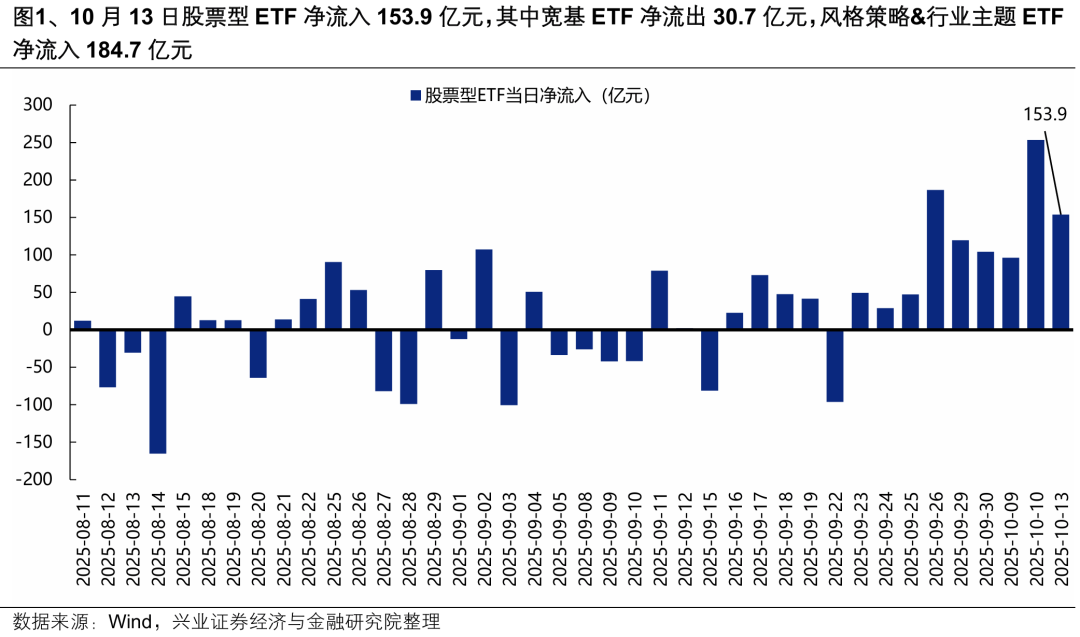
兴业证券:10月13日ETF重点流入哪些领域?
Zhi Tong Cai Jing· 2025-10-14 12:09
Group 1 - On October 13, the net inflow of equity ETFs was 15.39 billion, with broad-based ETFs experiencing a net outflow of 3.07 billion and style strategy & industry theme ETFs seeing a net inflow of 18.47 billion [1] - Among broad-based ETFs, the CSI 300 saw significant inflows, while the STAR Market, CSI A500, and CSI 1000 experienced outflows [4] - In terms of industry theme ETFs, the major inflow directions were concentrated in cyclical (non-ferrous), large finance (non-bank, banks), self-controllable (electronics, military, computers), advanced manufacturing (new energy, pharmaceuticals), and consumption, while the outflow directions were mainly in real estate, telecommunications, free cash flow, machinery, media, and chemicals [8]


金融制造行业10月投资观点及金股推荐-20251008
Changjiang Securities· 2025-10-08 14:49
Investment Rating - The report maintains a "Buy" rating for several key stocks in the financial and manufacturing sectors, including Yuexiu Property, New China Life Insurance, Nanjing Bank, and others [13][18][19][25][35][42]. Core Insights - The report highlights a recovery in industrial profits, with August showing a significant year-on-year profit growth of 20.4%, although revenue growth remains modest at 1.9% [10]. - The real estate sector is under pressure, but there is potential for policy easing to create trading opportunities, particularly for quality developers with low inventory [11]. - Non-bank financials are expected to maintain high growth in Q3, driven by market enthusiasm and performance of leading stocks [14]. - The banking sector is viewed positively, especially for quality city commercial banks, which are expected to offer stable dividends and growth [17]. - The new energy sector is identified as having established a bottom, with a focus on technological advancements and market demand recovery [20]. - The machinery sector is transitioning from traditional industries to growth segments, with a focus on companies with dual growth curves [27]. - The military industry is seen as promising, with investment opportunities in military trade, internal equipment, and civilian conversion [33]. - The light industry is expected to benefit from new consumption trends and overseas growth, with an emphasis on high dividend and low valuation stocks [36]. - The environmental sector presents various investment opportunities across absolute returns, growth, and aggressive strategies [43]. Summary by Sections Macro Overview - The report emphasizes the resilience of demand in Q4, with industrial profit growth driven by state-owned enterprise investment returns [10]. Real Estate - The report notes increasing downward pressure on housing prices in core cities, but anticipates potential policy support for quality developers [11][12]. Non-Bank Financials - The sector is expected to continue its high growth trend, with a focus on leading stocks and insurance companies benefiting from improved return on equity [14][16]. Banking - Quality city commercial banks are highlighted as attractive investments due to their stable earnings and dividend yields [17][18][19]. New Energy - The report identifies a stable outlook for the new energy sector, particularly in solar and storage technologies, with a focus on leading companies [20][23][25][26]. Machinery - The machinery sector is transitioning to growth areas, with recommendations for companies that show strong growth potential [27][30][31]. Military - Investment opportunities are identified in military trade and technology, with a focus on companies leading in military aircraft and related technologies [33][34]. Light Industry - The report highlights growth potential in new consumption and overseas markets, with a focus on companies with strong operational capabilities [36][38][39]. Environmental - The environmental sector is seen as having multiple investment opportunities, particularly in waste management and water services [43][44][50].