
鸡蛋

Search documents
年终盘点之大宗商品:能源疲软,贵金属“疯牛”!2026年“淘金热”行情转向有色?
智通财经网· 2025-12-29 14:22
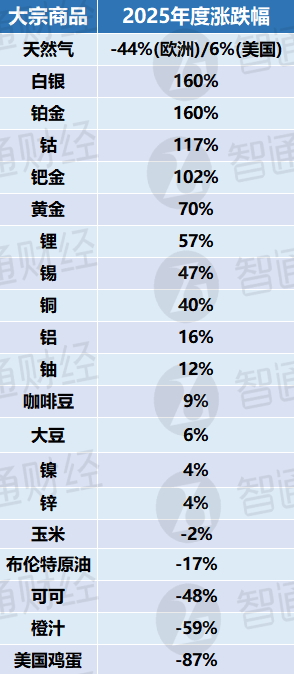
Key Insights - The global commodity market in 2025 shows a clear divergence, with energy and agricultural prices declining while precious metals (like gold and silver) and industrial metals (like copper) continue to rise and reach new highs. This situation is influenced by changes in global demand, geopolitical tensions, monetary policy adjustments, and the development of the new energy industry. This divergence is expected to persist into 2026, with energy prices anticipated to further decline due to oversupply, while precious metal prices are projected to continue rising [1]. Energy - The global crude oil market in 2025 experienced significant volatility, with Brent crude prices fluctuating between $60 and $70 per barrel by year-end. Geopolitical tensions and policy changes were key drivers of price movements, with prices peaking at $83 per barrel early in the year due to U.S. sanctions on Russia [3][5]. - In the second half of 2025, the market shifted from being geopolitically driven to one characterized by oversupply and weak demand, leading to a downward trend in oil prices. OPEC+ adjusted its strategy from production cuts to phased increases, while U.S. production reached historical highs, resulting in rapid inventory accumulation [5][6]. - For 2026, the oil market is expected to face severe oversupply pressures, with Brent crude prices projected to drop further. Analysts predict a price range of $56 to $60 per barrel, with some forecasts suggesting a potential dip to $51 per barrel in early 2026 [7]. Natural Gas - The global natural gas market in 2025 showed a "high then low" pattern, with prices initially rising due to cold weather and geopolitical factors but later declining as new U.S. production came online and demand slowed in Asia [8][10]. - In 2026, the market is expected to transition from a "tight balance" to "periodic oversupply," driven by increased LNG production from the U.S., Qatar, and Canada. Despite ample supply, demand is projected to rise by 2%, providing some price support [10]. Uranium - The uranium market in 2025 transitioned from "de-bubbling" to "structural support," with prices rebounding from a low of approximately $63 per pound to around $81-83 per pound by year-end. This was driven by renewed demand from nuclear power and AI data centers [11][13]. - For 2026, expectations are for uranium prices to accelerate upward, with forecasts suggesting prices could reach $91 per pound, with some estimates as high as $135 per pound due to increasing demand and supply constraints [14]. Precious Metals - Precious metals experienced a "historic rally" in 2025, with gold prices rising approximately 70% and silver prices soaring over 160%. This was fueled by central bank purchases, ETF inflows, and a low-interest-rate environment [15][17]. - For 2026, major financial institutions predict continued bullish trends for gold, with average prices expected to range from $4,500 to $5,000 per ounce, driven by central bank strategies and concerns over U.S. dollar credit [18][19]. Industrial Metals - The industrial metals market in 2025 was characterized by extreme differentiation, with copper prices reaching historical highs due to demand from AI data centers and global grid upgrades. Copper prices exceeded $12,700 per ton [21]. - In 2026, copper and tin are expected to remain strong, with copper potentially reaching $15,000 per ton, while tin prices may rise to $44,000 per ton due to ongoing supply constraints [28]. Agricultural Products - Cocoa prices fell significantly in 2025 after reaching a peak in 2024, while coffee prices exhibited a high-level fluctuation, with expectations for a return to balance in 2026 as supply improves [25][27]. - For 2026, cocoa is expected to see a surplus of about 150,000 tons, leading to price declines, while coffee prices are projected to drop significantly due to increased production in Brazil and Colombia [29][32].

综合晨报-20251229
Guo Tou Qi Huo· 2025-12-29 02:32
Report Industry Investment Ratings No relevant information provided. Core Viewpoints of the Report - The overall market shows complex trends, with different commodities and financial products having their own characteristics. Some are influenced by supply - demand fundamentals, some by geopolitical factors, and others by macro - economic policies and seasonal factors. The market rhythm switches quickly, and most products are in a state of oscillation, with different potential investment opportunities and risks [2][3][14] - Different industries have different outlooks. For example, some industries like polycrystalline silicon and manganese silicon are expected to have a relatively positive trend, while others such as urea and PVC may face certain challenges in supply - demand balance and price trends [13][18][28] Summary by Related Catalogs Precious Metals and Base Metals - **Precious Metals**: International gold prices continued a moderate upward trend after the breakthrough, while silver, platinum, and palladium accelerated their rise, with a gain of over 10%. The Fed's easing prospects and geopolitical risks support the strength of precious metals. The spot shortage expectation makes silver, platinum, and palladium more favored by funds, and the gold - silver ratio has dropped significantly below the average. However, exchange restrictions are frequent, and market volatility is extremely high [2] - **Copper**: Copper prices continued to rise strongly last Friday. The Shanghai copper weighted reached a maximum of 102,700 yuan, and it is expected that the London copper will open at $12,700 - $12,800. The market has quickly reached the bullish targets of most overseas institutions for 2026. The target price of the copper market is raised, with the London copper at about $13,100 and the Shanghai copper at about 104,000 yuan [3] - **Aluminum**: The aluminum market's fundamentals are neutral, with poor apparent demand and spot feedback. Shanghai aluminum mainly followed the upward trend, with relatively mild fluctuations. Long - positions should be held with the 40 - day moving average as the support [4] - **Zinc**: In late December, domestic smelter overhauls increased, supporting the adjustment of Shanghai zinc above the annual line. In January, the pressure on the zinc ingot supply side is small, and with the late Spring Festival in 2026 and the expected good start, the consumption side is not pessimistic. Shanghai zinc is expected to oscillate in the range of 22,800 - 23,800 yuan/ton [7] Energy and Chemicals - **Fuel Oil & Low - Sulfur Fuel Oil**: High - sulfur fuel oil supply is mainly affected by geopolitical factors, with the shipping rhythm in the Middle East and Russia slowing down. The demand side may be boosted by improved refinery profits and the US blockade of Venezuelan oil exports. Singapore's inventory continues to accumulate, and the high - inventory pressure is still significant. Low - sulfur fuel oil supply is dominated by overseas refinery starts. The demand side of ship fuel consumption is continuously weak due to high - sulfur substitution [21] - **Asphalt**: Since December, the weekly shipment volume has remained below 400,000 tons, at a low level in the same period of the past four years. Last week, both social and factory inventories increased. The supply - demand of BU is marginally relaxed, but positive news has a significant boost. However, it will eventually return to the price - pressured pattern dominated by supply - demand relaxation [22] Agricultural Products - **Soybean & Bean Meal**: CBOT soybeans oscillated downward after reopening last Friday, and Dalian soybean meal rose first and then fell. In the future, attention should be paid to the specific export situation of US soybeans and whether the La Nina weather in South America can have a continuous impact [35] - **Cotton**: US cotton rebounded from a low level last week, and the weekly signing data improved, with increased Chinese purchases. Domestic Zhengzhou cotton rose continuously, and the market is bullish. Although this year's new cotton production has increased significantly, the commercial inventory is basically the same as the previous year, and the sales progress is relatively fast [42] Others - **Stock Index**: The previous trading day, the broader market oscillated with heavy volume, and the Shanghai Composite Index recorded an 8 - day consecutive gain. All major futures index contracts closed higher, with IC leading the gain. Industrial profits of large - scale enterprises from January to November showed a growth trend, and the RMB exchange rate broke "7" last week [47] - **Treasury Bonds**: On December 26, 2025, the 30 - year treasury bond futures had the largest increase of 0.36%. In December, the central bank's net MLF injection was 10 billion yuan, a consecutive tenth - month incremental renewal. Against the background of increased counter - cyclical adjustment policies, long - term interest rates have risen significantly recently [48]
广发早知道:汇总版-20251226
Guang Fa Qi Huo· 2025-12-26 01:12
Report Industry Investment Rating No relevant content provided. Core Viewpoints of the Report The report offers a comprehensive analysis of various futures markets, including financial derivatives, precious metals, shipping indices, non - ferrous metals, black metals, agricultural products, and energy chemicals. It details the current market situation, influencing factors, and future outlooks for each category, and provides corresponding trading strategies. Summary by Directory Daily Selections - **Copper**: High copper prices have suppressed terminal demand, leading to significant spot discounts and inventory accumulation. Upward drivers include further deterioration of overseas inventory structure and improved interest - rate cut expectations; downward drivers are weak demand. Suggest a light - position holding of a protective put option portfolio [2]. - **PP**: The basis weakens, and trading improves. Pay attention to the expansion of PDH profits [3]. - **Coking Coal**: Spot coal prices vary, and the upside of the futures price is limited. Switch to short - selling on rallies [3]. - **Soybean Meal**: South American harvest expectations suppress prices, but cost supports the downside. Concerns about customs policies affect domestic supply. Be cautious in short - term operations [4]. - **Silver**: Supply tightness and capital drive prices to maintain a strong - side oscillation. Hold long positions, and reduce or lock positions before the Spring Festival [5]. Financial Derivatives Stock Index Futures - **Market Performance**: A - share indices rise, and the basis of the four major stock index futures contracts is repaired. The short - term negative factors are exhausted, and the index rebounds [7][8][9]. - **News**: Beijing eases housing purchase restrictions, and the US raises IPO liquidity thresholds [8][9]. - **Funding**: A - share trading volume is stable, and the central bank conducts net injections [9]. - **Operation Suggestion**: Try a bull - spread strategy on the CSI 300 index [9]. Treasury Bond Futures - **Market Performance**: Treasury bond futures decline, and short - term bonds are relatively strong [10]. - **Funding**: The central bank's reverse - repurchase operations result in net injections, and the funding rate is seasonally up but controllable [10]. - **Operation Suggestion**: Consider going long on the T contract on pullbacks and participate in the 2603 contract cash - and - carry arbitrage and basis - widening strategies [12]. Precious Metals - **Market Review**: Overseas markets are closed for holidays. Some precious metals experience price adjustments, with platinum strengthening and palladium once hitting the daily limit down [13][15]. - **Outlook**: The medium - to - long - term price of precious metals has an upward trend, but short - term fluctuations exist. Adopt a long - position strategy on dips [16]. Shipping Index (European Line) - **Index**: SCFIS and SCFI indices show an upward trend [19]. - **Fundamentals**: Container capacity increases, and demand in the eurozone and the US is weak [19]. - **Logic**: The futures contract is in a consolidation phase, with limited drivers, and is expected to oscillate in the short term [19]. Non - Ferrous Metals - **Copper**: High prices suppress demand, and the price is expected to oscillate strongly in the short term. Hold protective put options [24]. - **Alumina**: The market is oversupplied, and the price is expected to oscillate around the cash - cost line [26]. - **Aluminum**: The market is in a state of macro - positive expectations versus fundamental pressure, and the price is expected to oscillate widely [29]. - **Aluminum Alloy**: High costs and weak demand limit price movements, and the price is expected to oscillate in a high - level range [31]. - **Zinc**: TC stabilizes, demand is weak, and the price is expected to oscillate weakly [36]. - **Tin**: Supply is improving, and the price is expected to oscillate at a high level. Adopt a wait - and - see approach [40]. - **Nickel**: The market is affected by expectations of tightened ore supply, and the price is expected to oscillate strongly [42]. - **Stainless Steel**: The market is in a state of strong expectations versus weak reality, and the price is expected to oscillate and adjust [46]. - **Lithium Carbonate**: The market is in a state of high - level oscillation, with strong capital sentiment. The price is expected to oscillate widely [50]. - **Polysilicon**: The price is in a high - level oscillation, with demand weakness. Adopt a wait - and - see approach [53]. - **Industrial Silicon**: The price is expected to oscillate at a low level. Pay attention to production - cut implementation [55]. Black Metals - **Steel**: Steel production is cut, and inventory is reduced. The price is expected to oscillate. Consider exiting the 1 - 5 positive spread and looking for opportunities to go long on the 5 - month iron - ore ratio [57][58]. - **Iron Ore**: Supply is at a high level, and demand is weak. The price is expected to oscillate. Adopt a short - term range - trading strategy on the 05 contract [60]. - **Coking Coal**: Supply may decrease, and demand is weak. Switch to short - selling on rallies [66]. - **Coke**: The third price cut is implemented, and the price is expected to decline. Switch to short - selling on rallies [70][71]. - **Silicon Iron**: Supply is reduced, and demand is stable. The price is expected to oscillate in a range [73]. - **Silicon Manganese**: High inventory suppresses price rebounds, and the price is expected to run weakly. Consider short - selling when the price rebounds above the Ningxia spot cost [76]. Agricultural Products - **Soybean Meal and Rapeseed Meal**: South American harvest expectations suppress prices, and customs policies affect domestic supply. Be cautious in short - term operations [79]. - **Pigs**: Seasonal demand supports the market, and the price is expected to oscillate strongly in the short term [81]. - **Corn**: Supply and demand are balanced, and the price is in a stalemate. Pay attention to selling sentiment and policy releases [84]. - **Sugar**: The international market is bearish, and the domestic market may have limited rebounds. Adopt a bearish - on - rebounds strategy [85]. - **Cotton**: US cotton oscillates at the bottom, and domestic cotton prices are expected to rise. The supply pressure is released, and the long - term outlook is optimistic [88]. - **Eggs**: Supply pressure is high but eases marginally. Near - month contracts are expected to oscillate at the bottom [92]. - **Oils**: Palm oil may continue to rise but also faces downward risks. Soybean oil and rapeseed oil have different market situations. Adopt corresponding strategies according to different varieties [93][95][96]. - **Jujubes**: The price rebounds. Pay attention to sales in the distribution areas. Consider selling call options [97]. - **Apples**: The price oscillates. Consider closing long positions [98]. Energy Chemicals - **PX**: Valuation increases, and downstream feedback is negative. The upside is limited. Reduce long positions on rallies and consider long - term low - buying [100]. - **PTA**: Follow PX trends, and the upside is limited. Reduce long positions on rallies and consider long - term low - buying [102]. - **Short - Fiber**: Supply is high, and demand is weak. Follow raw - material fluctuations [104]. - **Bottle Chips**: Supply is expected to increase, and processing fees may be compressed. Adopt the same strategy as PTA and short - sell processing fees on rallies [106]. - **Ethylene Glycol**: Supply is expected to decrease, but the cost support is limited. The price is expected to oscillate. Adopt a 5 - 9 reverse - arbitrage strategy [108]. - **Pure Benzene**: Supply is stable, and demand is weak. The price is expected to oscillate in a range [109]. - **Styrene**: Supply and demand both increase, and the price is expected to oscillate in a range [111]. - **LLDPE**: Supply and demand are weak. Go long on the 2605 contract in the short term [113]. - **PP**: Pay attention to the expansion of PDH profits [3]. - **Methanol**: The market is expected to balance in the first quarter of next year. Pay attention to the contraction of MTO05 [114]. - **Caustic Soda**: Supply and demand are under pressure, and the price is expected to decline [116]. - **PVC**: Supply is expected to increase, and demand is weak. The price is expected to decline after a rebound [117]. - **Soda Ash**: Supply is stable, and demand is weak. Short - sell on rallies [120]. - **Glass**: The price is under pressure. Adopt a wait - and - see approach [120]. - **Natural Rubber**: The price is driven by macro - sentiment, but the fundamentals are weak. Try short - selling around 15700 [122]. - **Synthetic Rubber**: The price is expected to oscillate strongly in the short term. Avoid short - selling the BR2602 contract [124][125].
建信期货鸡蛋日报-20251225
Jian Xin Qi Huo· 2025-12-25 02:51
Group 1: General Information - Report date: December 25, 2025 [2] - Reported industry: Eggs [1] - Research team: Agricultural Products Research Team, including Yu Lanlan, Lin Zhenlei, Wang Haifeng, Hong Chenliang, and Liu Youran [4] Group 2: Market Review and Operation Suggestions Market Review | Contract | Previous Settlement Price | Opening Price | Highest Price | Lowest Price | Closing Price | Change | Change Rate | Trading Volume | Open Interest | Change in Open Interest | | --- | --- | --- | --- | --- | --- | --- | --- | --- | --- | --- | | Egg 2601 | 3029 | 3016 | 3075 | 3016 | 3072 | 43 | 1.42% | 26237 | 39087 | -1106 | | Egg 2602 | 2881 | 2878 | 2950 | 2878 | 2947 | 66 | 2.29% | 180956 | 169411 | -20946 | | Egg 2603 | 2938 | 2935 | 2991 | 2935 | 2986 | 48 | 1.63% | 110457 | 173845 | -4281 | [7] Operation Suggestions - The spot egg price in China is weak today. The average price in the main producing areas is 2.90 yuan/jin, down 0.07 yuan/jin from yesterday; the average price in the main selling areas is 3.22 yuan/jin, down 0.07 yuan/jin from yesterday. The 02 contract rose 2.29%. The prices in the main selling areas of Beijing, Shanghai, and Guangzhou all declined, and the red eggs in the northern producing areas also declined under pressure. The spot market is weak today. However, the futures market rose against the trend. The near - month main contracts rose with a reduction in positions, mainly due to the profit - taking of previous short positions rather than the impetus from the spot market. - Contracts 02 and 03 are off - season contracts and usually have a significant price drop from the pre - holiday high. Currently, there is no sign of a price increase before the holiday. If the spot price continues to fluctuate, short positions may make a comeback. For near - month contracts, consider shorting after a price increase or selling call options. For far - month contracts, due to the logic of production capacity reduction, they are generally bullish. However, since they have already started rising, the strategy is to build positions after a price drop and conduct rolling operations [8] Group 3: Industry News Inventory - As of the end of November 2025, the monthly inventory of laying hens in China was about 1.352 billion, down 0.52% month - on - month from 1.359 billion at the end of October and 1.368 billion at the end of September, ending the previous continuous growth. However, compared with 1.284 billion in the same period last year, the year - on - year increase was still 5.3%, indicating significant pressure on the supply side [9] Replenishment - In November 2025, the monthly output of laying hen chicks from sample enterprises was about 39.55 million, slightly up from 39.15 million in October but significantly down 13.5% from 45.69 million in the same period in 2024. The total replenishment from August to November 2025 was about 157.71 million, compared with about 180.11 million in the same period last year [9] Culling Volume - As of December 18, the culling volume of laying hens in the previous three weeks was 20.82 million, 19.84 million, and 19.67 million respectively, showing a continuous downward trend [9] Culling Age - As of December 18, the average culling age of laying hens was 486 days, the same as last week and 6 days earlier than last month [9][10] Group 4: Data Overview - The report provides multiple data charts, including the monthly inventory of laying hens in China, egg - laying chicken farming profit, the average price of eggs in the main producing areas, the seasonal trend of eggs in December, the basis of the egg 12 contract, and the spread between the egg 12 - 02 contracts, with data sources from Wind, Zhuochuang Information, and Trading Famen [12][14][15]
建信期货鸡蛋日报-20251224
Jian Xin Qi Huo· 2025-12-24 05:48
Group 1: General Information - Reported industry: Eggs [1] - Report date: December 24, 2025 [2] - Research team: Agricultural products research team including Yu Lanlan, Lin Zhenlei, Wang Haifeng, Hong Chenliang, and Liu Youran [4] Group 2: Market Review and Operation Suggestions Market Review - Today, the national egg price remained stable. The average price in the main producing areas was 2.97 yuan/jin, down 0.01 yuan/jin from yesterday; the average price in the main selling areas was 3.29 yuan/jin, also down 0.01 yuan/jin from yesterday. The 01 contract fell 1.01% [7] - The 2601 contract had a previous settlement price of 3058, opened at 3045, reached a high of 3045, a low of 3019, and closed at 3027, down 31 or -1.01%, with a trading volume of 18147 and an open interest of 42239, an increase of 4654. The 2602 contract had a previous settlement price of 2897, opened at 2885, reached a high of 2894, a low of 2873, and closed at 2876, down 21 or -0.72%, with a trading volume of 113934 and an open interest of 190357, an increase of 4038. The 2603 contract had a previous settlement price of 2951, opened at 2945, reached a high of 2954, a low of 2925, and closed at 2936, down 15 or -0.51%, with a trading volume of 66149 and an open interest of 178126, an increase of 1359 [7] Core View - In the first half of last week, the spot price of eggs stabilized at a low level and then rose slightly. The price increase areas were mainly concentrated in the two - lake powder egg area, while the red egg price remained stable. From the demand perspective, mid - to late December will gradually enter a small peak season with the expectation of double - holiday stocking. It is expected that the spot price will mainly fluctuate slightly, and neither a callback nor an increase will show a trend [8] - In the futures market, last week, the near - month contracts fluctuated at a low level, and the far - month contracts declined to some extent. Taking the 02 - 08 spread as an example, the current spot - peak season spread on the futures market reached more than 1300, the largest spread for the same period in the past 8 years, indicating that the market has been actively pricing in the expectation that the decline in next year's inventory will drive up the egg price. During the process of the expectation becoming a reality, there will be repeated twists and turns. Considering that the far - month contracts are currently fully priced, it is recommended that long - position investors wait for the far - month contracts to fully adjust before entering the market and adopt a rolling operation strategy. The near - month contracts lack topics. The 02 and 03 contracts are in the absolute off - season, and the positive impact of the inventory inflection point is relatively not obvious. However, for the price to go down, the spot price increase in the peak season of January needs to be lower than expected, and the time has not come. In the short term, there is insufficient driving force, and the contracts may fluctuate at a low level, waiting for the guidance of the spot price increase in January on the near - month contracts [8] Group 3: Industry News Inventory - As of the end of November 2025, the national monthly inventory of laying hens was about 1.352 billion, down 0.52% from the end of October (1.359 billion) and 1.368 billion at the end of September, ending the previous continuous growth. However, compared with 1.284 billion in the same period last year, the year - on - year increase still reached 5.3%, indicating significant pressure on the supply side [9] Replenishment - In November 2025, the monthly output of laying hen chicks of sample enterprises was about 39.55 million, slightly increasing from 39.15 million in October but significantly decreasing by 13.5% compared with 45.69 million in the same period in 2024. The total replenishment in the past 4 months (August to November 2025) was about 157.71 million, compared with about 180.11 million in the same period last year [9] Group 4: Data Overview Elimination Quantity - Recently, the trend of elimination quantity has decreased. According to Zhuochuang Information, in the three weeks up to December 18, the national culling volume of laying hens was 20.82 million, 19.84 million, and 19.67 million respectively, showing a continuous downward trend [17] Elimination Age - As of December 18, the average culling age of laying hens was 486 days, the same as last week and 6 days earlier than last month [17]
建信期货鸡蛋日报-20251223
Jian Xin Qi Huo· 2025-12-23 06:49
Report Overview - Report Date: December 23, 2025 [2] - Reported Industry: Egg [1] 1. Investment Rating - No investment rating provided in the report. 2. Core Viewpoints - The spot price of eggs is expected to fluctuate slightly, with neither significant downward nor upward trends. The futures market has already priced in the expected increase in egg prices due to a decline in next year's inventory. It is recommended that long - position investors wait for the far - month contracts to adjust sufficiently before entering the market and adopt a rolling operation strategy. Near - month contracts may experience low - level fluctuations in the short term, waiting for the guidance of the spot price increase in January [8]. 3. Summary by Section 3.1 Market Review and Operation Suggestions Market Review | Contract | Pre - settlement Price | Open Price | High Price | Low Price | Close Price | Change | Change Percentage | Volume | Open Interest | Change in Open Interest | | --- | --- | --- | --- | --- | --- | --- | --- | --- | --- | --- | | 2601 | 3068 | 3056 | 3077 | 3041 | 3049 | - 19 | - 0.62% | 25852 | 47063 | 10016 | | 2602 | 2902 | 2888 | 2918 | 2884 | 2888 | - 14 | - 0.48% | 141072 | 186319 | - 1370 | | 2603 | 2952 | 2950 | 2969 | 2936 | 2948 | - 4 | - 0.14% | 81349 | 176767 | 2185 | [7] - The average price of eggs in the main producing areas is 2.98 yuan/jin, a decrease of 0.09 yuan/jin from the previous day; the average price in the main selling areas is 3.30 yuan/jin, a decrease of 0.02 yuan/jin from the previous day. The 01 contract fell 0.62% [8]. Operation Suggestions - For far - month contracts, since the current pricing is relatively full, it is recommended that long - position investors wait for full adjustment and adopt a rolling operation strategy. For near - month contracts (02, 03), due to insufficient topics and the fact that the positive impact of the inventory inflection point is not obvious, they may experience low - level fluctuations in the short term, waiting for the guidance of the spot price increase in January [8]. 3.2 Industry News Inventory - As of the end of November 2025, the monthly inventory of laying hens in the country was about 1.352 billion, a month - on - month decrease of 0.52%, ending the previous continuous growth. However, compared with the same period last year (1.284 billion), the year - on - year increase was still 5.3%, indicating significant pressure on the supply side [9]. Replenishment - In November 2025, the monthly hatchling volume of laying hen chicks in sample enterprises was about 39.55 million, slightly increasing from 39.15 million in October but a significant decrease of 13.5% compared with 45.69 million in the same period in 2024. The total replenishment in the past 4 months (August - November 2025) was about 157.71 million, compared with about 180.11 million in the same period last year [9]. 3.3 Data Overview Elimination Volume - As of December 18, the national elimination volume of laying hens in the previous three weeks was 20.82 million, 19.84 million, and 19.67 million respectively, showing a continuous downward trend [17]. Elimination Age - As of December 18, the average elimination age of laying hens was 486 days, the same as the previous week and 6 days earlier than the previous month [17].
招商期货-期货研究报告:商品期货早班车-20251223
Zhao Shang Qi Huo· 2025-12-23 01:31
1. Report Industry Investment Ratings No industry investment ratings are provided in the report. 2. Core Views - The gold market shows strength with the Fed's expected rate - cut, suggesting a long - position for gold and a wait - and - see approach for silver [1]. - For base metals, different strategies are recommended for each metal based on their market performance, fundamentals, such as buying copper on dips, expecting aluminum to oscillate in the short - term, and predicting alumina to decline with oscillations [2]. - In the black industry, a wait - and - see approach is generally recommended, with attempts to short certain contracts like螺纹2605 and焦煤09 [5]. - In the agricultural products market, various trading strategies are proposed according to the supply - demand situation of different products, such as trading South American soybean bumper harvest expectations and weak exports for soybeans, and shorting sugar futures [6]. - For energy and chemical products, different trading strategies are given based on the supply - demand balance, including short - term oscillations and long - term improvement for some products, and short - selling for others [7][8]. 3. Summary by Category Gold and Precious Metals - **Market Performance**: International gold prices broke through and strengthened, standing above $4400 per ounce, and domestic gold prices exceeded 1000 yuan. Silver inventories showed different trends in different markets [1]. - **Fundamentals**: Fed officials' statements, geopolitical events, and inventory changes in gold and silver affected the market. For example, the Fed may not cut rates until next spring, and there were changes in gold and silver inventories in different exchanges and ETFs [1]. - **Trading Strategy**: Long gold and wait - and - see for silver [1]. Base Metals Copper - **Market Performance**: Copper prices oscillated [2]. - **Fundamentals**: The implementation time of US refined copper tariffs may be postponed, and the supply of copper mines remained tight [2]. - **Trading Strategy**: Buy on dips [2]. Aluminum - **Market Performance**: The closing price of the electrolytic aluminum main contract increased by 0.16% compared to the previous trading day [2]. - **Fundamentals**: Aluminum plants maintained high - load production, and the weekly aluminum product start - up rate decreased slightly [2]. - **Trading Strategy**: Expect aluminum prices to oscillate in the short - term within the current high - level range [2]. Alumina - **Market Performance**: The closing price of the alumina main contract decreased by 0.08% compared to the previous trading day [2]. - **Fundamentals**: Alumina plants' operating capacity remained stable, and electrolytic aluminum plants maintained high - load production [2]. - **Trading Strategy**: Expect alumina prices to decline with oscillations [2]. Zinc - **Market Performance**: The closing price of the沪锌2601 contract increased by 0.09% compared to the previous trading day, and social inventories increased [3]. - **Fundamentals**: LME zinc inventories increased significantly, and the consumption off - season deepened [3]. - **Trading Strategy**: Short on rallies [3]. Lead - **Market Performance**: The closing price of the沪铅2601 contract increased by 0.27% compared to the previous trading day, and social inventories decreased [3]. - **Fundamentals**: The supply of primary lead recovered after maintenance, while the supply of recycled lead decreased significantly. The lead battery start - up rate decreased slightly [3]. - **Trading Strategy**: Trade within a range, with a focus on long - positions at low prices [3]. Industrial Silicon - **Market Performance**: The main 05 contract decreased by 1.09% compared to the previous trading day, and the position increased [3]. - **Fundamentals**: The number of open furnaces decreased, and social inventories decreased. The demand from related industries remained stable [3]. - **Trading Strategy**: Expect the price to oscillate weakly in the range of 8000 - 9000, and adopt a wait - and - see approach [3]. Lithium Carbonate - **Market Performance**: LC2605 increased by 2.7% [3]. - **Fundamentals**: The price of Australian lithium concentrate increased, production increased, and demand decreased in some sectors. December saw inventory reduction [3]. - **Trading Strategy**: Expect short - term price increase with oscillations [3]. Polysilicon - **Market Performance**: The main 05 contract decreased by 2.32% compared to the previous trading day, and the position decreased [4]. - **Fundamentals**: Supply remained stable, demand decreased, and inventories increased slightly [4]. - **Trading Strategy**: Consider long - positions on dips after the price returns to the spot trading range [4]. Black Industry Steel - **Market Performance**: The螺纹2605 contract increased by 25 yuan/ton compared to the previous night - session closing price [5]. - **Fundamentals**: Steel mills continued to make losses, production might decline marginally, and the futures were at a large discount [5]. - **Trading Strategy**: Adopt a wait - and - see approach and attempt to short螺纹2605 [5]. Iron Ore - **Market Performance**: The铁矿2605 contract decreased by 1.5 yuan/ton compared to the previous night - session closing price [5]. - **Fundamentals**: Iron ore supply and demand were weak, and the port inventory increased [5]. - **Trading Strategy**: Adopt a wait - and - see approach [5]. Coking Coal - **Market Performance**: The焦煤2605 contract increased by 19 yuan/ton compared to the previous night - session closing price [5]. - **Fundamentals**: Coking coal supply and demand were weak, and the futures were at a premium [5]. - **Trading Strategy**: Adopt a wait - and - see approach and attempt to short焦煤09 [5]. Agricultural Products Market Soybean Meal - **Market Performance**: The CBOT soybean rebounded overnight [6]. - **Fundamentals**: Global soybean supply - demand is expected to be loose, with strong US soybean crushing and slow exports [6]. - **Trading Strategy**: Trade South American soybean bumper harvest expectations and weak exports, and the domestic market is driven down by cost in the short - term [6]. Corn - **Market Performance**: Corn futures prices are weak, and spot prices slightly declined [6]. - **Fundamentals**: The grain - selling progress slowed down, and downstream demand decreased [6]. - **Trading Strategy**: Futures prices are expected to oscillate [6]. Oils and Fats - **Market Performance**: The Malaysian palm oil market rose in the short - term [6]. - **Fundamentals**: Supply is in seasonal decline but with year - on - year growth, and demand shows an increase in exports [6]. - **Trading Strategy**: Oils and fats may enter an oscillation phase with product differentiation [6]. Sugar - **Market Performance**: The郑糖05 contract increased by 0.41% [6]. - **Fundamentals**: International sugar prices rebounded slightly, and the domestic market followed with a smaller increase. The long - term global sugar production is expected to increase [6]. - **Trading Strategy**: Short sugar futures and sell call options [6]. Eggs - **Market Performance**: Egg futures prices are weak, and spot prices increased [6]. - **Fundamentals**: The inventory of laying hens decreased, and demand is affected by price changes [6]. - **Trading Strategy**: Futures prices are expected to oscillate weakly [6]. Pigs - **Market Performance**: Pig futures prices oscillate, and spot prices show a north - up and south - down pattern [6]. - **Fundamentals**: Supply is still abundant, and demand is expected to increase seasonally [6]. - **Trading Strategy**: Futures prices are expected to oscillate [6]. Energy and Chemical Products LLDPE - **Market Performance**: The LLDPE main contract continued to decline slightly [7]. - **Fundamentals**: Supply pressure eases, and demand weakens in the agricultural film sector [7]. - **Trading Strategy**: Short - term oscillation with a downward trend, and long - positions on dips for far - month contracts [7]. PVC - **Market Performance**: V05 decreased by 1.7% [7]. - **Fundamentals**: Supply increases, demand weakens, and inventory is at a high level [7]. - **Trading Strategy**: Short - sell or use reverse spreads [7]. PTA - **Market Performance**: PX and PTA prices are at certain levels with a specific basis [7]. - **Fundamentals**: PX supply is high, and PTA has short - term supply decline and medium - term inventory accumulation pressure [7]. - **Trading Strategy**: Long - position PX in the medium - term and look for opportunities to long PTA processing margins in 05 [7]. Glass - **Market Performance**: fg05 decreased by 1.5% [7]. - **Fundamentals**: Glass prices decline, and inventory accumulates. Supply and demand are both weak [7]. - **Trading Strategy**: Use reverse spreads [7]. PP - **Market Performance**: The PP main contract continued to decline slightly [8]. - **Fundamentals**: Supply increases, demand weakens, and the export window opens [8]. - **Trading Strategy**: Short - term oscillation with a downward trend, and long - positions on dips for far - month contracts [8]. MEG - **Market Performance**: MEG has a certain spot price and basis [8]. - **Fundamentals**: Supply is high, inventory accumulates, and demand weakens in the off - season [8]. - **Trading Strategy**: Take profit in the short - term and look for inventory reduction opportunities in the medium - term for 05 [8]. Crude Oil - **Market Performance**: Oil prices rose due to short - term supply reduction [8]. - **Fundamentals**: Supply pressure is large, and demand is in the off - season [8]. - **Trading Strategy**: Short - sell crude oil on rallies [8]. Styrene - **Market Performance**: The EB main contract rebounded slightly [8]. - **Fundamentals**: Supply is weak in the short - term, and demand is in the off - season [8]. - **Trading Strategy**: Short - term oscillation with a downward trend, and long - positions on dips for styrene and related spreads in the second quarter [8]. Soda Ash - **Market Performance**: sa05 decreased by 0.8% [9]. - **Fundamentals**: Supply increases with new device production, and demand from photovoltaic glass is weak with high inventory [9]. - **Trading Strategy**: Use reverse spreads [9].
建信期货鸡蛋日报-20251222
Jian Xin Qi Huo· 2025-12-22 07:53
Industry - The industry under research is the egg industry [1] Report Date - The report was published on December 22, 2025 [2] Research Team - The research team consists of Yu Lanlan, Lin Zhenlei, Wang Haifeng, Hong Chenliang, and Liu Youran [4] Investment Rating - No investment rating was provided in the report Core Viewpoints - In the short - term, the spot price of eggs is expected to fluctuate slightly, with neither significant upward nor downward trends. The futures market has already priced in the expected increase in egg prices due to the decline in next year's egg - laying hen inventory. It is recommended that long - position investors wait for the far - month contracts to fully adjust before entering the market and adopt a rolling operation strategy. The near - month contracts may experience low - level fluctuations, awaiting guidance from the spot price increase in January [8] Summary by Section 1. Market Review and Operation Suggestions - **Market Review**: On the reporting day, the national egg price remained stable. The average price in the main production areas was 3.05 yuan per catty, unchanged from the previous day, and the average price in the main sales areas was 3.32 yuan per catty, also unchanged. The 01 contract rose 0.26%. The 2601 contract closed at 3077, up 8 or 0.26%; the 2602 contract closed at 2886, down 30 or - 1.03%; the 2603 contract closed at 2946, down 35 or - 1.17% [7] - **Operation Suggestions**: Wait for the far - month contracts to fully adjust before entering the market with long positions and use a rolling operation strategy. The near - month contracts may experience low - level fluctuations, waiting for the spot price increase in January to guide them [8] 2. Industry News - **Inventory**: As of the end of November 2025, the national monthly inventory of laying hens was about 1.352 billion, a month - on - month decrease of 0.52%, ending the previous continuous growth. However, it was still 5.3% higher than the same period last year, indicating significant supply - side pressure [9] - **Replenishment**: In November 2025, the monthly output of laying hen chicks from sample enterprises was about 39.55 million, slightly higher than 39.15 million in October but 13.5% lower than the same period in 2024. The total replenishment from August to November 2025 was about 157.71 million, compared with about 180.11 million in the same period last year [9] 3. Data Overview - **Elimination Volume**: As of December 18, the national chicken culling volume in the previous three weeks was 20.82 million, 19.84 million, and 19.67 million respectively, showing a continuous downward trend [17] - **Elimination Age**: As of December 18, the average age of culled chickens was 486 days, unchanged from the previous week but 6 days earlier than the previous month [17]
建信期货鸡蛋日报-20251218
Jian Xin Qi Huo· 2025-12-18 03:18
Report Summary 1. Reported Industry - The report focuses on the egg industry [1] 2. Core Viewpoints - The spot market for eggs has stabilized after a period of slight weakness, with expectations of a small peak season in mid - to late December due to double - holiday stocking. Spot prices are expected to fluctuate slightly, with neither significant downward nor upward trends. Futures were relatively weak last week, especially after the egg price in Hubei adjusted downward on Friday. The decline of peak - season contracts is a correction of the previous influx of long positions. Although there are signs of a turning point in the laying - hen inventory, the impact on egg prices will be delayed. The near - month contracts are affected, and the market is currently dominated by short positions. New short positions can focus on the 02 contract, while long positions can consider far - month peak - season contracts after the correction [8] 3. Section Summaries 3.1 Market Review and Operation Suggestions - **Market Review**: Today, the national egg price remained stable. The average price in the main production areas was 3.05 yuan/jin, unchanged from yesterday, and in the main sales areas, it was 3.32 yuan/jin, also unchanged. The 01 contract fell 0.77%. The 2601 contract closed at 3092, down 24 or 0.77%; the 2602 contract closed at 2927, down 9 or 0.31%; the 2603 contract closed at 3008, down 12 or 0.40% [7] - **Operation Suggestions**: New short positions can focus on the 02 contract due to the post - holiday off - season and the lack of a clear upward trend in the spot market. Long positions can look for entry opportunities in far - month peak - season contracts after the correction, using rolling operations. The 01 contract should focus on the stabilization of egg prices after the decline, and its correlation with the spot market will increase in the future [8] 3.2 Industry News - **Inventory**: As of the end of October 2025, the national monthly inventory of laying hens was about 1.359 billion, a 0.66% month - on - month decrease, ending the previous continuous growth trend, but still higher than the same period in 2024 [9] - **Replenishment**: In October 2025, the monthly output of laying - hen chicks from sample enterprises was about 39.15 million, slightly less than in September 2025 and significantly less than the same period in 2024. The total replenishment from July to October 2025 was about 158.14 million, less than the same period last year [9][10] 3.3 Data Overview - **Culling Quantity**: From the three weeks up to November 20, 2025, the national culling quantities were 19.81 million, 19.47 million, and 20.21 million respectively, showing fluctuations but a slight increase overall [15] - **Culling Age**: As of November 20, 2025, the average culling age was 492 days, 1 day earlier than the previous week and 7 days earlier than the previous month, indicating an accelerated culling speed [15]
建信期货鸡蛋日报-20251217
Jian Xin Qi Huo· 2025-12-17 01:15
Report Overview - Reported industry: Eggs [1] - Date: December 17, 2025 [2] - Research team: Agricultural Products Research Team [4] - Researchers: Yu Lanlan, Lin Zhenlei, Wang Haifeng, Hong Chenliang, Liu Youran [4] Report Key Points Investment Rating - No investment rating provided in the report Core View - The spot market for eggs stabilized last week after a continuous slight decline. The powder egg area represented by Hubei rebounded first, and other regions saw a slight increase. Overall, the spot market is slightly stronger, with normal sales and inventory levels. In December, the market is expected to enter a small peak season with the anticipation of double holiday stocking, and the spot price is expected to fluctuate slightly, with neither significant downward nor upward trends. [8] - The futures market was relatively weak last week. After the egg price in Hubei declined on Friday, the near - term 01 contract dropped significantly. The decline of the peak - season contracts is mainly a correction of the previous influx of long positions. Although the inventory of laying hens has shown a turning point, due to the large base, the impact on egg prices will be delayed and there may be fluctuations. The near - term contracts were affected, showing that the market is currently dominated by short positions. New short positions can focus on the 02 contract, which faces greater pressure due to the post - holiday off - season and the lack of a clear upward trend in the spot market. Long positions can still consider entering the far - term peak - season contracts after this correction, mainly through rolling operations. The near - term 01 contract should focus on the stabilization of egg prices after a decline, with its future performance being more correlated with the spot market. [8] Summary by Directory 1. Market Review and Operation Suggestions - **Market Review**: The prices of egg futures contracts showed different trends. The 2601 contract rose 0.19% to 3114, the 2602 contract fell 0.24% to 2928, and the 2603 contract fell 0.73% to 3007. The average price of eggs in the main production areas was 3.05 yuan/jin, down 0.02 yuan/jin from the previous day, and the average price in the main sales areas was 3.32 yuan/jin, unchanged from the previous day. [7] - **Operation Suggestions**: New short positions can focus on the 02 contract, and long positions can consider rolling operations in the far - term peak - season contracts after the correction. The near - term 01 contract should focus on the stabilization of egg prices after a decline. [8] 2. Industry News - **Inventory**: As of the end of October 2025, the monthly inventory of laying hens in China was about 1.359 billion, a month - on - month decrease of 0.66%, ending the previous continuous growth trend, but a year - on - year increase of 5.59% compared to the end of October 2024. [9] - **Replenishment**: In October 2025, the monthly output of laying hen chicks from sample enterprises was about 39.15 million, a slight decrease from September 2025 and a significant decrease compared to the same period in 2024. The cumulative replenishment from July to October 2025 was about 158.14 million, compared with about 176.1 million in the same period in 2024. [9][10] 3. Data Overview - **Culling Volume**: As of November 20, 2025, the weekly culling volumes of laying hens in the previous three weeks were 19.81 million, 19.47 million, and 20.21 million respectively. The culling volume has fluctuated recently but has increased slightly compared to the previous period. [15] - **Culling Age**: As of November 20, 2025, the average culling age of laying hens was 492 days, one day earlier than the previous week and seven days earlier than the previous month, indicating an accelerated culling speed. [15]