地产

Search documents
分化明显,博弈加剧,持仓还是持币?
Ge Long Hui· 2025-09-24 06:07
Market Overview - The market showed increased volatility with a notable divergence between bulls and bears, experiencing a rise followed by a pullback and then another surge. By midday, the Shanghai Composite Index rose by 0.63%, the Shenzhen Component increased by 1.11%, and the ChiNext Index climbed by 1.76%. Over 4,000 stocks in the two markets saw gains, with a total trading volume of 1.41 trillion yuan [1]. Chip Industry - The chip industry chain experienced a significant rally, surging by 7.02% by midday. More than 20 stocks, including ShenGong Co., Jingyi Equipment, and Jiangfeng Electronics, hit the daily limit. Notably, Zhangjiang Hi-Tech achieved a consecutive two-day limit increase, while Huasoft Technology and Xiangrikui both saw four consecutive limit increases, and Changchuan Technology and Shengmei Shanghai reached historical highs [3]. Real Estate Sector - The real estate sector showed signs of strength, with stocks like Dalong Real Estate achieving three limit increases in four days [3]. Robotics Sector - The robotics concept stocks were partially active, with Haoneng Co. hitting the daily limit [3]. Tourism Sector - The tourism sector faced a downturn, with stocks collectively dropping by 1.4% by midday. Companies such as Yunnan Tourism and Xiyu Tourism hit the daily limit down [3]. Other Industries - Several industries, including coal, wheel motors, precious metals, electric motors, synchronous reluctance motors, molten salt energy storage, and pumped storage, experienced slight declines [3]. Box Office Performance - According to data from Maoyan Professional Edition, as of September 23, 17:08, the pre-sale box office for new films during the 2025 National Day holiday has exceeded 5 million yuan [3]. Economic Outlook - Goldman Sachs indicated that as economic and market performance declines, high valuations are no longer justified, predicting further depreciation of the US dollar in the coming months [3]. Semiconductor Pricing - Samsung has significantly increased prices for its DRAM and NAND flash products, with some products seeing price hikes of up to 30% [3].

午评:科创50指数大涨近5%,地产、医药等板块拉升,半导体板块再爆发
Zheng Quan Shi Bao Wang· 2025-09-24 05:56
Market Overview - The stock indices in both markets experienced a significant rise, with the Shenzhen Component Index increasing by over 1%, the ChiNext Index rising nearly 2%, and the Sci-Tech 50 Index soaring by nearly 5% [1] - As of the midday close, the Shanghai Composite Index rose by 0.63% to 3845.91 points, the Shenzhen Component Index increased by 1.11%, the ChiNext Index by 1.76%, and the Sci-Tech 50 Index by 4.94%, with a total transaction volume of 1.42 trillion yuan across the three markets [1] Sector Performance - The tourism, coal, and insurance sectors saw declines, while the semiconductor sector continued to perform strongly, alongside robust performances in real estate, pharmaceuticals, and oil sectors [1] - Concepts related to lithography machines, storage chips, and new battery technologies were particularly active [1] Market Sentiment - Dongguan Securities noted that the current A-share market is experiencing a certain level of consolidation, but structural opportunities remain significant [1] - On the day in question, the semiconductor industry chain maintained its strong performance, with the banking and port shipping sectors also showing resilience, indicating that there is still some support in the market [1] - With the upcoming National Day holiday, some funds are taking precautionary measures, particularly leveraged funds actively closing positions ahead of the holiday, which is considered a seasonal normality [1] - Although the market is currently in a consolidation phase, the overall risk appetite has not materially decreased, and with a recovery in the fundamentals and improved profit expectations, a mid-term bull market is still in the making [1]
中观景气 9月第3期:内需周期品价格回暖,服务消费景气提升
Haitong Securities· 2025-09-24 05:42
Group 1: Downstream Consumption - The real estate market in major cities continues to improve, with the transaction area of commercial housing in 30 major cities increasing by 20.3% year-on-year, and the transaction area in first-tier cities rising by 68.8% [7][8] - Retail sales of passenger cars showed a slight increase of 1.0% year-on-year, with the price war in the car market easing, and air conditioning domestic sales increased by 1.2% year-on-year [9][11] - The service consumption index in Hainan increased by 1.3% month-on-month, and the box office revenue for movies surged by 364.6% month-on-month and 149.0% year-on-year [15][17] Group 2: Midstream Manufacturing - Construction demand has marginally improved, with the prices of rebar and hot-rolled coils increasing by 0.6% and 0.3% respectively, and the operating rate of blast furnaces at 84.0% [18][19] - Manufacturing operating rates have generally improved, with the operating rates for half-steel and full-steel tires at 73.7% and 65.7% respectively, showing a slight increase [28][30] Group 3: Upstream Resources - Coal prices have risen significantly, with the price of Q5500 thermal coal at 704 yuan per ton, up 3.5% week-on-week due to tight supply and increased pre-holiday stocking demand [38][41] - Industrial metal prices are under pressure, with copper and aluminum prices decreasing by 1.4% and 1.5% respectively, influenced by hawkish statements from Federal Reserve officials [43][44] Group 4: Logistics and Passenger Flow - Long-distance passenger transport demand has improved, with domestic flight operations increasing by 0.5% week-on-week and 5.0% year-on-year [52][57] - The logistics sector has shown a recovery, with highway truck traffic and railway freight volume increasing by 1.9% and 0.2% respectively [58][59]
A股半导体概念大面积涨停,设备股爆发
Guan Cha Zhe Wang· 2025-09-24 04:14
Market Overview - The market opened lower but quickly rebounded, with the ChiNext Index turning positive and the STAR 50 Index surging nearly 5% [1] - The total trading volume in the Shanghai and Shenzhen markets reached 1.41 trillion yuan, a decrease of 288.5 billion yuan compared to the previous trading day [1] Sector Performance - The semiconductor industry chain experienced a collective surge, with over 20 stocks, including Jiangfeng Electronics, hitting the daily limit [1] - Zhangjiang Hi-Tech achieved a two-day consecutive limit increase, while Huasoft Technology and Xiangrikui both saw four consecutive limit increases [1] - Real estate stocks showed strong fluctuations, with Dalong Real Estate achieving three limit increases in four days [1] - The robotics concept stocks were also active, with Haoneng Shares hitting the daily limit [1] ETF Performance - Semiconductor-related ETFs collectively surged, with several ETFs such as Guotai Zhongzheng Semiconductor Materials Equipment ETF and Wanji Zhongzheng Semiconductor Equipment ETF hitting the daily limit [1] - The STAR Semiconductor ETF and Huatai-PineBridge STAR Semiconductor Equipment ETF expanded their gains to 10% [1] Declining Sectors - Tourism stocks faced a collective decline, with Yunnan Tourism hitting the daily limit down [1] - The semiconductor, real estate, and oil & gas sectors saw the largest gains, while tourism, coal, and precious metals sectors experienced the most significant declines [1] Closing Summary - By the end of the trading session, the Shanghai Composite Index rose by 0.63%, the Shenzhen Component Index increased by 1.11%, and the ChiNext Index gained 1.76% [2]

让钱动起来:M1回暖与企业现金流活化的交叉印证
Huachuang Securities· 2025-09-23 23:30
Group 1 - The report indicates that M1 has shown a significant recovery, with a year-on-year increase of 11 percentage points from September 2024 to June 2025, which correlates with a 9 percentage point increase in non-financial corporate cash flow, suggesting a new cash flow cycle for enterprises has begun [1][7][10] - Non-financial operating cash flow saw a notable year-on-year increase of nearly 1 trillion yuan in Q2 2025, marking it as the primary positive contributor to the growth of cash and cash equivalents [7][10][17] - Historical cash flow cycles are referenced, indicating that the current improvements in operating cash flow, narrowing negative contributions from financing cash flow, and reduced negative contributions from investment cash flow align with the characteristics of the beginning of a new cash flow cycle [1][7][17] Group 2 - The overall improvement in non-financial operating cash flow is primarily attributed to reduced purchasing rather than increased sales, with a notable contraction in cash outflows for purchases, which is a rare occurrence historically [2][20][27] - Industries experiencing net inflow expansion due to downstream prosperity include automotive, machinery, electronics, non-ferrous metals, and chemicals, while those benefiting from significant cost reductions include construction, transportation, real estate, utilities, and new energy [2][8][20] - Leading contributors to cash increment across the A-share market include construction (+1.4 percentage points), new energy (+1.3 percentage points), real estate (+1.0 percentage points), and electronics (+1.0 percentage points), while coal and food & beverage sectors showed negative contributions [3][8][17] Group 3 - The report highlights that the automotive and food & beverage sectors have shown healthy cash flow expansion, indicating improved cash collection and sales quality, which is crucial for maintaining cash flow health [35][36] - The construction and transportation sectors are noted for their significant net inflow expansions, driven by cost control and operational efficiency improvements [2][29] - The electronics sector has benefited from increased demand driven by AI and technological advancements, leading to improved operating cash flow and accelerated capital expenditures [3][8][35]
诺德基金基金经理周建胜:政策暖风催生长期升势 双轮驱动布局未来机遇
Mei Ri Jing Ji Xin Wen· 2025-09-23 15:52
Core Viewpoint - The recent A-share market rebound, termed "9·24行情," is driven by a combination of systematic policy support, recovery in corporate earnings, and long-term capital inflow, indicating a potential shift towards a long-term positive trend in the market [1][2]. Group 1: Policy and Earnings Drivers - Systematic and sustained policy measures have transitioned from short-term market rescue to long-term institutional support, providing a solid foundation for the gradual upward trend in A-shares [2]. - Corporate earnings are showing signs of recovery, with the 2024 mid-year reports indicating a rebound in overall profitability for A-share listed companies, particularly in the midstream manufacturing, consumer services, and TMT sectors [2]. Group 2: Asset Allocation Trends - There is a historical shift in resident asset allocation from traditional sectors like real estate and wealth management towards equity markets, driven by the "wealth effect" and declining risk-free rates [3]. - The scale of public funds surpassed 30 trillion yuan in the first half of 2024, with significant growth in equity and mixed funds, indicating a positive outlook for the A-share market [3]. Group 3: Market Volatility Management - Despite the established upward trend, market volatility and adjustments are expected due to external uncertainties and technical corrections, which are considered normal in a healthy market [4]. - Investors are advised to maintain strategic focus on long-term trends and quality assets, rather than being swayed by short-term market fluctuations [5][6]. Group 4: Investment Themes - The first investment theme is "Asset Revaluation," where A-shares are still undervalued compared to historical averages, particularly in quality blue-chip and state-owned enterprises [7][8]. - The second theme is "New Quality Productive Forces," focusing on sectors like AI, new energy, and advanced manufacturing, which are aligned with national strategic initiatives [9][10]. Group 5: Long-term Outlook - The "9·24行情" marks a pivotal point in the restructuring of the A-share ecosystem, with policy effects shifting towards long-term institutional development and a continuous optimization of capital structure [11]. - Investors are encouraged to balance their portfolios between undervalued, high-dividend value stocks and high-growth technology sectors to navigate market volatility and seize opportunities [11].
倒车接人,积极把握买入机会!
Sou Hu Cai Jing· 2025-09-23 06:16
Market Overview - A-shares experienced a decline with all major indices falling, led by a significant retreat in the technology sector, while banking and semiconductor equipment sectors showed resilience [1][2] - The A-share market saw a trading volume of 1.71 trillion yuan, while the Hong Kong market recorded 165.23 billion HKD, indicating increased risk-averse sentiment among investors [1][2] Sector Performance - Defensive sectors such as banking and semiconductor equipment outperformed, with banking stocks rebounding due to policy support and high dividend yields attracting risk-averse capital [2][3] - The technology and consumer sectors faced substantial declines, particularly in tourism and real estate, with many stocks experiencing significant drops [2][3] Investment Strategy - The current market adjustment presents an opportunity to focus on quality assets, emphasizing sectors with policy certainty and sustainable performance [3][5] - Recommended strategies include strategic allocation in semiconductor equipment and AI infrastructure, as well as high-dividend blue-chip stocks to provide stable cash flow during economic fluctuations [3][4][5] Long-term Outlook - The long-term investment focus should be on industrial upgrades, green transformation, and consumption upgrades, with a preference for companies with strong cash flow and management buyback intentions [4][5]
国庆前后市场怎么走?日历效应如何?十大券商最新研判
Ge Long Hui· 2025-09-21 23:32
Market Overview - The market experienced fluctuations last week, with the Shanghai Composite Index falling by 1.30%, while sectors like power equipment, electronics, and communications continued to lead in gains, contrasting with stagnant performance in banking, non-banking, and food and beverage sectors [1] Broker Insights - Guotai Junan Securities believes that the recent market adjustment presents an opportunity, asserting that the Chinese stock market will not stagnate and is expected to reach new highs, driven by favorable conditions such as a stable short-term risk outlook and potential capital market reforms [1] - Guojin Securities indicates that a bull market may be in the making, with opportunities arising from the easing of liquidity constraints and a shift towards cyclical manufacturing sectors like non-ferrous metals, machinery, and chemicals [2] - Zheshang Securities suggests a period of consolidation for the Shanghai Composite Index, recommending a cautious approach to investment and a focus on sectors like hard technology and infrastructure [3] - Everbright Securities anticipates continued market fluctuations leading up to the National Day holiday, with a tendency for funds to secure profits amid uncertainties [4] - According to China Merchants Securities, historical patterns suggest that financing activities typically contract before the holiday and surge afterward, with a focus on sectors like solid-state batteries and AI [5] - Industrial rotation is emphasized by Industrial Securities, advocating for a diversified approach to investment to navigate market volatility [6][7] - CITIC Construction Investment highlights the clarity in future market trends following the Federal Reserve's interest rate cuts, with a focus on AI and domestic demand recovery [8] - Huaxia Securities maintains a positive long-term outlook despite short-term fluctuations, emphasizing the importance of sectors like AI and essential materials [9] - Galaxy Securities recommends four investment themes in the construction sector, focusing on urban renewal and digital transformation in construction [10]
A股行业轮动速度放缓,意味什么?机构:把握基本面 享受资金面
Feng Huang Wang· 2025-09-21 22:39
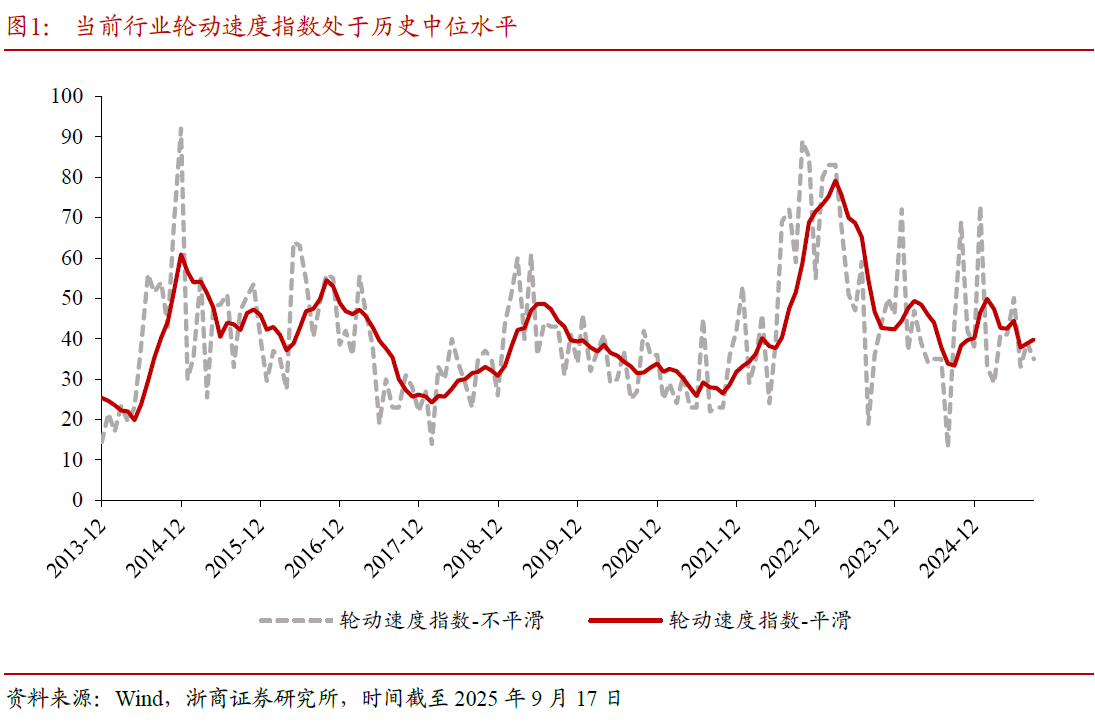
Core Viewpoint - The A-share market has entered a new phase of industry rotation, characterized by a slowdown in rotation speed but an increase in market differentiation [1][2][5] Group 1: Market Rotation Characteristics - The industry rotation speed has decreased since July, following a technology-led market rally, and is currently at the historical median over the past decade [2][5] - Despite the slowdown in rotation speed, the intensity of market differentiation has reached a new high for the year, indicating a significant structural divergence [5][6] Group 2: Driving Forces Behind Market Rotation - The core logic driving the current rotation is the interplay between liquidity and fundamentals, with liquidity being a major factor in the short term [6][7] - Different market phases are identified: liquidity-driven phases favor sectors like advanced manufacturing and TMT, while fundamental-driven phases benefit consumption, cyclical, and financial sectors [6][8] Group 3: Investment Strategies - Investment strategies should focus on balanced allocation to cope with moderate rotation speeds, while also identifying key opportunities in leading sectors [8][9] - Specific recommendations include focusing on the TMT sector due to strong catalysts and considering a shift to financial sectors as the market evolves [8][9] - The "dumbbell strategy" is suggested for long-term investors, emphasizing a tilt towards technology growth sectors while maintaining some exposure to dividend-paying stocks [9]
国泰海通 · 晨报0922|宏观、策略、海外策略、固收
国泰海通证券研究· 2025-09-21 13:55
Macro Overview - Overall consumption is improving, with notable increases in automobile retail and high-end liquor prices due to seasonal demand and base effects [4] - Service consumption indicators such as urban population flow and movie box office revenues are also showing improvement, although inter-city migration indices have turned negative year-on-year [4] - Investment in infrastructure is accelerating with special bond issuance, while real estate sales are recovering during the peak season, despite a cooling land market and low construction start data [4] - Production across most industries is declining, with sectors like power generation and steel adjusting due to demand or profit impacts [4] - Inventory levels are primarily focused on replenishment, with industrial prices rising and CPI showing divergence [4] - The dollar index has slightly increased, while the RMB has appreciated moderately [4] Strategy Insights - Market adjustments present opportunities, and the Chinese stock market is expected to continue its upward trajectory [7] - The "transformation bull market" is driven by the demand for assets and capital market reforms aimed at improving investor returns [7] - Recent communication between Chinese and U.S. leaders indicates a stabilization of short-term risks, while a weak dollar and overseas interest rate cuts favor Chinese monetary easing [7] - The consensus on economic expectations is overly cautious, but there are signs of stabilization in revenue and inventory growth for Chinese listed companies [8] - Emerging industries are entering a new capital expenditure expansion cycle, indicating increased certainty in economic development [9] Industry Comparisons - The technology sector remains a key focus, with recommendations for investments in internet, semiconductor, innovative pharmaceuticals, and robotics [9] - Financial stocks are suggested for gradual allocation due to potential increases in dividend returns after recent adjustments [9] - The shift in economic governance is expected to improve supply-demand dynamics for cyclical goods such as non-ferrous metals, chemicals, real estate, and new energy [9] - Recommendations for consumer sectors include national brands in retail and cosmetics, as well as traditional categories like agriculture and food and beverage [9] Thematic Recommendations - Positive outlook on domestic computing power infrastructure and increased penetration of domestic supply chains [10] - Favorable conditions for commercial aerospace investments due to satellite communication license issuance [10] - Anticipation of improved pricing expectations in sectors benefiting from economic governance changes, such as lithium batteries and energy storage [10] - Growth in embodied intelligence with accelerated equity financing in robotics and logistics [10] Hong Kong Dividend Assets - Hong Kong dividend assets are characterized by stable performance and sustainable cash flows, offering higher dividend yields compared to A-shares [15] - The average cash dividend payout ratio for Hong Kong stocks from 2017 to 2024 is 44%, significantly higher than A-shares at 36% [15] - The dividend yield for the Hang Seng Index is 2.9%, compared to 1.9% for the Wind All A Index, indicating a clear advantage for Hong Kong stocks [15] - Hong Kong dividend assets have a lower valuation level, with PE and PB ratios of 7.2x and 0.6x, respectively, compared to 7.9x and 0.8x for the CSI Dividend All Return Index [15] Market Dynamics - Both Hong Kong and A-share dividend assets exhibit defensive characteristics in weak markets, but absolute returns are positively correlated with market performance [16] - Hong Kong dividend assets face higher taxation and are more sensitive to U.S. Treasury yields compared to A-shares [16] - Current market conditions suggest that Hong Kong dividend assets may offer better value for allocation, especially as institutional demand for dividend stocks increases [17] - Long-term trends indicate a strengthening of dividend policies and a low-interest environment, enhancing the appeal of Hong Kong dividend assets for sustained investment [17]