科技

Search documents
GDP增长5%以上!2026年青岛要做好“九个新”
Qi Lu Wan Bao· 2026-01-20 14:33
Core Viewpoint - Qingdao aims for a GDP growth of over 5% in 2026, with a focus on enhancing public budget revenue, synchronizing resident income with economic growth, and maintaining reasonable consumer prices while achieving carbon reduction and environmental quality improvement goals [1][3]. Group 1: Economic and Social Development Goals - The "14th Five-Year Plan" period is crucial for Qingdao to enhance its economic strength, technological capability, competitiveness, and international influence, aiming for modernization by 2030 [2]. - Key areas for improvement include high-quality development, technological innovation, reform and opening-up, social civilization, quality of life, environmental sustainability, and safety development [2]. Group 2: Key Work Areas for 2026 - Qingdao will focus on nine key areas in 2026, including boosting GDP growth, increasing public budget revenue, synchronizing resident income with economic growth, and achieving carbon reduction targets [3]. - The city plans to enhance domestic demand by increasing consumption and effective investment, with initiatives such as opening 100 new brand stores and creating 30 service consumption hubs [4]. Group 3: Innovation and Industry Development - Qingdao aims to strengthen innovation by enhancing the role of enterprises in innovation, implementing "Artificial Intelligence+" initiatives, and fostering talent [5][6]. - The city will develop a modern industrial system, focusing on emerging industries and technological advancements, with significant investments in key projects [7]. Group 4: Marine Economy and International Cooperation - Qingdao will prioritize marine development, establishing international marine innovation centers and enhancing marine cooperation [8]. - The city plans to invest in marine technology and infrastructure, aiming to attract international organizations and enhance its marine economy [8]. Group 5: Reform and Open Economy - Qingdao will deepen reforms in key areas, promote the growth of the private economy, and enhance the business environment [9]. - The city will focus on cross-border e-commerce and optimize overseas business centers to boost trade [9]. Group 6: Rural Revitalization - Qingdao will enhance agricultural production, promote rural industry development, and improve rural governance [10][11]. - The city plans to build high-standard farmland and increase the number of quality agricultural products [11]. Group 7: Green and Low-Carbon Transition - Qingdao will advance carbon reduction and pollution control, aiming to become a model for ecological protection [12]. - The city plans to increase renewable energy capacity and implement numerous environmental projects [12]. Group 8: Urban Development and Public Services - Qingdao will improve urban living conditions, enhance cultural heritage, and develop health and wellness initiatives [13][14]. - The city aims to create more job opportunities, improve education and healthcare services, and strengthen social security systems [14].
关税并非“核心风险”?大摩Wilso:欧盟“反胁迫”工具将是科技巨头下一场“隐形风暴”
Hua Er Jie Jian Wen· 2026-01-20 12:48
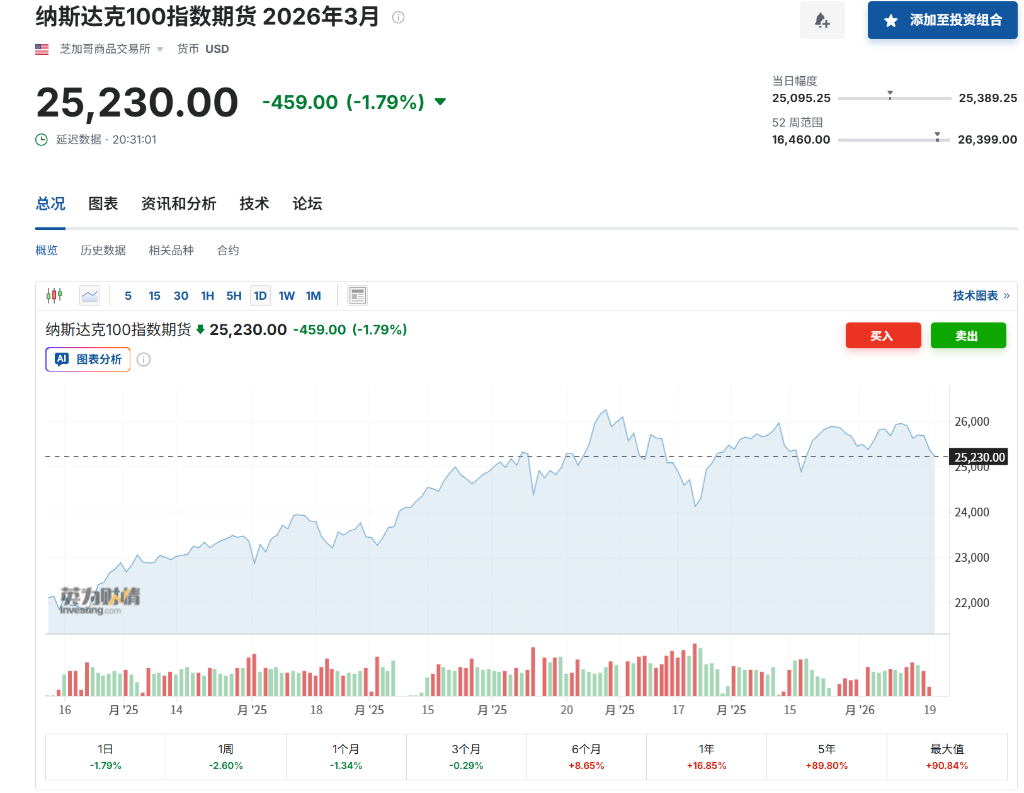
Core Viewpoint - The geopolitical tensions surrounding Greenland are evolving into a potential nightmare for large U.S. tech companies, with the market underestimating the risks of the EU's "anti-coercion" tool targeting the service sector, which could pose significant challenges for tech giants [1][2] Group 1: Geopolitical Risks - Morgan Stanley's chief U.S. equity strategist Mike Wilson warns that the EU's potential activation of its "anti-coercion" tool could escalate tensions beyond tariffs, impacting digital services and creating more severe challenges for U.S. companies [1][2] - The market sentiment has deteriorated rapidly, with Wall Street adopting a "sell first, ask questions later" approach, leading to a decline in U.S. stock index futures, particularly a 1.81% drop in Nasdaq 100 futures [1] Group 2: Impact on Tech Companies - Large tech companies are seen as the primary victims of the ongoing dispute, with concerns that tensions could escalate from tariff increases to more aggressive confrontations, such as limiting market access for these companies [3] - The significant drop in Nasdaq 100 futures reflects investor anxiety regarding the outlook for tech stocks ahead of earnings season [3] Group 3: Investment Shifts - In light of headwinds facing large tech stocks, there is a recommendation for investors to focus on small-cap stocks, which are expected to perform relatively well due to improving fundamentals [4] - Morgan Stanley favors small-cap sectors including discretionary consumer goods, regional and mid-sized banks, short-cycle industrials, and biotechnology, which are less affected by transatlantic trade disputes and EU regulatory tools [4]

机构称AI应用仍具备较大成长空间,关注港股通互联网ETF易方达(513040)、恒生科技ETF易方达(513010)等产品投资价值
Mei Ri Jing Ji Xin Wen· 2026-01-20 10:44
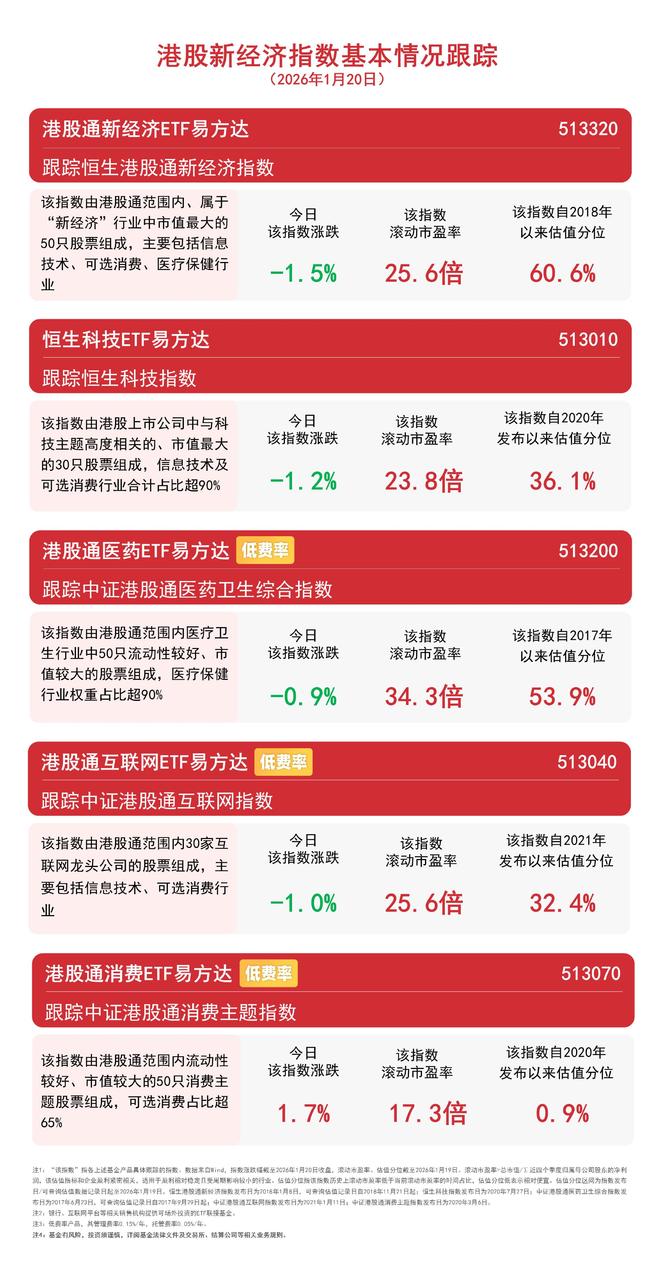
Group 1 - The core viewpoint of the news highlights the divergence in the Hong Kong stock market, with consumer concepts showing strength while AI application sectors continue to adjust [1] - The CSI Hong Kong Stock Connect Consumer Theme Index rose by 1.7%, while the CSI Hong Kong Stock Connect Pharmaceutical and Health Index fell by 0.9%, the CSI Hong Kong Stock Connect Internet Index decreased by 1.0%, the Hang Seng Technology Index dropped by 1.2%, and the Hang Seng Hong Kong Stock Connect New Economy Index declined by 1.5% [1] - There has been a continuous inflow of funds, with the Hong Kong Stock Connect Internet ETF (513040) and the Hang Seng Technology ETF (513010) both receiving over 1 billion yuan in net inflows this year [1] Group 2 - According to CITIC Securities, the AI application sector is expected to be a main focus starting in early 2026, with multiple catalysts for AI applications anticipated in the future [1] - AI is gradually penetrating daily life through various hardware, including automobiles, robots, smart glasses, smart home devices, and wearables like smart rings and headphones [1] - On the software side, the upgrade in model inference capabilities is accelerating the deployment of enterprise-level Agentic AI, indicating significant growth potential for AI applications in China [1]
亚太主要股指集体飘绿,A股化工股爆发,泡泡玛特涨超8%,黄金涨白银跌
2 1 Shi Ji Jing Ji Bao Dao· 2026-01-20 07:23
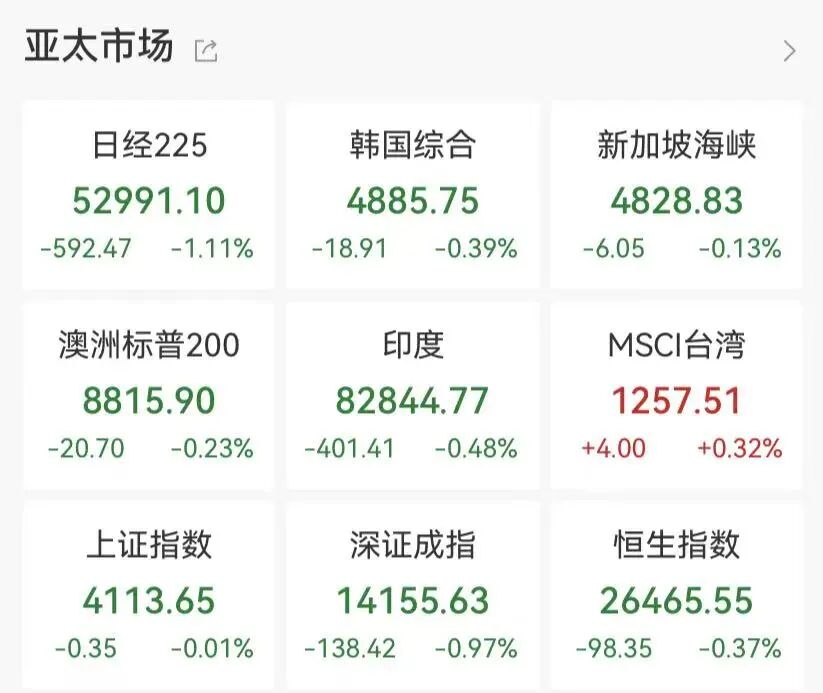
Market Overview - Major Asia-Pacific stock indices collectively declined on January 20, with the Nikkei 225 down by 592.47 points or 1.11%, the KOSPI down by 18.91 points or 0.39%, and the Straits Times Index down by 6.05 points or 0.13% [2] - The A-share market experienced fluctuations, with the Shanghai Composite Index down by 0.01%, the Shenzhen Component down by 0.97%, and the ChiNext Index down by 1.79%. Over 3,100 stocks in the market fell [2] Sector Performance - The satellite internet, CPO, commercial aerospace, and telecommunications sectors led the declines, with commercial aerospace stocks experiencing significant drops, including Shenjian Co. (002361) facing four consecutive trading halts and Aerospace Power (600343) facing two consecutive halts [3] - The chemical sector showed resilience, with over ten constituent stocks hitting the daily limit up, including Hongbaoli (002165), Shandong Heda (002810), Weiyuan Co. (600955), and Hongqiang Co. (002809) [3] - The real estate sector was active, with Dayuecheng (000031) and City Investment Holdings (600649) hitting the daily limit up [3] Hong Kong Market - In the Hong Kong market, the Hang Seng Technology Index fell over 1%, while the Hang Seng Index and Hang Seng China Enterprises Index saw slight declines. Most tech stocks were in the red, with SMIC, Sunny Optical Technology, and BYD (002594) down over 3%, while Xiaomi Group fell over 2%. Ctrip Group rose over 2.5%, and Midea Group (000333) and Baidu Group increased by over 1% [3] Gold and Silver Market - Gold prices rose, with spot gold surpassing $4,700, increasing by nearly 1% and up over 9% year-to-date. In contrast, spot silver fell nearly 0.5%, fluctuating around $94 per ounce [5] - Current prices for gold and silver include: - London Gold: $4,714.235, up by $45.051 or 0.96%, with a year-to-date increase of 9.17% - London Silver: $93.954, down by $0.444 or -0.47%, with a year-to-date increase of 31.26% - COMEX Gold: $4,712.5, up by $35.8 or 0.77%, with a year-to-date increase of 8.78% - COMEX Silver: $93.380, down by $0.900 or -0.95%, with a year-to-date increase of 31.58% [6]

亚太主要股指集体飘绿,A股化工股爆发,泡泡玛特涨超8%,黄金涨白银跌
21世纪经济报道· 2026-01-20 07:18
Market Overview - Major Asia-Pacific stock indices collectively declined, with the Nikkei 225 down by 1.11% and the Hang Seng Index down by 0.37% [2] - A-shares experienced volatility, with the Shanghai Composite Index closing down 0.01%, the Shenzhen Component down 0.97%, and the ChiNext Index down 1.79% [2] - Over 3,100 stocks in the market fell, indicating a broad market downturn [2] Sector Performance - The satellite internet, CPO, commercial aerospace, and communications sectors led the decline, with significant drops in commercial aerospace stocks [3] - The chemical sector showed resilience, with over ten stocks hitting the daily limit up, including Hongbaoli and Shandong Heda [3] - The real estate sector was active, with stocks like Diyi City and Urban Investment Holdings reaching the daily limit up [3] Stock Highlights - In Hong Kong, the Hang Seng Technology Index fell over 1%, while the overall Hang Seng Index saw a slight decline [3] - Notable declines were observed in tech stocks such as SMIC and BYD, both dropping over 3%, while Ctrip Group rose over 2.5% [3] - Pop Mart showed strong performance, initially rising over 10% after announcing a share buyback of 140,000 shares for HKD 251 million [3] Gold and Silver Market - Gold prices rose, surpassing USD 4,700, marking a year-to-date increase of over 9% [5] - In contrast, silver prices fell nearly 0.5%, fluctuating around USD 94 per ounce [5]
瑞士百达:持续投资科技股,市场未出现过度及不合理繁荣
Ge Long Hui A P P· 2026-01-20 06:31
Core Viewpoint - The firm remains optimistic about investing in technology stocks despite some underperformance from major players like Apple and Microsoft, highlighting the overall strength of many tech companies [1] Group 1: Investment Strategy - The company will continue to invest in technology stocks, indicating confidence in the sector's long-term potential [1] - There is a notable difference in market focus between the U.S. and China, with the U.S. emphasizing "current delivery" while China is more inclined towards long-term investments in technology such as robotics [1] Group 2: AI Outlook - The firm expresses a positive long-term outlook for AI, asserting that it is validated by customer demand and increased capital expenditures from AI companies [1] - The current market for AI does not exhibit signs of excessive or irrational exuberance, suggesting a stable investment environment [1]
恒生科技指数午盘跌0.66%,恒生指数跌0.04%
Mei Ri Jing Ji Xin Wen· 2026-01-20 04:22
Group 1 - The Hang Seng Technology Index decreased by 0.66% and the Hang Seng Index fell by 0.04% during the midday close on January 20 [1] - The passenger airline and healthcare service sectors showed notable gains, while hotel and resort REITs and biotechnology sectors experienced significant declines [1] - Individual stock performances included Pop Mart rising by 8.46%, Zhaoyi Innovation increasing by 4.69%, and China Eastern Airlines up by 4.56% [1] Group 2 - The largest declines were seen in stock prices such as Jiajie Ankang-B, which fell by 9.77%, and New World Development, which dropped by 10.57% [1]
2026开年洞察:全球资产重估与政策博弈下的投资新坐标
Sou Hu Cai Jing· 2026-01-20 04:06
Macro Changes - The market's rise at the beginning of 2026 is fundamentally a continuation of the global "easing consensus" from 2025, but three marginal changes are disrupting this trend [3] - The U.S. political cycle is intensifying the clash with monetary policy, as Trump pressures the Federal Reserve to lower interest rates, leading to heightened market expectations for a rate cut [3][7] - The expansion of "shadow banking" in the U.S. has shifted from a hidden concern to a significant variable, with money market funds and private credit rapidly growing, which could amplify liquidity and asset bubbles [4] Policy Dynamics - The Federal Reserve faces three constraints: persistent inflation, political pressure, and the balance between shrinking and expanding its balance sheet [7] - The European Central Bank and other global central banks are signaling potential policy shifts in response to U.S. monetary policy changes, indicating a global interconnectedness in policy decisions [8] Asset Implications - U.S. Treasury yields may steepen if rate cuts occur, but long-term rates could remain suppressed due to fiscal deficits [9] - The U.S. stock market is supported by liquidity expectations, but shadow banking could increase volatility through retail leverage [9] - Gold prices are expected to rise due to declining real interest rates and increased demand for safe-haven assets [9] Investment Shifts - China's "deposit migration" reflects a shift in asset allocation from risk-free to risk-return matching, impacting A-shares, Hong Kong stocks, and the bond market [11] - A-shares are transitioning from "stock game" to "incremental drive," with significant capital moving into equity markets, benefiting high-dividend and growth sectors [11] - Hong Kong stocks are experiencing dual elasticity, attracting both domestic and foreign investments due to improving fundamentals and lower financing costs [12] Conclusion - The global market in 2026 represents a struggle between normalized policy interventions and spontaneous market dynamics, with shadow banking and deposit migration indicating a new era for emerging market assets [13] - Investors should focus on policy-sensitive assets, growth-oriented investments, and safe-haven assets to navigate the evolving landscape [13]


国家发改委:把促进物价回升作为货币政策的重要考量,将研究制定出台2026年—2030年扩大内需战略实施方案
Jin Rong Jie· 2026-01-20 02:44
Core Viewpoint - The National Development and Reform Commission (NDRC) emphasizes the need for more proactive fiscal policies and moderately loose monetary policies to promote price recovery and stimulate economic growth [2] Group 1: Economic Policies - The NDRC plans to implement a more proactive fiscal policy and moderately loose monetary policy, focusing on price recovery as a key consideration [2] - A strategy for expanding domestic demand from 2026 to 2030 will be developed to address the current imbalance of strong supply and weak demand [3] - The NDRC is considering establishing a national-level merger fund to enhance government investment and fund planning [4] Group 2: Market Regulation - The NDRC aims to regulate low-price disorderly competition among enterprises and promote a healthy market order through quality and brand strategies [5] - There will be efforts to standardize local economic promotion behaviors and enhance market vitality by addressing "involution" competition [6] Group 3: Development Goals - By 2025, the NDRC expects to achieve major economic and social development goals, with a focus on implementing proactive macro policies and enhancing technological governance [7] - The NDRC is planning significant high-tech industry projects during the 14th Five-Year Plan period, anticipating a digital economy value of approximately 49 trillion yuan by 2025 [8][10] Group 4: Investment and Support - In 2025, approximately 8,400 projects will be supported by long-term special government bonds, driving total investment growth by 1.8 percentage points [11] - The NDRC will lower investment thresholds for project applications and increase support for small and medium-sized enterprises [12] - Strict measures will be taken against fraudulent practices in the consumer goods sector, ensuring compliance with price management [13] Group 5: Market Construction - The NDRC is working on regulations for the construction of a unified national market to strengthen legal guarantees and clarify local economic development guidelines [14]
新全球秩序催生金银牛市!美银:黄金有望突破6000美元
Hua Er Jie Jian Wen· 2026-01-19 23:20
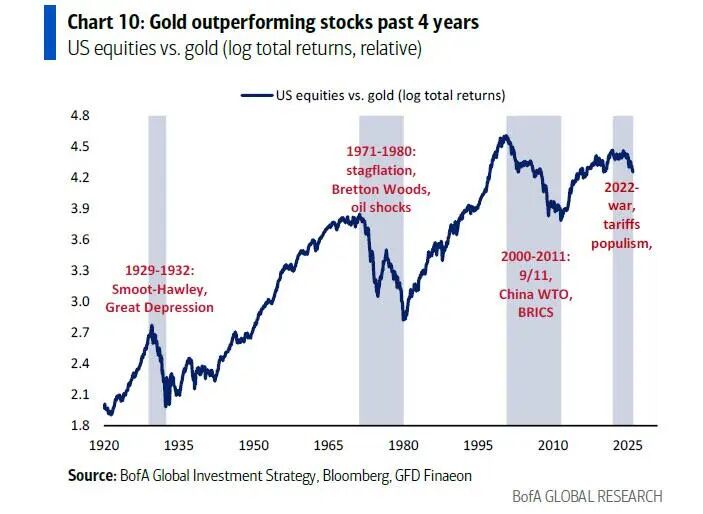
Group 1: New World Order and Global Bull Market - The chief investment strategist at Bank of America, Hartnett, believes that Trump is driving global fiscal expansion, leading to a "New World Order = New World Bull Market" scenario [1][2] - Hartnett suggests going long on international stocks as the market is shifting from U.S. exceptionalism to global rebalancing, with $1.6 trillion flowing into U.S. stock funds in the 2020s compared to only $0.4 trillion into global funds [2] - China is identified as the most promising market, with the end of deflation expected to catalyze bull markets in Japan and Europe [2] Group 2: Gold Bull Market - Hartnett emphasizes that the New World Order is not only fostering a stock bull market but also a gold bull market, despite short-term overbought conditions [3] - Gold was the best-performing asset in 2020, driven by factors such as war, populism, the end of globalization, excessive fiscal expansion, and debt devaluation [4] - The Federal Reserve and Trump’s administration are expected to increase quantitative easing liquidity by $600 billion through the purchase of government bonds and mortgage-backed securities by 2026 [5] - Gold has outperformed bonds and U.S. stocks over the past four years, and a higher allocation to gold remains reasonable, with historical bull markets averaging a 300% increase [6][7] Group 3: Economic Recovery Assets - In addition to gold, other assets are expected to benefit from the New World Bull Market, including mid-cap and small-cap stocks, homebuilders, retail, and transportation sectors [10] - Hartnett advises going long on "economic recovery" related assets while shorting large tech stocks until certain conditions are met, such as the U.S. unemployment rate rising to 5% [11] - Historical precedent shows that Nixon's price and wage freeze improved living costs and boosted his approval ratings, suggesting that if Trump fails to improve his ratings, risks for midterm elections will increase [15] Group 4: Risks from East Asian Currency Appreciation - The biggest risk identified is the rapid appreciation of the yen, won, and new Taiwan dollar, which could trigger global liquidity tightening [1][16] - The yen is currently trading near 160, at its weakest level against the yuan since 1992, and a rapid appreciation could reverse capital flows from Asia [16] - Hartnett warns that investors should closely monitor indicators like the "yen up, MOVE index up" risk aversion combination to determine when to exit the market [16]