
基建

Search documents
【广发宏观郭磊】7月经济数据边际放缓的两个源头
郭磊宏观茶座· 2025-08-15 07:00
Economic Overview - July economic data shows signs of slowdown, with only exports accelerating while industrial, service, consumption, investment, and real estate sales all underperformed compared to previous values, indicating a divergence in internal and external demand [1][6] - The actual GDP index estimated from industrial value added and service production index year-on-year is approximately 5.02%, while the estimate based on industrial value added and retail sales is about 4.79%, both lower than the second quarter [1][6] Industrial Performance - Industrial value added year-on-year growth is 5.7%, down from 6.8% previously, with a month-on-month seasonally adjusted increase of 0.38%, only higher than April's tariff impact [7][9] - Major product output shows significant declines in coal production growth, while new industry products like smartphones and robots also saw decreased growth rates; however, integrated circuits and power generation equipment remain at high growth levels [9][10] - The industrial enterprise sales rate increased to 97.1%, the second highest this year, indicating improved supply-demand relationships despite lower industrial supply [11] Consumer Spending - Retail sales year-on-year growth is 3.7%, down from 4.8%, with a month-on-month seasonally adjusted decline of 0.14% [12][13] - Key sectors dragging down retail performance include dining and tobacco, as well as automotive sales, which turned negative for the first time in five months, likely due to price competition constraints [12][13] - Growth in household appliances and mobile phones remains high, but cumulative growth has slowed compared to the first half of the year, influenced by the gradual release of demand and lower national subsidy fund balances [12][13] Investment Trends - Fixed asset investment cumulative year-on-year growth is 1.6%, down from 2.8%, with a month-on-month decline of 5.2% [13][14] - Manufacturing, infrastructure, and real estate investments all showed significant month-on-month declines, with manufacturing attributed to high equipment renewal funding released in the first half of the year [13][14] - Infrastructure investment's unexpected decline may be due to weather disturbances and the timing of new project approvals and financial tools, with local investment showing reduced activity [13][14] Real Estate Sector - The real estate sector continues to slow, with declines in sales, new starts, construction, investment, and funding availability [16][17] - The average price of new and second-hand homes in 70 cities showed slight month-on-month declines of 0.3% and 0.5%, respectively, indicating limited changes from trend values [16][17] - Recent policy adjustments in Beijing aim to stabilize the real estate market, suggesting that further policy support may be necessary to prevent continued declines [16][17] Overall Economic Sentiment - July's soft data, including PMI and BCI, along with credit and economic data, indicate a consistent trend of slowdown, aligning with the previously mentioned "deceleration zone" [5][18] - Ongoing macroeconomic policies are emerging, particularly focused on supporting service consumption, which is expected to gradually bolster consumer spending [5][18] - Local investment and real estate are identified as key sources of the overall data slowdown, with effective investment being a crucial part of terminal demand [5][18]


2025年7月宏观数据点评:多重因素复合作用下,7月经济增长动能有所减弱
Dong Fang Jin Cheng· 2025-08-15 06:16
Economic Growth - In July, the industrial added value increased by 5.7% year-on-year, down from 6.8% in June, with a cumulative growth of 6.3% from January to July[1] - The total retail sales of consumer goods grew by 3.7% year-on-year in July, a decrease from 4.8% in June, with a cumulative growth of 4.8% from January to July[1] - Fixed asset investment increased by 1.6% year-on-year from January to July, down from 2.8% in the previous period, with an annual growth target of 3.2%[1] Industrial Production - The industrial added value growth rate slowed by 1.1 percentage points in July, primarily due to weak domestic demand and external pressures[3] - Mining industry added value grew by 5.0%, down 1.1 percentage points, while manufacturing added value increased by 6.2%, down 1.2 percentage points[4] - Export delivery value only grew by 0.8% in July, a significant drop of 3.2 percentage points from the previous month[4] Consumer Spending - Retail sales growth slowed to 3.7% in July, primarily due to the suspension of the old-for-new consumption policy in some regions[6] - The retail sales of furniture, home appliances, and cultural office supplies increased by 20.6%, 28.7%, and 13.8% respectively, but growth rates decreased compared to June[6] - Cumulative retail sales growth from January to July was 4.8%, an increase of 1.3 percentage points compared to the same period last year[7] Investment Trends - Fixed asset investment growth from January to July was 1.6%, down 1.2 percentage points, with declines in infrastructure, manufacturing, and real estate investments[8] - Manufacturing investment growth was 6.2%, down 1.3 percentage points, influenced by external environment fluctuations and the implementation of anti-"involution" policies[8] - Real estate investment saw a cumulative decline of 12.0% from January to July, with a worsening drop of 0.8 percentage points compared to the previous period[10] Future Outlook - Economic growth momentum is expected to remain weak in August, with potential policy measures anticipated in the fourth quarter to stabilize the economy[12] - The macroeconomic policy may include increased fiscal support, interest rate cuts, and stronger measures to stabilize the real estate market[12] - The overall economic growth target for the year is around 5.0%, with expectations of a decline in industrial production growth due to weakening export momentum[12]
【专访】曹远征:提高工资收入的重点在于服务业转型升级
Sou Hu Cai Jing· 2025-08-15 04:06
Group 1 - The core focus of the "15th Five-Year Plan" is to prioritize people's livelihood issues, as China transitions towards a high-income society, leading to significant changes in consumer demand structures [1][3] - There is a notable shift in consumer preferences from basic necessities to services, with spending on food and clothing decreasing while expenditure on services increases, indicating a transition towards development-oriented and enjoyment-oriented consumption [1][4] - The demand for services in education, healthcare, and elderly care is currently high, but supply is relatively short, necessitating an upgrade in the service sector, particularly the service-oriented transformation of manufacturing [1][5] Group 2 - The aging population presents a significant challenge, with China experiencing negative population growth for three consecutive years, marking a historical turning point for the real estate and infrastructure sectors [1][3] - The shift in urban development from large-scale expansion to quality improvement and efficiency enhancement emphasizes urban renewal rather than expansion, which may lead to an oversupply of materials like steel and cement [1][3] - To enhance labor productivity in the service sector and create high-income jobs, a transformation towards productive services is essential, with education serving as a pathway to high-paying careers [3][8] Group 3 - The economic growth rate during the "15th Five-Year Plan" should be maintained at a minimum of 5% to meet the requirements for achieving socialist modernization and to avoid falling into the "middle-income trap" [3][10] - A comprehensive policy system supporting domestic demand expansion, particularly in consumption, is necessary to ensure sustainable economic development and to address the issue of "involution" [3][13] - The need for macroeconomic policy reform is highlighted, shifting from a supply-side focus to a demand-side approach, which is crucial for addressing the persistent issue of insufficient effective demand [12][13] Group 4 - The government should implement macroeconomic policies that include increased fiscal support and relaxed monetary policies to facilitate a reasonable recovery in prices [14] - Historical experiences suggest that expanding government fiscal expenditure is essential to correct situations where nominal GDP growth lags behind actual GDP growth [14] - A new mechanism for macroeconomic regulation should be established to ensure consistency between fiscal and monetary policies, enhancing overall policy effectiveness [14]

李嘉诚旗下长和最新表态:预计今年不会完成港口交易 将邀请内地投资者加入!
Mei Ri Jing Ji Xin Wen· 2025-08-14 13:45
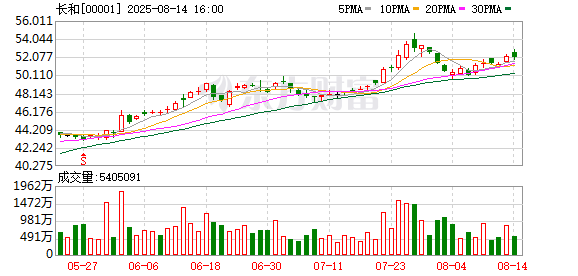
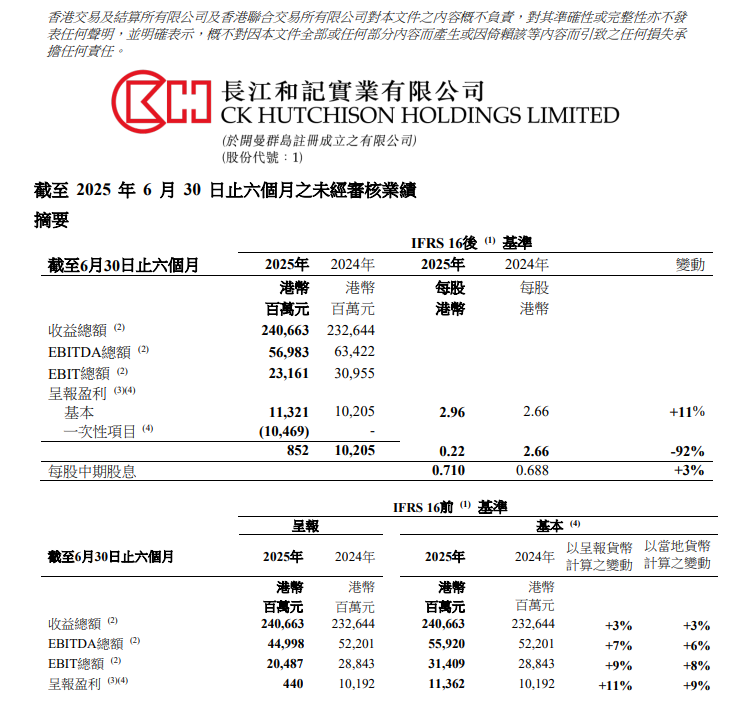
Core Viewpoint - The company reported a profit of HKD 11.32 billion for the first half of 2025, representing an 11% year-on-year increase, despite a decline in EBITDA by 9% to HKD 56.98 billion [2][5]. Financial Performance - Total revenue for the first half of 2025 was HKD 240.66 billion, up 3% from HKD 232.64 billion in the same period of 2024 [3][5]. - EBITDA decreased to HKD 56.98 billion from HKD 63.42 billion, a decline of 9% year-on-year [3][5]. - EBIT also fell to HKD 23.16 billion from HKD 30.96 billion, indicating a significant drop in operational profitability [3][5]. - Basic earnings per share were reported at HKD 0.22, down from HKD 2.66 in the previous year [6]. Port Business Performance - The port business generated revenue of HKD 235.97 billion, a 9% increase compared to the previous year, driven by growth in throughput at key ports [8]. - EBITDA for the port segment was HKD 87.19 billion, up 10%, while EBIT rose by 12% to HKD 65.08 billion [8]. - The growth in the port business was attributed to increased throughput and effective cost management [8]. Strategic Developments - The company completed a major strategic transaction by merging its UK telecommunications business with Vodafone UK, which is expected to enhance operational efficiency [5][9]. - The company is currently in discussions regarding the sale of its port business, which is subject to regulatory approvals and is anticipated to take longer than initially planned [4][10]. - The company has invited major investors from mainland China to participate in the discussions to facilitate the approval process [10]. Financial Position - The company holds over HKD 120 billion in cash, with total cash and liquid investments amounting to HKD 1372.68 billion [9]. - Total debt stands at HKD 2565.89 billion, with a net debt ratio of 14.7%, down from 16.2% at the end of 2024 [9]. Market Performance - The company's stock price has increased by over 30% year-to-date, closing at HKD 52 on August 14, 2025, with a total market capitalization nearing HKD 199.2 billion [9].

李嘉诚旗下长和最新表态:预计今年不会完成港口交易,将邀请内地投资者加入!上半年港口业务收入超200亿元,股价年内涨超30%
Mei Ri Jing Ji Xin Wen· 2025-08-14 13:36
Core Viewpoint - The company reported a profit of HKD 11.32 billion for the first half of 2025, representing an 11% year-on-year increase, while total revenue reached HKD 240.66 billion, a 3% increase from the previous year [1][4]. Financial Performance - Total revenue for the six months ending June 30, 2025, was HKD 240.66 billion, up 3% from HKD 232.64 billion in 2024 [2][4]. - EBITDA totaled HKD 56.98 billion, a decrease of 9% compared to HKD 63.42 billion in the same period last year [2][4]. - Basic earnings per share were HKD 0.22, down from HKD 2.66 in the previous year, reflecting a significant drop due to one-time non-cash losses related to the UK merger [5][8]. Business Segments - The port business generated revenue of HKD 235.97 billion (approximately RMB 215.73 billion), a 9% increase year-on-year, driven by increased throughput at key ports and a 27% surge in warehousing income from Mexico and Europe [7]. - EBITDA for the port segment was HKD 87.19 billion, and EBIT was HKD 65.08 billion, reflecting increases of 10% and 12% respectively [7]. Strategic Developments - The company completed a major strategic transaction by merging its UK telecommunications business with Vodafone UK in May 2025, which is expected to enhance operational efficiency and market presence [4][5]. - The company is currently in discussions to invite major investors from mainland China to participate in the port business sale, which is anticipated to take longer than initially planned and will not be completed in 2025 [3][11]. Financial Position - As of June 30, 2025, the company held cash and liquid investments totaling HKD 1,372.68 billion (approximately RMB 1,254.9 billion), with total debt amounting to HKD 2,565.89 billion [8]. - The net debt ratio decreased to 14.7% from 16.2% at the end of 2024, indicating improved financial stability [8]. Market Performance - The company's stock price has risen over 30% year-to-date, closing at HKD 52 on August 14, 2025, with a total market capitalization of nearly HKD 199.2 billion [8].
长和(00001) - 2025 Q2 - 业绩电话会
2025-08-14 10:02
Financial Data and Key Metrics Changes - Revenues increased by over $8 billion, with $1.3 billion attributed to favorable foreign exchange movements [4] - Underlying net earnings showed strong growth, although not as high as double-digit growth might suggest due to complex non-cash write-down impacts [5] - EBITDA increased by approximately $700 million, with about 13% of that growth due to favorable foreign exchange movements [7] - Operating free cash flow rose by $2.1 billion, reflecting an 11% growth compared to the first half of last year [8] - Net debt ratio decreased from 17% at the end of the first half last year to 14.7% [9][26] Business Line Data and Key Metrics Changes - Ports division throughput increased by 4% to 44 million TEU, with EBITDA rising by 10% in reported currency [29][30] - Retail division EBITDA for the first half reached HKD 8 billion, a 12% increase over last year, despite challenges in the Health and Beauty China segment [33][34] - Infrastructure showed a 6% increase in EBITDA in local currencies, maintaining a strong financial profile [41][44] - CKH Group Telecom reported a 4% growth in underlying EBITDA, with significant contributions from treasury gains [46][50] Market Data and Key Metrics Changes - The ports division experienced a 7% increase in HPH Trust and a 3% growth in Mainland China [29] - Retail operations in Asia and Europe showed varied performance, with Health and Beauty China under pressure while other segments performed well [34][36] - The telecom market in Europe faced challenges, particularly in Austria, but overall performance remained steady [50] Company Strategy and Development Direction - The company is focused on organic growth and cost efficiencies in the ports division, despite global trade volatility [32] - Retail strategy includes expanding the store network and enhancing the online sales model through dark stores [39][75] - Investment strategy emphasizes growth in existing businesses and value-accretive transactions, with a cautious approach to new investments [79][82] Management's Comments on Operating Environment and Future Outlook - Management expressed a cautious outlook for the second half of the year due to global uncertainties, despite strong first-half performance [8][16] - The company remains committed to maintaining a strong financial profile while exploring growth opportunities in infrastructure and telecom sectors [81][82] - Management highlighted the importance of adapting to changing consumer behaviors and market conditions, particularly in retail [75] Other Important Information - The company reported a significant increase in liquidity, with total liquid assets reaching $137 billion [26] - The average cost of debt decreased to 3.4%, reflecting lower interest rates [26] - Sustainability efforts are ongoing, with a focus on emissions reductions and compliance with international standards [70] Q&A Session Summary Question: Will future dividends be based on reported or recurring earnings? - Dividends are determined by the board, considering underlying performance and financial fundamentals, generally excluding non-cash accounting losses [72] Question: What strategic actions is Health and Beauty China taking to improve performance? - The division is transforming its business model by integrating dark stores for online fulfillment, despite temporary margin impacts [73][75] Question: Why is the nature of the one-time FX loss different from previous disclosures? - The difference is due to the transition from Hong Kong FRS to International Financial Reporting Standards, affecting the exchange reserve and valuation [78] Question: What is the group's investment strategy if net debt decreases significantly? - The group will focus on growth and value-accretive transactions, primarily within existing businesses, while maintaining a cautious investment approach [79][82] Question: Is regulatory approval from China required for the proposed ports transaction? - Yes, the transaction requires approval from multiple regulatory authorities, including those in China and the US [83][84] Question: What are the uses of the cash received from the merger? - Proceeds from the merger are being used for bond buybacks and to strengthen liquidity, with options for deleveraging or repatriation [87][89]
长和(00001) - 2025 H1 - 电话会议演示
2025-08-14 09:00
Financial Highlights - Revenue increased by 3% to HK$2407 billion in 1H 2025[6] - Net earnings decreased by 92% to HK$09 billion in 1H 2025, but underlying net earnings increased by 11%[6] - EPS decreased by 92% to $022 in 1H 2025, but underlying EPS increased by 11%[6] - EBITDA decreased by 14% to $450 billion in 1H 2025, but underlying EBITDA increased by 7%[7] - Operating Free Cash Flow increased by 11% to $218 billion in 1H 2025[7] - Free Cash Flow increased by 248%[17] Segment Performance - Ports and Related Services revenue increased by 9% to HK$23597 million[71], with throughput increasing by 4% to 440 million TEUs[26] - Retail revenue increased by 8% to HK$98840 million[71], with a 2% increase in store numbers to 16935[28] - Infrastructure revenue increased by 6% to HK$28627 million[71] - CK Hutchison Group Telecom revenue increased by 5% to HK$45012 million[71] - Finance & Investments and Others revenue decreased by 10% to HK$44587 million[71] Telecommunications - 3 Group Europe - 3 Group Europe's total revenue increased by 5% to HK$41958 million[38] - Underlying EBITDA increased by 7% to HK$11816 million[38] - Active customer base increased by 40% to 566 million[108] Financial Position - Liquid assets totaled $1373 billion, sufficient to cover all debt maturing before December 2028[21] - Net Debt Ratio was 147%[7] - Group GHG performance reduced scope 1 + 2 emissions by approximately 20% against 2020 baseline[54]
大和:升长江基建集团目标价至63.5港元 上半年业绩符合预期
Zhi Tong Cai Jing· 2025-08-14 08:29
Core Viewpoint - Daiwa's report indicates that Changjiang Infrastructure Group (01038) achieved a net profit attributable to shareholders of HKD 4.348 billion in the first half of the year, representing a year-on-year growth of 1% [1] - The company has confirmed the completion of the sale of its UK Rails assets, with performance and merger progress aligning with Daiwa's expectations [1] Financial Performance - The interim dividend per share is HKD 0.73, an increase of HKD 0.01 compared to the previous year [1] - The forecast for the second half of the year suggests a slight slowdown in profit growth from the UK business [1] Strategic Moves - The company is unlikely to declare a special dividend from the sale of the UK Rails assets [1] - There are rumors regarding the company's withdrawal from bidding for the LNG project with the UK National Grid, which will be closely monitored [1] Target Price Adjustment - Daiwa has raised the target price from HKD 59 to HKD 63.5, maintaining a "Buy" rating [1]

里昂:微升长江基建集团(01038)目标价至63港元 重申“跑赢大市”评级
智通财经网· 2025-08-14 08:21
智通财经APP获悉,里昂发布研报称,长江基建集团(01038)上半年纯利为43.48亿港元,分别达到机构 及里昂对其全年预测的50%和46%,符合预期。该行相信,公司下半年受到英镑和澳元走强、高通胀以 及来自英国铁路部门的3亿英镑处置收益所支持,应将录得更强盈利。该行表示,长江基建的现金流具 有高收益能见度、投资级信用评级及经营往绩坚韧,应该能够支持公司股息持续增长。该行将公司目标 价由62港元略为上调至63港元,并重申跑赢大市评级。 ...
大行评级|里昂:上调长江基建目标价至63港元 重申“跑赢大市”评级
Ge Long Hui· 2025-08-14 06:17
里昂发表研究报告指,长江基建上半年纯利为43.48亿港元,分别达到彭博及里昂对其全年预测的50% 和46%,符合预期。该行相信,公司下半年受到英镑和澳元走强、高通胀以及来自英国铁路部门的3亿 英镑处置收益所支持,应将录得更强盈利。 该行表示,长江基建的现金流具有高收益能见度、投资级信用评级及经营往绩坚韧,应该能够支持公司 股息持续增长。该行将公司目标价由62港元上调至63港元,并重申"跑赢大市"评级。 ...