外汇

Search documents
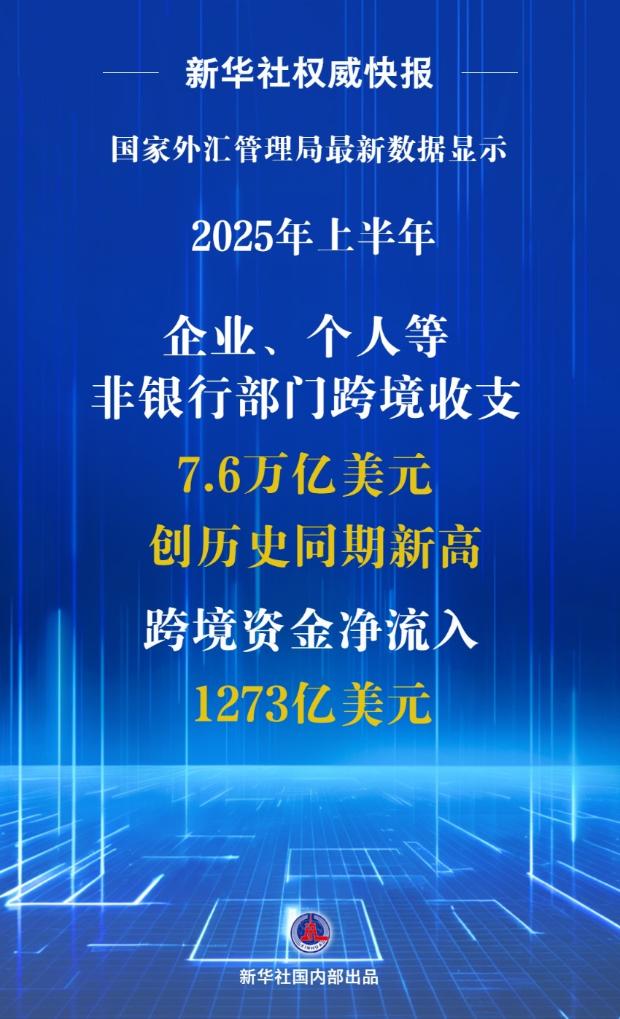
新华社权威快报丨上半年我国非银行部门跨境资金净流入1273亿美元
Xin Hua Wang· 2025-08-12 06:25
Group 1 - The total cross-border income and expenditure of non-bank sectors, including enterprises and individuals, reached $7.6 trillion in the first half of 2025, marking a historical high for the same period [1][2] - The proportion of Renminbi in cross-border receipts and payments reached 53% [2] - The net inflow of cross-border funds for non-bank sectors was $127.3 billion, continuing the net inflow trend observed since the second half of last year [2] Group 2 - China's international balance of payments remains basically balanced [2] - The foreign exchange market operates in a stable and orderly manner [2]

上半年我国境内人民币外汇市场交易量总计达21万亿美元
Xin Hua Wang· 2025-08-12 06:24
Core Insights - The total trading volume of the domestic RMB foreign exchange market reached 21 trillion USD in the first half of the year [1] Group 1 - The Deputy Director and spokesperson of the State Administration of Foreign Exchange, Li Bin, announced the trading volume during a press conference on July 22 [1]
外汇市场处变不惊显韧性
Xin Hua Wang· 2025-08-12 06:20
Group 1 - The core viewpoint is that despite the appreciation of the US dollar and the depreciation of other non-USD currencies, the Chinese yuan remains relatively stable, indicating resilience in China's foreign exchange market amidst complex international and domestic challenges [1][2]. - Foreign capital has been reducing its holdings of RMB-denominated bonds since February, raising concerns in the market, although this has not significantly altered the overall balance of cross-border capital flows [1][2]. - From January to May, the net inflow of cross-border funds related to goods trade reached $214.4 billion, a year-on-year increase of 66%, reflecting the growth in China's import and export activities [2]. Group 2 - The current account surplus remains robust, with a surplus of $88.9 billion in the first quarter, up 25% year-on-year, and is expected to maintain a certain scale in the second quarter [3]. - China's industrial and supply chains are stable, supporting a continued surplus in goods trade, which is essential for maintaining a balanced current account [3]. - The financial market's high level of openness is expected to enhance foreign investors' confidence in holding RMB assets long-term, as China continues to improve its legal and international framework for the bond market [4].
大类资产早报-20250812
Yong An Qi Huo· 2025-08-12 01:24
Report Overview - Report Date: August 12, 2025 [2] - Report Type: Global Asset Market Performance Report 1. Global Bond Market 1.1 10-year Treasury Yields - On August 11, 2025, the 10-year Treasury yields in the US, UK, and France were 4.287%, 4.564%, and 3.355% respectively [3]. - The latest changes in the US, UK, and France were 0.003, -0.036, and 0.007 respectively [3]. - The one - year changes in the US, UK, and France were 0.310, 0.683, and 0.363 respectively [3]. 1.2 2-year Treasury Yields - On August 11, 2025, the 2-year Treasury yields in the US, UK, and Germany were 3.720%, 3.859%, and 1.961% respectively [3]. - The latest changes in the US, UK, and Germany were 0.030, -0.037, and 0.009 respectively [3]. - The one - year changes in the US, UK, and Germany were -0.630, 0.156, and -0.486 respectively [3]. 1.3 Credit Bond Indexes - The latest changes in the US investment - grade credit bond index, Eurozone investment - grade credit bond index, etc. were 0.09%, -0.00%, etc. respectively [3][4]. - The one - year changes in the US investment - grade credit bond index, Eurozone investment - grade credit bond index, etc. were 4.87%, 4.56%, etc. respectively [4]. 2. Global Stock Market 2.1 Major Economy Stock Indexes - On August 11, 2025, the S&P 500, Dow Jones Industrial Average, and NASDAQ were 6373.450, 43975.090, and 21385.400 respectively [3]. - The latest changes in the S&P 500, Dow Jones Industrial Average, and NASDAQ were -0.25%, -0.45%, and -0.30% respectively [3]. - The one - year changes in the S&P 500, Dow Jones Industrial Average, and NASDAQ were 17.02%, 8.99%, and 24.38% respectively [3]. 2.2 Stock Index Futures Trading Data - The closing prices of A - shares, CSI 300, and SSE 50 were 3647.55, 4122.51, and 2789.90 respectively [5]. - The price - to - earnings ratios (PE(TTM)) of CSI 300, SSE 50, and CSI 500 were 13.30, 11.43, and 30.82 respectively [5]. - The latest values of capital flows in A - shares, the main board, and the small and medium - sized enterprise board were 524.49, 191.94, etc. respectively [5]. 3. Foreign Exchange Market 3.1 USD against Major Emerging Economy Currencies - On August 11, 2025, the exchange rates of USD against the Brazilian Real, South African Rand, and South Korean Won were 5.443, 17.757, and 1390.850 respectively [3]. - The latest changes in the exchange rates of USD against the Brazilian Real, South African Rand, and South Korean Won were 0.15%, 0.06%, and 0.21% respectively [3]. - The one - year changes in the exchange rates of USD against the Brazilian Real, South African Rand, and South Korean Won were -5.28%, -2.83%, and 1.55% respectively [3]. 3.2 RMB Exchange Rates - On August 11, 2025, the on - shore RMB, off - shore RMB, and RMB central parity rate were 7.189, 7.197, and 7.141 respectively [3]. - The latest changes in the on - shore RMB, off - shore RMB, and RMB central parity rate were 0.12%, 0.10%, and 0.03% respectively [3]. - The one - year changes in the on - shore RMB, off - shore RMB, and RMB central parity rate were -0.78%, -0.76%, and 0.11% respectively [3]. 4. Futures Market 4.1 Stock Index Futures - The closing prices of A - shares, CSI 300, and SSE 50 were 3647.55, 4122.51, and 2789.90 respectively [5]. - The price - to - earnings ratios (PE(TTM)) of CSI 300, SSE 50, and CSI 500 were 13.30, 11.43, and 30.82 respectively [5]. - The latest values of capital flows in A - shares, the main board, and the small and medium - sized enterprise board were 524.49, 191.94, etc. respectively [5]. 4.2 Treasury Bond Futures - The closing prices of T00, TF00, T01, and TF01 were 108.495, 105.735, 108.390, and 105.780 respectively [6]. - The price changes of T00, TF00, T01, and TF01 were 0.00%, 0.00%, 0.00%, and 0.00% respectively [6].
7月中国通胀数据基本符合预期
Dong Zheng Qi Huo· 2025-08-11 00:49
Report Industry Investment Ratings Not provided in the content. Core Views of the Report - The overall market is influenced by multiple factors including geopolitical events, economic data, and policy changes. For instance, the potential outcomes of the US-Russia talks and the uncertainty in the US-China trade relationship are key factors affecting various markets [17][44]. - In the financial market, different asset classes have different outlooks. Gold is expected to continue its oscillatory trend with increased volatility; the US dollar is predicted to remain weak in the short - term; and the US stock market may face correction risks due to the fluctuating interest - rate cut expectations [13][18][22]. - In the commodity market, each sector has its own supply - demand dynamics. For example, the油脂 market may experience short - term pullbacks but has long - term potential for long - positions; the copper market is likely to have high - level oscillations with inventory increases limiting the upside [33][57]. Summary by Directory 1. Financial News and Reviews 1.1 Macro Strategy (Gold) - Fed's Bowman supports three interest rate cuts this year. The gold price oscillated on Friday with increased intraday volatility. After the White House clarified that imported gold bars would not be taxed, the COMEX gold price declined to narrow the spread with London gold. The gold price is in an oscillatory range, and short - term oscillations are expected to continue with attention to correction risks [12][13]. 1.2 Macro Strategy (Foreign Exchange Futures - US Dollar Index) - The NATO Secretary - General is optimistic about the "Trump - Putin meeting". Nordic and Baltic leaders reaffirmed their support for Ukraine. The US - Russia meeting in Alaska and the European stance on Ukraine make the outcome of the meeting and the cease - fire in the Russia - Ukraine conflict highly uncertain, leading to the US dollar remaining weak in the short - term [14][15][17]. 1.3 Macro Strategy (US Stock Index Futures) - Fed officials have different views on interest rates. Some support maintaining the current rate due to unmet inflation targets, while others advocate for rate cuts. The market's interest - rate cut expectations are volatile, and the US stock market at its current level may face correction risks [19][21][22]. 1.4 Macro Strategy (Treasury Bond Futures) - The issuance of local bonds with VAT on interest started on August 8. The central bank conducted reverse repurchase operations. The bond market is expected to be in a favorable period in the first half of August, and trading - position long - holders can continue to hold their positions [23][24][27]. 1.5 Macro Strategy (Stock Index Futures) - In July, China's CPI was flat year - on - year, and PPI decreased by 3.6% year - on - year. Beijing optimized its housing purchase restrictions, and the capital market is expected not to have a large - scale IPO expansion. The strengthening of the core CPI may support the stock market pricing, and it is recommended to allocate evenly among stock indices [28][29][31]. 2. Commodity News and Reviews 2.1 Agricultural Products (Soybean Oil/Rapeseed Oil/Palm Oil) - The actual soybean crushing volume in the 32nd week was 2177500 tons, and the expected volume in the 33rd week is 2369500 tons. Multiple countries' policies may change. India may raise edible oil import tariffs, and there are rumors about the US RVO proposal. The short - term oil market may pull back, but it has long - term potential for long - positions, and it is recommended to go long on dips [32][33]. 2.2 Agricultural Products (Soybean Meal) - The market expects the USDA August supply - demand report to raise the US soybean yield. The US soybean market is weak, while the domestic soybean meal market is relatively strong. It is recommended to continue to focus on the development of Sino - US relations and changes in import and demand [34][35]. 2.3 Agricultural Products (Sugar) - Brazil's sugar exports decreased in July, indicating weak export demand. The international sugar market is under pressure due to the expected oversupply in the 25/26 season. However, factors such as the low sugar - ethanol price difference and poor cane quality may limit the downside of the ICE raw sugar price. The domestic sugar market is also under pressure from increased imports, but the downside of the Zhengzhou sugar price is limited, and it is not recommended to short aggressively [39][40]. 2.4 Agricultural Products (Cotton) - The US tariff policy and the uncertainty in the US - China trade relationship increase market concerns. The ICE cotton price is expected to remain weak in the short - term. Domestically, the cotton supply is tight before the new cotton harvest, and there may be a small - scale "rush to buy" at the beginning of the new cotton season. The 1 - month contract may rebound, and it is recommended to pay attention to the US - China trade policy [44]. 2.5 Black Metals (Rebar/Hot - Rolled Coil) - China has completed the ultra - low emission transformation of 600 million tons of crude steel production capacity. The inventory of five major steel products is increasing, and the demand has not changed significantly. The steel price is expected to oscillate in the short - term due to the limited impact of environmental protection restrictions on supply and the difficulty of the spot price to follow the increase [45][47]. 2.6 Agricultural Products (Corn Starch) - The cassava starch inventory has increased again at a high level, and the price difference with corn starch has narrowed. There is no driving force for the price difference to strengthen in the supply - demand situation, and the price difference in the 09 contract may be affected by the new corn harvest in North China [48]. 2.7 Agricultural Products (Corn) - The成交 rate of imported corn auctions remains low. The market's demand for imported corn substitutes is expected to decline, and the old - crop spot price is likely to weaken. It is recommended to hold short positions in new - crop corn and pay attention to the weather [49][50]. 2.8 Non - ferrous Metals (Alumina) - Two factories of a Shanxi alumina enterprise were affected by ore supply. The spot price remained stable, and the futures price was weak. It is recommended to wait and see [51][53]. 2.9 Non - ferrous Metals (Copper) - The US is interested in investing in Pakistan's copper mining. Chile's Codelco partially restarted a copper mine. Macro factors may provide short - term support for the copper price, but the increase in global inventory will limit the upside. It is recommended to wait and see for single - side trading and focus on the cross - market reverse arbitrage strategy [54][57]. 2.10 Non - ferrous Metals (Polysilicon) - The Guangzhou Futures Exchange added new registered brands for polysilicon futures. The spot trading is light, and the inventory is increasing. The short - term polysilicon price may range between 45000 - 57000 yuan/ton, and it may reach over 60000 yuan/ton in the long - term. It is recommended to go long on dips and consider the 9 - 12 positive arbitrage [58][60]. 2.11 Non - ferrous Metals (Industrial Silicon) - Some production capacities in Xinjiang have resumed production. The supply may increase in August, but the demand from polysilicon may lead to inventory reduction. It is recommended to go long on dips in the short - term, with risks from large - factory resumption and polysilicon production cuts [61][62]. 2.12 Non - ferrous Metals (Lithium Carbonate) - Ningde Times' Jiaxiaowo mining site will stop production. The production loss will lead to inventory reduction in the third - quarter balance sheet. The short - term price is expected to be strong, and it is recommended to go long on dips and consider the inter - month positive arbitrage [63]. 2.13 Non - ferrous Metals (Lead) - The primary lead production is expected to increase, while the secondary lead production is affected by sewage inspections. The demand is in the pre - peak season waiting to be verified. It is recommended to hold long positions established at low prices and pay attention to the positive arbitrage between domestic and foreign markets [65][66]. 2.14 Non - ferrous Metals (Zinc) - The LME zinc inventory has decreased significantly, while the domestic zinc supply is high. The demand is stable in the primary processing sector. The short - term trading of Shanghai zinc is difficult, and it is recommended to manage positions for single - side trading, consider the medium - term positive arbitrage, and wait and see for the domestic - foreign trading [67][68]. 2.15 Non - ferrous Metals (Nickel) - The LME nickel inventory has increased. The macro - environment provides some support, but the supply is expected to be in surplus. The short - term nickel price is unlikely to decline significantly, and it is recommended to focus on short - term trading opportunities and consider short - selling at high prices in the medium - term [69][70]. 2.16 Energy Chemicals (Carbon Emissions) - The EU carbon price oscillated last week. The carbon price may be supported by the buying demand before the compliance deadline, but the weak demand may limit the upside. The EU carbon price is expected to oscillate in the short - term [71][72]. 2.17 Energy Chemicals (Crude Oil) - The US oil rig count decreased. India's state - owned refineries are招标 to purchase non - Russian crude oil. The oil price has fallen to a new low since early June due to reduced geopolitical risk premiums. The short - term oil price volatility is expected to increase [73][74][76]. 2.18 Energy Chemicals (Caustic Soda) - The Shandong caustic soda market is stable. The supply has decreased slightly, and the demand is average. The caustic soda spot price is starting to weaken, but the downside is limited due to factors such as low liquid chlorine prices and strong coal prices [77][78]. 2.19 Energy Chemicals (Pulp) - The imported wood pulp spot market has limited adjustments. The futures price is oscillating. The anti - involution sentiment has cooled down, and the pulp market is expected to be weak and oscillatory in the short - term [79]. 2.20 Energy Chemicals (PVC) - The domestic PVC powder market is weakly oscillating. The futures price is down, and the trading is light. The PVC fundamentals are weak, but the macro - environment and coal prices provide support. The market is expected to oscillate [80]. 2.21 Energy Chemicals (PX) - A South Korean PX plant is under maintenance, and Japanese PX plants are restarting. The PX price is affected by downstream demand, PTA spot price, and other factors, and is expected to oscillate in the short - term [81]. 2.22 Energy Chemicals (PTA) - A Northeast PTA plant is shutting down. The weaving industry is in the off - season, and the PTA supply and demand have little contradiction. The PTA price mainly follows the crude oil price and is expected to oscillate in the short - term [82][83]. 2.23 Shipping Index (Container Freight Rate) - Maersk's second - quarter earnings were strong. The SCFI index has declined. The shipping companies are accelerating price cuts, and the supply pressure is increasing. The freight rate may continue to decline, and it is recommended to pay attention to the short - selling opportunities when the market is boosted by sentiment [84][87].

8月8日人民币最新汇率公布,这些变化你感受到了吗
Sou Hu Cai Jing· 2025-08-09 23:26
Core Viewpoint - Exchange rate fluctuations significantly impact daily life, affecting costs related to travel, shopping, and international trade, thus influencing consumer spending and business profitability [1][2][7]. Group 1: Exchange Rate Overview - The exchange rate is defined as the conversion ratio between two currencies, with the USD to CNY rate on August 8 being 1:7.1345, indicating that 1 USD can be exchanged for 7.1345 CNY [4]. - On August 8, the exchange rates for major currencies were as follows: EUR to CNY at 1:8.3291, GBP at 1:9.5460, and JPY at approximately 1:4.8589 CNY [5]. Group 2: Impact on Consumers and Businesses - For consumers, an increase in the USD exchange rate means higher prices for imported goods, such as electronics, which can affect purchasing decisions [2][7]. - For businesses, fluctuations in the exchange rate can lead to significant differences in costs; for instance, a rise in the USD exchange rate from 7.1345 to 7.20 would increase the cost of exchanging 1000 USD by 65.5 CNY, which could translate to substantial amounts for larger transactions [5]. Group 3: Factors Influencing Exchange Rates - Exchange rate movements are influenced by various factors, including international economic conditions, central bank policies, and market supply and demand dynamics [5]. - It is crucial for individuals and businesses engaged in foreign exchange, travel, or international trade to monitor exchange rate trends and make informed decisions regarding currency conversion [5][9]. Group 4: Strategies for Managing Exchange Rate Fluctuations - To mitigate the impact of exchange rate volatility, it is recommended to adopt a strategy of phased currency exchange rather than attempting to predict the lowest exchange rate [5]. - Rational decision-making and timely information are essential for effectively navigating the "price game" created by exchange rate fluctuations [9].

今年以来外汇市场运行平稳韧性较强
Zhong Guo Zheng Quan Bao· 2025-08-08 07:04
Core Viewpoint - The foreign exchange situation in China has shown resilience amidst complex external challenges, with positive trends in foreign investment and a stable currency exchange rate [1][2][3]. Group 1: Foreign Investment Trends - From January to May, net inflows of foreign direct investment (FDI) in equity reached $31.1 billion, a year-on-year increase of 16% [1][3]. - Net inflows of foreign securities investment were approximately $33 billion, reversing the net outflow trend observed in the second half of the previous year [1][3]. - In the first half of the year, foreign investors increased their holdings of domestic stocks and funds by $10.1 billion, marking a turnaround from the net reduction seen over the past two years [4]. Group 2: Currency Exchange Rate Stability - The RMB appreciated by 1.9% against the USD in the first half of the year, with the exchange rate fluctuating between 7.15 and 7.35 [2]. - Market expectations for the RMB remain stable, with no significant unilateral appreciation or depreciation anticipated [2][6]. Group 3: International Balance of Payments - The current account surplus has shown steady growth, maintaining a reasonable balance, while the non-reserve financial account has recorded a deficit roughly equivalent to the current account surplus [3][6]. - In the first half of the year, net inflows of cross-border funds from non-bank sectors reached $127.3 billion, continuing the net inflow trend from the second half of the previous year [3]. Group 4: Foreign Asset Allocation - Foreign investment in RMB-denominated bonds has increased, with holdings exceeding $600 billion, reflecting a historically high level [4]. - The proportion of foreign investors holding domestic bonds and stocks is currently between 3% and 4%, indicating potential for stable and sustainable growth in foreign asset allocation [4]. Group 5: Policy Environment and Market Resilience - The financial market's high-quality development has created a favorable policy environment for foreign investment in China [5]. - The Chinese economy's robust fundamentals and ongoing high-level opening-up policies are expected to support the stable operation of the foreign exchange market [6][7]. - The RMB's market-oriented formation mechanism has improved, enhancing its ability to respond to external pressures and maintain supply-demand balance [7].
Miran获特朗普提名出任美联储理事
Dong Zheng Qi Huo· 2025-08-08 01:54
Investment Rating of the Report The provided content does not mention the industry investment rating. Core Viewpoints of the Report - Gold prices are trending upward with strong performance, influenced by the risk - aversion sentiment due to the implementation of reciprocal tariffs by the US. The potential US tariff on Swiss gold imports has significantly increased the premium of COMEX gold over London gold. The short - term trend of the US dollar is weak. The US stock index futures face the need for more data to verify the intensification of economic downward pressure, and there is a risk of correction at the current level. The bond market is in a favorable period in early August, but the upward rhythm is relatively tortuous. For various commodities, their prices are affected by factors such as supply - demand relationships, policies, and international situations [14][19][23][31]. Summary by Directory 1. Financial News and Comments 1.1 Macro Strategy (Gold) - The US allows 401(k) investors to invest in alternative assets. Trump nominates a new Fed governor. China's gold reserves increased by 1.86 tons in July. Gold prices are trending upward, and there are arbitrage opportunities due to the widening regional price difference [12][13][14]. 1.2 Macro Strategy (Foreign Exchange Futures - US Dollar Index) - Miran is nominated as a Fed governor by Trump. The US dollar is expected to weaken in the short term [18][19]. 1.3 Macro Strategy (US Stock Index Futures) - Trump nominates Stephen Miran as a Fed governor. The risk in the job market has increased, and inflation expectations have risen in July. The possibility of a Fed rate cut within the year has increased in the short term, but the long - term independence of the Fed is affected. Attention should be paid to the risk of correction [21][22][23]. 1.4 Macro Strategy (Stock Index Futures) - China's import and export data in July exceeded expectations. It is recommended to allocate various stock indices evenly [25][27][28]. 1.5 Macro Strategy (Treasury Bond Futures) - The central bank conducted reverse repurchase operations. China's import and export data in July exceeded expectations. The sustainability of strong export growth is questionable. The bond market is in a favorable period in early August, but the upward rhythm is tortuous, and the timing of going long should be carefully grasped [29][30][31]. 2. Commodity News and Comments 2.1 Agricultural Products (Soybean Meal) - China imported 1166.6 million tons of soybeans in July. ANEC expects Brazil to export 815 million tons of soybeans in August. US soybean exports were better than expected, and CBOT soybeans stopped falling and stabilized. The supply in China may tighten in the fourth quarter if no US soybeans are purchased. The operating center of soybean meal futures prices is expected to move up [33][35][37]. 2.2 Agricultural Products (Soybean Oil/Rapeseed Oil/Palm Oil) - China imported 53.4 million tons of edible vegetable oil in July. The oil market is expected to maintain a strong - side oscillating trend. It is not recommended to enter the market today, and existing long positions can be held [39]. 2.3 Black Metals (Rebar/Hot - Rolled Coil) - The excavator monthly operation rate in July was 56.7%. The inventory of five major steel products increased this week, suppressing the market. Steel prices are driven by policies, but it is difficult for spot prices to rise. It is recommended to be cautious about market rallies [40][41][42]. 2.4 Agricultural Products (Corn Starch) - The operating rate of the corn starch industry increased, and inventory accumulated again. The supply - demand situation does not support the strengthening of the rice - flour price difference, and the regional price difference may be unfavorable to the 09 contract [44][45]. 2.5 Agricultural Products (Corn) - The northern port inventory is similar to that of the same period last year. The inventory of deep - processing enterprises decreased, and consumption slightly increased. It is recommended to hold new - crop short positions and pay attention to the weather [47][48][49]. 2.6 Black Metals (Steam Coal) - The price of steam coal in the northern port market was strong on August 7. The coal price is expected to remain strong in the short term, but it is difficult to continue to rebound. Attention should be paid to the change in daily consumption in mid - August [49]. 2.7 Black Metals (Iron Ore) - China imported 10462.3 million tons of iron ore and its concentrates in July. The ore price is expected to be weakly oscillating in the short term [50][51]. 2.8 Agricultural Products (Cotton) - India's cotton planting area in the 25/26 season is 1058.7 million hectares. Vietnamese textile enterprises have weak restocking intentions. Textile and clothing exports declined in July. Zhengzhou cotton is expected to have limited room for further decline in the short term and may rebound [52][53][54]. 2.9 Black Metals (Coking Coal/Coke) - The online auction price of coking coal in Jinzhong Lingshi market increased. The coking coal market has strong speculation sentiment due to policy and inspection factors, and the impact on the fundamentals depends on further policies [58][59]. 2.10 Non - ferrous Metals (Alumina) - A large - scale alumina enterprise in Guangxi postponed the maintenance of a roasting furnace to August 16. The alumina futures price is expected to be weakly oscillating, and it is recommended to wait and see [60][61]. 2.11 Non - ferrous Metals (Polysilicon) - Jingao's project is under pre - approval publicity. The spot transaction price has increased, and the polysilicon price is expected to operate between 45000 - 57000 yuan/ton in the short term. A strategy of selling out - of - the - money put options can be considered [62][63][64]. 2.12 Non - ferrous Metals (Industrial Silicon) - The social inventory of industrial silicon increased by 0.7 million tons. The supply may increase slightly in August, and the balance sheet may still show inventory reduction. It is recommended to pay attention to the opportunity of going long at 8000 - 8500 yuan/ton [65][67]. 2.13 Non - ferrous Metals (Copper) - China's copper import volume increased in July. A copper mine accident in Chile affected production. The macro - sentiment is favorable to copper prices in the short term, but inventory accumulation suppresses the market. It is recommended to wait and see for single - side trading and pay attention to the internal - external reverse arbitrage strategy [68][70][71]. 2.14 Non - ferrous Metals (Nickel) - LME nickel inventory decreased by 240 tons on August 7. The nickel price is difficult to decline deeply in the short term. It is recommended to pay attention to short - term band opportunities and medium - term short - selling opportunities at high prices [73][74][75]. 2.15 Non - ferrous Metals (Lithium Carbonate) - Australia will invest in a lithium project. The demand is strong in August, and the supply risk remains. It is recommended to wait and see before the risk event is resolved and take profit on the 9 - 11 reverse arbitrage [76][77]. 2.16 Non - ferrous Metals (Lead) - Pan American Silver's lead concentrate production increased in the second quarter. The lead price has cost support at the bottom. It is recommended to pay attention to the opportunity of going long at low prices and wait and see for arbitrage [78][79]. 2.17 Non - ferrous Metals (Zinc) - Pan American Silver's zinc concentrate production increased in the second quarter. The zinc price may continue to rise in the short term. It is recommended to wait and see for single - side trading and pay attention to the medium - term positive arbitrage opportunity [80][81][82]. 2.18 Energy and Chemicals (Liquefied Petroleum Gas) - China's LPG weekly commodity volume increased slightly, and the inventory situation changed. The fundamentals are weak, and attention should be paid to the behavior of factory warehouses [83][84]. 2.19 Energy and Chemicals (Carbon Emission) - The CEA price is oscillating. It is recommended to buy on dips cautiously for enterprises with quota demand [85][86]. 2.20 Energy and Chemicals (Caustic Soda) - The price of liquid caustic soda in Shandong decreased, and the inventory increased. The downward space of caustic soda is limited [87][88][89]. 2.21 Energy and Chemicals (Pulp) - The price of imported wood pulp is stable. The pulp market is expected to be weakly oscillating in the short term [91]. 2.22 Energy and Chemicals (PVC) - The PVC powder market is locally weak. The PVC price is expected to oscillate in the short term due to cost support from coal [92][93]. 2.23 Energy and Chemicals (PX) - PX supply may increase, and PTA is in a loss. PX may accumulate inventory in August - September, and the market is expected to oscillate in the short term [93][94]. 2.24 Energy and Chemicals (PTA) - The operating rate in Jiangsu and Zhejiang has been adjusted locally. The downstream is still in the off - season, and the PTA market is expected to oscillate in the short term [95][96][97]. 2.25 Energy and Chemicals (Styrene) - A new styrene device of Jingbo has produced qualified products. The styrene market is expected to oscillate at the current price [99]. 2.26 Energy and Chemicals (Soda Ash) - The inventory of soda ash manufacturers increased. In the medium term, a strategy of short - selling at high prices can be considered for soda ash [100]. 2.27 Energy and Chemicals (Float Glass) - The inventory of float glass manufacturers increased. The glass price is expected to oscillate. It is recommended to be cautious in single - side trading and focus on arbitrage [101][102]. 2.28 Shipping Index (Container Freight Rate) - China's import and export data from January to July was released. The container freight rate is expected to be weakly oscillating, and attention should be paid to the opportunity of short - selling on rebounds [103][104].
2025年8月6日美元兑人民币汇率公布,今天换汇划算吗?
Sou Hu Cai Jing· 2025-08-08 01:23
Core Insights - The exchange rate of RMB against USD showed slight appreciation on August 6, 2025, with the central parity rate at 7.1366, indicating a stable market expectation for RMB [3][4] - The impact of RMB appreciation varies across different groups, benefiting individuals planning to travel or study abroad while posing challenges for export-oriented businesses [3][4] - The recent narrowing of RMB exchange rate fluctuations signals increased market confidence and stable cross-border capital flows, reflecting a balanced financial market sentiment [3][4] Exchange Rate Impact on Different Groups - RMB appreciation reduces exchange costs for travelers, students, and overseas shoppers, making it more economical for these groups [3][4] - Conversely, for export enterprises, RMB appreciation diminishes international competitiveness, potentially leading to reduced orders and profit margins [3][4] Underlying Factors of Exchange Rate Stability - Enhanced market confidence is indicated by the stability of the exchange rate, suggesting strong expectations for China's economic future [3][4] - The People's Bank of China (PBOC) has effectively intervened to maintain the exchange rate within a reasonable range, contributing to financial market stability [4][6] Recommended Exchange Strategies - For short-term exchange needs, a phased approach to currency exchange is advisable due to the current stability, rather than waiting for the lowest rate [4][6] - Investors in USD assets should consider factors beyond just the exchange rate, including USD interest rates and the international economic environment [4][6] - A strategy of gradual exchange and investment is recommended to mitigate risks associated with currency fluctuations [4][6] Broader Economic Implications - Exchange rate movements serve as indicators of international capital flow trends, reflecting the economic health of the country [4][6] - The confidence index related to exchange rates reflects investor sentiment regarding future economic developments [6]

Moneta外汇:美日关税谈判及美元走势分析
Sou Hu Cai Jing· 2025-08-05 10:34
Group 1 - The core viewpoint of the articles highlights the agreement between the US and Japan to reduce automobile tariffs, with the US lowering the import tariff on Japanese cars from 27.5% to 15% [1] - The tariff adjustment aims to eliminate the previous "stacked taxation" issue, ensuring that goods already subjected to tariffs higher than 15% will not face additional burdens [1] - This agreement is expected to alleviate trade tensions between the two countries and provide clearer expectations for the automotive supply chain [1] Group 2 - The current global trade environment remains uncertain, and the speed of tariff policy adjustments will have a profound impact on the foreign exchange market [5] - Temporary fluctuations in trade tensions are anticipated to resemble past disruptions caused by the pandemic, with expected quick manifestations and dissipations of impacts, although short-term market volatility is likely to increase [5] - Investors are advised to closely monitor the Federal Reserve's monetary policy direction and the progress of tariff negotiations among countries to strategically allocate their asset portfolios [5]