
房地产

Search documents
港龙中国地产(06968.HK)1月实现合同销售金额约2.01亿元
Ge Long Hui· 2026-02-25 13:05
Group 1 - The core point of the article is that Hong Kong Dragon Real Estate (06968.HK) announced a contract sales amount of approximately RMB 2.01 billion achieved by the group along with its joint ventures and associates as of January 2026 [1]
上海225楼市新政点评:楼市改善趋势下政策放松加码,更彰显维稳房价的目标和决心
Shenwan Hongyuan Securities· 2026-02-25 13:05
Investment Rating - The report maintains an "Overweight" rating for the real estate sector, indicating a positive outlook for the industry [4]. Core Insights - The recent policy adjustments in Shanghai and Beijing reflect a significant shift towards stabilizing housing prices, with Shanghai's measures being more aggressive than those in Beijing [4]. - The new policies aim to lower the barriers for non-local residents to purchase homes, enhance housing loan policies, and improve property tax regulations, which are expected to stimulate demand in the housing market [4]. - The report anticipates that the combination of these policies will lead to a recovery in housing transactions and prices, indicating a potential "small spring" in the real estate market [4]. Summary by Sections Policy Adjustments - Shanghai's new policies include reducing the required social insurance or personal income tax payment period for non-local residents from three years to one year, allowing them to purchase one additional home in the outer ring [2][4]. - The maximum housing provident fund loan amount for first-time buyers has increased from 1.6 million to 2.4 million RMB, with additional allowances for families with multiple children [4][5]. Market Outlook - The report highlights a notable increase in housing transaction activity since January 2026, with prices recovering more than expected, driven by government policies aimed at stabilizing the market [4]. - The expectation is that other first-tier cities will follow suit with similar policy relaxations, further supporting the recovery of the real estate sector [4]. Investment Recommendations - The report recommends several quality real estate companies for investment, including China Vanke, China Overseas Land & Investment, and Poly Developments, among others, indicating that the sector is becoming increasingly attractive due to low valuations [4][6].


港龙中国地产(06968)1月实现合同销售金额约2.014亿元,同比减少55.24%
智通财经网· 2026-02-25 13:03
智通财经APP讯,港龙中国地产(06968)公布,该集团连同其合营公司和联营公司由2026年1月共实现合 同销售金额约人民币2.014亿元,同比减少55.24%。 ...
ETF日报:当前钢铁板块或是弹性大且有预期差的底部板块,关注钢铁ETF
Xin Lang Cai Jing· 2026-02-25 12:30
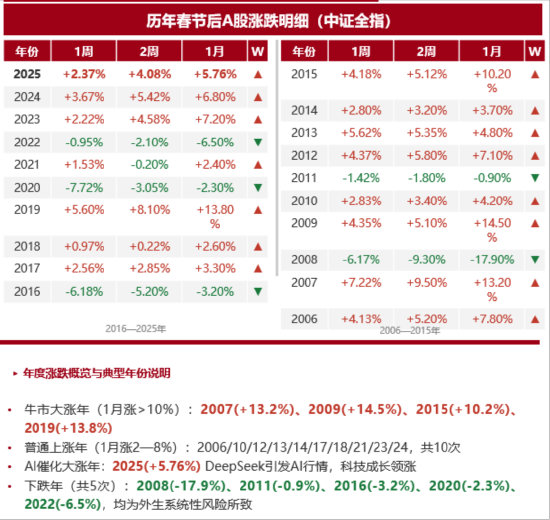
Market Overview - A-shares opened higher and closed with gains, with the Shanghai Composite Index rising by 0.72% to 4147.23 points, Shenzhen Component Index up 1.29%, and ChiNext Index up 1.41% [1][17] - The total trading volume for the day was 2.48 trillion yuan, compared to 2.22 trillion yuan the previous day, indicating a neutral to strong risk appetite in the market [1][17] - Over 3700 stocks in the market saw an increase, with small-cap stocks outperforming large-cap stocks, and growth stocks lagging behind value stocks [1][17] Spring Festival Market Trends - Historical data from 2006 to 2025 shows a consistent trend of gains in the A-share market following the Spring Festival, with an average increase of 1.6% in the first week, 2.5% in the second week, and 4.6% in the first month [3][19] - The success rate of the post-Spring Festival rally is notable, with a 76% win rate in the first two weeks and a 71% win rate in the first month, significantly higher than the annual average of about 52% [3][19] Semiconductor Equipment Sector - The Semiconductor Equipment ETF (159516) saw a significant increase of 4.56% after a volatile trading session [21] - Chinese top chip manufacturers plan to increase advanced chip production from less than 20,000 units currently to 100,000 units within 1-2 years, with a long-term goal of adding 500,000 units by 2030 [7][23] - The semiconductor equipment sector is expected to benefit from the expansion of advanced processes and storage, driven by global AI demand, making it a strong growth narrative [8][24] Real Estate Policy Impact - Shanghai's new real estate policy, "沪七条," aims to lower the threshold for home purchases, which is expected to stabilize housing prices in the outer ring of the city [8][9] - The policy includes reducing the social security requirement for non-local families from three years to one year and increasing the public housing loan limit from 1.6 million to 2.4 million yuan [8][9] - The new policy is anticipated to stimulate demand in the real estate market, benefiting related sectors such as building materials and real estate [9][25] Steel Sector Dynamics - The steel sector experienced a significant rise, with the Steel ETF (515210) increasing by 4.27%, driven by both demand and supply-side catalysts [11][27] - The Ministry of Industry and Information Technology released new guidelines for the steel industry, which are expected to lead to a phase of consolidation and resource allocation towards stronger companies [12][28] - Current low inventory levels and cautious market sentiment suggest potential upward price elasticity for steel if demand catalysts emerge [12][28]

恒指温和收涨 周期股领涨科技分化
2 1 Shi Ji Jing Ji Bao Dao· 2026-02-25 12:09
Market Overview - The Hong Kong stock market experienced a mixed performance with a structural characteristic of "strong cyclicals, weak technology" as policy support and rising commodity prices drove the market upward, while profit-taking affected the technology sector [1][2] - The Hang Seng Index rose by 0.66% to 26,765.72 points with a trading volume of 236.765 billion HKD, while the Hang Seng Tech Index slightly declined by 0.19% to 5,260.5 points with a trading volume of 51.908 billion HKD [1][2] Sector Performance - Cyclical sectors such as real estate services (+5.48%), building materials (+3.51%), and mining (+3.29%) led the gains, supported by favorable policies and rising commodity prices [2] - In contrast, technology sectors like software (-5.11%) and semiconductor materials and equipment (-3.94%) saw significant declines due to profit-taking from previously high-performing stocks [2] Individual Stocks - Notable gainers included Tianbao Energy (+69.49%) due to a projected profit increase of 84.5% year-on-year, and Semir Holdings (+60.53%) benefiting from active small-cap market sentiment [2] - Major decliners included Zhijing International Financial (-26.32%), Zhuoyue Holdings (-23.08%), and China National Pharmaceutical Group (-18.75%) [2] Trading Activity - The top three stocks by trading volume were Tencent Holdings (11.981 billion HKD), Alibaba-W (7.110 billion HKD), and HSBC Holdings (6.193 billion HKD) [2] Policy and Economic Developments - The Hong Kong budget proposed optimizing the listing system, including revising "same share, different rights" requirements and advancing T+1 settlement cycle consultations, aiming to enhance market efficiency [2] - New policies in Shanghai's real estate market, including shortening the social security period for non-local buyers and increasing public housing loan limits, stimulated the Hong Kong real estate sector [2] Future Outlook - Analysts suggest focusing on three sectors: precious metals and energy due to rising geopolitical risks, consumer sectors at relatively low valuations, and technology sectors expected to rebound as AI applications accelerate [3] - Concerns over potential VAT increases in service sectors may affect investor sentiment, but pre-meeting policy expectations could support the Hong Kong market [3] - The real estate sector showed overall gains during the Spring Festival, with a continued positive outlook for first-tier and select second-tier cities [3]




雅居乐集团:清盘呈请聆讯延期至3月2日
Zhi Tong Cai Jing· 2026-02-25 12:06
雅居乐集团(03383)发布公告,于2026年2月25日的高等法院聆讯中,高等法院颁令将呈请聆讯延期至 2026年3月2日。本公司将适时另行刊发公告,以知会股东及投资者任何有关呈请的重大进展。 ...
越秀集团236亿元竞得广州马场路地块
Xin Lang Cai Jing· 2026-02-25 11:46
【越秀集团236亿元竞得广州马场路地块】智通财经2月25日电,据广州公共资源交易中心公示信息,天 河区黄埔大道以南、马场路以东地块(马场1期地块)经过243轮竞价,网上竞价活动已经结束。竞价结 果显示,本次竞价最终报价为236.04亿元,最终报价人为广州越诚达有限公司(号牌:828)。天眼查 信息显示,广州越秀集团持有广州越诚达有限公司100%股权。(智通财经记者 王海春) 转自:智通财经 ...

多重利好叠加,房地产板块及黑色商品期货大涨
Qi Huo Ri Bao· 2026-02-25 11:07
Core Viewpoint - The recent announcement of the "Shanghai Seven Measures" aims to optimize the city's real estate policies by reducing housing purchase restrictions and increasing financial support for homebuyers, thereby stimulating market demand and stabilizing expectations in the real estate sector [1][2]. Policy Adjustments - The new policy allows non-Shanghai residents who have paid social insurance or individual income tax for at least one year to purchase unlimited housing outside the outer ring and one unit within the inner ring. Those with three years of contributions can buy two units in the inner ring, while holders of a Shanghai residence permit for over five years can buy one unit citywide [1]. - The policy also raises the public housing fund loan limit for first-time buyers to 2.4 million yuan, with a maximum of 3.24 million yuan, and optimizes loan conditions to alleviate financial pressure on families [1]. Market Impact - The announcement is expected to boost housing transactions during the traditional peak season of "Golden March and Silver April," with the real estate sector and related industries, such as steel, experiencing significant stock price increases [2][3]. - The real estate sector accounts for approximately 25% of domestic steel consumption, making it a crucial demand driver for the black metal sector [3]. Inventory and Production Insights - As of February 23, 2026, social steel inventory was reported at 10.52 million tons, a year-on-year decrease of 10.8%, while member companies of the China Iron and Steel Association reported a steel inventory of 15.11 million tons, down 6.8% year-on-year [4]. - The reduction in high furnace loads in northern steel mills due to environmental regulations is expected to lead to a decrease in daily iron output, coinciding with the seasonal increase in downstream demand [5]. Future Outlook - The market sentiment is cautiously optimistic, with expectations of a stable demand environment as the policy effects take time to materialize. The focus will be on the sales data for March and April to determine if the anticipated demand growth is realized [6]. - The steel market is expected to maintain a strong performance due to cost support from supply constraints, although the potential for significant price increases will depend on the speed of demand recovery [6].
策略点评:周期股领涨市场
Tebon Securities· 2026-02-25 11:00
Market Overview - The A-share market continues to show a strong upward trend, with the three major indices collectively rising. The cyclical sectors, including real estate services, non-ferrous metals, and steel, lead the market, while the technology growth sector shows mixed performance [3][6] - As of the market close, the Shanghai Composite Index rose by 0.72% to 4147.23 points, the Shenzhen Component Index increased by 1.29% to 14475.87 points, and the ChiNext Index climbed by 1.41% to 3354.82 points. The total market turnover reached approximately 2.48 trillion, indicating a good profit effect with 3742 stocks rising and 1609 falling [2][3] Sector Performance - The cyclical stocks have shown significant strength, with steel, non-ferrous metals, real estate, building materials, and basic chemicals rising by 4.26%, 3.53%, 2.51%, 2.41%, and 2.37% respectively. The recent policy adjustments in Shanghai's real estate sector have further boosted these sectors [6][8] - The rare earth sector also experienced a surge, with prices for various rare earth products increasing significantly post-holiday. For instance, the average price of praseodymium and neodymium oxide rose by 4.16 million yuan/ton, while neodymium metal increased by 8 million yuan/ton [6][8] Investment Themes - The report identifies several key investment themes, including AI applications, commercial aerospace, nuclear fusion, quantum technology, brain-machine interfaces, robotics, consumer sectors, brokerage firms, precious metals, and non-ferrous metals. Each theme has specific core logic and follow-up points for future monitoring [9][10] - The AI application sector is highlighted for its potential growth driven by product application acceleration and technological upgrades. The commercial aerospace sector is supported by the establishment of a commercial aerospace office, while nuclear fusion and quantum technology are gaining traction due to industrialization and policy support [9][10] Market Sentiment and Future Outlook - The report suggests a shift in market sentiment from "concept-driven" to "price-driven" profit enhancement, indicating a balanced allocation between technology and consumer sectors. The upcoming "Two Sessions" may further influence the cyclical sectors, particularly in real estate policy implementation and commodity prices [8][11] - The bond market is experiencing adjustments, with the long-end bonds leading the decline. The report notes that the LPR rates remain unchanged, and the market is expected to maintain a stable liquidity environment in the short term [8][11]
雅居乐集团(03383.HK)清盘呈请聆讯延期至2026年3月2日
Ge Long Hui· 2026-02-25 10:56
格隆汇2月25日丨雅居乐集团(03383.HK)公告,于2026 年2月25日的高等法院聆讯中,高等法院颁令将 呈请聆讯延期至2026年3月2日。 ...