
军工

Search documents
特朗普宣布扩军计划 重燃全球军工行情
Ge Long Hui A P P· 2026-01-08 12:50
格隆汇1月8日|特朗普增加美国军事预算的计划,为全球国防股注入了新动力。在这一注定由地缘政治 主导的年份里,欧洲国防股的开局表现尤为强劲。高盛集团的一篮子欧洲国防股周四上涨多达3.8%, 使本周涨幅扩大至约13%。在美国,诺斯罗普·格鲁曼公司和洛克希德·马丁公司的股价在盘前交易中飙 升超过6%,从前一天的跌势中回升;此前特朗普曾呼吁限制该行业的行政薪酬和股东回报。亚洲国防 股亦录得上涨。Saxo Markets英国投资策略师Neil Wilson表示:"地缘政治是2026年迄今为止不可回避的 主题。"在欧洲,涨幅最大的是英国航空航天系统公司,该公司近一半的收入来自美国,其股价上涨多 达7%。德国防务巨头莱茵金属上涨多达4.1%,触及10月以来的最高水平。 ...


新光光电:公司积极探索军贸,努力推动打造新的业绩增长点
Zheng Quan Ri Bao Wang· 2026-01-08 12:13
Core Viewpoint - The company is focusing on developing civilian products while leveraging its military foundation and actively exploring military trade to create new growth points in performance [1] Group 1 - The company emphasizes its commitment to serving national political and diplomatic policies [1] - The company is closely monitoring market trends and increasing efforts in military trade business development [1]

暗盘大涨26%!
Zhong Guo Ji Jin Bao· 2026-01-08 11:18
【导读】MINIMAX暗盘大涨26%! 1月8日,港股三大指数齐跌。截至收盘,恒生指数跌1.17%,恒生科技指数跌1.05%,恒生国企指数跌1.09%。全日大市成交额为2683亿港元,南向资金净 卖出49.01亿港元。 | 序号 | 代码 | 名称 | 现价 | 涨跌 | 涨跌幅 | 成交额 | 年初至今 | | --- | --- | --- | --- | --- | --- | --- | --- | | 1 | HSI | 恒生指数 | 26149.31c | -309.64 | -1.17% | 2683亿 | 2.02% | | 2 | HSTECH | 恒生科技 | 5678.34c | -60.18 | -1.05% | 754亿 | 2.94% | | 3 | HSBIO | 恒生生物科技 | 15879.59c | -13.66 | -0.09% | 127亿 | 12.00% | | 4 | HSCEI | 恒生中国企业指数 | 9039.34c | -99.41 | -1.09% | 941亿 | 1.41% | | 5 | HSCI | 恒生综合指数 | 4004.72c | -43 ...



A股继续走牛有底气
IPO日报· 2026-01-08 10:33
Market Performance - The A-share market experienced its first decline of the year, ending the Shanghai Composite Index's 14-day winning streak with a drop of -0.07% on January 8, while the Shenzhen Index fell by -0.51% and the ChiNext Index decreased by -0.82% [1] - Trading volume was 28.262 billion, a decrease of 553 billion compared to the previous trading day, with a net capital outflow of 710 billion [1] International Political Impact - The A-share market is facing significant international political turmoil, particularly following U.S. President Trump's announcement on January 3 regarding military action against Venezuela, which has caused global shockwaves [3][4] - The U.S. aims to control Venezuela's oil revenues to purchase American products, indicating a strategy to dominate Latin America and secure its resources [5] Regional Reactions - The U.S. actions have provoked strong reactions from various countries, including Russia, which condemned the use of force against a sovereign nation, and several Latin American countries that view the intervention as a violation of international law [6] - Countries like Chile, Colombia, Brazil, and Mexico have expressed concerns that U.S. actions exacerbate regional conflicts and undermine stability [6] A-share Market Resilience - Despite the international turmoil, the A-share market has shown resilience, with significant sectors like semiconductor, coal, and commercial aerospace performing well, and trading volumes remaining high [7][8] - The Shanghai Composite Index reached a ten-year high of 4093.87 points on January 7, with a trading volume nearing 2.9 trillion [7] Investor Sentiment and Future Outlook - The continuous rise in the A-share market has boosted investor confidence, with a strong profit-taking sentiment leading to a net outflow of 710 billion on January 8 [9] - The market is expected to continue its bullish trend, supported by government policies aimed at stabilizing the market and maintaining a loose monetary policy through 2026 [9]

美股异动丨特朗普猛增军费预算,国防股盘前大涨,洛克希德马丁、诺斯罗普格鲁曼涨超7%
Ge Long Hui· 2026-01-08 09:58
美股军工国防股盘前集体走强,其中,洛克希德马丁、诺斯罗普格鲁曼大涨超7%,雷神技术涨超4%。 消息面上,美国总统特朗普表示,他将要求2027年军费预算从1万亿美元左右增加到1.5万亿。特朗普还 要求国防企业加大生产和研发投入,停止股票回购和派息。 ...

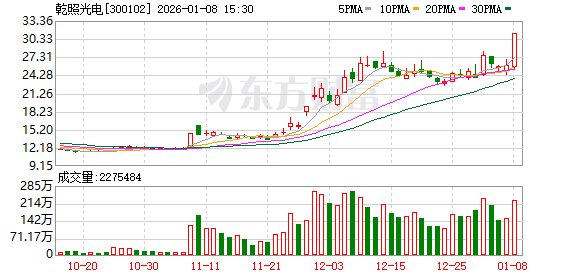
军工股尾盘异动!乾照光电最后约7分钟20%涨停!
Zheng Quan Shi Bao Wang· 2026-01-08 09:41
Group 1 - The defense and military industry saw a net inflow of over 18.9 billion yuan, while the computer sector had over 16.9 billion yuan, and machinery equipment received over 10.8 billion yuan in net inflows [2] - Non-bank financials experienced a net outflow of over 6.7 billion yuan, with the metals sector seeing a net outflow of over 5.4 billion yuan [2] - The military industry is expected to stabilize and improve, with a focus on high-end loyal drones and low-cost unmanned aerial vehicles as key development directions [7] Group 2 - The A-share market showed slight fluctuations, with major indices like the Shanghai Composite Index and Shenzhen Component Index experiencing minor declines, while technology growth stocks performed relatively well [4] - The new energy sector, particularly wind power equipment, showed strong performance, with significant increases in stock prices for companies like Goldwind Technology [7] - The global energy transition and the explosion of AI computing power are creating unprecedented opportunities for the new energy sector, with predictions of significant growth in wind power installations in various regions [9]




胡萝卜加大棒:特朗普拟增5000亿军费,为何反向重锤军工巨头?
智通财经网· 2026-01-08 08:22
Core Viewpoint - The U.S. President has proposed a significant increase in defense spending while simultaneously threatening to impose restrictions on major defense contractors, leading to a drop in their stock prices as traders attempt to interpret the administration's true intentions [1][2]. Group 1: Defense Spending and Contractor Regulations - The President has called for an annual increase of $500 billion in defense spending, aiming for a total of $1.5 trillion by 2027, which represents a more than 50% increase [2][4]. - Major defense contractors, including RTX, Lockheed Martin, Northrop Grumman, and General Dynamics, are facing pressure to halt stock buybacks, stop dividend payments, and limit executive salaries to $5 million until they increase investments in manufacturing and R&D [1][3]. - The President's actions reflect a longstanding concern regarding cost overruns and delays in the delivery of major weapon systems, exacerbated by advancements in technology from other countries [3][4]. Group 2: Market Reactions and Analyst Opinions - Following the President's statements, stock prices of major defense contractors fell, indicating market uncertainty regarding the implementation of these proposed measures [1][2]. - Analysts have expressed skepticism about the effectiveness of the proposed regulations, questioning whether they might drive talented management away from large defense contractors, potentially worsening production delays [3][7]. - The current administration's reliance on defense contractors has deepened, with the government overseeing numerous military operations and airstrikes, further entrenching the relationship between the government and defense companies [2][4]. Group 3: Government's Role and Industry Dynamics - The government has previously intervened in the defense sector, including purchasing stakes in companies like Intel and allowing Nvidia to sell chips in China under certain conditions [3][4]. - The Secretary of Commerce has suggested that the government might take equity stakes in some defense contractors, which has led to a slight rebound in their stock prices [4]. - New entrants in the defense sector, such as Anduril Industries, are challenging traditional contractors and are open to regulatory measures proposed by the President, indicating a shift in industry dynamics [5][6].

军工ETF(512660)收盘领涨超4.5%,同类规模第一,军工有望具有结构性行情
Mei Ri Jing Ji Xin Wen· 2026-01-08 08:18
Core Viewpoint - The military industry ETF (512660) closed up over 4.5% on January 8, leading its peers, indicating a potential structural market trend in the military sector [1] Group 1: Industry Outlook - The military sector is identified as a strategic industry, with certain domestic equipment expected to achieve "0-1" development during the 14th Five-Year Plan, suggesting a favorable structural market trend [1] - The paradigm of unmanned combat is becoming the preferred choice for asymmetric warfare, with various unmanned equipment likely to be the focus of future deployments [1] - The commercial aerospace sector is anticipated to become a promising investment track once systemic, capacity, and application issues are resolved [1] - The low-altitude economy is currently experiencing a slowdown in policy and planning benefits, with market attention shifting to the next phase of implementation, which could lead to sustained gains once clear turning points are identified in airworthiness and logistics [1] - Deep-sea technology is viewed as a national strategic asset, with the industry still in its early stages, and further systemic reforms may act as catalysts for growth [1] Group 2: ETF and Index Information - The military ETF (512660) tracks the CSI Military Industry Index (399967), which comprehensively covers aerospace, naval, and terrestrial military sectors [1] - The index selects listed companies involved in military fields from the Shanghai and Shenzhen markets, primarily including the ten major military groups' listed companies, reflecting the overall performance of related securities in China's military industry [1] - The industry allocation is primarily focused on aviation equipment and military electronics, highlighting the growth potential and market vitality of the military sector [1]
收评:沪指微跌 军工板块强势,工业软件概念等活跃
Jing Ji Wang· 2026-01-08 07:39
Market Overview - The Shanghai Composite Index closed at 4082.98 points, down 0.07%, with a trading volume of 11,831.89 billion [1] - The Shenzhen Component Index closed at 13,959.48 points, down 0.51%, with a trading volume of 16,170.77 billion [1] - The ChiNext Index closed at 3,302.31 points, down 0.82%, with a trading volume of 7,503.35 billion [1] Sector Performance - The insurance, brokerage, and banking sectors collectively declined [1] - The military industry sector showed strong performance [1] - Real estate, steel, pharmaceuticals, and semiconductor sectors experienced gains [1] - Industrial software, commercial aerospace, and military trade concepts were active [1]
收评:沪指震荡微跌,军工板块强势,工业软件概念等活跃
Zheng Quan Shi Bao Wang· 2026-01-08 07:28
Market Overview - The Shanghai Composite Index experienced slight fluctuations, closing down 0.07% at 4082.98 points, while the Shenzhen Component Index fell by 0.51% and the ChiNext Index decreased by 0.82%. In contrast, the Sci-Tech 50 Index rose by 0.82% [1] - The total trading volume across the Shanghai, Shenzhen, and Beijing markets reached approximately 2.83 trillion yuan [1] Sector Performance - The insurance, brokerage, and banking sectors collectively declined, while the military industry sector showed strong performance. Other sectors such as real estate, steel, pharmaceuticals, and semiconductors also saw gains [1] - Active sectors included industrial software, commercial aerospace, and military trade concepts [1] Investment Insights - Dongguan Securities noted that the current external environment benefits from a weak dollar trend, while the internal environment is supported by expectations of proactive policy measures. The market volume has been increasing since the beginning of 2026, indicating strong market sentiment [1] - Recommendations for investment focus include AI technology sectors (such as brain engineering, computing power engineering, and humanoid robots), price increase sectors (like storage chips and rare earths), and large financial sectors [1] - Upcoming data releases to watch include China's CPI, U.S. non-farm employment data, and a U.S. Supreme Court ruling on tariff issues [1]