
信息技术

Search documents
基于风险案例与退市新规视角:可转债风险重构与应对
Lian He Zi Xin· 2025-12-08 11:03
1. Report Industry Investment Rating No relevant information provided. 2. Core Viewpoints of the Report - 2024 was a turning - point for the convertible bond market, with the long - standing zero - default pattern broken. From 2024 - 2025, 5 convertible bonds defaulted, and many rating - downgrade events occurred. Credit risk became prominent, and the risk is rooted in the dual attributes of "bond nature" and "equity nature", resulting from the combination of issuer's short - board in qualification and market policy changes [2][4]. - The disposal of convertible bond risks presents a gradient path system of "regular resolution - extreme disposal". The choice of path is a comprehensive consideration of fundamentals, clause design, and external support. The market may face a peak of concentrated bond maturities in 2027, and the risk stratification will intensify [2][44]. 3. Summary by Relevant Catalog 3.1 Convertible Bond Risk Overview - **Substantial Default**: Since 2024, there have been 5 cases of substantial default in the convertible bond market. As of November 2025, 5 listed convertible bonds failed to repay the principal and interest on schedule, including bonds like "Soute Convertible Bond" and "Hongda Convertible Bond" [4][5][7]. - **Rating Downgrade**: Since 2019, 123 convertible bonds have experienced 270 rating downgrades. The number of downgrades increased significantly in 2024. The construction industry had the most downgrades (49 times), and industries such as chemical, textile and apparel also had over 20 downgrades [8][9]. - **Delisting**: As of now, 5 convertible bonds have delisted along with their underlying stocks. Among them, 3 have defaulted, and 2 are at high risk of default [13][15]. 3.2 Causes of Convertible Bond Risks 3.2.1 Operational Risk - From the Perspective of Bond Nature - The issuers of convertible bonds are mainly small and medium - sized private enterprises with weak qualifications. The proportion of high - grade credit ratings is low. As of October 2025, the proportion of AA+ and above high - grade subjects in the outstanding public convertible bonds was only 14.95% [14]. - **External Environmental Changes**: Convertible bond issuers are more sensitive to external environment changes. For example, local financial pressure affects municipal engineering - related bonds, the real - estate downturn impacts downstream industries, and emergencies and environmental protection policies also affect relevant bonds [16][17]. - **Downturn in Cyclical Industries**: In the downturn of cyclical industries such as agriculture, forestry, animal husbandry, and fishery, and the photovoltaic industry, the debt - paying ability of enterprises weakens, leading to high risks for convertible bonds. For instance, "Zhengbang Convertible Bond" and "Jingneng Convertible Bond" faced problems due to industry downturns [21][22]. - **Goodwill Impairment Risk**: High - premium mergers and acquisitions may lead to goodwill impairment, which can drag down the issuer's performance. In the 2024 annual reports of 522 non - directional convertible bond issuers, 110 had goodwill impairment, with a total impairment of 5.565 billion yuan [24][25]. - **Corporate Governance Defects**: Common governance defects in private enterprises, such as information disclosure violations, illegal activities by actual controllers or senior executives, and high - proportion equity pledges, are important incentives for convertible bond risks [29]. 3.2.2 Market Risk - From the Perspective of Equity Nature - **Weakness in the Equity Market**: It weakens the effectiveness of clause games. On one hand, the conversion value is compressed, and investors' willingness to convert decreases. On the other hand, the put - back pressure surges, which may trigger issuer's default [31][32]. - **Deterioration of Market Liquidity**: It can lead to a vicious cycle of "panic selling - price decline - liquidity exhaustion", especially affecting low - rated and low - liquidity convertible bonds [33]. - **Tightening of Delisting Rules**: The new delisting rules in 2024 have accelerated the clearance of weak - quality issuers, making the credit risk and delisting risk of convertible bonds closely related. Four types of convertible bond issuers need to be closely monitored [34][43]. 3.3 Analysis of Diversified Paths and Practical Characteristics of Convertible Bond Risk Disposal - **Clause Game**: Issuers can lower the conversion price to encourage investors to convert bonds, reducing their own debt - paying pressure. However, this method has certain requirements, such as obtaining shareholders' approval and reasonable adjustment range [45][48]. - **Early Redemption**: When the underlying stock price is too low to trigger the put - back clause, the issuer can redeem the convertible bonds in advance. But this requires sufficient cash flow [51]. - **Introduction of Strategic Investors**: When the issuer is in trouble, introducing strategic investors can help it get out of difficulties and improve its debt - paying ability [52]. - **Extreme Disposal**: When the issuer's operation deteriorates continuously, it may enter debt restructuring or bankruptcy liquidation procedures, usually causing significant losses to investors [55]. - **Risk End - Game**: With the implementation of new delisting rules, convertible bonds usually delist along with their underlying stocks. Delisted convertible bonds have a high risk of default [59]. 3.4 Future Outlook - **Batch Maturity**: The year 2027 may be a peak year for convertible bond maturities, which may lead to local liquidity pressure and credit risk [62]. - **Risk Release**: The decline in the conversion ratio weakens the "natural clearance" ability, the high proportion of low - rated convertible bonds amplifies credit risk, and the difference in exit methods reflects risk stratification [64][66][67]. - **Key Industries**: The chemical industry will face a peak of risk release in 2028, while the construction industry has a gentle maturity rhythm, but still needs to pay attention to the repayment ability of individual issuers [68][69][71].
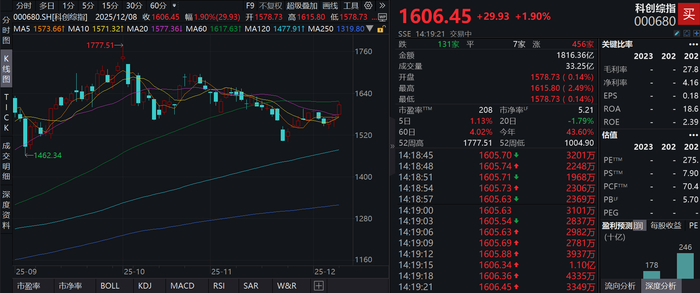
科创综指强势涨超2%,泰康上证科创板综合指数增强A(023970)近3月涨幅同类居前,一键分享硬科技长期成长收益
Xin Lang Cai Jing· 2025-12-08 06:48
Core Viewpoint - The current surge in the STAR Market, particularly in the semiconductor sector, is driven by technological advancements, policy support, and increased market recognition, making it a key investment area for technology self-sufficiency [3][4][6]. Group 1: Market Performance - As of December 8, 2025, the STAR Market Index (000680) saw an intraday increase of over 2%, with a current rise of 1.98% [1]. - Notable stocks such as Aikesaibo (688719) and Ruikeda (688800) both surged by 20%, while Liyuanheng (688499) rose by 18.59% [1]. Group 2: Investment Opportunities - The TaiKang STAR Market Comprehensive Index Enhanced A Fund (023970) achieved a cumulative increase of 6.43% over the past three months, ranking among the top in its category [3]. - The fund employs a dual strategy of "full sector coverage + quantitative enhancement," allowing investors to participate in the recovery of the technology sector, particularly in semiconductors and new energy [5][7]. Group 3: Industry Developments - The national integrated circuit industry investment fund, with a scale of 344 billion yuan, has officially launched its third phase, focusing on advanced packaging, storage chips, and high-end GPUs, providing direct support for the industry [3][4]. - Significant progress has been made in domestic photolithography machines, with the 28nm immersion DUV photolithography machine entering mass production and the successful development of 13.5nm wavelength EUV light sources [4]. Group 4: Fund Strategy and Risk Management - The TaiKang STAR Market Comprehensive Index Enhanced Fund aims to control tracking error while seeking to achieve excess returns over the benchmark index through a quantitative model that dynamically tracks changes in company fundamentals and industry conditions [5][7]. - The fund's strategy allows for diversified exposure to core assets in the STAR Market, reducing individual stock volatility and capitalizing on policy support and technological breakthroughs [5][6].

韩交所芮兑昊:半导体+AI驱动韩股,中韩资本市场合作空间广阔
2 1 Shi Ji Jing Ji Bao Dao· 2025-12-08 05:40
Group 1 - The South Finance Forum 2025 focused on "Innovation Surge and China's Asset Revaluation," gathering insights from government, industry, academia, and finance sectors to build consensus on development [1] - The main forum featured representatives from major global financial centers discussing the opportunities and attractiveness of Chinese assets on the international stage [1] Group 2 - The KOSPI index of the Korean stock market reached a historical high, increasing by 64% by the end of November compared to the beginning of the year, making it the top performer among major global indices [2] - The rise in the KOSPI index is attributed to three main factors: effective corporate value enhancement policies, significant contributions from the semiconductor and AI industries, and revitalizing capital market reforms by the new government [2][3] - The corporate value enhancement plan initiated in May 2024 has led to a 70% increase in the corporate value enhancement index, surpassing the overall KOSPI performance [2] Group 3 - Major companies like Samsung Electronics and SK Hynix saw their stock prices double and triple, respectively, due to the surge in global demand for semiconductors and AI [2] - The new government's capital market reforms include improving corporate governance, protecting minority shareholders, and encouraging dividends through tax reforms [3] - The IPO market in Korea is expected to raise approximately 4 to 5 trillion KRW in 2025, with over 100 new listings, including significant projects from LG Group [3] Group 4 - Looking ahead to 2026, the performance of the Korean capital market will depend on the effectiveness of ongoing government policies and the actual performance of the economy and enterprises amid global changes [4] - The Korean Exchange plans to extend trading hours from 6.5 to 12 hours daily and is exploring a 24-hour trading mechanism to enhance market liquidity and attract global capital [5] - The exchange aims to build a digital asset ecosystem, including launching a security token offering (STO) market and introducing virtual asset ETFs [6] Group 5 - The Korean Exchange plans to implement AI technology for market regulation and operations, including a generative AI-based market surveillance system to detect unfair trading [6] - Emphasizing the importance of international cooperation, the exchange seeks to deepen collaboration with China, particularly in advanced technology and manufacturing sectors [6]
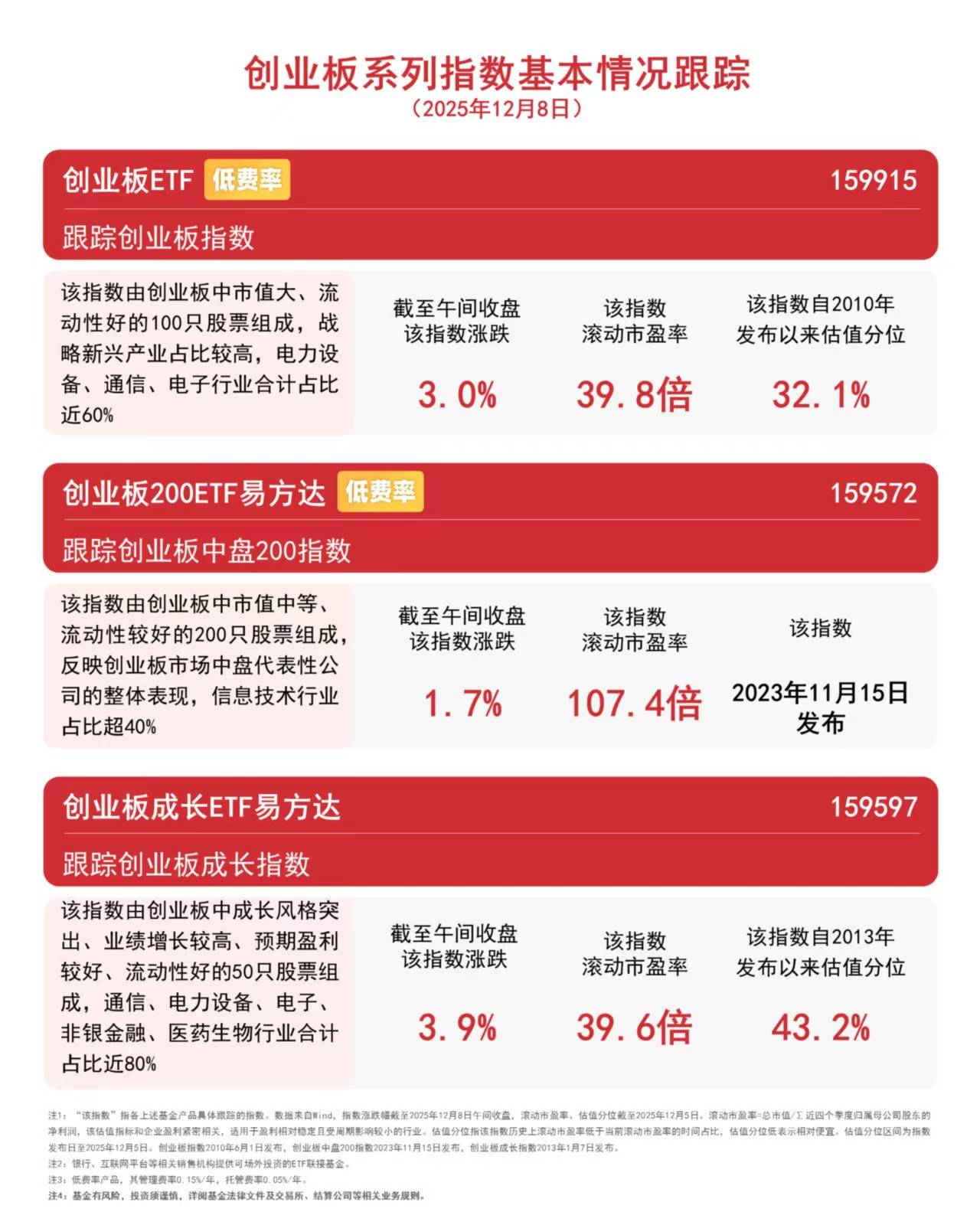
CPO板块爆发,创业板指涨超3%,创业板ETF(159915)等产品交投活跃
Sou Hu Cai Jing· 2025-12-08 05:14
Group 1 - The article discusses the performance and characteristics of various ETFs tracking the ChiNext Index, including the ChiNext 100 ETF, ChiNext 200 ETF, and ChiNext Growth ETF [2] - The ChiNext 100 Index consists of 100 stocks with large market capitalization and good liquidity, primarily from emerging industries, with a significant representation from the power equipment, communication, and electronics sectors, accounting for nearly 60% [2] - The ChiNext 200 Index tracks 200 mid-cap stocks with good liquidity, reflecting the overall performance of mid-cap companies in the ChiNext market, with over 40% representation from the information technology sector [2] - The ChiNext Growth Index includes 50 stocks characterized by strong growth potential and good liquidity, with nearly 80% representation from the communication, power equipment, electronics, non-bank financials, and pharmaceutical sectors [2] Group 2 - As of the latest trading session, the ChiNext 100 Index recorded a change of 3.0% with a rolling price-to-earnings ratio of 39.8 times [2] - The ChiNext 200 Index showed a change of 1.7% with a rolling price-to-earnings ratio of 107.4 times [2] - The ChiNext Growth Index experienced a change of 3.9% with a rolling price-to-earnings ratio of 39.6 times [2]

资本搭桥“蜀道”变“通途” 成就产业跃迁西部高地|决胜“十四五” 擘画“十五五”·地方资本市场高质量发展之四川篇
证券时报· 2025-12-08 04:20
Core Viewpoint - Sichuan is leveraging its capital market to transform the historically challenging "Shudao" into a smooth "Tongtu," facilitating capital flow and industrial upgrades [1]. Group 1: Capital Market Development - During the 14th Five-Year Plan, Sichuan has integrated capital market development into its broader economic and social development strategy, using policy innovation to eliminate institutional barriers and enhance capital flow efficiency [5]. - By the end of Q3 2025, Sichuan is expected to have 179 listed companies, a 32% increase from the end of 2020, with a total market capitalization of 3.4 trillion yuan [5]. - Sichuan's capital market has achieved significant growth, with direct financing exceeding 2.1 trillion yuan during the 14th Five-Year Plan, supporting various sectors such as advanced manufacturing and green energy [8]. Group 2: Quality and Structure of Listed Companies - Sichuan's listed companies have not only increased in number but also improved in quality and structural diversity, with total revenue reaching 823.1 billion yuan and net profit of 82.15 billion yuan in the first three quarters of 2025 [12]. - The industry structure of listed companies shows a clear trend of traditional industries stabilizing while emerging industries lead growth, with the market capitalization of industrial and information technology sectors rising from 26.69% to 51.76% [12]. Group 3: Mergers and Acquisitions - Sichuan's capital market has utilized mergers and acquisitions to optimize resource allocation, with 136 M&A transactions totaling 81.3 billion yuan during the 14th Five-Year Plan [13]. - The cash dividend mechanism has been enhanced, with listed companies distributing over 230 billion yuan in cash dividends, reflecting a commitment to shareholder returns [14]. Group 4: Innovation and Financing Tools - Sichuan is focusing on innovation-driven development, with 79 companies listed on the Sci-Tech Innovation Board, accounting for 44% of the total listed companies [16]. - The province has issued 168 innovative bonds, including Sci-Tech bonds and green bonds, raising over 100 billion yuan to support various projects [17]. Group 5: Risk Management and Investor Protection - Sichuan has established a comprehensive investor protection and risk prevention system, with significant achievements in risk monitoring and management during the 14th Five-Year Plan [19][21]. - The regulatory framework has been strengthened to combat financial fraud and ensure accountability among listed companies [22]. Group 6: Future Outlook - Looking ahead to the 15th Five-Year Plan, Sichuan aims to deepen the integration of its capital market with local economic development, focusing on nurturing core technology enterprises and enhancing the competitiveness of listed companies [24]. - The province plans to accelerate the construction of a Western financial center, enhancing the capital market's role in regional development [25].


云智能资产控股(新加坡)申请视频传输方法、系统及相关产品专利,有效降低视频传输卡顿
Jin Rong Jie· 2025-12-08 03:43
Core Viewpoint - Cloud Intelligent Asset Holdings (Singapore) Private Limited has applied for a patent related to video transmission methods and systems, indicating a focus on improving video transmission efficiency and reducing lag in video streaming [1]. Summary by Relevant Sections Patent Application - The patent application, titled "Video Transmission Method, Video Transmission System, Computing Device, Computer-Readable Storage Medium, and Computer Program Product," was published under CN121078251A with an application date of June 2024 [1]. - The patent describes a method that involves obtaining transmission information for a target video frame in response to a video transmission request, determining the initial redundancy of the target video frame, and adjusting this redundancy based on the receiving end's status [1]. Technical Details - The method generates a redundancy package for each video frame, allowing the receiving end to start recovering video packets for each frame, which effectively reduces video transmission stuttering [1]. - The approach utilizes single-frame redundancy determination and adjusts the initial redundancy based on reception status information, enhancing the reliability of video transmission [1].
拟入主安妮股份 晟世天安有何来头?业务涉及大模型一体机 去年年末净资产6000万元
Xin Lang Cai Jing· 2025-12-07 23:29
Core Viewpoint - Annie Co., Ltd. has signed a share transfer agreement with Beijing Shengshi Tianan Technology Co., Ltd., resulting in Shengshi Tianan becoming the controlling shareholder with a 15.92% voting power in the company [1][6]. Group 1: Share Transfer Details - The share transfer involves Lin Xuxi and Zhang Jie transferring a total of 15.92% of their shares to Shengshi Tianan at a price of 8.361 yuan per share, totaling 772 million yuan (including tax) [1][7]. - After the transfer, the actual controllers of Annie Co. will change from Lin Xuxi and Zhang Jie to Li Ning and Wang Lei [1][6]. Group 2: Company Profiles - Annie Co. specializes in anti-counterfeiting traceability system solutions, copyright services, and business information paper [2][7]. - Shengshi Tianan focuses on integrated solutions for "industry intelligence computing and embodied intelligent applications," providing high-performance computing infrastructure and software development for key sectors like government, healthcare, and education [2][8]. Group 3: Financial Performance and Future Outlook - Shengshi Tianan's revenue for January to November 2025 reached 918 million yuan, with a net profit of 71 million yuan, showing significant growth compared to 284 million yuan in revenue for 2024 [4][10]. - The share transfer is seen as a strategic move by Shengshi Tianan, which recognizes the intrinsic value of Annie Co. and aims to enhance its management and resource allocation for better profitability [3][8]. Group 4: Ownership and Management - Li Ning and Wang Lei collectively control 98.32% of the voting rights in Shengshi Tianan, with Li Ning serving as the general manager responsible for the company's overall development [5][10].

海外高频 | 美国公布《国家安全战略》(申万宏观·赵伟团队)
赵伟宏观探索· 2025-12-07 16:05
Group 1: Major Assets & Overseas Events & Data - Most developed countries' government bond yields have risen significantly, with the US 10-year Treasury yield increasing by 12.0 basis points to 4.14% [15] - The S&P 500 rose by 0.3% and the Nasdaq by 0.9% during the week, while the dollar index fell by 0.5% to 98.98 [94] - WTI crude oil prices increased by 2.6% to $60.1 per barrel, while COMEX gold prices decreased by 0.6% to $4197.6 per ounce [33][94] Group 2: US National Security Strategy - The US released its 2025 National Security Strategy, emphasizing the protection of US territory and security in the Western Hemisphere as top priorities [62] - The strategy criticizes the decline of Europe and demographic changes, insisting that Europe must bear the primary costs of its own defense [62] - The importance of the Middle East has been downgraded, with a focus on avoiding re-engagement in prolonged ground wars [62] Group 3: Employment and Consumption Data - In November, ADP employment in the US decreased by 32,000, contrary to market expectations of an increase of 10,000, with weakness concentrated in small businesses [69] - The actual PCE consumption in September was flat at 0%, below the market expectation of 0.1%, indicating weakness in consumer spending [72] Group 4: Commodity Prices - The prices of most commodities rose, with LME copper increasing by 5.7% to $11,616 per ton and WTI crude oil rising by 2.6% [33][38] - The inflation expectations rose by 3 basis points to 2.26% [42]

债市专题研究:关注成长板块的配置价值
ZHESHANG SECURITIES· 2025-12-07 09:57
证券研究报告 | 债券市场专题研究 | 债券研究 债券市场专题研究 报告日期:2025 年 12 月 07 日 关注成长板块的配置价值 ——债市专题研究 核心观点 中期维度,政策催化下慢牛预期依然稳固,权益市场风险偏好近期逐步回升,科技板 块转债作为高弹性品种,其股性价值有望得到进一步巩固。在资产荒格局延续的背景 下,"固收+"资金对转债,特别是具备成长确定性的科技品种,配置需求依然旺盛。 ❑ 转债市场走势先下后上,整体呈现成交缩量、区间震荡,估值压缩。 近期在债券市场的持续调整下,纯债基金的赎回规模明显放大,市场流动性收缩 明显,带动固收+基金赎回规模同步扩大,但转债市场通过估值波动熨平债券市场 震荡影响,总体持仓体验更优。中期维度,虽然转债供给持续缩量,但市场增量 资金充足,预计转债估值回调空间有限,同时随着投资者止盈预期接近尾声,权 益慢牛预期下市场对于高估值的标的容忍度有所提升。 ❑ 近期市场缩量盘整,但科技板块成交依旧活跃,量价均已呈现企稳态势。 10 月以来,科技板块跟随股市同步调整,虽然板块转债估值被动收缩,但依旧呈 现较为明显的抗跌性;万得可转债信息技术指数近两月回调 2.43%,表现整体优 ...
中银量化大类资产跟踪:日本利率显著上行,关注对全球股指的冲击效应
Bank of China Securities· 2025-12-07 07:34
- The report tracks the performance of various stock market indices, including A-shares, Hong Kong stocks, and US stocks, with a focus on the relative performance of different styles such as growth vs. dividend, small-cap vs. large-cap, and micro-cap vs. CSI 800[1][2][7] - The report highlights the valuation and equity-bond cost-effectiveness of A-shares, noting that the current PE_TTM of A-shares is at a historically high percentile, with marginal increases over the past week[41][42][46] - The report discusses the relative crowding and cost-effectiveness of different styles, with growth vs. dividend and micro-cap vs. CSI 800 being at historically high levels, while small-cap vs. large-cap is at a historically balanced level[72][75][78] - The report examines the impact of US Treasury yields on the performance of different styles, noting that the recent rise in US Treasury yields has led to growth outperforming dividends and large-cap underperforming small-cap, which is consistent with long-term trends[83][85][86] - The report tracks the performance of major funds, noting that most major fund indices have outperformed the Wind All A index over the past week, with the social security heavy index and the national team index leading the gains[89][93][95] - The report provides an overview of the bond market, noting that both Chinese and US Treasury yields have risen over the past week, with the China-US spread at a historically high level[112][113][114] - The report tracks the performance of the commodity market, noting that both Chinese and US commodity markets have risen over the past week, with the Nanhua Precious Metals Index and the CRB Metals Index leading the gains[123][124][125]
