
生猪养殖

Search documents
商务部对欧盟猪肉征反倾销税,产业链或现弹性释放
Jin Rong Jie· 2025-12-17 01:34
Group 1 - The Ministry of Commerce announced an anti-dumping tax on imported pork and pork by-products from the EU, effective from December 17, 2025, with rates ranging from 4.9% to 19.8% for a duration of five years [1] - The decision was made in response to significant damage caused to the domestic industry due to dumping practices, reflecting strong calls for protection from local producers [1] - The report indicates that the investigation was conducted fairly, with input from various stakeholders, leading to the conclusion that EU imports have harmed the domestic pork industry [1] Group 2 - The implementation of the anti-dumping tax is seen as a positive signal for the pig farming industry, which is currently at the bottom of its cycle [2] - Investment strategies should follow a "breeding first, animal health and feed later" logic, with close monitoring of key metrics such as the number of breeding sows, pork prices, and monthly sales data to validate trends [2]
建信期货生猪日报-20251217
Jian Xin Qi Huo· 2025-12-17 01:23
Report Overview - Report Title: Pig Daily Report - Report Date: December 17, 2025 - Industry: Pig Farming 1. Industry Investment Rating - No investment rating information is provided in the report. 2. Core Viewpoints - The supply of live pigs is expected to maintain a slight increasing trend. There is dual supply pressure due to concentrated second - fattening and pressure - keeping in October and continuous capacity release, which continues to put pressure on the 01 and 03 contracts. However, the price decline compared to the same period last year is large, and recent northern epidemics have intensified, triggering a low - level rebound sentiment, increasing the frequency of bottom oscillations. - On the spot market, both supply and demand are increasing. Second - fattening is mainly in a wait - and - see mode, with weak support for prices. Spot prices are oscillating strongly due to the demand for curing and enema [7][9]. 3. Summary by Directory 3.1 Market Review and Operation Suggestions 3.1.1 Market Conditions - Futures: On the 16th, the main 2603 contract of live pigs opened flat, then bottomed out and rebounded, fluctuating higher, closing in the positive territory. The highest was 11360 yuan/ton, the lowest was 11260 yuan/ton, and the closing price was 11350 yuan/ton, up 0.22% from the previous day. The total position of the index increased by 1459 lots to 350618 lots [6]. - Spot: On the 16th, the average price of ternary pigs nationwide was 11.52 yuan/kg, down 0.04 yuan/kg from the previous day [6]. 3.1.2 Market Analysis - Supply: In the long term, the slaughter of live pigs is expected to maintain a slight increasing trend until the first half of next year. The utilization rate of second - fattening pens is relatively high, slightly higher than the same period last year, increasing the supply pressure before the Spring Festival. In December, the planned slaughter of sample breeding enterprises is 27.72 million heads, with a monthly planned increase of 4.64%. Currently, the overall completion progress of many regional groups is slightly slow [7]. - Demand: Currently, second - fattening is mainly in a wait - and - see mode. There may still be a small amount of rolling restocking demand in December. With the continuous cooling of the weather, the demand for curing and enema is increasing, and terminal consumer demand is rising. The orders of slaughtering enterprises are increasing, which significantly supports the slaughter volume. On December 16th, the slaughter volume of sample slaughtering enterprises was 190,800 heads, down 300 heads from the previous day, up 8600 heads week - on - week, and up 24,000 heads month - on - month [7]. - Policy: China imposes anti - dumping duties on imported related pork and pork by - products from the EU, but the impact is very limited due to the extremely low proportion compared to domestic consumption [7]. 3.2 Data Overview - November actual slaughter volume of Yongyi sample enterprises was 26.49 million heads, with a completion rate of 99.36%. The planned slaughter volume in December is 27.72 million heads, a monthly planned increase of 4.64% and a daily average increase of 1.27% [13]. - As of December 11th, the average profit per head of self - breeding and self - raising was - 146 yuan/head, a week - on - week decrease of 11.5 yuan/head; the average profit per head of purchasing piglets for breeding was - 264 yuan/head, a week - on - week decrease of 5.6 yuan/head [13]. - As of December 11th, the expected cost of self - breeding and self - raising was 12.09 yuan/kg, a week - on - week increase of 0.04 yuan/kg. The expected cost of purchasing piglets for fattening to 125 kg and then selling was 11.41 yuan/kg, a week - on - week increase of 0.12 yuan/kg [13]. - In the week ending December 11th, the average slaughter weight of live pigs was 129.63 kg, a decrease of 0.19 kg from the previous week. The proportion of pigs under 90 kg in slaughter increased by 0.38% to 5.43% compared with the previous week, and the proportion of pigs over 150 kg was close to the same as the previous week at 6.9% [13].
商务部:对欧盟进口猪肉等征收反倾销税
Qi Huo Ri Bao Wang· 2025-12-17 00:57
Core Viewpoint - The Ministry of Commerce of China has announced the final ruling on anti-dumping duties on imported pork and pork products from the EU, effective December 17, 2025, in response to significant damage to the domestic industry caused by dumping practices [1] Group 1: Anti-Dumping Measures - The Ministry of Commerce will impose anti-dumping duties ranging from 4.9% to 19.8% on EU companies starting December 17, 2025, for a duration of five years [1] - The decision was made following a request from the China Animal Husbandry Association, highlighting the strong demand for protection within the domestic industry [1] Group 2: Impact on Domestic Industry - The ruling is expected to reduce imports of pork and related products from the EU, which may alleviate supply pressure in the domestic pork market, contributing to the stability of the swine industry [1] - Current data indicates that the domestic pork supply is in surplus, with a decrease in imported pork and related products over the past two years [2] Group 3: Import Trends - From January to October, pork imports amounted to approximately 860,000 tons, a year-on-year decrease of 3.3%, while the total imports of pork and pork offal reached about 1.86 million tons, down 2.4% year-on-year [2] - Overall, the import volume of pork and related products is expected to remain low in 2025, suggesting that the impact of the anti-dumping duties on domestic supply may be limited [2]
明日四大主题前瞻 | 中央财办强调!扩大内需是明年排在首位的重要任务,商务部对欧盟进口猪肉征收反倾销税
Jin Rong Jie· 2025-12-16 15:38
Group 1: L3 Autonomous Driving and Smart Driving Industry - The Ministry of Industry and Information Technology has officially announced the first batch of L3 conditional autonomous driving vehicle permits, marking a significant step towards commercial application in China [1] - Two models designed for urban congestion and highway conditions will conduct road trials in designated areas of Beijing and Chongqing, indicating a shift from testing to commercial use [1] - The implementation of this policy removes regulatory barriers for high-level autonomous driving technology, accelerating the maturation and cost reduction of the smart driving hardware and software industry [1] - As technology evolves and consumer acceptance increases, smart driving features are gradually penetrating mainstream vehicles, becoming a core driver of the automotive industry's intelligent upgrade [1] Group 2: Domestic Consumption and Economic Strategy - The central government has prioritized the expansion of domestic demand as a key task for 2025, focusing on unleashing consumer potential and implementing special actions to boost consumption [2] - The National Development and Reform Commission has emphasized stabilizing major consumption and promoting policies such as trade-in for consumer goods, enhancing brand leadership, standard upgrades, and new technology applications [2] - Sectors closely related to residents' daily lives, such as retail, e-commerce, cultural tourism, and service consumption, are expected to benefit from increased demand, along with investment growth in consumption infrastructure and supply chain enterprises [2] Group 3: Impact of AI on Power Demand and Grid Investment - The development of AI has led to a surge in electricity demand, with internet data service electricity consumption increasing by 43% year-on-year from January to October this year [3] - The consensus is that "the end of computing power is electricity," highlighting the critical role of electricity in supporting the digital economy [3] - The rapid construction of AI computing centers will significantly drive the demand for stable, efficient, and green electricity, indicating a new golden period for grid investment [3] - Urgent needs for upgrades in the power system will encompass ultra-high voltage transmission, smart distribution networks, energy storage, and virtual power plants [3]
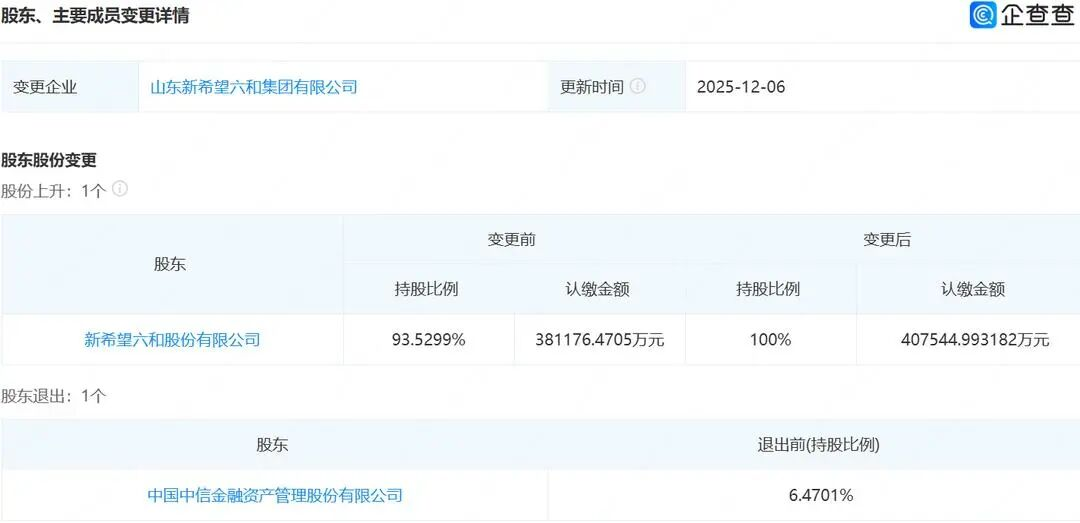
国资退潮与抄底,猪周期下的冰与火
Xin Lang Cai Jing· 2025-12-16 14:03
Core Insights - The recent developments in the pig farming industry highlight contrasting strategies among state-owned capital, with CITIC Financial Asset Management exiting Shandong New Hope Liuhe Group and TianKang Biological acquiring a 51% stake in Qiangdu Animal Husbandry for over 1.2 billion yuan [1][10]. Group 1: Short-term Financial Investment vs. Long-term Industrial Layout - CITIC Financial Asset Management, which held a 6.47% stake in Shandong New Hope Liuhe for less than nine months, opted to exit as the company underwent significant asset adjustments and attempted to pivot towards biotechnology, which may not align with the financial investor's preference for quick returns [2][11]. - The full acquisition of Shandong Liuhe by New Hope Group reflects a strategic focus on consolidating control and optimizing resources to enhance its core operations in feed, food processing, and biotechnology, aiming to navigate industry challenges more effectively [3][13]. Group 2: Strategic Positioning and Regional Deepening in a Downturn - Despite the ongoing low pig prices and industry losses, TianKang Biological's acquisition of Qiangdu Animal Husbandry represents a strategic move by state-owned capital to expand during a market downturn, leveraging its backing from the Xinjiang Production and Construction Corps [4][10]. - The acquisition is not merely about scaling but involves integrating quality production capabilities, with TianKang's annual output expected to reach 5 million heads, thereby reinforcing its position as a leading player in the western pig farming sector [7][16]. Group 3: Implications for Industry Practitioners - The contrasting decisions of state-owned capital provide insights into industry trends, indicating that financial investors like CITIC are more sensitive to market fluctuations and may exit based on strict financial assessments [8][18]. - Conversely, the entry of companies like TianKang during low periods signals opportunities for consolidation and upgrading within the industry, suggesting that firms with strong management and cost control may find more collaboration or integration opportunities [18].



华源晨会精粹20251216-20251216
Hua Yuan Zheng Quan· 2025-12-16 12:40
Group 1: Construction Materials Industry - The central economic work conference emphasizes "internal strength" and highlights the contradiction of "strong supply and weak demand" in the construction materials industry, indicating a shift towards supply-side reforms and potential investment opportunities in the cement sector [2][6][9] - The policy focus has shifted from "extraordinary counter-cyclical adjustments" to "increasing counter-cyclical and cross-cyclical adjustment efforts," suggesting a more gradual adjustment in demand-side policies for the upcoming year [2][6] - The cement sector remains the most valuable investment area within the construction materials industry, with expectations for a new round of supply-side reform [2][6] Group 2: Cosmetics Raw Materials Industry - The Chinese cosmetics raw materials market is projected to grow from CNY 1147.80 billion in 2019 to CNY 1603.90 billion by 2024, with a compound annual growth rate (CAGR) of 6.9% [10] - The peptide raw materials market is expected to grow from CNY 11.2 billion in 2019 to CNY 21.7 billion by 2024, with a CAGR of 14.1% [10] - Leading companies in the industry include Weiqi Technology and Jiakai Biological, with Weiqi holding a 6.6% market share in the peptide raw materials sector [10][11] Group 3: Transportation Industry - The logistics demand in emerging markets is showing robust growth, with Jitu Express achieving record daily collection volumes in Brazil [15][16] - The international air transport association (IATA) forecasts a stable profit outlook for airlines, with a projected total net profit of USD 41 billion in 2026 [18] - The supply chain bottlenecks continue to restrict the growth of the aviation industry, with a structural mismatch between demand and available aircraft [18] Group 4: Agriculture, Forestry, Animal Husbandry, and Fishery Industry - The pig price is expected to remain weak, with a recent increase to CNY 11.54/kg, but overall industry losses persist [31][32] - The central economic work conference has introduced policies aimed at stabilizing pig prices and enhancing farmers' income, indicating a shift towards protecting farmers' rights and promoting innovation [32] - The chicken industry faces a "high capacity, weak consumption" dilemma, with leading companies likely to gain market share as they adapt to changing conditions [33]
天康生物(002100) - 002100天康生物投资者关系管理信息20251216
2025-12-16 10:32
Group 1: Acquisition Overview - TianKang Bio is acquiring 51% of Xinjiang Qiangdu Animal Husbandry Technology Co., Ltd., which retains 49% ownership, ensuring long-term interests are aligned [2] - Qiangdu has approximately 70,000 sows and is projected to produce 1.36 million pigs in 2024 and around 1.5 million in 2025 [1] - The acquisition is valued at 3.511 billion CNY, with the final agreed value set at 3.5 billion CNY, leading to an actual payment of 1.275 billion CNY after accounting for 1 billion CNY in unpaid profits [2] Group 2: Financial Structure and Performance - Qiangdu has maintained profitability for six consecutive years, even during the lowest pig prices in 2021 and 2023 [2] - The acquisition includes a performance commitment of at least 837 million CNY from 2025 to 2027, with a compensation cap of 534 million CNY if targets are not met [2] - The 1 billion CNY payable dividends will be distributed over five years, linked to annual performance, calculated at 70% of the annual profit [2] Group 3: Strategic Implications - The acquisition aligns with national policies to reduce breeding sows and does not involve new capacity or projects, facilitating rapid integration into the southern Xinjiang market [3] - By incorporating Qiangdu, TianKang Bio aims to significantly enhance its revenue and profit levels, supporting its "cluster-style" development strategy in the pig farming industry [3] - The deal is designed to optimize cash flow and reduce initial capital outlay by 510 million CNY, improving the cost-effectiveness of the acquisition [2]
天康生物斥资12.75亿元并购:9月以来售价再度跌破成本 猪价低迷下对外扩张将带来什么?
Xin Lang Cai Jing· 2025-12-16 10:20
Core Viewpoint - TianKang Biological has officially completed the acquisition of 51% of Xinjiang Qiangdu Animal Husbandry Technology Co., Ltd. for 1.275 billion yuan, despite facing declining pig prices and significant financial pressure [1][2]. Financial Performance - TianKang Biological's net profit has significantly declined, with a 74.58% drop in the third quarter compared to the previous year, leading to lowered profit forecasts for 2025 and 2026 by several brokerages [5][7]. - The company's cash and short-term debt situation shows a cash ratio of 1.17, indicating potential financial strain from the acquisition [1][6]. Acquisition Details - The acquisition involves a total valuation of 3.511 billion yuan for Qiangdu Animal Husbandry, with a 69.54% premium over the assessed value [2]. - Qiangdu is expected to contribute approximately 136,000 pigs in 2024 and over 150,000 in 2025, which will increase TianKang's total output to 480,000 pigs [2][3]. Market Conditions - The pig farming industry is currently experiencing a downturn, with prices dropping below production costs, which poses risks to profitability for both TianKang and Qiangdu [4][6]. - The recent pig price fluctuations have shown a significant decline from a peak of over 20 yuan per kilogram to below 13 yuan, impacting the financial health of pig farming companies [3][4]. Strategic Implications - The acquisition is seen as a strategy to bypass current production capacity control policies by rapidly expanding scale [2][3]. - Despite the potential for increased revenue from the acquisition, the ongoing low prices in the pig market raise concerns about future profitability and operational stability for TianKang [7].
农林牧渔行业报告(2025.12.05-2025.12.12):猪价低位窄幅震荡
China Post Securities· 2025-12-16 08:10
Investment Rating - The industry investment rating is "Outperform the Market" and is maintained [2][35] Core Viewpoints - The agricultural sector experienced a slight decline, with the agricultural index down by 0.08%, ranking 10th among 31 primary industries [4][12] - The pig price is fluctuating at a low level, with expectations of continued capacity reduction due to oversupply [5][15] - The white feather chicken market shows stable chick prices and a slight increase in meat chicken prices, supported by holiday stocking [6][28] Summary by Sections 1. Market Review - The agricultural sector saw a minor decline, with the agricultural index down 0.08% [12] - The animal health and pig farming sectors led the gains due to ongoing low pig prices [13] 2. Livestock Industry Chain Tracking 2.1 Pigs - Pig prices are fluctuating around 11 CNY/kg, showing a trend of bottoming out [5][15] - Supply exceeds demand, with expectations of continued increases in pig output due to prior increases in piglet supply [15][18] - The industry is currently experiencing overall losses, with expectations that pig prices have not yet reached their lowest point [18] 2.2 White Feather Chicken - As of December 12, chick prices are stable at 3.7 CNY/chick, with an average profit of approximately 0.8 CNY per chick [6][28] - Meat chicken prices have increased by 1.39% to 3.65 CNY/jin, supported by holiday demand [6][28] 3. Planting Industry Chain Tracking - Sugar prices continue to decline, with an average price of 5393 CNY/ton as of December 12, down 56 CNY from the previous week [30] - Soybean prices have decreased, with Brazilian soybeans at 3762 CNY/ton and U.S. soybeans at 4329 CNY/ton, both down 2.1% [30] - Corn prices are rising, with an average price of 2299 CNY/ton, up 19 CNY from the previous week [30]
12月港股消费观察:1-2月流动性改善后港股消费买什么?
2025-12-16 03:26
12 月港股消费观察:1-2 月流动性改善后港股消费买什么? 20251215 摘要 服务零售额逆势增长,2025 年累计同比增长 5.4%,超过出口和投资增 速,成为提高居民消费率的关键。服务消费受房地产市场波动影响小, 且不存在消费透支问题,政府可通过构建消费场景有效拉动。 茅台通过控价措施稳定批发价,预计 2026 年批价至少维持在 1,500 元 左右,供给侧显著改善。大众占比提升可弥补部分商务缺失,经销商有 维护批价动力,食品饮料板块或已见底,建议积极布局。 李宁公司处于经营周期底部,营销和产品推新动作频繁,重新获得中国 奥委会合作权益,多条产品线将在 2026 年推出新品。经销商渠道库存 处于低位,实控人持续增持,建议在底部布局。 服装和鞋类制造业订单自 2025 年二季度以来逐步恢复,三季度增速加 快,美国服装零售及批发的库销比处于近三年低位。预计 2025 年三季 度是制造业订单低谷,四季度开始下游将陆续补库。 2026 年鞋服代工龙头企业利润率有望修复,推荐高股息率的龙头公司, 如申洲国际、精苑国际和九星控股。港股新标的乐舒适在非洲卫生用品 市场占据领先地位,收入和净利润复合增长率显著。 Q ...