
纺织

Search documents
天蓝山绿水更清
Jing Ji Ri Bao· 2025-09-30 22:08
Core Viewpoint - The articles emphasize the importance of green development in China, highlighting the integration of innovative, coordinated, green, open, and shared development concepts as essential for sustainable growth and improving the quality of life for citizens [1]. Group 1: Green Production Practices - Tangshan has transformed its steel industry by implementing technologies such as high furnace gas purification and deep desulfurization, significantly reducing pollution [2]. - Qingdao's Jifa Group has adopted supercritical carbon dioxide dyeing technology, saving 100,000 tons of water annually and preventing substantial wastewater discharge [2]. - Traditional industries are proving to be compatible with green development, as they can achieve a balance between ecological sustainability and economic benefits [2]. Group 2: Regulatory and Policy Framework - The government has strengthened access management to optimize industrial structure, with a notable decrease in environmental impact assessments (EIAs) for high-emission projects during the 14th Five-Year Plan [3]. - A comprehensive ecological environment standard system has been established, leading to significant reductions in emissions from traditional industries, including 198 million tons of coke production capacity and 110 million tons of cement capacity undergoing ultra-low emission transformations [4]. Group 3: Technological Innovation - A national platform for ecological environment technology has been created, gathering over 5,000 innovative technologies to support green and low-carbon development [5]. - The establishment of the world's largest clean steel production system has been achieved through the adoption of new technologies that significantly reduce energy consumption and pollutant emissions [5]. Group 4: Green Lifestyle Adoption - The popularity of electric bicycles and shared bicycles is rising, with over 50 million electric bicycles in use and over 600 million users of shared bicycle services in China [6]. - A growing trend towards green living is evident, with practices such as garbage classification and low-carbon commuting becoming common [7]. Group 5: Green Consumption Trends - The market for green consumption products, including new energy vehicles and energy-efficient appliances, is expanding, with over 70 million green smart products expected to enter the market by 2024 [8]. - The second-hand market is thriving, with daily transactions exceeding 1 billion yuan and over 4 million items listed on platforms, indicating a shift towards circular economy practices [8]. Group 6: International Cooperation and Global Impact - China is actively contributing to global environmental governance, sharing low-emission technologies with other countries and supporting their clean and low-carbon transitions [10]. - Projects like the Kenya Mombasa-Nairobi Railway have been designed with ecological considerations, ensuring wildlife migration and receiving local commendation [11][12].
临清市推动工业设计与“数智化”融合共生
Qi Lu Wan Bao Wang· 2025-09-30 01:19
Core Viewpoint - The news highlights the significant achievements of the Linqing City in industrial design, emphasizing the establishment of numerous industrial design centers and the promotion of digital transformation in the industry, which collectively contribute to the enhancement of industrial enterprises and the acceleration of industrial upgrading [1][3][4]. Group 1: Industrial Design Centers - Linqing City has established 26 municipal industrial design centers and 15 provincial industrial design centers, leading the city in terms of quantity [3]. - Notable industrial design centers include high-precision silent bearing design centers and silent deep groove ball bearing design centers, which support local industrial enterprises [3]. Group 2: Promotion of Industrial Design - The city has intensified efforts to promote industrial design policies, enhancing the development and innovation awareness among enterprises, leading to improvements in products, services, and branding for various local industries [3]. - Key industries such as textile, bearing, dairy, paper, and furniture have benefited from these initiatives, showcasing effective enhancements across multiple dimensions [3]. Group 3: Digital Transformation in Industrial Design - The integration of emerging technologies like 5G, artificial intelligence, and big data is being leveraged to promote the digital transformation of industrial design [3]. - Two enterprises, Yanzhou Cloud Technology and Yanzhou Bearing, have been selected for provincial digital transformation pilot projects, indicating a focus on digital solutions in the bearing industry [3]. Group 4: Future Initiatives - Future plans include leveraging the industrial design competition to further promote industrial design policies and organize various training programs for enterprises [4]. - The city aims to create a cluster of industrial design institutions and talent, focusing on key industries and exemplary enterprises to drive high-quality industrial economic development [4].

中泰化学:9月29日召开董事会会议
Mei Ri Jing Ji Xin Wen· 2025-09-29 12:54
Group 1 - The company Zhongtai Chemical (SZ 002092) announced on September 29 that its 30th board meeting for the eighth session was held via telecommunication, where it reviewed the proposal for appointing the auditing firm for the fiscal year 2025 [1] - For the first half of 2025, Zhongtai Chemical's revenue composition is as follows: Industrial sector accounts for 66.13%, Textile sector for 27.91%, Other businesses for 3.4%, Trade for 1.35%, and Logistics for 1.21% [1] - As of the time of reporting, Zhongtai Chemical has a market capitalization of 11.9 billion yuan [1]

棉花策略季报:2025 年四季度:棉花:先抑后扬
Guang Da Qi Huo· 2025-09-29 08:53
Report Title and Period - The report is titled "Cotton Strategy Quarterly Report: Q4 2025" [2] Industry Investment Rating - No industry investment rating is provided in the report Core Viewpoints - The price of cotton is expected to decline first and then rise. In the international market, the fundamentals provide some support, but the driving force is limited, and macro - level factors may cause market sentiment to fluctuate. In the domestic market, there is short - term supply pressure during the cotton concentration listing period, but there are also positive factors, and the price of Zhengzhou cotton futures is expected to show a trend of first decline and then rise in the fourth quarter [11][12] Summary by Directory Supply - Globally in the 2025/26 season, cotton production is expected to be 25.622 million tons, a 1.3% year - on - year decrease. US cotton production is expected to be 2.879 million tons, a decrease of 259,000 tons or 8.2% year - on - year. China's cotton production is expected to be 7.076 million tons, but the domestic general expectation is between 7.2 - 7.5 million tons [6] - Affected by drought, the proportion of US cotton - growing areas is still high, and the excellent - good rate of US cotton is gradually decreasing. High - level drought - affected areas are increasing rapidly, and attention should be paid to subsequent weather disturbances [43][46] Demand - Globally in the 2025/26 season, cotton consumption is expected to be 25.873 million tons, a 0.3% year - on - year decrease [7] - In August, the monthly retail value of US clothing and clothing accessories was $27.183 billion, a 1% month - on - month increase and an 8.3% year - on - year increase [7][64] - In August, the retail sales of clothing, footwear, and textile products in China were 104.51 billion yuan, a 3.1% year - on - year increase, and the cumulative retail sales from January to August were 940.04 billion yuan, a 2.9% year - on - year increase [7][70] - As of the week of September 19, the comprehensive load of yarn was 50.06%, a 0.18 - percentage - point week - on - week increase; the load of pure - cotton yarn mills was 47.6%, a 0.1 - percentage - point week - on - week increase [7][72] - As of the week of September 19, the comprehensive load of staple - fiber cloth was 52.73%, a 2.31 - percentage - point week - on - week increase; the load of pure - cotton grey cloth was 50.42%, a 3.12 - percentage - point week - on - week increase [7][77] Import and Export - In August, China imported 70,000 tons of cotton, a month - on - month increase of 20,000 tons, and the cumulative imports from January to August decreased by 1.56 million tons year - on - year; imported 130,000 tons of cotton yarn, a month - on - month increase of 20,000 tons, and the cumulative imports from January to August decreased by 100,000 tons year - on - year [8] - In August, the monthly export value of clothing and clothing accessories was $14.146 billion, a 10.08% year - on - year decrease; the cumulative export from January to August was $10.2761 billion, a 1.7% year - on - year decrease [8][84] - In August, the monthly export value of Chinese textile yarns, fabrics, and related products was $12.393 billion, a 1.43% year - on - year increase; the cumulative export from January to August was $94.513 billion, a 1.6% year - on - year increase [8][81] Inventory - As of mid - September, China's commercial cotton inventory was 1.1759 million tons, a year - on - year decrease of about 700,000 tons; the industrial inventory was 862,100 tons, a year - on - year increase of about 45,000 tons [9] - As of the week of September 19, the comprehensive inventory of yarn was 26.32 days, a 0.38 - day week - on - week decrease; the comprehensive inventory of staple - fiber cloth was 29.28 days, a 0.94 - day week - on - week decrease [9][94] - As of the week of September 19, the cotton inventory of textile enterprises was 28.7 days, a 0.65 - day week - on - week decrease; the cotton yarn inventory of textile enterprises was 27.22 days, a 0.48 - day week - on - week decrease [9][96] - As of the week of September 19, the cotton yarn inventory of weaving factories was 7.78 days, a 0.26 - day week - on - week increase; the inventory of pure - cotton grey cloth was 31.18 days, a 1.4 - day week - on - week decrease [9][98] - The speed of cotton warehouse receipt liquidation has increased. As of September 25, 2025, the total number of cotton warehouse receipts and valid forecasts was 3,595, a decrease of 3,127 compared to August 28 [106] Option - The historical volatility of cotton is gradually decreasing, and the historical volatility cone is at a moderately low level [107]
西部证券晨会纪要-20250929
Western Securities· 2025-09-29 02:29
Group 1: Medical Devices Industry - The cardiovascular medical device industry has significant growth potential, with the market for cardiac electrophysiology devices in China expected to grow from CNY 65.80 billion in 2021 to CNY 157.26 billion by 2025, and further to CNY 419.73 billion by 2032 [5][6] - The global market for cardiac rhythm management devices increased from USD 9.7 billion in 2016 to USD 10.6 billion in 2021, with a projected growth to USD 12.8 billion by 2030 [5] - The market for coronary artery disease devices in China is also expanding, with the number of patients expected to reach 31.67 million by 2030, and the market for aortic stent grafts projected to grow significantly [6][7] Group 2: AI Cooling Industry - The AI computing upgrade is driving innovation in cooling technologies, with liquid cooling expected to reduce data center energy consumption by 20%-30%, achieving a PUE below 1.2 [8][9] - The liquid cooling market in China is projected to reach USD 1.26 billion in the first half of 2024, with cold plate solutions currently dominating the market due to their maturity and lower infrastructure modification requirements [9][10] - The market for immersion cooling fluids is expected to grow, with silicone oil and fluorinated liquids being key players, although regulatory challenges may arise [10] Group 3: Semiconductor Industry - Aojie Technology (688220.SH) is a leading player in the baseband chip market, with projected revenues of CNY 45.80 billion, CNY 57.35 billion, and CNY 70.72 billion for 2025, 2026, and 2027 respectively [12][13] - The company has a strong presence in both mobile baseband and IoT sectors, with significant growth expected in its ASIC business, which is anticipated to see multiple-fold growth by 2026 [12][14] Group 4: Pharmaceutical Industry - Lifang Pharmaceutical (003020.SZ) is expected to achieve revenues of CNY 18.53 billion, CNY 22.93 billion, and CNY 27.37 billion from 2025 to 2027, with a strong growth trajectory driven by its unique traditional Chinese medicine products [16][17] - The company is set to launch its first generic version of methylphenidate extended-release tablets in April 2025, targeting a large ADHD market in China [17] Group 5: Beverage Industry - IFBH (6603.HK) is positioned to capture a significant share of the coconut water market in China, which is expected to grow at a CAGR of 55% from 2019 to 2025 [19][20] - The company has established a strong brand presence and is leveraging its supply chain advantages to maintain a competitive edge in the market [20] Group 6: Nonferrous Metals Industry - Zhongmin Resources (002738.SZ) is projected to achieve net profits of CNY 6.03 billion, CNY 12.72 billion, and CNY 22.64 billion from 2025 to 2027, driven by its high-margin cesium and rubidium salt business [22][23] - The company is strategically expanding its copper business, which is expected to provide significant growth potential as demand for copper increases [23][24] Group 7: Aerospace Industry - The commercial aerospace sector is anticipated to reach a turning point with increased satellite launches and the development of reusable rockets, which are critical for the growth of satellite internet [29][30] - Companies like Blue Arrow Aerospace and Tianbing Technology are making significant advancements in rocket technology, with planned launches that could enhance China's capabilities in commercial space [30][31]




项目建设 提速增效
He Nan Ri Bao· 2025-09-28 23:34
Core Viewpoint - The province is experiencing strong growth in private investment, accelerated investment in emerging industries, and effective policy implementation, leading to significant progress in high-quality project construction and overall economic improvement [1][4]. Group 1: Project Construction Progress - Major project construction in the province has accelerated, with a total of 1,044 key projects planned for 2025 and an annual investment target of 8,510 billion yuan. As of the first eight months of the year, 7,335 billion yuan has been invested, achieving 86.2% of the annual target, exceeding the timeline by nearly 20 percentage points [3][4]. - The province has implemented a monthly scheduling system for major projects, utilizing a "map-based combat" platform for monitoring and analysis, and has established a warning system to address project delays, resolving over 100 major project issues to ensure timely progress [3][4]. Group 2: Private Investment Dynamics - The province has introduced a series of policies to encourage private investment in major projects, aiming to enhance the role of private enterprises in driving high-quality development. The "Action Plan for Promoting High-Quality Development of the Private Economy" was issued in May, focusing on optimizing the policy environment and strengthening financial support [5][6]. - From January to August, private investment in the province increased by 7.3% year-on-year, contributing 4.4 percentage points to overall investment growth. This growth is attributed to various policy measures aimed at expanding the development space for private investment [5][6]. Group 3: Emerging Industries Development - The province is focusing on projects with high innovation content to foster new productive forces and enhance industrial competitiveness. For instance, the integrated circuit and new materials application industrial park project in Sanmenxia is set to support critical national projects and advanced civilian products [6]. - In August, the added value of high-tech manufacturing and strategic emerging industries grew by 11.1% and 10.9% year-on-year, respectively, outpacing the overall industrial growth rate by 2.9 and 2.7 percentage points [6].
江苏新增11名大国工匠
Xin Hua Ri Bao· 2025-09-28 21:32
Core Points - The third National Craftsman Innovation Exchange Conference and Forum recently concluded, where 200 high-skilled talents were officially awarded the title of "National Craftsman" after over a year of training [1] - Among the newly recognized craftsmen, 11 are from Jiangsu province, representing various industries including equipment manufacturing, transportation, metallurgy, electricity, and textiles [2] Group 1 - Jiangsu province now has a total of 16 National Craftsmen and 682 provincial craftsmen [2] - The newly recognized craftsmen are top technical talents in their respective fields, contributing significantly to industrial upgrades and high-quality development in Jiangsu [2] - Notable individuals include He Guanghua from State Grid Jiangsu Electric Power Company, Qiao Sen from Changzhou Public Transport Group, and Du Huajun from Jiangsu Daming Industrial Technology Group [2]
墨西哥配合美国,想对中国加税,中方报复措施先到了:瞄准农产品
Sou Hu Cai Jing· 2025-09-27 03:42
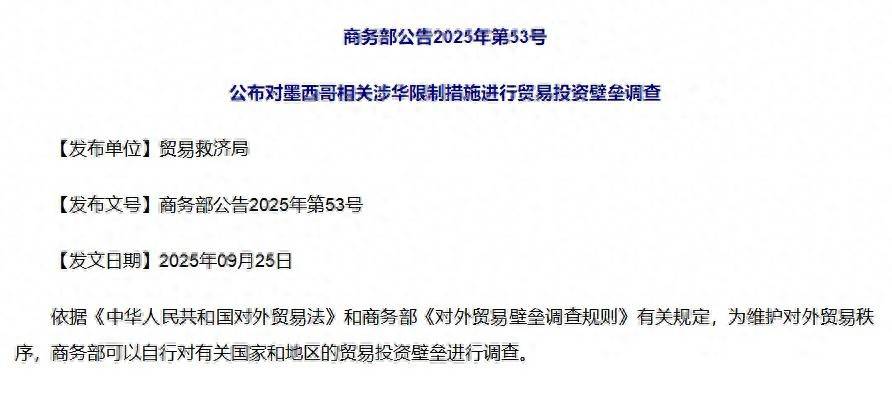
Group 1 - The Chinese Ministry of Commerce announced a trade investigation into Mexico's trade restrictions against Chinese imports, particularly targeting the automotive sector [1] - The investigation was triggered by Mexico's decision to raise tariffs on automotive imports from countries without free trade agreements from 20% to 50%, significantly impacting Chinese automotive exports, which amounted to $3.7 billion in 2022, accounting for 15% of Mexico's total automotive imports [1] - The scope of the investigation mirrors the sectors affected by Mexico's tariff increase, including automotive manufacturing, textiles, children's toys, and agricultural products, with a flexible investigation period of six months that can be extended [1] Group 2 - The investigation serves as a warning to Mexico, emphasizing that external pressures should not compromise third-party interests, implicitly pointing to the influence of the United States [2] - By initiating this investigation during a time when the Biden administration is strengthening economic ties with Mexico, China is sending a clear message that any attempts to create a trade encirclement against China will face strong retaliation [4] - Mexico exports approximately $280 million worth of agricultural products to China annually, with fresh products like avocados and berries having a high dependency rate of 40%, which could become leverage for China in future retaliatory measures [4] Group 3 - There remains a negotiation window of about 90 days before Mexico's tariff policy is officially implemented, indicating potential for resolution [7] - If Mexico proceeds with the tariff increase, it could lead to significant impacts on global supply chains, particularly affecting consumers in Mexico who rely heavily on Chinese manufacturing for automotive and electronic products [7] - The outcome of this trade dispute will test the political acumen of all parties involved [7]

聚酯链进出口数据汇总(8月):长丝短纤出口延续增长,PTA出口规模收缩
Heng Li Qi Huo· 2025-09-26 23:30
Report Summary 1. Investment Rating No investment rating information is provided in the report. 2. Core View In August, the import and export data of the polyester chain showed differentiation. PX imports continued to grow, and ethylene glycol imports remained stable. PTA exports declined, while polyester exports continued to rise year - on - year. Textile and clothing exports also showed different trends, with textile exports rebounding and clothing exports decreasing. The short - term impact of tariffs on clothing and textile exports has decreased, but the tariff negotiation dynamics need continuous attention [2]. 3. Summary by Content PX Import - In August, PX imports reached 87.6 tons, a month - on - month increase of 12% and a year - on - year increase of 15.9%. From January to August, the cumulative import was 615.8 tons, a year - on - year increase of 6.5%, and the cumulative year - on - year growth rate continued to expand. The top three import sources were South Korea, Japan, and Brunei [6][8]. PTA Export - In August, PTA exports were 29.9 tons, a month - on - month decrease of 20.1% and a year - on - year decrease of 26.8%. From January to August, the cumulative export was 253 tons, a year - on - year decrease of 16.9%. The top five export destinations from January to August were Vietnam, Egypt, Oman, Turkey, and Pakistan. In August, exports to Turkey and India decreased significantly [3]. Ethylene Glycol Import - In August, ethylene glycol imports were 59.2 tons, a year - on - year increase of 1.4%. The import volume from Saudi Arabia decreased, but the increase from Kuwait, Oman, and the United States offset the reduction. From January to August, the cumulative import was 502.8 tons, a year - on - year increase of 16%, and the year - on - year growth rate narrowed. Saudi Arabia is the main source of ethylene glycol imports, and future imports are expected to increase [6]. Polyester Export - From January to August, the cumulative polyester export was 962 tons, a year - on - year increase of 15.8%. In August, the export was 122.5 tons, a month - on - month increase of 1.8% and a year - on - year increase of 9.1%. Short - fiber and filament exports performed well, while bottle - chip and film exports decreased month - on - month. The top five export destinations from January to August were Vietnam, Indonesia, South Korea, Pakistan, and India [4][5]. Textile and Clothing Export - From January to August, the cumulative textile and clothing export was $197.3 billion, a year - on - year decrease of 0.4%. Among them, textile exports were $94.53 billion, a year - on - year increase of 1.4%, and clothing exports were $102.77 billion, a year - on - year decrease of 2.1%. In August, textile exports increased both year - on - year and month - on - month, while clothing exports decreased [7].
努力在中国式现代化中走在前列——长三角一体化发展观察(奋勇争先,决战决胜“十四五”)
Ren Min Ri Bao· 2025-09-26 21:57
Economic Growth and Integration - The GDP of the Yangtze River Delta region is projected to grow from 27.6 trillion yuan in 2021 to over 33 trillion yuan by 2024, indicating steady economic growth [2] - Nine cities in the region have entered the "trillion-yuan city" category, and 26 national-level advanced manufacturing clusters account for nearly one-third of the country [2] - The region is home to 282 out of 589 companies listed on the Science and Technology Innovation Board, showcasing its strong innovation capabilities [2] Innovation and Technology - The region is focusing on integrating scientific research and industrial innovation, with a significant emphasis on high-quality development [3][4] - Major industries in Shanghai, such as integrated circuits, biomedicine, and artificial intelligence, have seen continuous growth, reaching a scale of 1.8 trillion yuan [4] - The establishment of specialized synchrotron radiation experimental platforms aims to enhance product development and performance through advanced scientific tools [5][7] Infrastructure and Connectivity - The Shanghai Oriental Hub International Business Cooperation Zone will allow global business personnel to enter without a visa, enhancing international business activities [9][10] - The G60 Science and Technology Corridor connects multiple cities, facilitating collaboration and resource sharing among them [11][12] - A new "super ring" train service connects major cities in the region, improving transportation and integration [16][17] Environmental and Ecological Initiatives - The region is committed to ecological protection and sustainable development, with initiatives like the New安江 ecological compensation mechanism [21][22] - The average proportion of days with good air quality in the region is projected to reach 84.5% by 2024, an increase of 8.8 percentage points since 2018 [22] - The establishment of green manufacturing systems and practices is aimed at balancing economic growth with environmental sustainability [23][24] Future Outlook - The region is focused on continuous high-quality development and integration, with plans to enhance collaborative innovation and resource allocation [25][26]