银行业

Search documents
最新LPR报价公布,连续9个月按兵不动
Zhong Guo Ji Jin Bao· 2026-02-24 03:31
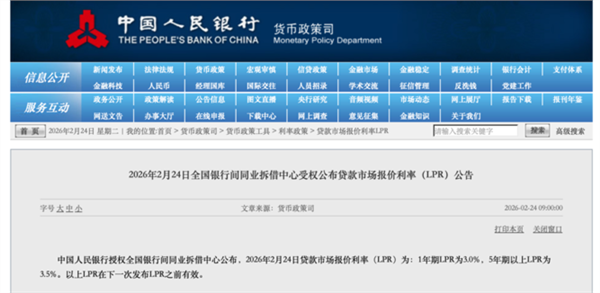
(原标题:最新LPR报价公布,连续9个月按兵不动) 2月24日,中国人民银行授权全国银行间同业拆借中心公布,2026年2月24日贷款市场报价利率(LPR) 为:1年期LPR为3.0%,5年期以上LPR为3.5%。以上LPR在下一次发布LPR之前有效。 这是两个期限品种的LPR报价自去年6月份以来连续9个月保持不变。 东方金诚首席宏观分析师王青分析,LPR报价一直按兵不动,背后的根本原因是受出口持续偏强、以高 技术制造业为代表的新质生产力领域较快发展等推动,同时2025年宏观经济顶住外部经贸波动压力和国 内房地产市场调整等影响,顺利完成全年经济增长目标;2026年1月,央行根据经济金融形势需要,先 行推出一揽子结构性货币政策,强化对科技创新、小微企业等国民经济重点领域和薄弱环节的支持力 度。这也意味着短期内货币政策处于观察期,政策利率和LPR报价有望保持稳定。 "值得注意的是,高频数据显示,2026年一季度我国出口还会处于偏强状态,物价水平有望延续温和回 升势头。这些都为当前货币政策保持定力提供了支撑。"王青称。 展望后续,中国人民银行副行长邹澜于1月15日在国新办新闻发布会上明确指出,今年降准降息还有一 定空 ...

特朗普关税核弹与中东战云密布,金价四连阳逼近5250美元
Sou Hu Cai Jing· 2026-02-24 03:22
汇通财经APP讯——周一(2月22日),现货黄金价格大涨2.5%,为连续四个交易日上涨。周二(2月 23日)亚市早盘,金价延续涨势,截止07:35,现货黄金一度触及5250关口附近,为1月30日以来新 高。美国黄金期货4月合约同样劲升2.8%,结算价报5225.60美元/盎司。这波涨势是多重不确定性叠加 引发的避险需求集中爆发,尤其是美国总统特朗普关税政策反复带来的全球贸易不确定性,成为点燃金 价的最直接导火索。 特朗普的关税大棒:旧伤未愈,新痛又来 故事的起点,依然是那位永远不缺话题的美国总统特朗普。上周五,美国最高法院以一纸裁决,否定了 特朗普此前利用《国际紧急经济权力法》单方面实施关税的权力,认定其超越了总统的职权范围。这无 疑是对特朗普贸易政策的一次重大司法阻击。然而,这并没有让这位以"交易艺术"自居的总统退缩,反 而激发了他更猛烈的反击。 特朗普迅速在社交媒体上连发数条帖文,言辞激烈地警告那些试图借法院裁决"玩花样"的国家,将面 临"更高、甚至更严厉"的关税。他立即祭出了另一项法律武器——《1974年贸易法》第122条款,威胁 对所有国家的进口商品征收最高可达15%的临时关税。这如同一枚在贸易领域引 ...
最高法:2025年司法建议对应的信用卡和保证保险纠纷的增幅 分别低于民商事案件增幅的10%和13%
Xin Lang Cai Jing· 2026-02-24 03:05
Group 1 - The Supreme People's Court emphasizes the implementation of judicial recommendations No. 2 and No. 4, focusing on financial services for the real economy and enhancing consumer rights protection in finance [1] - There is a notable improvement in the governance of financial disputes and diversified resolution methods [1] - By 2025, the increase in credit card disputes and guarantee insurance disputes is projected to be below 10% and 13% respectively, compared to the increase in civil and commercial cases [1]
金价大幅波动,背后究竟隐藏了什么秘密?
Sou Hu Cai Jing· 2026-02-24 02:55
Core Insights - The article highlights the significant price discrepancies in the gold market during the Chinese New Year, particularly on February 22, 2026, where international gold prices surged while domestic prices remained stagnant due to the Shanghai Gold Exchange being closed for the holiday [1][3]. Group 1: Price Discrepancies - On February 22, 2026, the international gold price reached $5,104.24 per ounce, increasing by $117, or over 2.35%, while domestic gold jewelry was priced at 1,560 RMB per gram, with buyback prices around 1,100 RMB per gram, creating a price gap of 460 RMB per gram [1][3]. - The domestic wholesale gold prices were frozen at the last trading day before the holiday, with AU9999 spot and gold T D prices at 1,109 RMB and 1,108.5 RMB per gram respectively, leading to a "parallel universe" effect in pricing [3]. Group 2: Market Dynamics - Retailers raised prices to include a "risk premium" due to uncertainty in international gold prices, which could lead to losses if they sold at pre-holiday prices [3]. - The recovery price for gold jewelry is significantly lower because consumers pay for craftsmanship and brand value, while recyclers only consider the raw material value, leading to a substantial price difference [4][6]. Group 3: Investment vs. Consumption - For consumers purchasing gold jewelry for personal use, the emotional and aesthetic value justifies the higher prices, while investors seeking asset preservation should avoid jewelry and focus on bank gold bars or gold ETFs, which are closely aligned with raw gold prices [10][12]. - The article emphasizes the importance of understanding the different pricing layers in the gold market, where gold serves as both an investment asset and a consumer product, each with distinct pricing mechanisms [12]. Group 4: Market Influences - The surge in international gold prices was driven by expectations of the Federal Reserve starting a rate-cutting cycle in 2026, alongside geopolitical tensions that heightened global risk aversion [8]. - Central banks have been net buyers of gold for several years, with the World Gold Council reporting a net purchase of 863 tons in 2025, contributing to a solid price foundation for gold [8].

宝城期货资讯早班车2026-02-24-20260224
Bao Cheng Qi Huo· 2026-02-24 02:47
投资咨询业务资格:证监许可【2011】1778 号 期货研究报告 资讯早班车-2026-02-24 一、 宏观数据速览 | 发布日期 | 指标日期 | 指标名称 | 单位 | 当期值 | 上期值 | 去年同期值 | | --- | --- | --- | --- | --- | --- | --- | | 2026-01-19 | 2025/12 | GDP:不变价:当季同比 | % | 4.5 | 4.8 | 5.4 | | 2026-01-31 | 2026/01 | 制造业 PMI | % | 49.3 | 49.0 | 49.1 | | 2026-01-31 | 2026/01 | 非制造业 PMI:商务活动 | % | 49.4 | 50.1 | 50.2 | | 2026-02-14 | 2026/01 | 社会融资规模:当月值 | 亿元 | 72208 | 8178 | 70546 | | 2026-02-13 | 2026/01 | M0:同比 | % | 2.7 | 10.6 | 17.2 | | 2026-02-13 | 2026/01 | M1:同比 | % | 4.9 | 6.2 | ...
中原期货晨会纪要-20260224
Zhong Yuan Qi Huo· 2026-02-24 02:27
1. Report Industry Investment Rating No relevant content provided. 2. Core Viewpoints of the Report - The geopolitical tensions between the US and Iran during the Spring Festival in 2026 led to a significant increase in international gold prices and a sharp rebound in international crude oil prices. The global market generally rose during the holiday, which is expected to have a positive impact on the A - share market after the holiday [7][8][9]. - For various commodities, their prices and market trends are affected by factors such as supply - demand relationships, policies, and international events. For example, sugar prices are expected to be weak, while some commodities like urea may continue to be strong [11][13][14]. - In the stock market, due to the decline of US stock indexes during the Spring Festival, the A - share market is expected to open lower, but there may be opportunities for low - buying after the holiday [18][21]. 3. Summary by Relevant Catalogs 3.1 Macro News - Geopolitical risks between the US and Iran escalated during the Spring Festival, causing international gold prices to strengthen and international crude oil prices to rebound significantly. The US Supreme Court ruled that Trump's large - scale tariffs were illegal, and Trump later imposed new tariffs. China continued to promote large - scale equipment updates, and the Fed's January meeting minutes showed differences in interest - rate decisions [7]. - During the Spring Festival, most global markets rose. COMEX silver led the increase, and many stock indexes also rose, while the Dow Jones Industrial Index fell. Alibaba released a new - generation large - model, and the Spring Festival box - office hit a high. OpenAI adjusted its capital expenditure expectations [8][9]. 3.2 Morning Meeting Views on Major Varieties 3.2.1 Agricultural Products - **Sugar**: Supply pressure is the core issue. International and domestic sugar markets face supply increases, but domestic policies and price levels may provide some support. Zhengzhou sugar is expected to be weak and volatile [11]. - **Corn**: Supply pressure has been released, and policy support exists. Demand is limited. The price has support at the bottom, and light - position long positions can be considered [11]. - **Peanut**: Supply and demand are relatively balanced. The price is expected to be in a narrow - range shock. Attention should be paid to the support and resistance levels [11]. - **Pig**: The spot price fell after the holiday, with supply exceeding demand. The futures market shows a pattern of near - term weakness and long - term strength [11]. - **Egg**: The spot price fell after the holiday. The market will digest inventory first, and the futures price may open lower and then rebound [11][13]. - **Jujube**: The price is expected to be stable in the short term, with weak consumption and fragmented demand [13]. - **Cotton**: The new - year planting area reduction provides support, but high inventory restricts price increases. A long - position strategy can be considered at the lower end of the shock range [13]. 3.2.2 Energy and Chemicals - **Caustic Soda**: Supply is sufficient, demand is slightly reduced, and there is inventory pressure. The profit of Shandong chlor - alkali enterprises has turned negative [13]. - **Coking Coal and Coke**: The market was stagnant during the holiday, with high inventory and low downstream demand. The price is expected to first decline and then rise [13]. - **Double - offset Paper**: Supply pressure has been relieved, and demand is stable. The price has broken through the previous range, and long positions can be considered [13]. - **Urea**: The price is stable and strong. Production is at a high level, and demand is expected to pick up. Attention should be paid to Indian tenders [14]. 3.2.3 Non - ferrous Metals - **Gold and Silver**: Prices rose during the holiday due to geopolitical risks and economic uncertainties. A long - position strategy is recommended [14]. - **Copper and Aluminum**: The prices are expected to be under pressure after the holiday. Attention should be paid to inventory changes and downstream demand recovery [14]. - **Alumina**: The market was stable during the holiday, with supply surplus. The price is expected to remain low [14]. 3.2.4 Steel and Iron Alloys - **Rebar and Hot - rolled Coil**: Inventory increased during the holiday. The price is expected to be weak and stable in the short term and may rebound after terminal resumption [14]. - **Ferroalloys**: Prices were stable during the holiday. Supply and demand changed little, and the market is waiting for external drivers [14][16]. 3.2.5 Lithium Carbonate - Supply is expected to shrink in February, but demand support is limited. It is recommended to wait and see before the holiday and consider long - position opportunities after the holiday if demand recovers [16]. 3.3 Option Finance - The external stock market was weak during the Spring Festival. The A - share market is expected to open lower, but there may be opportunities for low - buying after the holiday. The development of domestic AI is promising, and the market is more interested in AI - related hardware [18][19][21].
1月份金融数据“开门红”成色十足
Jin Rong Shi Bao· 2026-02-24 02:16
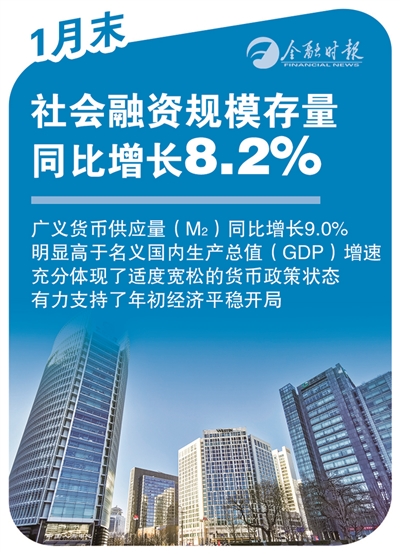
Core Viewpoint - The latest financial statistics released by the central bank indicate that the growth rates of M2 and social financing remain high, creating a favorable monetary environment for economic recovery [1][3]. Monetary Policy and Financing Growth - As of the end of January, the stock of social financing increased by 8.2% year-on-year, while M2 grew by 9.0%, significantly outpacing nominal GDP growth, reflecting a moderately loose monetary policy [3][4]. - The proactive macroeconomic policies, including a reduction in the structural tool interest rate by 0.25 percentage points and increased government bond financing, are key drivers of this growth [3][4]. - In January, government bond financing reached 976.4 billion yuan, an increase of 283.1 billion yuan compared to the same period last year, with its share in total social financing at 13.5%, the highest since 2021 [3][4]. Direct Financing Channels - Besides government bonds, corporate bonds and equity financing are also accelerating, with a focus on providing diversified funding support for high-tech and emerging industries [4][5]. - Companies are increasingly considering a "short loan + long bond" financing model to balance funding costs and durations for project investments and R&D [4]. Credit Growth and Demand Recovery - By the end of January, the balance of RMB loans was 276.62 trillion yuan, growing by 6.1% year-on-year, which is still above nominal economic growth [6][7]. - The first quarter typically sees high credit issuance, and early policy implementation can yield quicker results [6]. - Major projects are driving increased project loan disbursements, with the National Development and Reform Commission announcing a total investment of approximately 295 billion yuan for early construction projects [6]. Support for the Real Economy - In January, new loans to enterprises reached 4.45 trillion yuan, with over 70% being medium- and long-term loans, providing substantial support for manufacturing and emerging industries [7][8]. - Personal loans are also experiencing stable growth due to increased consumer spending ahead of the holiday season, supported by favorable policies extending personal consumption loan interest subsidies [7][8]. High-Quality Development Financing - The growth of inclusive small and micro loans reached 37.16 trillion yuan, with a year-on-year increase of 11.6%, indicating a shift of credit resources towards high-quality development sectors [8][9]. - The central bank's structural monetary policy tools, such as re-loans, are effectively supporting consumption and innovation, with significant increases in funding for small and medium-sized enterprises [9][10]. Future Monetary Policy Focus - Experts suggest that future monetary policy should emphasize structural optimization, as the economy transitions to medium-high growth and faces challenges such as high household leverage and bank asset quality [10].
关税、AI双重“暴击”,三大股指全线大跌
2 1 Shi Ji Jing Ji Bao Dao· 2026-02-24 02:14
Group 1: Market Overview - The U.S. stock market experienced a significant decline, with the S&P 500 index falling by 1.04% to 6837.75 points, the Nasdaq composite down 1.13% to 22627.27 points, and the Dow Jones Industrial Average dropping 1.66% to 48804.06 points due to dual pressures from tariff news and AI concerns [1] - The uncertainty surrounding U.S. tariff policies is negatively impacting market risk appetite, with analysts indicating that the Supreme Court ruling is not seen as a signal for trade easing [3] Group 2: Tariff Policy Implications - The Biden administration is focusing on extending tariff tools rather than expediting refunds, implementing a temporary global 15% tariff for 150 days while utilizing traditional tools to build new tariff barriers [1] - The estimated refunds for IEEPA tariffs could exceed $175 billion, representing about 0.6% of the U.S. GDP in 2025, potentially increasing the fiscal deficit [3] Group 3: AI Impact on Companies - IBM's stock plummeted over 13%, marking its largest single-day drop since 2000, due to concerns that AI tools like Anthropic's "Claude Code" could disrupt its core business involving COBOL systems [2] - Anthropic's AI programming tool is aimed at modernizing legacy systems that predominantly use COBOL, which is critical for IBM's large-scale transaction processing systems [2] Group 4: Economic Growth Concerns - The U.S. economy showed signs of cooling, with the annualized quarterly GDP growth rate dropping to 1.4% in Q4 2025, primarily due to tariff policies and a prolonged government shutdown [4] - The overall economic growth for 2025 was 2.2%, down from 2.8% the previous year, despite an increase in imports and a widening trade deficit [4] Group 5: Economic Stability Analysis - The chief economist at Wilmington Trust Company suggests that while the U.S. economy appears stable, it is actually quite unstable, with a 45% chance of recession due to slow job growth and rising defaults on consumer loans [5]
关税、AI双重“暴击”,三大股指全线大跌|美股一线
2 1 Shi Ji Jing Ji Bao Dao· 2026-02-24 02:08
Group 1: Market Impact - The U.S. stock market experienced a significant decline, with the S&P 500 index falling by 1.04% to 6837.75 points, the Nasdaq composite dropping by 1.13% to 22627.27 points, and the Dow Jones Industrial Average decreasing by 1.66% to 48804.06 points on February 23 [1] - Concerns over tariffs and AI developments have contributed to market volatility, leading to a trend of "sell first, ask questions later" among investors [1] Group 2: Tariff Policy - The Biden administration is focusing on extending tariff measures rather than expediting refunds, implementing a temporary global 15% tariff for 150 days while utilizing traditional tools to build new tariff barriers [1][3] - The uncertainty surrounding U.S. tariff policies is negatively affecting market risk appetite, with analysts indicating that the Supreme Court ruling does not signal a trade easing [3] Group 3: AI Developments and Company Impact - Anthropic's AI programming tool "Claude Code" aims to modernize legacy systems using COBOL, which is critical for IBM's business, leading to a significant drop in IBM's stock by over 13%, marking its largest single-day decline since 2000 [2] - The introduction of "Claude Code Security" by Anthropic, which scans for security vulnerabilities, has also negatively impacted stock prices of various cybersecurity companies [2] Group 4: Economic Outlook - The U.S. economy showed signs of cooling, with a projected annualized quarterly growth rate of 1.4% for Q4 2025, attributed to tariff policies and government shutdowns [4] - Despite a 2.2% overall growth in 2025, the economic situation appears unstable, with a 45% chance of recession predicted due to slow job growth and rising consumer defaults [5]
专访连平:天量定期存款将到期,如何为实体经济“添薪”蓄力
Nan Fang Du Shi Bao· 2026-02-24 02:07
Core Insights - The 2026 Guangdong Province High-Quality Development Conference focused on the collaborative development of manufacturing and service industries, emphasizing the role of financial innovation in promoting industrial integration [2] - A significant amount of time deposits, estimated between 72 trillion to 90 trillion yuan, will mature in 2026, raising questions about how these funds will be redirected to support industrial integration and technological innovation [5][6] - The release of these funds presents a historic opportunity for banks to adopt differentiated strategies to retain customers and lower funding costs, thereby directing more resources towards high-quality development sectors [2][5] Financial Landscape - The total amount of maturing time deposits in 2026 is projected to be between 72 trillion and 90 trillion yuan, with approximately 49 trillion to 61 trillion yuan from households and 23 trillion to 29 trillion yuan from enterprises [6][7] - The growth rate of time deposits in China has exceeded 10% annually over the past three years, with a total balance of 179.6 trillion yuan as of the end of 2025 [6] Factors Influencing Deposit Behavior - The preference for long-term time deposits has been driven by low-risk tolerance among investors, particularly among older demographics seeking to preserve capital [7][8] - The COVID-19 pandemic and subsequent economic uncertainties have led to an increase in precautionary savings, with many individuals opting for time deposits as a safe asset [8][9] - Regulatory changes in asset management and a downturn in the real estate market have also contributed to the shift towards time deposits [9][10] Potential Fund Allocation Post-Maturity - Upon maturity, a portion of these funds is expected to remain within the banking system, while some may flow into private banking products, bonds, and equity markets, depending on market conditions [10][11] - The likelihood of a large-scale migration of deposits to capital markets is low due to the conservative risk profile of depositors, but some funds may seek higher returns in stable investment vehicles [11][12] Economic Implications - The movement of these funds into capital markets could enhance liquidity, stimulate market activity, and support direct financing for enterprises, particularly benefiting small and medium-sized enterprises [14] - A portion of the released funds may also enter the consumer market, potentially boosting demand in sectors like retail and tourism [14] Banking Sector Impact - The upcoming maturity of time deposits is expected to improve bank performance in the short term by reducing funding costs, but may also lead to long-term challenges as banks face pressure on asset yields [19][20] - Large state-owned banks are better positioned to retain maturing deposits due to their extensive customer base and resources, while smaller banks may struggle to compete [20][21] Strategies for Customer Retention - Different types of banks are adopting varied strategies to retain customers amid the maturing deposit wave, with state-owned banks focusing on comprehensive service offerings and smaller banks emphasizing local engagement and innovative products [21][23] - The competition is shifting from interest rate-based retention to a focus on overall service quality and customer experience [23]