
石油石化

Search documents
固定收益周报:重点转至政府债发行-20260104
Huaxin Securities· 2026-01-04 14:25
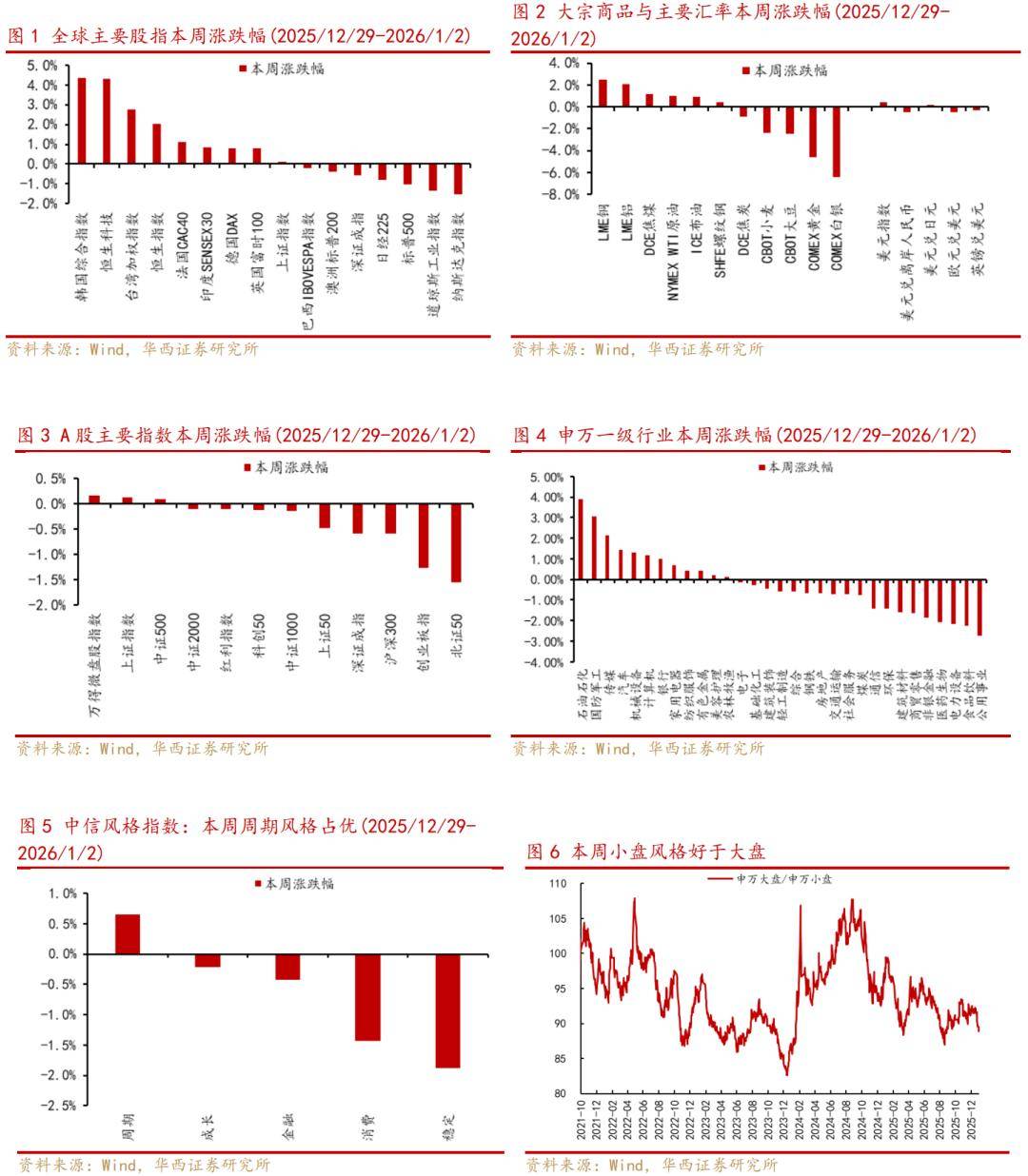
1. Report Industry Investment Rating No relevant information provided. 2. Core Viewpoints of the Report - The focus of observation has shifted to the government bond issuance in January 2026. The government bond issuance in January 2026 is in line with expectations. The long - end bonds are at the upper limit of the expected range and are worth participating in. For equities, the style is generally balanced with growth slightly dominant before the significant increase in government bond issuance. The report recommends a portfolio of the Shanghai Composite 50 Index (40% position), the China Securities 1000 Index (40% position), and the 30 - year Treasury Bond ETF (20% position) [2][8][21] - In the deleveraging cycle, the stock - bond ratio favors equities to a limited extent, and the value style is more likely to be dominant. The report recommends an A + H dividend portfolio of 13 stocks and an A - share portfolio of 20 stocks, mainly concentrated in industries such as banking, telecommunications, petroleum and petrochemicals, and transportation [9][55] 3. Summary by Relevant Catalogs 3.1 National Asset Balance Sheet Analysis - **Liability Side**: In November 2025, the liability growth rate of the real - economy sector was 8.6% (previous value: 8.7%), in line with expectations. It is expected to decline to around 8.3% in December 2025, lower than the 8.8% at the end of 2024, consistent with the goal of stabilizing the macro - leverage ratio. The government debt growth rate is expected to decline to around 12.4% in December 2025 from 13.1% at the end of November 2025. The central bank's stance on stabilizing the macro - leverage ratio remains unchanged, and the quantitative fiscal targets are awaited from the Two Sessions in 2026 [2][16][17] - **Monetary Policy**: Last week, the capital market tightened marginally. The one - year Treasury bond yield rose to 1.34% at the weekend. It is estimated that the lower limit of the one - year Treasury bond yield is about 1.3%, with a central value around 1.4%, and a 10 - basis - point interest rate cut is expected in 2026. The term spread between the ten - year and one - year Treasury bonds narrowed to 51 basis points. The spreads between the ten - year and one - year Treasury bonds and between the thirty - year and ten - year Treasury bonds are expected to be in the range of 20 - 50 basis points, and the future yield ranges of the ten - year and thirty - year Treasury bonds are expected to be around 1.6% - 1.9% and 1.8% - 2.3% respectively [3][17] - **Asset Side**: In November 2025, the physical volume data showed signs of stabilizing at a low level compared to October. The full - year real economic growth target for 2025 was set at around 5%, and the nominal economic growth target was around 4.9%. It remains to be seen whether a nominal economic growth rate of around 5% will become the central target for China's nominal economic growth in the next 1 - 2 years [4][18] 3.2 Stock - Bond Cost - effectiveness and Stock - Bond Style - **Macroeconomic Background**: Since 2011, China has entered a period of declining potential economic growth, which seems to have ended in Q4 2024. Subsequently, China's profit cycle has entered a state of narrow - range oscillation at a low level. The government's policy goals of stabilizing the macro - leverage ratio, having the financial sector benefit the real economy, and ensuring that housing is for living in rather than speculation are still in effect, and the deleveraging on the liability side has limited room for further contraction. If the valuation of the technology sector in the US is re - evaluated, global funds may flow from the US to China, and attention should be paid to whether the RMB exchange rate will enter an appreciation channel. The risk appetite may also oscillate within a certain range [6][19] - **Market Performance**: Last week, the capital market tightened marginally, resulting in a double - kill of stocks and bonds, with the growth style still dominant. The yields of both long - and short - term bonds rose, and the stock - bond cost - effectiveness favored stocks. The ten - year Treasury bond yield rose by 1 basis point to 1.85%, the one - year Treasury bond yield rose by 5 basis points to 1.34%, and the thirty - year Treasury bond yield rose by 4 basis points to 2.27%. The broad - based rotation strategy outperformed the CSI 300 Index by 0.03 pct last week but has underperformed the CSI 300 Index by - 5.34 pct since its establishment in July 2024, with a maximum drawdown of 12.1% (compared to 15.7% for the CSI 300 Index) [7][20] 3.3 Industry Recommendations - **Industry Performance Review**: This week, the A - share market rose with increased trading volume. The Shanghai Composite Index rose 0.13%, while the Shenzhen Component Index fell 0.58% and the ChiNext Index fell 1.25%. Among the Shenwan primary industries, petroleum and petrochemicals, national defense and military industry, media, automobiles, and machinery and equipment had the largest increases, with weekly changes of 3.9%, 3.1%, 2.1%, 1.4%, and 1.3% respectively. Public utilities, food and beverages, power equipment, pharmaceuticals, and non - bank finance had the largest declines, with weekly changes of - 2.7%, - 2.3%, - 2.2%, - 2.1%, and - 1.8% respectively [26][27] - **Industry Crowding and Trading Volume**: As of December 31, the top five industries in terms of crowding were electronics, power equipment, machinery and equipment, national defense and military industry, and computers, with values of 15.5%, 9.4%, 8.9%, 8%, and 6.8% respectively. The bottom five were comprehensive, beauty care, coal, steel, and petroleum and petrochemicals. The top five industries with increased crowding this week were media, machinery and equipment, household appliances, computers, and national defense and military industry. The trading volume of the entire A - share market rebounded this week. Media, petroleum and petrochemicals, computers, beauty care, and national defense and military industry had the highest year - on - year growth rates in trading volume [28][30] - **Industry Valuation and Earnings**: This week, among the Shenwan primary industries, the PE (TTM) of petroleum and petrochemicals, national defense and military industry, media, machinery and equipment, and automobiles had the largest increases, while public utilities, food and beverages, power equipment, pharmaceuticals, and non - bank finance had the largest declines. Industries with high full - year 2024 profit forecasts and relatively low current valuations compared to historical levels include banking, insurance, coal, public utilities, transportation, pharmaceuticals, beauty care, new energy, and consumer electronics [34][35] - **Industry Prosperity**: Externally, there was a marginal decline in demand. The global manufacturing PMI decreased from 50.5 to 50.4 in December. Internally, the second - hand housing price remained flat in the latest week, and the quantity indicators showed mixed trends. The capacity utilization rate of ten industries showed a fluctuating upward trend from May to December 2025 [39] - **Public Fund Market Review**: In the fifth week of December (December 29 - 31), most actively managed public equity funds outperformed the CSI 300 Index. As of December 31, the net asset value of actively managed public equity funds was 3.95 trillion yuan, slightly up from 3.66 trillion yuan in Q4 2024 [52] - **Industry Recommendations**: In the deleveraging cycle, an A + H dividend portfolio of 13 stocks and an A - share portfolio of 20 stocks are recommended, mainly concentrated in industries such as banking, telecommunications, petroleum and petrochemicals, and transportation [55]
深度学习因子12月超额5.46%,本周热度变化最大行业为有石油石化、建筑装饰:市场情绪监控周报(20251229-20251231)-20260104
Huachuang Securities· 2026-01-04 14:05
- The DecompGRU model was used to construct a weekly long-only stock selection portfolio, holding the top 200 stocks with the highest integrated scores based on the model. The portfolio is rebalanced weekly on the first trading day, using factor values updated after the previous Friday's close. Stocks from the CSI All Share Index are selected, excluding stocks with trading halts or price limits, and transaction costs are not considered. The benchmark for comparison is the CSI All Share equal-weighted index[7][9] - The DecompGRU model's stock scores were aggregated to construct an ETF rotation portfolio. The ETF pool is limited to industry and thematic ETFs, retaining only the ETF with the highest 5-day average trading volume if multiple ETFs track the same index. ETFs must meet minimum trading volume criteria (5-day average > 20 million and 20-day average > 10 million). The portfolio holds 2-6 ETFs per period and is rebalanced weekly without a fixed schedule. The benchmark for comparison is the Wind ETF Index[10][12] - A sentiment factor was constructed using user behavior data from Tonghuashun, aggregating stock-level heat metrics (browsing, watchlist, and click counts) normalized by market share on the same day and multiplied by 10,000. The sentiment factor serves as a proxy for "emotional heat" at the broader index, industry, and concept levels[14] - A simple rotation strategy was built based on weekly heat change rates (MA2 smoothed) for broad-based indices. On the last trading day of each week, the strategy buys the index with the highest heat change rate. If the "Others" group has the highest rate, the strategy remains in cash. The strategy's annualized return since 2017 is 8.74%, with a maximum drawdown of 23.5%. In 2025, the strategy achieved a return of 36.8%, compared to the benchmark's 35%[20][23] - A concept-level sentiment strategy was constructed by selecting the top 5 concepts with the highest weekly heat change rates. Stocks within these concepts were filtered to exclude the bottom 20% by market capitalization. Two portfolios were created: a "TOP" portfolio holding the top 10 stocks by total heat within each concept, and a "BOTTOM" portfolio holding the bottom 10 stocks. The BOTTOM portfolio achieved an annualized return of 15.71% with a maximum drawdown of 28.89%. In 2025, the BOTTOM portfolio returned 41.8%[40][41] - The DecompGRU TOP200 portfolio achieved a cumulative absolute return of 60.48% and an excess return of 34.62% relative to the CSI All Share equal-weighted index since its inception on March 31, 2025. The portfolio's maximum drawdown was 10.08%, with weekly and monthly win rates of 67.50% and 100%, respectively. In December 2025, the portfolio's absolute return was 7.57%, with an excess return of 5.46%[9] - The ETF rotation portfolio achieved a cumulative absolute return of 26.23% and an excess return of 1.56% relative to the Wind ETF Index since its inception on March 18, 2025. The portfolio's maximum drawdown was 7.82%, with weekly and monthly win rates of 60.98% and 66.67%, respectively. In December 2025, the portfolio's absolute return was 2.35%, with an excess return of -1.51%[12][13]
李立峰、张海燕:春季躁动提前启动,牛市格局依旧未改
Sou Hu Cai Jing· 2026-01-04 12:53
Market Review - The South Korean Composite Index, Hong Kong's Hang Seng Tech Index, and Taiwan Weighted Index led global gains, while US stock indices declined during the week of December 29, 2025, to January 2, 2026. In the A-share market, cyclical and growth sectors performed well, with oil and petrochemicals, military industry, and media leading gains, while utilities lagged behind. On January 2, 2026, the Hong Kong stock market opened strong, with the Hang Seng Tech Index surging 4%, particularly in semiconductor, AI computing, and internet giants, indicating a recovery in market risk appetite. In commodities, base metals and crude oil rose, while precious metals fell, with COMEX silver and gold down 6.39% and 4.63%, respectively. The offshore RMB strengthened against the US dollar, surpassing 6.97 on Friday [1][2][3]. Market Outlook - The market is expected to maintain a bullish trend into 2026, driven by several positive factors. The macro policy cycle is favorable, with multiple departments rolling out supportive industrial policies and investment plans as 2026 marks the start of the 14th Five-Year Plan. Coordinated fiscal and monetary policies are creating a friendly liquidity environment. Institutional funds, particularly in stock ETFs, have shown significant inflows, indicating a strong willingness to invest as foreign capital returns due to currency appreciation. The narrowing decline in PPI suggests a mild recovery in corporate profits, which will support market sentiment [2][4][5]. Key Focus Areas 1. **Overseas Developments**: The selection of a new Federal Reserve Chair is a key focus, with the December meeting minutes indicating a majority support for further rate cuts, though there are significant policy path divergences. The probability of a rate cut in January is low at 17%, with potential candidates like Hassett and Waller advocating for further easing [2][3]. 2. **PMI Data**: Both manufacturing and non-manufacturing PMIs returned to expansion territory in December 2025, with manufacturing PMI at 50.1% and non-manufacturing PMI at 50.2%. This improvement in production and new orders supports the spring market rally [3][4]. 3. **Policy Measures**: The government has implemented a series of targeted policies to boost market confidence, including a 295 billion yuan investment plan and early release of subsidies and local debt limits. The real estate sector is also seeing policy adjustments to lower transaction costs, which may stabilize market expectations [4][5]. 4. **Institutional Investment Trends**: There has been a notable net inflow of institutional funds into stock ETFs, particularly those related to the A500 index, indicating a proactive approach to the upcoming spring market rally. The favorable policy outlook and stable currency are expected to attract further foreign investment [5]. Industry Focus - The focus for industry investment should be on emerging growth sectors supported by policy, such as AI computing, robotics, and energy storage, as well as sectors benefiting from price increases and "anti-involution" trends, including chemicals and non-ferrous metals [5].

A股策略周报:春季行情可期,主题成长突围-20260104
Ping An Securities· 2026-01-04 09:45
Core Viewpoints - The A-share market is expected to see a spring rally, with thematic growth breaking through despite mixed signals from the global economy and domestic indicators [2] - The manufacturing PMI for December rose by 0.9 percentage points to 50.1, indicating a return to expansion [3][4] - The "old-for-new" policy and optimization of real estate policies are expected to further support domestic demand [2] Recent Dynamics - The manufacturing PMI increased to 50.1, with production and new orders indices both above 50, indicating improved business conditions [3][4] - The construction PMI rose significantly by 3.2 percentage points to 52.8, reflecting a strong recovery in the construction sector [4] - The service sector PMI also showed slight improvement, rising to 49.7, indicating a gradual recovery [4] Policy Tracking - The 2026 "old-for-new" policy aims to support the replacement of old vehicles and appliances, with a focus on smart products and mid-to-high-end automobiles [5][6] - The reduction of the personal housing sales value-added tax rate is expected to enhance the activity in the second-hand housing market [6] - The central bank's measures to strengthen the digital RMB management system are set to enhance financial services [6] Market Performance - The A-share market showed mixed performance, with the Shanghai Composite Index slightly up by 0.13%, while the ChiNext Index fell by 1.25% [15] - Key sectors such as oil and petrochemicals, defense, and media led the gains, with increases of 3.92%, 3.05%, and 2.13% respectively [13][15] - The average daily trading volume in the A-share market rose to approximately 2.1 trillion yuan, reflecting an 8.3% increase week-on-week [15][17]
金融工程:AI识图关注化工、非银和卫星
GF SECURITIES· 2026-01-04 09:04
- The report introduces a quantitative model based on Convolutional Neural Networks (CNN) to analyze price-volume data and predict future stock prices. The model maps learned features to industry theme indices, including chemical, non-bank financial, and satellite sectors[77][79][80] - The construction process involves standardizing price-volume data into graphical formats for each stock within a specific window period. These standardized charts are then used as input for the CNN model to identify patterns and predict future trends[77][78][79] - The model's evaluation highlights its ability to capture complex relationships in price-volume data and its application in thematic industry allocation. It emphasizes the importance of deep learning techniques in quantitative finance[77][80] - Backtesting results show the latest thematic allocations include indices such as CSI Subdivision Chemical Industry Theme Index, CSI Satellite Industry Index, CSI All Share Dividend Quality Index, and others, reflecting the model's predictions[79][80]
量化择时周报:上行趋势仍在持续,板块如何选择-20260104
ZHONGTAI SECURITIES· 2026-01-04 08:46
- Model Name: Timing System Model; Model Construction Idea: The model uses the distance between the long-term moving average (120 days) and the short-term moving average (20 days) to distinguish the overall market environment[2][6][11] - Model Construction Process: The model calculates the distance between the 20-day moving average and the 120-day moving average. The latest data shows the 20-day moving average at 6298 points and the 120-day moving average at 6090 points. The difference between the two lines is 3.41%, and the absolute value of the distance continues to be greater than 3%, indicating that the market is in an upward trend[2][6][11] - Model Evaluation: The model effectively identifies the market's upward trend, providing a positive signal for market timing[2][6][11] - Model Name: Industry Trend Allocation Model; Model Construction Idea: The model identifies industry trends and allocates based on medium-term reversal expectations and sector performance[2][5][7] - Model Construction Process: The model signals to focus on service consumption sectors such as tourism and media based on medium-term reversal expectations. The TWO BETA model continues to recommend the technology sector, focusing on AI applications and commercial aerospace. The industry trend model shows that the communication, industrial metals, and energy storage sectors continue their upward trend[2][5][7] - Model Evaluation: The model provides clear guidance on sector allocation, helping investors to focus on promising sectors[2][5][7] - Model Name: Position Management Model; Model Construction Idea: The model suggests stock allocation based on valuation indicators and short-term trends[5][7] - Model Construction Process: The model uses the PE and PB ratios of the WIND All A Index. The PE ratio is near the 90th percentile, indicating a relatively high valuation, while the PB ratio is at the 50th percentile, indicating a moderate level. Based on these indicators and short-term trends, the model suggests an 80% stock allocation for absolute return products[5][7] - Model Evaluation: The model provides a balanced approach to stock allocation, considering both valuation and market trends[5][7] Model Backtest Results - Timing System Model, Moving Average Distance: 3.41%[2][6][11] - Timing System Model, Market Trend Line: 6262 points[2][6][11] - Timing System Model, Profit Effect: 2.71%[2][6][11] - Position Management Model, PE Ratio: 90th percentile[5][7] - Position Management Model, PB Ratio: 50th percentile[5][7] - Position Management Model, Stock Allocation: 80%[5][7]
短期模型大部分翻多,开年行情可期:【金工周报】(20251229-20251231)-20260104
Huachuang Securities· 2026-01-04 08:25
- Short-term volume models for some broad-based indices turned bullish[1][3][11] - Feature-based institutional model turned bullish[1][3][11] - Feature-based volume model remained neutral[1][3][11] - Intelligent algorithm model for CSI 300 remained neutral, while for CSI 500 turned bullish[1][3][11] - Mid-term limit-up and limit-down model turned bullish[1][3][12] - Up-down return difference model turned bullish for all broad-based indices[1][3][12] - Calendar effect model remained neutral[1][3][12] - Long-term momentum model turned bullish for some broad-based indices[1][3][13] - Comprehensive A-share V3 model turned bullish[1][3][13] - Comprehensive A-share Guozheng 2000 model turned bullish[1][3][13] - Mid-term turnover amplitude model for Hong Kong stocks turned bullish[1][3][14] - Hang Seng Index up-down return difference model remained neutral[1][3][14]
宏观和大类资产配置周报:寻找美元的替代品-20260104
Bank of China Securities· 2026-01-04 07:44
Macro Economic Overview - The report indicates a downward trend in the Shanghai Composite Index, which fell by 0.59% this week, while the CSI 300 index futures decreased by 0.06% [1][11] - The report highlights a mixed performance in commodity futures, with coking coal futures down by 0.76% and iron ore futures up by 2.00% [1][11] - The yield on ten-year government bonds increased by 1 basis point to 1.85%, while active ten-year government bond futures dropped by 0.36% [1][11] Asset Allocation Recommendations - The recommended order for asset allocation is equities > commodities > bonds > currency, reflecting a positive outlook on A-shares and stable bond yields [2][4] - The report suggests that the U.S. dollar's safe-haven status is weakening, prompting international capital to seek alternatives, with RMB assets being a top choice due to their stability and growth potential [2][4] - The report anticipates that commodity prices will be influenced by supply pressures in oil and demand dynamics in cyclical goods, while agricultural products will be affected by supply factors [2][4] Key Economic Indicators - The manufacturing PMI for December was reported at 50.1, indicating a slight expansion, while the non-manufacturing PMI was at 50.2, returning to the expansion zone [18] - The report notes that the upcoming National People's Congress will convene on March 4, 2026, which may influence economic policies [18][19] Market Performance Insights - The report details a significant decline in the real estate market, with a notable drop in transaction volumes for new homes in major cities, indicating potential market stabilization due to recent policy changes [36][41] - The automotive sector is experiencing a downturn, with wholesale and retail sales of passenger vehicles showing negative growth for four consecutive weeks [36][41] Bond Market Analysis - The yield on ten-year government bonds has risen to 1.85%, with a noted increase in the yield of ten-year policy bank bonds to 2.00% [46] - The report highlights a significant rise in yields for low-rated credit bonds, indicating a shift in market sentiment [46]
港股IPO放量的影响与高效打新策略
Sou Hu Cai Jing· 2026-01-04 02:06
Group 1 - The Hong Kong IPO market has significantly rebounded in 2025, with 99 companies listed as of December 12, raising over 250 billion HKD, accounting for 67% of the total fundraising for Chinese companies this year, marking a 10-year high [1][17][21] - The IPO success rate has increased to 73% with an apparent return rate of 34%, both significantly higher than previous years, although the average winning rate has dropped to 20%, the lowest in a decade [1][21] - The characteristics of the Hong Kong IPO market include a registration system with a low listing success rate of 37% since 2016, no market capitalization requirements for participation, and a higher first-day failure rate compared to A-shares, averaging 45% since 2016 [1][6][50] Group 2 - There is a weak positive correlation between the primary market financing and the secondary market performance, driven by common macroeconomic factors such as a weak US dollar and low Hibor rates [2][7][62] - Large IPOs do not significantly impact the overall secondary market but can boost specific sectors like consumer goods and technology [2][8] - A selection model for IPOs can enhance returns by evaluating market sentiment, company fundamentals, and issuance characteristics, with a scoring system that can increase returns by approximately 15 percentage points for selected stocks [2][9] Group 3 - The outlook for 2026 suggests continued activity in the Hong Kong IPO market, with 314 companies currently in the listing application process, estimating a central fundraising scale of around 330 billion HKD [3][24][28] - The historical data indicates that the performance of the secondary market in the previous year influences the IPO application decisions of companies [3][25] - The average fundraising scale in 2026 is expected to be over 20% higher than in 2025, reflecting a robust pipeline of IPOs [3][28]

A股市场运行周报第74期:看多马年春节,短线两手准备-20260103
ZHESHANG SECURITIES· 2026-01-03 13:44
Core Viewpoints - The report is optimistic about the A-share market post-New Year, anticipating a "good start" after the holiday due to the rise in Hong Kong stocks and the A50 index [1][2][50] - There is uncertainty regarding the sustainability of the three driving factors behind the recent A-share rally: the A500 ETF's volume and price increase, the strength of optical modules, and the booming commercial aerospace sector [1][2][50] - The mid-term outlook suggests that the market may continue to rise before March, with a general recommendation to be bullish and proactive in investments [1][2][50] Market Overview - The market experienced narrow fluctuations before the New Year, with most broad indices slightly declining; the Shanghai Composite Index rose by 0.13%, while the CSI 300 and SSE 50 fell by 0.59% and 0.47% respectively [10][48] - The A500 ETF's share increased by only 1.58 billion shares in the last three days before the holiday, a significant drop from the previous week [10][48] - The overall market sentiment indicated a tendency to "rest and prepare for the next battle," as reflected in the low volatility before the holiday [10][48] Sector Observations - The report highlights strong performance in the petrochemical and commercial aerospace sectors, with the oil and petrochemical sector rising by 3.92% and the commercial aerospace sector increasing by 3.05% [13][49] - The report notes a resurgence in interest in robotics and AI applications, with automotive and machinery sectors rising by 1.44% and 1.32% respectively, while consumer sectors like food and beverage saw declines [13][49] Fund Flow Analysis - The latest margin trading balance reached 2.54 trillion yuan, an increase of 0.47% from the previous week, indicating a positive trend in fund inflow [26][48] - The report indicates that the securities ETF saw the highest net inflow of 13.1 billion yuan, while the electronic ETF experienced the largest outflow of 8.9 billion yuan [26][48] Valuation Insights - The dynamic valuation model shows that the current market indices have seen an increase in valuation levels, with the Shanghai Composite Index's PE-TTM at 16.59, placing it in the 91.99 percentile [40][42] - The Shenzhen Component Index's PE-TTM is at 31.24, in the 77.52 percentile, indicating a generally elevated valuation across major indices [40][42]