化工

Search documents
另类视角看行业Ⅱ:CJSC 人形机器人系列指数:“具身”启新程,“人形”创未来
Changjiang Securities· 2026-02-28 06:42
Investment Rating - The report emphasizes the strategic significance of the humanoid robot industry, indicating a strong investment outlook as the industry transitions from the "0-1" stage to the "1-10" stage of development [3][6]. Core Insights - The 2026 Spring Festival Gala marked a historic milestone for the humanoid robot industry, showcasing advanced technologies and commercial opportunities, which have significantly increased consumer interest and market potential [17][20]. - The report outlines the evolution of the humanoid robot industry through four key stages, highlighting the transition from academic exploration to commercial mass production [27]. - The establishment of a specialized humanoid robot index is crucial for guiding capital towards core segments of the industry and aligning with national strategic directives [27][28]. Summary by Sections Industry Overview - The humanoid robot industry is experiencing rapid growth, driven by advancements in AI and robotics, with significant public interest generated by high-profile events like the Spring Festival Gala [20][24]. - The report identifies key technological advancements in humanoid robots, including dynamic control, AI integration, and physical interaction capabilities [20][24]. Key Sectors and Companies - **Rare Earth Materials**: Essential for high-performance motors used in humanoid robots, providing stability and efficiency [7]. - **Chemicals**: The development of AI and related hardware is expected to increase demand for semiconductor materials and cooling solutions [7]. - **New Energy**: Focus on core components like reducers and screws, with companies developing batteries specifically for humanoid robots [7]. - **Automotive**: The automotive industry is heavily involved in the production of humanoid robots, leveraging existing manufacturing capabilities [8]. - **Home Appliances**: Companies like Midea are exploring humanoid robots for both B2B and consumer applications [8]. - **Electronics**: The report highlights the importance of machine vision in humanoid robots, distinguishing them from other types of robots [8]. - **Computing**: The integration of large AI models is seen as critical for enhancing the capabilities of humanoid robots [9]. Investment Opportunities - The report suggests that investors should focus on companies with strong technological barriers and high-profit margins in core components, as these will likely yield the best returns as the industry scales [38]. - The humanoid robot index will help investors identify key players and trends within the rapidly evolving market [27][39]. Index Performance - The humanoid robot indices have outperformed broader market benchmarks, particularly in 2023 and 2025, indicating strong investor interest and market confidence in this sector [40][41].

春节中观景气跟踪:春节旅游景气提升,科技和资源涨价
GUOTAI HAITONG SECURITIES· 2026-02-28 05:44
Group 1: Spring Festival Tourism - The Spring Festival travel demand significantly increased due to a 9-day extended holiday, with average daily cross-regional passenger flow up by 6.0% year-on-year during the first 24 days of the Spring Festival travel period [7][10] - Domestic average daily tourism volume and revenue during the Spring Festival increased by 5.7% and 5.5% year-on-year, respectively, recovering to 111.7% and 121.6% of the levels seen in 2019 [10][12] - Despite the increase in volume, the average daily spending per tourist was 149.8 yuan, down 11.3% year-on-year, indicating a need for improvement in consumer spending willingness [10][12] Group 2: Downstream Consumption - New home sales in 30 major cities increased by 47.7% compared to the same period last year, with first-tier cities seeing an 84.0% increase [18][21] - The average price of live pigs decreased by 0.9% week-on-week, attributed to a still ample supply [22][23] - The release of new real estate policies in Shanghai is expected to effectively stimulate pent-up housing demand [18] Group 3: Technology and Manufacturing - The prices of DRAM memory chips remained high, with average prices for DDR3, DDR4, and DDR5 increasing by 0.3%, 0.0%, and 0.1% respectively compared to pre-holiday levels [24][25] - The revenue of the semiconductor industry in Taiwan continued to grow rapidly, with storage sector companies seeing a year-on-year revenue increase of approximately 200% [24][25] - Lithium carbonate prices rose by 5.8% and lithium hydroxide prices by 5.1% due to increased expectations for downstream energy storage demand [26] Group 4: Upstream Resources - Coal prices increased slightly by 0.7% week-on-week, with port inventories continuing to decline [29][31] - Industrial metal prices showed a strong fluctuation, with copper and aluminum prices on the Shanghai Futures Exchange rising by 1.1% and 1.5% respectively [32][33] - International industrial metal prices also experienced upward trends due to expectations of interest rate cuts and geopolitical tensions [32][33]
2月28日晋煤华昱甲醇最新报价 每日提醒
Xin Lang Cai Jing· 2026-02-28 03:42
已有0人打赏 新浪合作大平台期货开户 安全快捷有保障 原标题:2月28日晋煤华昱甲醇最新报价 每日提醒 来源:甲醇网 晋煤华昱:1950元/吨起拍,3050吨,最终1966-1967全部成交。 (来源:甲醇网) ...


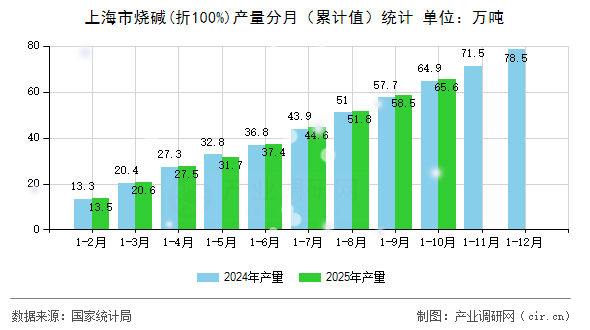
【图】2025年10月上海市烧碱(折100%)产量数据分析
Chan Ye Diao Yan Wang· 2026-02-28 03:28
Core Insights - The production of caustic soda (100% equivalent) in Shanghai's industrial enterprises reached 656,000 tons in the first ten months of 2025, marking a 1.1% increase compared to the same period in 2024, but the growth rate has slowed down by 7.6 percentage points compared to 2024 [1] - The production accounted for 1.7% of the national caustic soda production of 38.241 million tons during the same period, which is 3.5 percentage points lower than the national growth rate [1] Monthly Analysis - In October 2025, the caustic soda production in Shanghai was 71,000 tons, showing a decline of 1.1% compared to October 2024, with a growth rate decrease of 1.2 percentage points compared to the previous year [2] - This production represented 1.8% of the national caustic soda output of 3.897 million tons for the same month, which is 4.6 percentage points lower than the national growth rate [2]
巴斯夫公布2025财年业绩,将把部分岗位转移至亚洲
Xin Lang Cai Jing· 2026-02-28 02:12
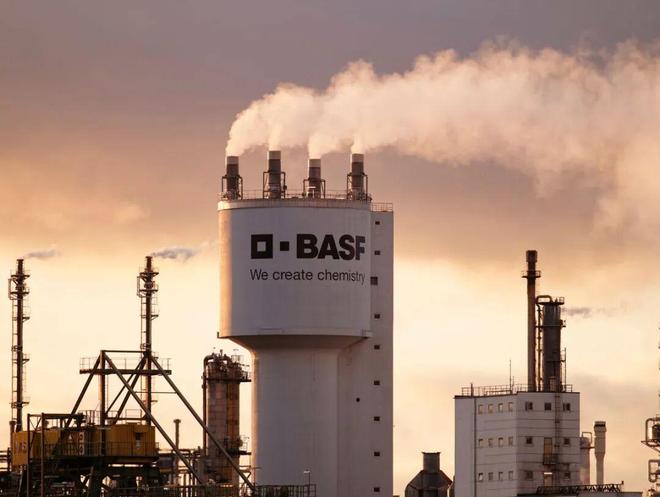
Core Viewpoint - BASF, the world's largest chemical company, reported a decline in both profit and revenue for the fiscal year 2025 compared to 2024, indicating ongoing challenges in the market and a need for significant cost-cutting measures [1][2]. Financial Performance - Revenue decreased by nearly 3%, from €61.4 billion in 2024 to €59.7 billion in 2025 [1]. - Operating profit fell by nearly 10%, from €7.2 billion in 2024 to €6.6 billion in 2025, with an expected operating profit of €6.2 to €7.0 billion for 2026 [1]. - Net profit attributable to shareholders increased from €1.3 billion to €1.6 billion, primarily due to special gains from the sale of the construction coatings business to Sherwin-Williams and compensation related to asset seizures in Russia [1]. Cost-Cutting Measures - The company plans to transfer jobs from Germany to Asia to significantly reduce costs, with an expected annual cost saving of approximately €2.3 billion by the end of 2026, exceeding the initial target of €2.1 billion [2][3]. - Administrative positions will be cut, including those in Berlin, although specific layoff numbers have not been disclosed [3]. - Capital expenditures will be significantly reduced, with fixed asset investments limited to €13 billion from 2026 to 2029, over 30% lower than the previous plan [3]. Operational Adjustments - BASF is focusing on enhancing efficiency through competitive service levels and targeted digital transformation while significantly reducing the overall workforce in the digital sector [4]. - The company has recently cut approximately 4,800 jobs, with a reduction of 11% in management positions, aiming for cost savings of €1.7 billion by 2025 [5]. - The Ludwigshafen site, which employs about 33,000 people, is under pressure due to low capacity utilization and is currently operating at a loss [5]. Market Outlook - The outlook for 2026 remains cautious, with no signs of improvement in operating conditions, and the company does not anticipate a significant market recovery or easing of geopolitical tensions in the short term [5].

财经视角解读德国总理访华,五大看点背后有哪些深意?
Huan Qiu Wang· 2026-02-28 01:31
Group 1 - The core message of the news is that German Chancellor Merz's visit to China signifies a renewed commitment to the comprehensive strategic partnership between China and Germany, emphasizing mutual benefits and deepening cooperation [1][2][3] - The visit is marked by the largest business delegation since Merkel's era, indicating Germany's urgent need to explore the Chinese market amid economic pressures [2][3] - The bilateral trade volume between China and Germany reached 251.8 billion euros in 2025, with China surpassing the US as Germany's largest trading partner [2][6] Group 2 - Merz's delegation includes executives from about 30 leading German companies, such as Volkswagen, BMW, and Siemens, focusing on sectors like automotive, chemicals, and machinery [2][3] - The visit aims to strengthen ties between high-level officials, businesses, and civil society, providing new ideas for future cooperation and better trade conditions for German companies [2][3] - The emphasis on cooperation in emerging fields like AI, digital economy, and green technology reflects a shift in focus from traditional manufacturing to innovative sectors [5][9] Group 3 - German companies view China as a stable investment opportunity, with a significant increase in direct investments exceeding 7 billion euros in the previous year, marking a 50% growth compared to 2024 [6][7] - A survey indicated that 93% of German companies operating in China have no plans to withdraw from the market, with 53% planning to increase investments in the next two years [7][8] - The collaboration between Chinese and German industries is characterized by high complementarity, creating substantial commercial value and contributing to global supply chain stability [8][10] Group 4 - The visit included discussions on maintaining global supply chain stability and exploring new trade policies, including the China-EU Free Trade Agreement [3][11] - The presence of high-profile executives from various sectors indicates a strategic shift towards local production in China to serve both domestic and global markets [6][7] - The partnership is expected to foster new job opportunities in high-end manufacturing and cross-border project management, enhancing the talent landscape in both countries [11]
美国海关宣布:取消对等关税与芬太尼税务!2月24日起实施
Sou Hu Cai Jing· 2026-02-27 21:22
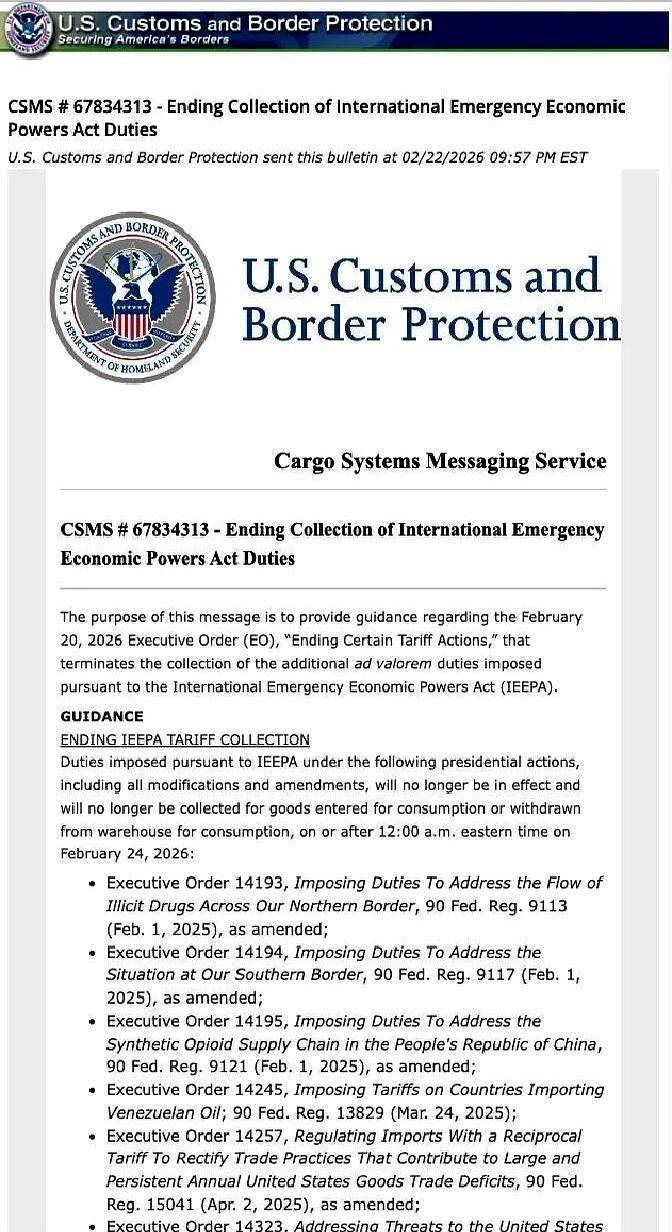
Group 1 - The U.S. Customs announced the cancellation of certain tariffs on Chinese goods, which appears to be a response to internal conflicts among U.S. interest groups rather than a genuine goodwill gesture towards China [1][4] - The removal of tariffs on fentanyl and reciprocal tariffs is expected to boost orders for Chinese manufacturers, leading to increased activity at ports like Long Beach [1][6] - The announcement has created a "golden loophole" with a 10-day customs declaration buffer, allowing importers to avoid tariffs if they declare by February 24, leading to chaos in the logistics and customs sectors [6][7] Group 2 - The tariff policy is criticized as self-defeating, as it was intended to punish China but ultimately harmed U.S. consumers by driving up prices [7][9] - The U.S. government faces challenges in refunding previously collected tariffs, as companies may need to engage in lengthy legal battles to reclaim funds [9][10] - China's manufacturing sector has shown resilience and adaptability to U.S. trade policy fluctuations, maintaining steady export growth despite uncertainties [10][12] Group 3 - The U.S. trade policies are perceived as inconsistent, with high tariffs still imposed on certain sectors like high-tech products and steel, indicating a lack of genuine commitment to fair competition [10][12] - The ongoing trade tensions highlight the importance of China's role in the global supply chain, as U.S. inflation pressures have made reliance on Chinese goods more critical [12][13] - The unpredictability of U.S. policies poses a greater threat to businesses than high tariffs, as companies struggle to adapt to frequent changes in regulations [12][13]
【华西宏观】资产配置日报:再战前高
Xin Lang Cai Jing· 2026-02-27 19:50
Market Overview - The equity market saw a significant increase on February 25, with the Wind All A Index rising by 1.05% and a total trading volume of 2.48 trillion yuan, an increase of 262.7 billion yuan compared to the previous day [2] - The Hang Seng Index rose by 0.66%, while the Hang Seng Technology Index fell by 0.19%. Southbound capital experienced a net outflow of 4.057 billion HKD [2] Sector Performance - Resource sectors, particularly industrial metals, benefited from price increases, with the Wind Rare Earth and Copper Industry Indexes rising by 8.45% and 3.67%, respectively. The Phosphate Chemical Index also increased by 6.74% [3] - The Wind PCB Index rose by 3.63%, with copper-clad laminate and fiberglass indexes increasing by 4.36% and 3.90%, indicating sustained interest from investors despite index fluctuations [3] Commercial Aerospace and Semiconductor Equipment - The commercial aerospace sector saw a notable rebound, with the Wind Commercial Aerospace Index increasing by 3.02%. This sector remains a focal point for market sentiment [4] - The semiconductor equipment sector also performed well, with the corresponding Wind Index rising by 3.86%. However, the sector's congestion level increased from 22% to 27%, indicating potential challenges ahead [4] Real Estate and Debt Market - The real estate sector received a boost from new policies in Shanghai, which led to a temporary increase in the sector's performance, although it later retreated [4][6] - The bond market experienced a decline due to the impact of real estate news, with the 10-year government bond yield rising to 1.81% and the 30-year bond reaching 2.23% [6] Commodity Market Dynamics - The commodity market showed mixed performance, with precious metals experiencing divergence; gold slightly decreased by 0.04%, while silver rose by 4.57%. Industrial metals continued to show strength [7] - A significant outflow of 93.2 billion yuan from commodity indices was noted, primarily affecting precious metals, non-ferrous, and chemical sectors due to the restoration of margin requirements to pre-holiday levels [7] Geopolitical Tensions - Tensions surrounding U.S.-Iran negotiations have heightened, with military deployments influencing market sentiment and leading to increased gold and silver prices [8] - Supply disruptions in the non-ferrous sector, particularly in tin and lithium, have contributed to strong market performance in these commodities [8]
权益ETF周度跟踪:电网设备 ETF 价升量增-20260227
HUAXI Securities· 2026-02-27 15:32
1. Report Industry Investment Rating - No information provided in the given content 2. Core View of the Report - As of the market situation on February 27, considering the "return - crowding" quadrant chart and ETF fund flow, the power grid equipment sector still has high attention value. From February 24 - 27, resource products and power grid equipment led in terms of gains, and their crowding degrees increased. The resource products were the main market theme of the week, with both popularity and price rising. The crowding degree of the power grid equipment further heated up at a high level, and its short - term market depends on the flow of funds. Meanwhile, the chemical and semiconductor equipment sectors strengthened, with an increase in crowding degree but not overheating. The game, media, tourism, and liquor sectors declined significantly, with their sector popularity decreasing to varying degrees. The game sector adjusted significantly, and its popularity cooled down. Combining the ETF fund flow, the willingness to chase the rise of power grid equipment is strong, and its subsequent market is still worth tracking; the capital movement in the resource product sector is not obvious, and it may be in a wait - and - see state; some funds in the chemical and semiconductor equipment sectors took profits, the gambling sentiment increased, and there may be short - term fluctuations. In addition, the capital cashing sentiment in the game sector has eased, showing signs of stabilization [1]. 3. Summary by Relevant Catalogs 3.1 Market Trend: Steady Rise - From February 24 - 27, the market rose steadily. As of February 27, 2026, the closing price of the Wind All - A Index was 6942.40, up 2.75% from February 13 [6]. - From February 24 - 26, stock - type ETFs maintained a small net outflow. Stock - type ETFs had a net outflow of 32.86 billion yuan. Structurally, broad - based index ETFs had a net outflow of 26.244 billion yuan, theme index ETFs had a net outflow of 7.308 billion yuan, while industry index ETFs had a net inflow of 2.215 billion yuan [9]. 3.2 Theme Performance: Resource Products, Power Grid Equipment, and Chemicals Led in Gains - From February 24 - 27, resource products and power grid equipment led in gains, and their crowding degrees increased; the game, media, tourism, and liquor sectors declined significantly, and their popularity decreased to varying degrees. - Resource products were the main market theme of the week, with both popularity and price rising. From February 24 - 27, the rare earth, steel, non - ferrous metals, and oil and gas indexes rose 11.49%, 10.98%, 10.77%, and 9.06% respectively. At the same time, their crowding degree quantiles since 2020 increased by 6.4, 21.6, 4.9, and 17.1 percentage points respectively, showing the characteristics of volume - increasing and price - rising. The rare earth and non - ferrous metals mainly benefited from the price - rising logic, the oil market revolved around the US - Iran situation, and the steel benefited from the production control policy expectation. The crowding degrees of these themes are at a relatively high historical level, and the subsequent market may have stricter requirements for the logic [13]. - The crowding degree of the power grid equipment further heated up at a high level, and its short - term market depends on the flow of funds. The power grid equipment index rose 8.03%, and the crowding degree quantile since 2020 increased from 96.9% to 98.7%, a year - on - year increase of 1.8 percentage points. The power grid equipment has fundamental support, and the demand logic of AI for electricity is difficult to falsify, while the short - term market depends on the flow of funds [13]. - The chemical and semiconductor equipment sectors strengthened, with an increase in crowding degree but not overheating. The chemical and semiconductor equipment indexes rose 6.40% and 3.98% respectively this week. At the same time, their crowding degree quantiles since 2020 increased by 11.9 and 12.3 percentage points to 63.10% and 33.80% respectively [14]. - The game sector adjusted significantly, and its popularity cooled down. This week, the game index fell 6.57%, and the crowding degree decreased by 33.7 percentage points [14]. 3.3 Follow - up Attention: Focus on Power Grid Equipment - Combining the ETF fund flow, the power grid equipment had the largest net inflow and was favored by funds; while the chemical, media, and tourism sectors had large net outflows and faced cashing pressure. - The willingness to chase the rise of power grid equipment is strong, and its subsequent market is worth tracking. From February 24 - 26, against the background that most popular themes faced cashing, the power grid equipment ETF had a net inflow of 2.436 billion yuan. Moreover, this industry has both fundamental and logical support, and there may still be room for long - term growth. However, it is worth noting that the crowding degree of the power grid equipment is at a historical high since 2020, and the market may fluctuate in the short term. If the funds do not flow out significantly after the adjustment, it has high allocation value [19]. - The capital movement in the resource product sector is not obvious, and it may be in a wait - and - see state. From February 24 - 26, the net outflows of the Rare Earth ETF Harvest, Industrial Non - Ferrous Metals ETF Wanjia, Steel ETF, and Oil ETF Penghua were all less than 300 million yuan. After the crowding degree of the sector rose to a high level, the funds have not yet reached a consensus [19]. - Some funds in the chemical and semiconductor equipment sectors took profits, and the gambling sentiment increased. From February 24 - 26, some funds in the chemical and semiconductor equipment sectors chose to take profits, with net outflows of 1.685 billion yuan and 818 million yuan respectively for the ETFs. Coupled with the rising sector popularity and high gains this week, there may be short - term fluctuations [19]. - The game sector showed signs of stabilization. From February 24 - 26, the Game ETF had a net inflow of 25 million yuan, the capital cashing sentiment eased, and with the significant decline in sector popularity, it showed signs of stabilization [20].
2026年第3期:“申万宏源十大金股组合”
Shenwan Hongyuan Securities· 2026-02-27 14:41
Group 1 - The report presents the "Shenwan Hongyuan Top Ten Gold Stock Portfolio" for March 2026, reflecting the firm's market outlook and stock selection capabilities [1][11] - The previous portfolio saw an overall decline of 2.10%, with 8 A-shares rising by an average of 1.13%, outperforming the Shanghai Composite Index by 0.04 percentage points [6][14] - Since the first portfolio release on March 28, 2017, the cumulative return of the gold stock portfolio has reached 474.13%, with A-shares up 366.61% [6][14] Group 2 - The strategy for March indicates potential for a rebound due to key events such as the National People's Congress and observations on Sino-US relations, suggesting a continuation of the first phase of the market's upward trend [14] - Recommended investment directions include "prosperous technology" focusing on AI and semiconductor sectors, and "cyclical alpha" in shipping and power equipment [14] - The report highlights a "triangular" stock selection strategy, featuring stocks like China Merchants Energy Shipping, Huazheng New Materials, and TBEA [14][17] Group 3 - The current top ten gold stocks include China Merchants Energy Shipping, Huazheng New Materials, TBEA, Kweichow Moutai, Tongkun Co., Chongqing Bank, Zhongkong Technology, China Jushi, Yuanjie Technology, and Ping An Insurance (Hong Kong) [17][20] - The "triangular" stocks are expected to benefit from high industry demand and favorable market conditions, with specific growth drivers identified for each [17][20] - The report provides detailed valuation and profit forecasts for each stock, indicating expected growth rates and earnings per share for the coming years [22][23]