消费

Search documents
A股行业轮动速度放缓,意味什么?机构:把握基本面 享受资金面
Feng Huang Wang· 2025-09-21 22:39
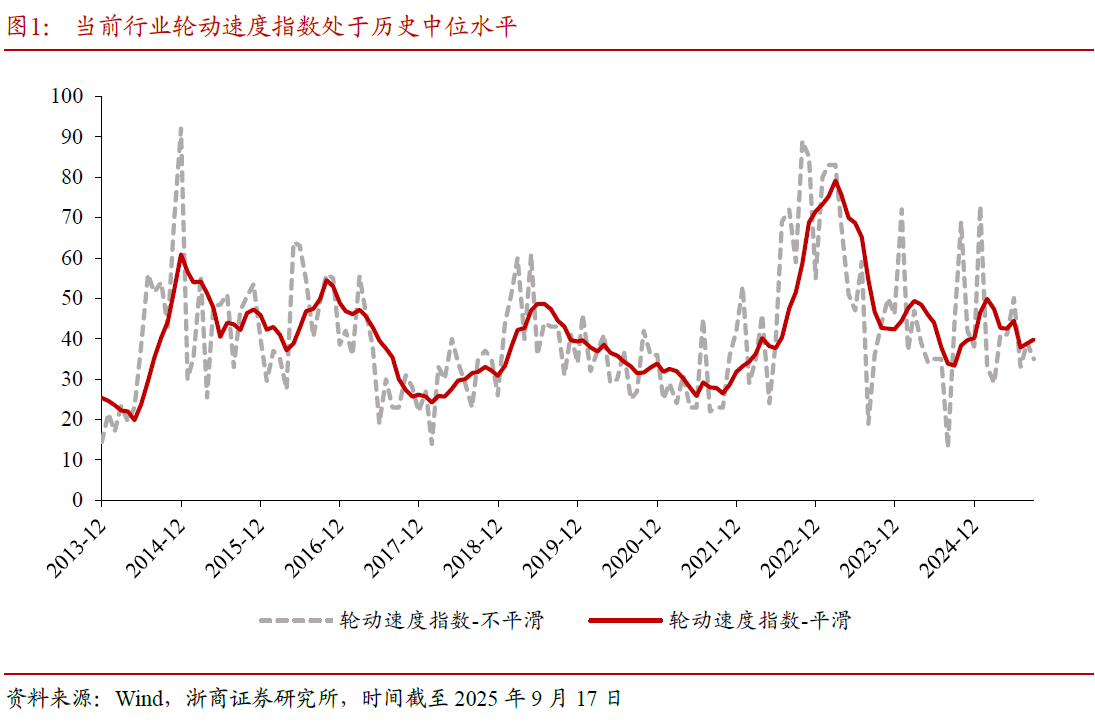
Core Viewpoint - The A-share market has entered a new phase of industry rotation, characterized by a slowdown in rotation speed but an increase in market differentiation [1][2][5] Group 1: Market Rotation Characteristics - The industry rotation speed has decreased since July, following a technology-led market rally, and is currently at the historical median over the past decade [2][5] - Despite the slowdown in rotation speed, the intensity of market differentiation has reached a new high for the year, indicating a significant structural divergence [5][6] Group 2: Driving Forces Behind Market Rotation - The core logic driving the current rotation is the interplay between liquidity and fundamentals, with liquidity being a major factor in the short term [6][7] - Different market phases are identified: liquidity-driven phases favor sectors like advanced manufacturing and TMT, while fundamental-driven phases benefit consumption, cyclical, and financial sectors [6][8] Group 3: Investment Strategies - Investment strategies should focus on balanced allocation to cope with moderate rotation speeds, while also identifying key opportunities in leading sectors [8][9] - Specific recommendations include focusing on the TMT sector due to strong catalysts and considering a shift to financial sectors as the market evolves [8][9] - The "dumbbell strategy" is suggested for long-term investors, emphasizing a tilt towards technology growth sectors while maintaining some exposure to dividend-paying stocks [9]

美国降息落地、需求改善可期,智能眼镜、新型烟草产业密集催化
Xinda Securities· 2025-09-21 05:09
Investment Rating - The industry investment rating is "Positive" [2] Core Views - The report highlights that the recent interest rate cut in the US and expected demand improvement could catalyze growth in sectors such as smart glasses and new tobacco products [2][3] - The report emphasizes the potential for export recovery due to the interest rate cut, which is expected to benefit companies with strong overseas production capabilities [2][4] - The smart glasses sector is seeing product improvements and optimization of industry pain points, which may lead to high growth in sales [3][4] Summary by Sections Pulp and Paper - Supply disruptions in pulp continue, with UPM extending maintenance at its Kaukas pulp mill until October 11, 2025, impacting production [2] - Price adjustments for various types of pulp are noted, with expectations of price increases from paper companies in Q4 [2] Exports - The recent interest rate cut by the Federal Reserve is expected to lead to a gradual recovery in interest-sensitive sectors like real estate and home consumption [2] - Companies with robust overseas production are anticipated to show greater resilience and improved export orders [2][4] New Tobacco - Increased competition in Japan's heated tobacco market is noted, with major players reducing prices to enhance market share [2][3] - The report anticipates growth in sales of new tobacco products, particularly in Europe and North America [3] Smart Glasses - Meta's launch of new AI smart glasses with improved features is expected to enhance market appeal and sales [3] - The report suggests that the industry may see high growth in sales due to these advancements [3] Packaging - The report discusses the strong overseas expansion of packaging leaders, with expectations of increased profitability [2] - Companies are focusing on high-margin clients and expanding their overseas production capabilities [2] Gold and Jewelry - The report notes a positive outlook for traditional jewelry brands despite challenges from rising gold prices [2] - Companies are expected to adapt their strategies to maintain sales growth [2] Two-Wheel Vehicles - The electric three-wheeler market is seen as having growth potential, with new product launches from leading companies [2] - The report highlights strategic partnerships aimed at enhancing performance in the electric motorcycle segment [2] E-commerce - The report indicates that cross-border e-commerce sellers are expected to maintain stable performance, with a focus on optimizing operations [2] - The upcoming holiday season is anticipated to drive sales growth [4] Pet Products - The pet industry is expected to maintain a positive trend, with new high-end products being introduced [2] - Companies are focusing on brand development to enhance market presence [4] IP Retail - The report highlights the strong performance of brands like Pop Mart in the global market, with plans for further expansion [2] - New product launches are expected to drive sales during the upcoming holiday season [4] Maternal and Child Products - Recent government policies aimed at boosting birth rates are expected to benefit the maternal and child retail sector [5] - Leading companies are positioned to capitalize on these policy changes [5]
[9月19日]指数估值数据(港股牛市上涨,跟A股有啥区别;自动止盈功能上线;港股指数估值表更新;抽奖福利)
银行螺丝钉· 2025-09-19 14:07
Core Viewpoint - The article discusses the performance and outlook of the Hong Kong stock market, particularly focusing on the technology sector, and highlights the differences in investor behavior between Hong Kong and A-shares [8][10][12]. Group 1: Market Performance - The overall market showed slight declines, with large-cap stocks slightly up and small-cap stocks slightly down, indicating low volatility [2][3]. - Value style stocks experienced an overall increase, while growth style stocks also saw minor gains [3][5]. - The Hong Kong stock market showed mixed results, with technology stocks leading the gains [7][8]. Group 2: Investor Behavior - The investor structure in Hong Kong is different from that in A-shares, with a higher proportion of institutional and Western investors who prefer large and mid-cap stocks [10][11]. - Historically, during bull markets, large and mid-cap stocks in Hong Kong tend to rise significantly, while small-cap stocks do not see as much upward movement [12][14]. Group 3: Technology Sector Analysis - The Hong Kong Technology Index fell nearly 70% from 2021 to 2022 due to several factors, including rising USD interest rates and concerns over the delisting of Chinese stocks from US exchanges [21][22][23]. - The technology sector's earnings declined for two consecutive years, leading to a bear market characterized by both valuation drops and profit declines [25]. - By 2023, the earnings of Hong Kong technology stocks stabilized, and by 2024, profits grew over 110% year-on-year, indicating a recovery phase [26][31]. Group 4: Sector Performance and Valuation - The most prosperous sectors in Hong Kong this year are technology and pharmaceuticals, both showing over 100% year-on-year profit growth in Q1 [40][41]. - The Hang Seng Consumer Index also saw a profit increase of over 20%, outperforming A-share consumer stocks [44][45]. - The article provides valuation data for various indices, indicating that the Hong Kong market has returned to a more favorable valuation compared to A-shares [52][53]. Group 5: Market Cycles and Investment Strategy - The article emphasizes that market cycles are crucial; strong fundamentals lead to higher valuations, while weak fundamentals can result in undervaluation opportunities [50][51]. - The article suggests monitoring quarterly earnings reports to gauge the potential for further increases in the Hong Kong Technology Index [35][36].

美股策略:“预防式”降息驱动美股上涨
Guotai Junan Securities· 2025-09-19 09:39
Core Insights - The report highlights that the U.S. stock market, particularly the S&P 500 and Nasdaq 100 indices, has experienced significant gains driven by expectations of interest rate cuts by the Federal Reserve [4][5] - The Federal Reserve's recent 25 basis point rate cut is characterized as a "risk management cut," aimed at preemptively addressing potential economic risks rather than responding to an existing recession [6][9] - The report emphasizes the importance of consumer spending, noting that U.S. retail sales data has exceeded expectations for three consecutive months, indicating strong consumer resilience [11][13] Economic Outlook - The Federal Reserve has slightly upgraded its economic growth forecasts for this year and next, while maintaining stable inflation and unemployment rate predictions, signaling a robust economic foundation for the stock market [9][13] - The report suggests that the "preventive" nature of the recent rate cut is expected to stabilize economic expectations and support corporate earnings, thereby benefiting the stock market [4][7] Market Performance - The S&P 500 index recorded a cumulative increase of 2.0% and the Nasdaq 100 index saw a 3.5% rise in the ten trading days leading up to September 18, reflecting market anticipation of policy easing [5][11] - Small-cap stocks are expected to outperform large-cap stocks due to their higher reliance on floating-rate financing, benefiting more from the reduced borrowing costs following the rate cut [9][11] Sector Analysis - The telecommunications, information technology, and consumer discretionary sectors have shown the best performance in the current market environment [11][12] - The report indicates that the historical context of last year's "preventive" rate cut led to sustained gains in the stock market, suggesting a potential repeat of this trend under similar economic conditions [11][13]
杨德龙:美联储降息靴子落地 大盘短期调整不改中长期趋势
Xin Lang Ji Jin· 2025-09-19 08:12
Group 1: Federal Reserve Rate Cut Impact - The Federal Reserve's first rate cut this year has caused significant adjustments in global capital markets, including A-shares and Hong Kong stocks, which experienced profit-taking after previous gains [1] - Despite short-term adjustments, the long-term bullish trend for A-shares and Hong Kong stocks remains intact, driven by policy and capital inflows [1] - The rate cut is expected to stabilize U.S. economic growth and alleviate pressure on the government, which has a high debt burden of $37 trillion [3] Group 2: Economic Indicators and Future Projections - The Fed's decision to cut rates was influenced by lower-than-expected non-farm payroll data and a decline in the unemployment rate, indicating a slowdown in U.S. economic growth [2] - The current federal funds rate is now between 4% and 4.25%, with potential further cuts expected by the end of the year [2] - The anticipated rate cuts may not be isolated, suggesting a new cycle of monetary easing [3] Group 3: Market Opportunities and Sector Focus - The human-shaped robot sector is highlighted as a key area of focus, benefiting from the integration of AI and consumer applications, with significant stock price increases observed [5] - The semiconductor sector remains a critical area for investment, with domestic companies ramping up efforts in chip production and showing strong stock performance [5] - The innovative pharmaceutical sector is expected to rebound in the fourth quarter, despite recent pullbacks due to external policy influences [5] - Traditional consumer stocks may see a resurgence in the fourth quarter as market conditions improve and consumer spending increases [5]
中信证券:港股基本面预期向好的板块或持续获得市场关注
Zhong Zheng Wang· 2025-09-19 01:43
Core Insights - The Hong Kong stock market showed signs of stabilization and positive growth in the first half of the year, with net profit margins and return on equity remaining at high levels, indicating robust operational efficiency [1] - Sectors such as technology, pharmaceuticals, and materials exhibited high levels of prosperity, supporting the overall performance of the Hong Kong stock market, while non-bank and certain consumer sectors also performed well [1] - However, sectors like energy, utilities, real estate, and most consumer industries continue to face performance pressures [1] - The outlook for the Hong Kong stock market is optimistic, with expectations of a performance turnaround in underperforming sectors such as energy and essential consumer goods in the second half of the year [1] - Given the liquidity-driven nature of the current Hong Kong stock market, sectors with improving fundamental expectations are likely to continue attracting market attention [1]

中信证券:预计港股部分上半年景气度低迷的板块将在下半年迎来业绩反转
Zheng Quan Shi Bao Wang· 2025-09-19 00:27
Core Viewpoint - The report from CITIC Securities indicates that Hong Kong stocks are expected to stabilize and achieve positive growth in the first half of 2025, with net profit margins and ROE remaining at high levels, reflecting robust operational efficiency [1] Industry Summary - The technology, pharmaceutical, and raw materials sectors are experiencing high prosperity, supporting the performance of Hong Kong stocks in the first half of 2025 [1] - Non-bank and certain consumer sectors are also showing positive performance, while the energy, public utilities, real estate, and most consumer sectors continue to face performance pressures [1] Performance Outlook - The earnings outlook for Hong Kong stocks is optimistic, with CITIC Securities projecting a turning point in earnings growth for the second half of 2025 [1] - It is expected that the raw materials, healthcare, and technology sectors will maintain high prosperity, with upward revisions in expectations [1] - Sectors that experienced low prosperity in the first half, such as energy and essential consumer goods, are anticipated to see a performance reversal in the second half [1] Market Dynamics - The current bull market in Hong Kong stocks, driven by liquidity, may continue to focus on sectors with positive fundamental expectations [1]
中信证券:在流动性驱动至今的港股牛市,基本面预期向好的板块或继续享有市场关注
Xin Lang Cai Jing· 2025-09-19 00:24
Core Viewpoint - CITIC Securities indicates that Hong Kong stocks' performance in the first half of 2025 has stabilized and achieved positive growth, with net profit margins and ROE maintaining high levels, reflecting robust operational efficiency [1] Industry Summary - The technology, pharmaceutical, and raw materials sectors are experiencing high prosperity, supporting the performance of Hong Kong stocks in the first half of 2025 [1] - Non-bank and certain consumer sectors also show positive performance, while the energy, public utilities, real estate, and most consumer sectors continue to face performance pressures [1] Performance Outlook - The earnings outlook for Hong Kong stocks is optimistic, with a projected turning point in performance growth for the second half of 2025 [1] - It is expected that the raw materials, healthcare, and technology sectors will continue to maintain high prosperity, with upward revisions in expectations [1] - Sectors that experienced low prosperity in the first half, such as energy and essential consumer goods, are anticipated to see a performance reversal in the second half [1] Market Dynamics - In the current bull market driven by liquidity, sectors with positive fundamental expectations are likely to continue attracting market attention [1]
[9月18日]指数估值数据(大盘回调;美联储降息,对A股港股影响如何;红利指数估值表更新)
银行螺丝钉· 2025-09-18 14:06
Core Viewpoint - The article discusses the impact of the Federal Reserve's interest rate cuts on A-shares and Hong Kong stocks, highlighting that while the initial reaction may be positive, the benefits may diminish over time due to market expectations and previous price adjustments [3][5][6]. Group 1: Market Reactions - The stock market experienced fluctuations, with A-shares and Hong Kong stocks showing a significant rise of approximately 33% globally since the Fed's first announcement of rate cuts in September 2024 [5]. - The A-share market, represented by the CSI All Share Index, increased by over 50%, while the Hong Kong Hang Seng Index rose by over 60% during the same period [5]. - The article notes that the current market conditions reflect a decline in large-cap stocks, with a more modest drop in small-cap stocks, indicating a shift in investor sentiment [5][6]. Group 2: Interest Rate Dynamics - The Federal Reserve cut interest rates by 25 basis points, aligning with market expectations, which is seen as beneficial for global assets, including A-shares and Hong Kong stocks [5][6]. - The article emphasizes that the benefits of rate cuts may not be immediate and often manifest before the actual cut occurs, as markets tend to price in expectations [5][6]. - Future expectations suggest that the Fed may implement additional rate cuts, potentially lowering rates by another 50 basis points, which could further influence market dynamics [6]. Group 3: Valuation Insights - The article provides insights into the valuation of dividend and free cash flow indices, suggesting that these metrics are crucial for assessing investment opportunities in the current market environment [7][10]. - A valuation table is included, detailing various indices' earnings yield, price-to-earnings ratio, and other financial metrics, which can guide investors in making informed decisions [8][9]. - The article encourages investors to monitor these valuations regularly through a dedicated mini-program for updated data [10].

今天为何跳水?
表舅是养基大户· 2025-09-18 13:22
Market Overview - The market experienced a significant drop, with the ChiNext index showing a fluctuation exceeding 3cm, attributed mainly to large sell orders from major brokerages and the recent Federal Reserve interest rate cut [1][2][3][4] Investment Trends - Insurance companies are increasing their stock investment scales, with total stock investments projected to rise from 10,624.8 million in 2023 to 18,464.29 million in the first half of 2025, indicating a growing interest in equity markets [7] Technical Analysis - The Shanghai Composite Index reached a high of 3,899.96 points, showing a clear cooling trend as it struggled to surpass the 3,900-point mark, leading to a near 100-point drop intraday [9] - The time taken for the Shanghai Composite Index to break through key levels has slowed down, with 19 days since surpassing 3,800 points, indicating a potential market cooling [11] Market Sentiment - Recent speculative activities, such as the surge in Shanghai Construction's stock price, highlight the extreme levels of market speculation, with significant financing inflows observed [13][14] - The A-share market is currently experiencing a lack of value discovery, as evidenced by the significant price discrepancies between Agricultural Bank of China and other major banks, suggesting a misalignment in market valuations [18][20][23] Investment Strategy - A balanced investment approach is recommended, focusing on quality stocks rather than chasing market trends, especially in a low-interest-rate environment [25] - The recent performance of Hong Kong's new consumption stocks illustrates the risks of high valuations in a bullish market, with notable declines observed since June [26] Global Economic Factors - The Federal Reserve's interest rate cut has implications for the bond market, with expectations that domestic monetary policy will not closely follow the Fed's actions [32]