
服务业

Search documents
强调“保护”和“鼓励”,上海为促进民营经济立法
Di Yi Cai Jing· 2025-09-26 09:51
Core Viewpoint - The newly passed Shanghai Private Economy Promotion Regulation aims to enhance the role of private enterprises in the local economy, emphasizing protection and encouragement for these businesses [1][2]. Group 1: Legislative Framework - The Shanghai Private Economy Promotion Regulation will take effect on October 20, 2023, and is a local legislative refinement based on the national Private Economy Promotion Law [1]. - The regulation consists of 11 chapters, which is two more than the national law, focusing on protecting private enterprises and ensuring fair competition [2]. Group 2: Key Areas of Focus - The regulation addresses six main areas: removing hidden market entry barriers, enhancing policy guidance, solving financing issues, boosting innovation capabilities, optimizing services for enterprises going global, and strengthening rights protection [2][3]. - It emphasizes the implementation of a unified negative list for market entry, ensuring equal treatment of all economic organizations [2]. Group 3: Financing and Global Expansion - The regulation aims to improve credit fairness and establish a government financing guarantee system to support private enterprises [3]. - It includes measures to enhance overseas service systems, facilitate customs processes, and optimize cross-border financial services for private enterprises [3]. Group 4: Economic Performance and Future Plans - In the first half of the year, private enterprises in Shanghai showed positive growth, with industrial output increasing by 8.8% and service sector revenue rising by 9.9% [4]. - The Shanghai Development and Reform Commission plans to implement a "6-in-1" approach to ensure the effective execution of the regulation, focusing on comprehensive policy measures and communication mechanisms [5][6].
经典重温 | “十五五”:产业破局与重构 ——“十五五”规划研究系列之三(申万宏观·赵伟团队)
申万宏源宏观· 2025-09-25 16:03
Core Insights - The article discusses the importance of industrial structure adjustment in China's 14th and upcoming 15th Five-Year Plans, emphasizing the shift from focusing on the ratio of the three industries to prioritizing technological innovation and R&D investment [3][5][28]. Group 1: Industrial Structure Adjustment in Five-Year Plans - Industrial structure adjustment is a crucial component of China's Five-Year Plans, serving as a key means to achieve core objectives [3][16]. - The focus of industrial structure adjustment has evolved from the ratio of the three industries to a greater emphasis on technological innovation and R&D investment [5][28]. - The 14th Five-Year Plan has introduced specific targets for R&D expenditure and digital economy core industries, reflecting a shift towards more refined and precise planning [5][28]. Group 2: Trends in Industrial Structure Adjustment - The direction of industrial structure adjustment has transitioned from emphasizing the three industries' ratios to focusing on technological innovation [5][28]. - The importance of the service sector has increased, with a notable shift from finance and real estate to information technology and production services [6][47]. - The 15th Five-Year Plan is expected to continue supporting technological innovation and address issues such as supply-demand mismatches and "involution" in the manufacturing sector [7][8][22]. Group 3: Key Areas of Focus in the 15th Five-Year Plan - The 15th Five-Year Plan is likely to prioritize emerging industries such as artificial intelligence, marine economy, and commercial aerospace [7][22]. - There is an anticipated increase in the emphasis on service industry development, particularly in enhancing service consumption and trade [8][26]. - The plan may also focus on improving the quality and efficiency of service industries, aligning with the broader economic development goals [8][49].


经典重温 | “反内卷” :市场可能误解了什么?(申万宏观·赵伟团队)
申万宏源宏观· 2025-09-25 16:03
Core Viewpoint - The market's focus on "anti-involution" has significantly increased, but there is considerable divergence in understanding "involution"; most viewpoints interpret it through the lens of supply-side reform, which may lead to misunderstandings [1] Misunderstanding of "Involution" and "Anti-Involution" - "Anti-involution" is not equivalent to "anti-surplus"; the causes of demand differ: "surplus" arises from declining demand and passive supply, while "involution" involves proactive supply increases in strong demand areas [2][9] - Price behaviors differ: "surplus" leads to follow-up price reductions due to demand decline, while "involution" results in chaotic price competition despite strong demand [2][9] Supply Issues - Prior to supply-side reform, there was surplus in upstream and state-owned enterprises; the current "anti-involution" is more pronounced in downstream and private enterprises [3][9] - High-energy-consuming industries have completed capacity concentration reforms, and traditional backward capacity is not as significant as before [4][9] Policy Focus - Policies may target industries with excessive supply growth, such as coal and photovoltaic sectors, but the focus is more on downstream adjustments rather than drastic supply reductions [5][9] - Avoiding excessive contraction in upstream supply is crucial to prevent "super-inflation" in prices, which could hinder the effectiveness of "anti-involution" policies [5][9] Policy Mechanisms - "Anti-involution" should not rely solely on self-discipline talks; successful strategies may include encouraging industry mergers, raising industry standards, and matching supportive policies [6][9] - The experience from Japan, the US, and Germany shows that market-driven reforms and non-price competition can effectively address overcapacity issues [7][9] Structural Adjustments - "Anti-involution" requires addressing the structural imbalance in demand rather than stimulating demand in surplus areas; developing service sector demand can help rebalance the economy [7][9] - The service sector has significant potential to absorb manufacturing job losses and alleviate "involution" challenges [7][9] Equipment and Debt Management - Addressing equipment update issues and overdue payments is essential; the current trend shows new equipment purchases without corresponding old equipment retirements, which can exacerbate "involution" [7][9] - The issue of overdue payments is more pronounced now, especially among private enterprises, necessitating stronger governance measures [7][9]
商务部9月25日召开例行新闻发布会
Shang Wu Bu Wang Zhan· 2025-09-25 12:49
Group 1: Digital Consumption Development - The Ministry of Commerce, along with seven other departments, issued guidelines to promote digital consumption, emphasizing the importance of enhancing both "hard infrastructure" and "soft environment" for digital consumption [4][5] - Digital consumption is projected to reach 23.8 trillion yuan in 2024, accounting for 44.2% of total household consumption [4] - The guidelines encourage the development of digital products, services, and content, aiming to innovate consumption scenarios and stimulate diverse and quality consumption [4][5] Group 2: WTO and Trade Relations - Premier Li Qiang announced that China will not seek new special and differential treatment in WTO negotiations, reflecting China's commitment to a balanced and fair global trade system [6][7] - China submitted a position paper to the WTO, asserting its rights as the largest developing country while emphasizing the need for reform in the organization [7][8] - The announcement aims to strengthen multilateral trade systems and support the global development agenda, aligning with the UN's 2030 Sustainable Development Goals [7][8] Group 3: Free Trade Zone Best Practices - The Ministry of Commerce released the sixth batch of "best practice cases" from free trade zones, totaling 29 cases that focus on trade facilitation, free flow of factors, and high-quality industrial development [9][10] - These cases highlight innovative achievements in areas such as cross-border data flow and customs efficiency, showcasing the unique regional characteristics of different free trade zones [9][10] - The Ministry plans to guide local areas in learning from these best practices to further enhance reform and innovation in free trade zones [11] Group 4: Service Export Policies - The Ministry of Commerce, along with nine other departments, introduced measures to promote service exports, which have grown from $219.1 billion in 2014 to $445.9 billion in 2024, with an average annual growth of 7.3% [12][13] - The new policies include 13 practical measures focusing on financial support, tax incentives, and facilitating international market access for service exports [12][13] - The Ministry aims to enhance the international competitiveness of service export enterprises through these targeted measures [13] Group 5: Sino-US Trade Relations - The Ministry of Commerce emphasized the importance of local-level economic cooperation in Sino-US relations, suggesting that the US should remove unreasonable tariffs to facilitate bilateral trade [14] - The essence of Sino-US economic relations is mutual benefit, with both countries having extensive common interests and cooperation potential [14] - The Ministry expressed hope for a favorable environment for stable and sustainable development of Sino-US trade relations [14]
瑞典国家经济研究所调查显示消费者情绪持续改善
Shang Wu Bu Wang Zhan· 2025-09-25 02:32
Core Insights - The economic trend indicator in Sweden rose again in September, indicating a sentiment slightly below normal levels [1] - The consumer confidence index increased for the fifth consecutive month, reflecting improved expectations for personal economic conditions and the overall Swedish economy [1] Group 1: Consumer Confidence - The rise in the consumer confidence index is primarily due to improved expectations regarding personal economic conditions and the outlook for the Swedish economy over the next twelve months [1] - Despite the increase, the consumer confidence index still indicates a level of sentiment that is weak [1] Group 2: Business Sector Confidence - The business sector's expectations for sales prices over the next three months remained stable compared to August and are close to historical averages [1] - The manufacturing confidence index has risen, indicating sentiment at normal levels, although production plans for the next three months are less optimistic than usual [1] - The construction confidence index slightly declined, showing sentiment below normal levels, with over 60% of firms citing insufficient demand as a barrier to growth [1] Group 3: Trade and Services Confidence - The trade confidence index continues to rise, indicating the strongest sentiment in the business sector, although the food retail confidence index has decreased but remains above normal levels [1] - Confidence in automotive trade, wholesale trade, and non-food retail trade is hovering around historical averages [1] - The services confidence index has slightly decreased but still indicates sentiment at normal levels, with ongoing dissatisfaction regarding business volume among firms [1]
全国用电量再破万亿千瓦时,外卖平台新规征求意见 | 财经日日评
吴晓波频道· 2025-09-25 00:29
Economic Indicators - In September, the US manufacturing PMI fell to 52, while the services PMI dropped to 53.9, indicating a slight slowdown in economic expansion [2] - The composite PMI also decreased to 53.6, marking the lowest level since June 2025, with new orders and employment indices declining [2] - Despite the slowdown, consumer spending remains resilient, and the Federal Reserve's interest rate cuts may help prevent a recession [3] Regulatory Developments - The State Administration for Market Regulation in China has released a draft for public consultation on the basic requirements for food delivery platforms, focusing on service management and fee transparency [4] - The draft aims to regulate platform fees and promotional behaviors to prevent unfair competition and ensure food safety [4][5] Energy Consumption - In August, China's total electricity consumption reached 10,154 billion kWh, a year-on-year increase of 5.0%, with the manufacturing sector showing the highest growth at 5.5% [6] - The electricity demand growth reflects a robust economic recovery, although supply challenges remain due to mismatches in demand and supply timing [7] Computing Industry Initiatives - Hubei Province plans to develop a computing industry cluster, aiming for a total computing power of 25 EFLOPS by 2027, with a focus on integrating computing with optical communication and chip industries [8] - The measures encourage the development of a diverse computing infrastructure and aim to avoid homogeneous competition among cities [9] Labor Market Concerns - A survey indicates that 24% of young employees in the US and Europe are very concerned about potential job loss due to AI, compared to only 10% of older workers [10] - The rise of AI technology presents both challenges and opportunities for young workers, who may leverage AI to enhance their skills and productivity [11] Agricultural Sector Trends - The price of live pigs has dropped significantly, with a 10.4% decrease from early September and a 24.4% decline from the peak in February, reflecting an oversupply in the market [12] - Despite short-term measures to control production, the long-term outlook for the pig farming industry suggests a need for reduced production capacity to balance supply and demand [13] Stock Market Performance - On September 24, the stock market saw a broad increase, with the Shanghai Composite Index rising by 0.83% and the ChiNext Index reaching a three-year high [14] - The semiconductor sector continued to perform strongly, driven by developments in AI and chip demand, while consumer sectors like tourism showed weakness [15]

2025,一直“在线”!
赵伟宏观探索· 2025-09-24 16:03
Core Viewpoint - The article emphasizes the importance of continuous research iteration to approach the truth, highlighting that growth comes from persistent denial and reconstruction [2][26]. Group 1: Research Framework and Goals - The team is undergoing a comprehensive upgrade in 2025, focusing on restructuring the research framework and systematically displaying research outcomes [2]. - The guiding principle is to provide valuable independent research results that are grounded in reality and actionable [2]. Group 2: Economic Insights - The article discusses the shift in the economic "three drivers" from manufacturing to services, indicating that as GDP per capita reaches $10,000 to $30,000 and urbanization hits 70%, service sector demand will accelerate [28]. - It notes that new consumption policies emphasize long-term strategies for domestic demand expansion rather than short-term stimuli, while also providing support for manufacturing to counter tariff impacts [29]. - The concept of "anti-involution" is presented as a new phase of supply-side structural reform, with increased government and industry focus, broader coverage, and stronger coordination among policies and market mechanisms [31]. Group 3: Global Economic Trends - The article highlights that the biggest expectation gap in the global macroeconomic landscape for the first half of 2025 is the disproof of the "American exceptionalism" narrative [21]. - It mentions that the focus of tariffs may shift towards validating economic data, with potential concerns about recession if the U.S. unemployment rate rises to 4.6% [21]. - The impact of geopolitical risks, particularly since the Russia-Ukraine conflict, is noted as a significant factor in global macroeconomic conditions and asset pricing [23].

“924”一周年经济回顾与展望:如何重塑增长和提振就业
Lian He Zi Xin· 2025-09-24 11:09
Economic Overview - The "924" policy has shown resilience in the Chinese economy amidst complex domestic and international environments, with macroeconomic policies stabilizing growth and prices[4] - The need to reassess the 5.0% growth target based on economic momentum and to prioritize employment in policy adjustments is emphasized[5] Consumption and Retail - Social retail sales grew by 4.6% year-on-year as of August 2025, a 1.2 percentage point increase from August 2024, aligning with the 5.0% economic growth target[6] - Specific retail categories such as home appliances and communication equipment saw significant growth, with increases of 28.4% and 22.3% respectively compared to the previous year[6] Investment Trends - Fixed asset investment growth was only 0.5% year-on-year as of August 2025, a decline of 2.9 percentage points from August 2024, primarily due to a 12.9% drop in real estate investment[9] - Infrastructure and manufacturing investments also saw declines of 2.5 and 4 percentage points respectively, indicating limited effectiveness of investment policies[9] Trade Performance - Total goods import and export volume increased by 2.5% year-on-year as of August 2025, with exports rising by 5.9%, a 1.2 percentage point increase from the previous year[10] - Exports of electromechanical products grew by 9.2%, accounting for 60.2% of total exports, showcasing resilience in external trade[10] Capital Market Stability - The Shanghai Composite Index rose by 39% year-on-year to 3821.83 points as of September 23, 2025, while the ChiNext Index surged by 103%[12] - The ten-year government bond yield decreased by 0.16 percentage points to 1.877%, reflecting a stable capital market environment[12] Employment and Structural Challenges - The urban unemployment rate averaged 5.18% from January to August 2025, a slight increase from the previous year, indicating challenges in job creation[17] - The youth unemployment rate for ages 16 to 24 rose to 16.43%, highlighting the need for targeted employment strategies[17] Policy Recommendations - Future policies should shift focus from "scale stimulus" to "employment priority" to achieve high-quality economic development[22] - Fiscal policies must prioritize job creation, with proposals for special funds to support new employment initiatives and tax incentives for businesses hiring new employees[27][28]
英国9月综合PMI初值降至51,出口创特朗普关税以来最快跌幅
智通财经网· 2025-09-23 09:41
Group 1 - The UK export demand is declining at the fastest rate since April, following the announcement of global tariff policies by the US President Trump, with the Purchasing Managers' Index (PMI) dropping from a one-year high of 53.5 in August to 51 [1] - Both the service and manufacturing sectors contributed to the decline, with factory output shrinking and overseas new orders reaching their worst performance in five months, indicating weak sales to the US and Europe [1][5] - The report highlights the ongoing damage from US tariff policies, despite the UK facing lower export barriers compared to most countries, posing challenges for the UK Chancellor of the Exchequer, Rachel Reeves, in addressing public finance issues amid ongoing economic weakness and geopolitical tensions [5] Group 2 - The chief business economist at S&P Global, Chris Williamson, indicated that the warning signs of economic weakness have been raised, which may lead to a more dovish stance in the Bank of England's policy discussions [5] - Companies reported a slowdown in input price growth, with the rate of increase falling from a three-month high last month, although suppliers are attempting to pass on rising labor costs amid ongoing increases in energy bills and food prices [5] - Manufacturing output is declining at the fastest rate since March, while service sector activity growth is also slowing due to weak domestic demand and heightened geopolitical tensions, leading employers to continue reducing jobs for the past 12 months [5]
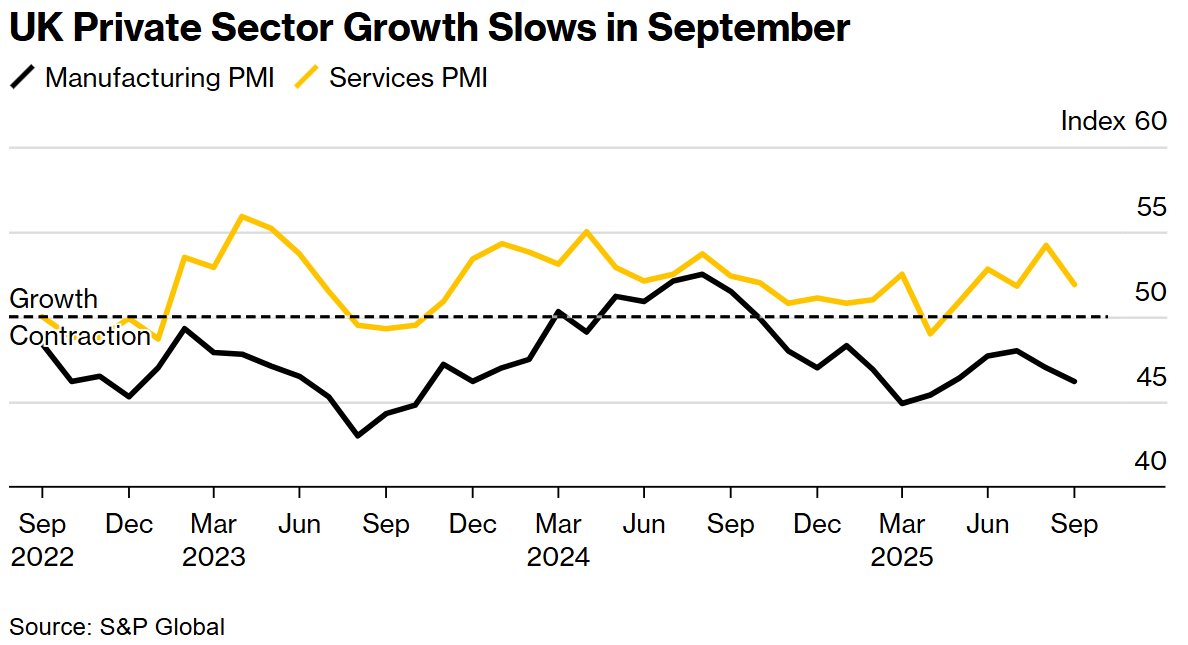
欧元区9月制造业PMI初值 49.5,预期 50.7,前值 50.7
Hua Er Jie Jian Wen· 2025-09-23 08:04
Group 1 - The Eurozone's September Services PMI preliminary value is 51.4, exceeding expectations of 50.5 and matching the previous value of 50.5 [1] - The Eurozone's September Composite PMI preliminary value is 51.2, slightly above the expected 51.1 and higher than the previous value of 51 [1]