
美容护理

Search documents
【2日资金路线图】银行板块净流入逾23亿元居首 龙虎榜机构抢筹多股
证券时报· 2026-02-02 12:07
2月2日,A股市场整体下跌。截至收盘,上证指数收报4015.75点,下跌2.48%,深证成指收报 13824.35点,下跌2.69%,创业板指收报3264.11点,下跌2.46%,北证50指数下跌2.03%。 1. A股市场全天资金净流出539.77亿元 今日A股市场主力资金开盘净流出143.2亿元,尾盘净流出157.11亿元,A股市场全天资金净流出 539.77亿元。 | | | 沪深两市近五日主力资金流向情况(亿元) | | | | --- | --- | --- | --- | --- | | 日期 | | 净流入金额 开盘净流入 | | 尾盘净流入 超大单净买入 | | 2026-2-2 | -539.77 | -143. 20 | -157. 11 | -384. 36 | | 2026-1-30 | -595. 71 | -279.84 | -50. 70 | -303.01 | | 2026-1-29 | -602. 22 | -221.16 | -98.94 | -296. 09 | | 2026-1-28 | -274.87 | -58.90 | -29.34 | -118. 55 | | ...


大消费行业周报(1月第4周):《方案》催化服务消费提质扩容
Century Securities· 2026-02-02 10:24
Investment Rating - The report does not explicitly state an investment rating for the industry Core Insights - The service consumption sector is expected to see quality improvements and expansion due to the "Accelerating the Cultivation of New Growth Points for Service Consumption Work Plan" issued by the State Council, which includes twelve specific measures targeting key areas such as transportation, housekeeping, and tourism [3] - The gold and jewelry sector is experiencing significant volatility in gold prices, leading to a mixed development landscape, with high-end consumption scenarios showing promise despite challenges in gold jewelry demand due to rising prices [3] - The report highlights a divergence in performance across the consumer sector, with textiles, social services, and retail showing declines, while food and beverage sectors have seen some gains [3] Market Weekly Review - The consumer sector showed mixed performance in the week of January 26-30, with textiles down by 0.68%, social services down by 3.45%, and food and beverage up by 1.56% [3] - Notable stock performances included Huangtai Liquor (+22.92%) and Samsung New Materials (+23.72%) leading gains, while stocks like Haoxiangni (-20.89%) and Tianyin Electromechanical (-18.66%) faced significant declines [3] Industry News and Key Company Announcements - Shenzhen's market supervision authorities have launched a three-year action plan to optimize the consumption environment, focusing on digital consumption and innovative retail formats [15] - The China Chain Store and Franchise Association reported a moderate recovery in shopping center operations, with increased member consumption but a decline in average transaction values [15] - Anta Sports announced a €1.5 billion acquisition of a stake in Puma, becoming the largest shareholder, which reflects strategic moves in the sportswear market [15] - The World Gold Council reported a record high in gold bar and coin purchases in China for 2025, indicating strong investment demand despite price pressures [15]
大消费行业周报(1月第4周):《方案》催化服务消费提质扩容-20260202
Century Securities· 2026-02-02 08:30
Investment Rating - The report does not explicitly state an investment rating for the industry, but it suggests a positive outlook on service consumption and specific sectors such as cultural tourism, catering, and duty-free services [3]. Core Insights - The "Accelerating the Cultivation of New Growth Points for Service Consumption Work Plan" aims to enhance service consumption quality and expansion, focusing on optimizing supply and fostering new growth points in six key areas, including transportation and home services [3]. - The gold and jewelry sector is experiencing significant volatility due to fluctuating gold prices, with a notable performance differentiation among brands. High-end consumption scenarios are highlighted as a growth area despite challenges posed by rising gold prices [3]. - The report indicates a mixed performance in the consumer sector, with textiles, social services, and retail showing declines, while food and beverage sectors have some positive movements [3]. Market Weekly Review - The consumer sector showed varied performance from January 26 to January 30, with textiles down by 0.68%, social services down by 3.45%, and food and beverage up by 1.56%. Notable gainers included Huangtai Liquor (+22.92%) and Samsung New Materials (+23.72%), while significant losers included Haoxiangni (-20.89%) and Tianyin Electromechanical (-18.66%) [3]. - The report emphasizes the importance of service consumption as a driver for domestic demand and high-quality development, suggesting a focus on sectors like cultural tourism and catering [3]. Industry News and Key Company Announcements - Shenzhen's market supervision authorities have launched a three-year action plan to optimize the consumption environment, promoting digital consumption and new retail formats [15]. - The report mentions that the China Chain Store and Franchise Association indicates a mild recovery in shopping centers, with over 40% of projects seeing increased customer conversion rates [15]. - Anta Sports announced a significant acquisition of a stake in Puma, indicating strategic moves within the sportswear sector [15]. - The World Gold Council reported a record high in gold bar and coin purchases in China for 2025, suggesting strong demand despite price pressures [15].
2025年业绩预告有哪些线索值得关注?
Yin He Zheng Quan· 2026-02-02 06:21
策略研究 · 策略专题 2025 年业绩预告有哪些线索值得关注? 2026 年 02 月 02 日 核心观点 分析师 杨超 :010-80927696 :yangchao_yj@chinastock.com.cn 分析师登记编码:S0130522030004 王雪莹 :(010)80927721 :wangxueying_yj@chinastock.com.cn 分析师登记编码:S0130525060003 www.chinastock.com.cn 证券研究报告 请务必阅读正文最后的中国银河证券股份有限公司免责声明 周美丽 :zhoumeili_yj@chinastock.com.cn 分析师登记编码:S0130525070002 相关研究 2026-01-23,公募基金 2025 年四季度持仓有哪些 看点? 2026-01-06,如何理解"非理性繁荣"下的"理性 泡沫" ?——AI 泡沫系列研究之总量篇 2025-12-28,节奏看"水",集中靠"质"——2026 年港股市场投资展望 2025-12-11,2025 年 12 月中央经济工作会议对投 资的启示:向新向优 2025-12-08,12 月中央政 ...
机构研究周报:风格转换成长“轮休”,黄金短空长多
Wind万得· 2026-02-01 22:37
【 摘要 】浙商证券廖静池称,展望后市,科技成长板块在经历三周的强势期之后,"跟随"权重 指数节奏进入高位震荡整理。招商银行陈峤认为,短期黄金回调动能仍在累积,中长期看,黄金 基本面逻辑稳固,牛市趋势未改。 一、焦点锐评 1.黄金、白银史诗级暴跌 1月30日,在亚市早盘传出特朗普将提名凯文·沃什任美联储主席的消息后贵金属即转跌,现货白 银价格一度暴跌36%,创出历史最大日内跌幅;现货黄金价格一度下跌超过12%,盘中跌穿每盎 司4700美元,遭遇40年来单日最大跌幅。沃什在美联储任职期间一贯对通胀保持警惕,经常支持 更高利率。但去年他转而呼应特朗普观点。 【解读】招商银行陈峤分析称,短期看,在本月极端单边行情落地后,市场回调动能仍在累积, 后续调整走势或进一步延续,建议交易型投资者保持警惕,防范市场波动风险。中长期看,黄金 基本面逻辑稳固,牛市趋势未改。当下市场更多聚焦于美元信用重塑与全球秩序重构,与1970- 1974年布雷顿森林体系瓦解时的黄金牛市更为类似。 二、权益市场 1.富国基金:从"结构牛"走向"全面牛" A股 | 万得全A | 6783.79 -1.59% | | 5. 78% | 5. 83% ...



策略周评20260201:年报业绩预告中的景气线索
Soochow Securities· 2026-02-01 05:37
Core Insights - The overall profitability of A-share listed companies continues to recover, with 2,983 companies disclosing performance forecasts, achieving a disclosure rate of 55.73% as of January 31, 2026. The disclosed net profit for 2024 is nearly 540 billion yuan, accounting for 10.30% of total A-share net profit [1][2][3] Performance Forecasts - Among the disclosed performance forecasts, the positive forecast rate is 36.67%, an increase from 34.07% in 2024. There are 1,069 companies expecting profits and 1,846 expecting losses, with the highest positive forecast rate in the ChiNext board at 38.33% [2][3] Profit Growth Rates - The median net profit growth rate for all A-share companies is 17.5% year-on-year, with an overall growth rate of 38.2%, both higher than the growth rates for the first three quarters of 2025. The ChiNext board shows significant improvement in profit growth, driven by overseas computing power and reduced losses in some new energy companies [3][4] Industry Insights - In terms of industry performance, non-bank financials and non-ferrous metals have high positive forecast rates of 87.50% and 65.75%, respectively. Other sectors with notable rates include beauty care (53.85%), automotive (53.68%), and public utilities (50.94%) [4][5] - The median year-on-year net profit growth rates for industries such as non-ferrous metals (68.98%), non-bank financials (67.63%), and steel (59.17%) rank among the highest for 2025 [4][5] Sectoral Opportunities - Key sectors showing strong performance indicators include resource commodities benefiting from new demand from AI and high-end manufacturing, as well as the AI sector experiencing explosive growth due to increased capital expenditure by cloud vendors [5][6] - Leading manufacturing companies are expanding into new growth areas through overseas operations, particularly in automotive parts, power equipment, and shipbuilding, which are expected to drive industry growth [5][6] Market Outlook - The A-share market is entering a traditional bullish window, with historical data indicating a 76% probability of index increases in February, with an average increase of 3.4% [8][9] - Investment focus should be on sectors with strong performance indicators, including AI hardware, new energy storage, and sectors highlighted in the 14th Five-Year Plan, such as commercial aerospace and 6G technology [9]
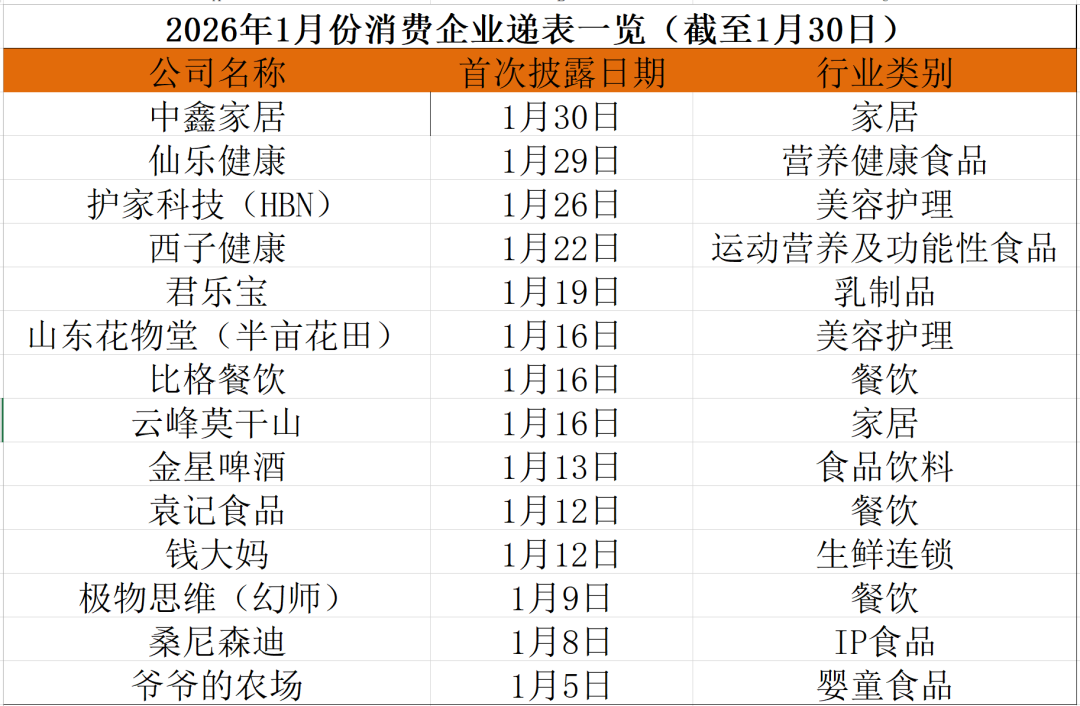
大爆发!“组团”来了:君乐宝、钱大妈、袁记食品......知名消费企业掀港股上市潮
Zhong Guo Ji Jin Bao· 2026-01-31 06:58
Core Viewpoint - The Hong Kong capital market is experiencing a surge in listings from consumer companies, with notable firms like Junlebao, Qian Dama, and Yuanji Food preparing to go public, indicating a strategic move amidst a challenging domestic consumption environment [1][5]. Group 1: Market Trends - In early 2026, 14 consumer companies have disclosed H-share prospectuses, a significant increase compared to the same period in 2025 [1]. - The IPO of Dongpeng Beverage, expected to raise HKD 10 billion, marks the largest IPO in the Asian beverage sector in recent years [1]. - The trend of consumer companies going public in Hong Kong reflects a strategic response to various market conditions, including policy support and capital market changes [5][6]. Group 2: Company Highlights - Junlebao, a leading player in the dairy industry, aims to raise funds for factory construction, capacity expansion, brand marketing, and digital transformation, with annual revenue around RMB 20 billion [2]. - Jin Xing Beer, a traditional brewery, has shown explosive growth, with revenue increasing from RMB 356 million to RMB 1.109 billion and net profit soaring from RMB 12 million to RMB 305 million over two years [3]. - The emerging beauty brand Banmu Huatian is also pursuing a Hong Kong listing to enhance R&D and brand development in a competitive market [3]. Group 3: Factors Driving Listings - Policy support from the Chinese government has facilitated the process for consumer companies to list in Hong Kong, with measures introduced to encourage leading firms to access capital markets [5][6]. - The shift towards Hong Kong listings is also driven by tightening A-share market conditions for consumer companies, making Hong Kong a more attractive option for capital raising [6]. - The influx of venture capital and private equity into emerging consumer firms has created pressure for exits, making public listings a viable path for capital recovery [7]. Group 4: Market Performance and Challenges - There is a noticeable divergence in stock performance among consumer companies listed in Hong Kong, with some achieving high valuations while others struggle post-IPO [8][9]. - The market favors companies with strong brand presence and visible cash flow, while smaller brands face liquidity discounts due to lack of profitability [9]. - Successful expansion in the consumer sector requires matching growth with profitability, as merely increasing store numbers is no longer sufficient to attract capital [9].
大爆发!“组团”来了:君乐宝、钱大妈、袁记食品、金星啤酒、比格餐饮......知名消费企业掀港股上市潮,资本、市场与政策共振的必然结果
Zhong Guo Ji Jin Bao· 2026-01-31 05:35
Core Viewpoint - The surge of consumer companies listing on the Hong Kong Stock Exchange (HKEX) in early 2026 is driven by a combination of capital demands, market conditions, and favorable policy environments, marking a significant trend in the consumer sector [1][8]. Group 1: Listing Trends - Major consumer companies such as Mingming Hen Mang and Dongpeng Beverage have recently completed their IPOs, with Dongpeng raising an estimated HKD 10 billion, setting a record for the Asian beverage industry [1][4]. - As of January 30, 2026, 14 consumer companies have disclosed their H-share prospectuses, indicating a notable increase compared to the same period in 2025 [2][4]. - The trend includes a diverse range of sectors, including food and beverage, beauty care, and home goods, showcasing a multi-faceted approach to capitalizing on market opportunities [4][6]. Group 2: Company Highlights - Junlebao, a leading dairy brand, aims to raise funds for factory construction, capacity expansion, and brand marketing, with an annual revenue of approximately CNY 20 billion [4]. - Jinxing Beer, known for its craft beer, reported a revenue increase from CNY 356 million to CNY 1.109 billion from 2023 to the first nine months of 2025, with net profit soaring from CNY 12 million to CNY 305 million, marking a 2400% increase [5]. - Other notable companies like Qian Dama and Yuanji Food are also advancing their listing processes, reflecting a broader trend of consumer companies seeking capital to support growth and expansion [4][6]. Group 3: Market Dynamics - The favorable policy environment, including measures from the China Securities Regulatory Commission to support leading enterprises in listing in Hong Kong, has facilitated this trend [8]. - The recovery of the HKEX since 2025 has made it an attractive option for consumer companies, with over one-third of new listings in the first half of 2025 being consumer-related [9]. - The internal pressures for capital and the need for significant funding to support growth strategies are driving companies to pursue listings as a means of capitalizing on market opportunities [9][10]. Group 4: Valuation and Market Performance - There is a noticeable divergence in stock performance among consumer companies listed on the HKEX, with some achieving high valuations while others struggle post-IPO [11][12]. - The market favors companies with strong brand presence and visible cash flow, while smaller brands face liquidity discounts due to lack of profitability [12]. - The ability to expand internationally and enhance operational efficiency is becoming increasingly important for valuation in the consumer sector [12].
2026年以来A股尽显分化: 科创、有色领跑“老登”失落
证券时报· 2026-01-29 13:00
2026年以来,A股市场总体呈现较明显的结构性分化。一方面,科创类股票、有色金属类股票强势领跑,被市场戏称为"老登"的银行、白酒等 传统行业板块表现则明显滞后。 与此同时,个股的分化则更为明显,翻倍股与"腰斩"股均已陆续出现。 2026年以来指数和板块分化明显:科创、有色领跑 "老登"板块失落 2026年以来近一个月的时间里,尽管市场跌宕起伏,但A股市场总体呈现较大分化,这一分化首先体现在主要指数表现的差异上。 数据显示,A股市场主要指数中,中证500指数表现亮眼,2026年以来累计已上涨14.09%。据Wind数据,该指数成份股2026年以来不到一个月的时间合计 成交额超过11万亿元,超过2025年9月的月度数值。这意味着,该指数的成份股月度合计成交额将创出历史新高。 在中证500指数之外,科创50指数的表现也不遑多让,2026年以来累计涨幅已达12.16%,这是在此前一年该指数大涨的基础上。2025年,科创50指数已大 幅上涨35.92%。在指数大幅上行的同时,2026年以来科创板交投活跃度也随之进一步提升,不到一个月的时间里合计成交额已超过6万亿元,超过科创板 此前任何一个月份的月度成交额。 北证50指 ...

1月28日有色金属、通信、计算机等行业融资净买入额居前
Sou Hu Cai Jing· 2026-01-29 01:46
以幅度进行统计,有色金属行业融资余额增幅最高,最新融资余额为1554.22亿元,环比增长3.99%,其 次是建筑装饰、纺织服饰、石油石化行业,环比增幅分别为2.63%、1.97%、1.48%;融资余额环比降幅 居前的行业有建筑材料、美容护理、社会服务等,最新融资余额分别有142.38亿元、69.00亿元、135.67 亿元,分别下降1.04%、0.34%、0.32%。(数据宝) 1月28日各行业融资余额环比变动 | 代码 | 最新融资 | 较上一日增减(亿元) | 环比增幅(%) | | --- | --- | --- | --- | | | 余额(亿元) | | | | 有色金属 | 1554.22 | 59.68 | 3.99 | | 通信 | 1352.03 | 12.35 | 0.92 | | 计算机 | 1890.97 | 12.09 | 0.64 | | 建筑装饰 | 427.93 | 10.98 | 2.63 | | 非银金融 | 2021.76 | 10.09 | 0.50 | | 医药生物 | 1705.41 | 9.39 | 0.55 | | 银行 | 845.51 | 8.93 | 1. ...