
军工

Search documents
沈连涛:战争经济重演
Xin Lang Cai Jing· 2025-12-19 13:19
Group 1 - European countries are committing to increase defense spending to 5% of GDP, reminiscent of the 1930s when military expenditure helped economies recover from the Great Depression [1] - The global military expenditure is projected to rise by 6.8% in 2023, surpassing $2.4 trillion, which is 2.3% of global GDP [2] - The U.S. remains the largest military spender with $916 billion, exceeding the combined total of the next nine largest military spenders [2] Group 2 - A report from the Kiel Institute for the World Economy suggests that increasing military spending in Europe from 2% to 3.5% of GDP could boost overall GDP by 0.9% to 1.5% [3] - Military spending can lead to significant productivity gains, with a temporary increase of 1% in GDP potentially raising long-term productivity by 0.25 percentage points [3] - Increased military spending in Europe could create a multiplier effect, where every €100 spent on defense could increase GDP by approximately €50 [3] Group 3 - The United Nations reports that global military spending has reached a record $2.7 trillion, while the funding gap for achieving Sustainable Development Goals (SDGs) is $4 trillion annually [4] - The surge in military expenditure may exacerbate geopolitical tensions and increase the risk of conflict, particularly in low-income and fragile states [4] Group 4 - The UN calls for a shift from a narrow security perspective focused on military capabilities to a human-centered, multidimensional security approach rooted in dignity, human rights, and sustainable development [6] - The UN proposes five action points to address rising military spending, including prioritizing diplomacy, integrating military spending into disarmament agendas, and promoting transparency and accountability in defense budgets [6]
调整时间快“熬到头了”!下行趋势中的反弹,还有哪些投资机会?
Sou Hu Cai Jing· 2025-12-19 07:54
Group 1 - The A-share market has limited valuation upside after two consecutive years of growth, with future index increases expected to come from earnings and the continuation of "anti-involution" policies, which may support profit growth due to a low base in the first half of the year [1] - Key sectors for investment include technology growth and high dividend strategies, focusing on domestic support policies under the backdrop of US-China competition, internet technology companies with independent growth, and high dividend low volatility sectors such as telecommunications, utilities, and banking [1] - The top five sectors for net inflow include new energy vehicles, auto parts, military industry, non-ferrous metals, and pharmaceuticals, while the top five concepts are state-owned enterprise reform, Belt and Road Initiative, energy storage, and free trade zones [1] Group 2 - The panel industry is expected to see a positive long-term outlook due to improved competition dynamics, with profit release logic shifting from price increases to value creation, driven by large-size demand, cost reduction through domestic production, and recovery of minority shareholder rights [3] - The aviation sector is facing capacity constraints due to low new aircraft introductions and maintenance issues, but there is a recovery in business travel demand, with expectations for profitability to return by 2025 [4] - The Federal Reserve is anticipated to lower interest rates by 25 basis points, with mixed opinions among policymakers regarding the impact on inflation and the labor market, while the macro environment remains favorable for gold [6] Group 3 - The Shanghai Composite Index has been fluctuating around 3900 points for an extended period, indicating a transition phase rather than a clear bull or bear market, with a focus on domestic economic circulation and sustainable growth [10] - The communication equipment industry is seeing increased demand due to the launch of satellite IoT business trials and advancements in technology, although current valuations are high, requiring sustained industry performance [10]


早盘直击|今日行情关注
申万宏源证券上海北京西路营业部· 2025-12-19 02:05
Core Viewpoint - The market is experiencing a mixed performance after stabilizing, with a focus on dividend stocks showing significant gains while technology indices are retreating, indicating a return to defensive strategies as year-end approaches [1] Market Outlook - Concerns over a potential interest rate hike by the Bank of Japan are leading to cautious market sentiment, with expectations of reduced trading activity as year-end approaches. However, the market has the potential for upward movement due to improved supply-demand conditions in the manufacturing sector by mid-2026, which could boost the earnings growth of A-share companies [2] - Key focus areas for December include the impact of the 14th Five-Year Plan on industries, event-driven dynamics in the technology sector, and price recovery driven by anti-involution trends, suggesting multiple sectors may act as catalysts for a sustained upward trend in the market [2] Hot Sectors - In December, sectors benefiting from dividends and price increases are expected to outperform, with short-term attention on banking, public utilities, coal, and non-ferrous metals. Consumer sectors may also gain traction due to event-driven factors [3] - Technology remains a primary focus for 2026, with particular attention on AI, lithium batteries, military industry, and robotics. The trend of AI hardware is solidifying, with increasing token usage indicating a peak in AI applications by 2026 [3] - The domestic production of robots is anticipated to grow, expanding from humanoid robots to quadrupedal and functional robots, creating opportunities in related sectors such as sensors and controllers [3] - The trend towards semiconductor localization continues, with a focus on semiconductor equipment, wafer manufacturing, materials, and IC design [3] - The military sector is expected to see a recovery in orders by 2026, with signs of bottoming out in the performance of various military sub-sectors [3] - The innovative pharmaceutical sector is entering a recovery phase after nearly four years of adjustment, with positive net profit growth expected to continue into 2026 [3]

A500ETF南方(159352)震荡高开,连续三个交易日单日成交额超70亿元,机构预计市场延续高位震荡态势不变
Sou Hu Cai Jing· 2025-12-19 01:52
Group 1 - The A500ETF Southern (159352) has shown a positive performance with a 0.25% increase and a trading volume of 23.02 million yuan as of December 19, 2025 [1] - The CSI A500 Index, which the A500ETF tracks, has risen by 0.24%, with notable increases in constituent stocks such as Dongfang Risheng (up 11.48%) and Xibu Chao (up 5.55%) [1] - The total scale of CSI A500 index funds has exceeded 290 billion yuan, with eight products managing over 10 billion yuan each, and 108 funds showing a net value growth rate exceeding 15% this year [1] Group 2 - The CSI A500 Index covers high-quality large and mid-cap A-share companies, focusing on emerging manufacturing and consumption upgrade sectors, and is designed to reflect the value of Chinese assets [2] - The index is recognized for its balanced industry and market capitalization distribution, making it a suitable investment vehicle for long-term capital [2] - The A500ETF Southern has a low tracking error and a significant excess return rate, providing advantages of low deviation and precise tracking [2] Group 3 - The CSI A500 Index is considered a benchmark for China's new productive forces, utilizing a unique compilation logic that prioritizes industry leaders and excludes negative ESG factors [3] - The top ten weighted stocks in the index include major companies like CATL, Kweichow Moutai, and China Ping An, reflecting a strong alignment with national strategic industries [3] - The A500ETF Southern offers the lowest fee rates in the industry, enhancing its appeal as a cost-effective investment option [3]
谨慎调仓?
第一财经· 2025-12-18 11:46
A股三大指数呈分化格局,与前一日普涨反弹形成明显反差,沪指低开高走,收带长上影阳线, 受阻于3880-3900点压力区;深成指与创业板指跌破短期均线,呈弱势探底格局。 2025.12. 18 234 家上涨 涨跌停比 个股呈涨多跌少. 但赚钱效应收敛,盘面上,大 消费走强,零售方向领涨;商业航天概念股反复 活跃,军工股午后局部发力,医药商业题材表现 强势,银行板块震荡拉升。光伏、锂电池、算力 硬件、Al手机等题材调整。 两市成交额 万亿元 ▼8.59% 两市成交额显著缩量,资金观望情绪升温,全 天呈现"早盘缩量、午后小幅放量回落"态势, 无明显资金进场承接信号,存量博弈特征显 著,资金集中流向防御性板块。 资金情绪 19 Last / Lanch and M 上 证 指 数 3876.37 0月10日 1月16日 6月19日 日16日 8月28日 9月11日 11月6日 1月20日 0月24日 11月7日 1月21日 1月2日 2月27日 3月13日 3月27日 5月8日 5月22日 6月5日 7月3日 9月25日 12月5日 12月19日 1月30日 2月13日 1月10日 4月24日 8月14日 10月9 ...

——国防军工行业周报(2025年第51周):军工外延效应显著,继续关注商业航天板块-20251218
Shenwan Hongyuan Securities· 2025-12-18 11:43
班牙/分出京 2025 年 12 月 18 日 证券分析师 看好 相关研究 达邵炜 A0230124030001 dasw@swsresearch.com 申万宏源研究微信服务号 军工外延效应显著,继续关注 航天板块 -国防军工行业周报(2025 年第 51 周) 本期投资提示: 上周申万国防军工指数上涨 2.8%,中证军工龙头指数上涨 1.73%,同期上证综指下跌 0.34%,沪深 300 下跌 0.08%,创业板指上涨 2.74%,申万国防军工指数跑赢创业板 指、跑赢沪深 300、跑赢上证综指、跑赢军工龙头指数。1、从细分板块来看,上周国 防军工板块 2.8%的涨幅在 31 个申万一级行业涨跌幅排名第 2 位。2、从我们构建的军 工集团指数变化来看,上周中证民参军涨跌幅排名靠前,平均涨幅为 4.34%。3、从个 股表现来看,申万国防军工板块及民参军上市公司名单中,剔除停牌个股后,上周国防 军工板块涨幅排名前五的个股分别为航天动力(42.17%)、西部材料(40.98%)、赛 微电子(29.37%)、派克新材(20.54%)、航天工程(18.73%)。上周国防军工板块 涨幅排名后五的个股分别为*ST 奥维( ...
数据看盘三家实力游资激烈博弈顺灏股份 多路资金联手抢筹美年健康
Sou Hu Cai Jing· 2025-12-18 11:16
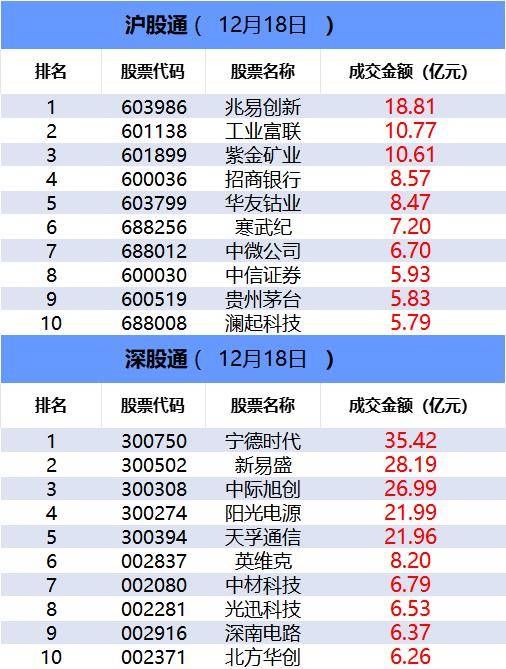
Summary of Key Points Core Viewpoint - The trading volume of the Shanghai and Shenzhen Stock Connect reached a total of 183.4 billion, with significant activity in specific stocks and sectors, indicating a dynamic market environment [1]. Trading Volume - The total trading amount for the Shanghai Stock Connect was 83.09 billion, while the Shenzhen Stock Connect reached 100.31 billion [2]. Top Stocks by Trading Volume - In the Shanghai Stock Connect, the top stock by trading volume was Zhaoyi Innovation with 1.881 billion, followed by Industrial Fulian and Zijin Mining [3]. - In the Shenzhen Stock Connect, the leading stock was CATL with 3.542 billion, followed by Xinyi Technology and Zhongji Xuchuang [3]. Sector Fund Flow - The defense and military sector saw the highest net inflow of funds at 2.106 billion, while the banking sector followed with 743 million [5]. - The electronic sector experienced the largest net outflow of funds at -11.454 billion, indicating a significant sell-off [6]. ETF Trading Activity - The Chemical ETF (516020) saw a remarkable increase in trading volume, with a 166% rise compared to the previous trading day [8]. - The top ETF by trading volume was A500 ETF Huatai Baichuan with 12.4331 billion, followed by A500 ETF Fund [7]. Futures Positioning - In the four major futures contracts, both long and short positions were reduced, with a notable decrease in short positions for IM and IC contracts [9]. Market Activity - The market saw active participation from institutions, with Meinian Health receiving significant buying interest from institutions totaling 686.6 million, alongside a net inflow from the Shenzhen Stock Connect of 831.1 million [11]. - The commercial aerospace concept stock Shunhao Co. hit the daily limit, attracting 164 million from two leading funds [12].






国防军工行业周报(2025年第51周):军工外延效应显著,继续关注商业航天板块-20251218
Shenwan Hongyuan Securities· 2025-12-18 10:51
Investment Rating - The report maintains an "Overweight" rating for the defense and military industry, indicating a positive outlook compared to the overall market performance [26]. Core Insights - The defense and military sector has shown significant growth, with the Shenwan Defense Industry Index rising by 2.8% last week, outperforming major indices such as the Shanghai Composite Index and the CSI 300 [2][5]. - The report highlights the acceleration of order deliveries in December, with expectations for a surge in orders during the first quarter of the next year, driven by geopolitical uncertainties and increased demand for consumable military equipment [4][5]. - The report emphasizes the importance of focusing on investment opportunities in new main battle equipment, consumable weapons, military trade, and military intelligence, as well as thematic investments in commercial aerospace and controllable nuclear fusion [4][5]. Market Performance - Last week, the Shenwan Defense Industry Index outperformed the CSI 300 and the Shanghai Composite Index, ranking second among 31 Shenwan primary industry sectors [5]. - The average increase in the civilian-military integration index was 4.34%, indicating strong performance in this segment [5]. - Top-performing stocks in the defense sector included Aerospace Power (up 42.17%), Western Materials (up 40.98%), and Saiwei Electronics (up 29.37%) [5][12]. Valuation Changes - The current PE-TTM for the Shenwan Defense Industry is 82.24, indicating it is at a historically high valuation level, with significant differentiation among sub-sectors [13][19]. - The aerospace and aviation equipment sectors are noted to be at relatively high valuation levels since 2020 [19][20]. Key Investment Targets - Recommended stocks include high-end combat capabilities such as AVIC Shenyang Aircraft (600316.SH) and AVIC Xi'an Aircraft (600893.SH), as well as new quality combat capabilities like Unisoc (002049.SZ) and Chengdu Huami (688143.SH) [4][20][22].


军工ETF(512660)收涨超1%,市场关注大国博弈下装备升级机遇
Mei Ri Jing Ji Xin Wen· 2025-12-18 08:55
Group 1 - The commercial aerospace industry is entering a period of accelerated development, with significant breakthroughs in launch capacity expected [1] - The Zhuque-3 rocket is set to compete with SpaceX's Falcon 9, and national institutions are projected to double their launch capacity next year, with clear schedules for private rocket launches [1] - Key upcoming events include the December launch of the Tianlong-3 rocket carrying 36 satellites, the planned IPO of Blue Arrow in 2026, and the bidding by Xingwang [1] Group 2 - The military ETF (512660) tracks the CSI Military Industry Index (399967), which selects listed companies in the aerospace, aviation, and shipbuilding sectors from the Shanghai and Shenzhen markets [1] - The index primarily includes stocks from the top ten military industrial groups, reflecting the overall performance of publicly traded companies in China's military industry [1] - The industry allocation focuses on aviation equipment and military electronics, highlighting the growth potential and prosperity of the military sector [1] - As of December 17, 2025, the military ETF has a scale of 12.59 billion, ranking first among 12 similar products [1]
韩国计划孵化万家AI等硬科技初创企业
Xin Hua She· 2025-12-18 08:55
Core Viewpoint - The South Korean government plans to incubate 10,000 startups in hard tech fields such as artificial intelligence (AI) over the next five years, aiming to make these companies a significant force in the country's economic development [1]. Group 1: Government Initiatives - The Ministry of SMEs and Startups, along with relevant departments, released a comprehensive strategy titled "Towards Becoming One of the Global Four Venture Capital Powerhouses" [1]. - The strategy includes multiple goals, such as creating 50 unicorns and "decacorns," and facilitating connections to a global venture capital market estimated at approximately 40 trillion Korean Won (about 1.904 trillion RMB) annually [1]. Group 2: Resource Allocation - To achieve these goals, the South Korean government plans to acquire around 50,000 graphics processing units (GPUs) by 2030 to establish a large AI computing power node and manage resource allocation effectively [1]. - Priority will be given to supporting venture capital and hard tech startups through adjustments and improvements to the policy framework related to strategic industries such as AI, biomedicine, military, energy, and advanced manufacturing [1].