半导体

Search documents
“AI牛市叙事”再掀巨浪! 黄仁勋抛出万亿美元AI宏图 英伟达(NVDA.US)扬帆起航冲6万亿美元市值
智通财经网· 2026-03-17 05:00
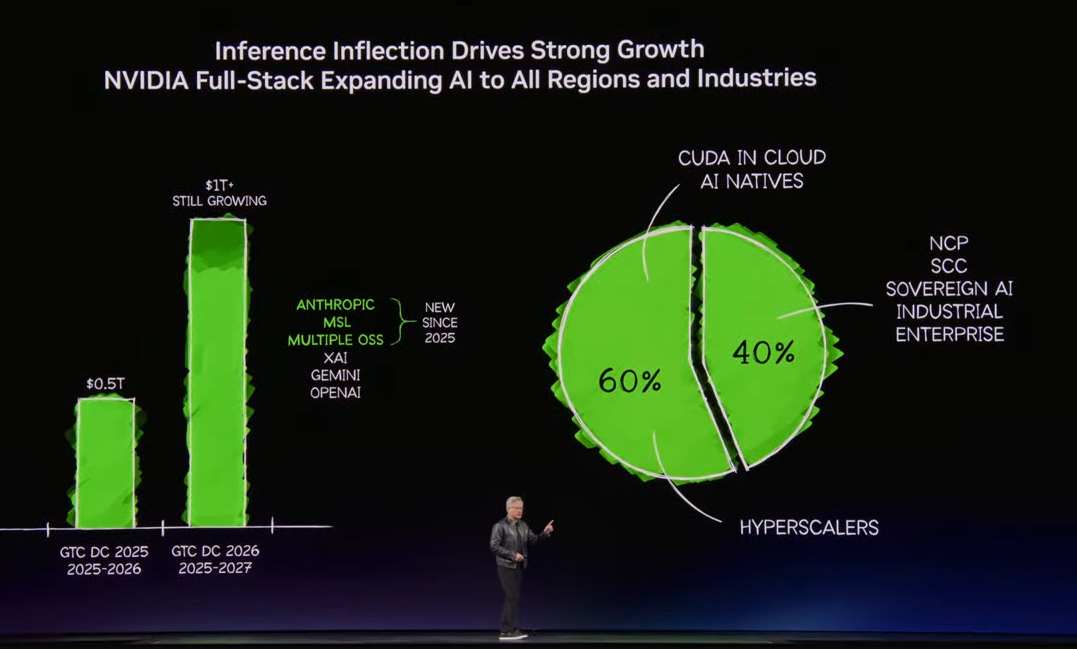
Core Viewpoint - NVIDIA's CEO Jensen Huang announced at the GTC conference that the company's future revenue in the AI chip sector could reach at least $1 trillion by 2027, significantly higher than the previous estimate of $500 billion by 2026, driven by strong demand for the Blackwell architecture GPUs and the upcoming Vera Rubin architecture [1][16] Group 1: AI Infrastructure and Market Position - Analysts from Goldman Sachs, Wedbush, and Morgan Stanley are optimistic about NVIDIA's stock price, predicting that the company's market value will surpass $5 trillion again and potentially reach historical highs [1] - The average target price from Wall Street analysts suggests NVIDIA's market value could exceed $6 trillion within the next 12 months, with the most optimistic estimates reaching as high as $8.8 trillion [1] - Huang emphasized that the AI infrastructure market is transitioning from a focus on training to inference, indicating a shift in how the company defines its competitive landscape [6][14] Group 2: Technological Advancements - NVIDIA introduced a new data center-level CPU and a set of AI inference infrastructure systems based on Groq's exclusive architecture, showcasing its commitment to enhancing its position in the inference computing space [3][4] - The company is integrating various components, including CPU, GPU, LPU, DPU, and networking technologies, into a unified platform, which is expected to enhance performance and efficiency [8][9] - Huang highlighted that the Vera Rubin platform could achieve up to 10 times the inference throughput per watt compared to the Blackwell platform, indicating significant advancements in energy efficiency and cost-effectiveness [7][9] Group 3: Market Dynamics and Future Outlook - The demand for AI inference is expected to rise, with Huang stating that the "AI inference era has arrived," which aligns with the broader market trend towards AI deployment [5][14] - The integration of AI infrastructure into a comprehensive system is seen as a strategic move to redefine the economics of AI, focusing on metrics such as tokens per watt and cost per token [7][12] - Analysts believe that NVIDIA's strong positioning in the AI infrastructure market will continue to attract investment, alleviating concerns about the sustainability of capital expenditures in the tech sector [13][18]


一文梳理“十五五”规划相关产业投资机会-20260317
Guolian Minsheng Securities· 2026-03-17 04:33
Core Insights - The report emphasizes three strategic directions in the "14th Five-Year Plan": technological self-reliance, boosting domestic demand, and upgrading openness [2] - The plan marks a significant shift in focus, highlighting the importance of technology in driving industry, with a dedicated section on achieving high-level technological self-reliance [3] - The report identifies key investment opportunities across various sectors, particularly in emerging industries and new energy sectors, with a projected investment exceeding 7 trillion yuan in the current year [4][10] Strategic Directions - Technological Self-Reliance: The plan elevates technology from a supporting role to a leading role, indicating a strategic shift towards high-level self-reliance in technology [2][3] - Domestic Demand: The plan sets a core goal of significantly increasing the household consumption rate, emphasizing the need to enhance consumption capacity and promote new types of consumption [2] - Upgraded Openness: The plan stresses a higher level of institutional openness, particularly in the service sector, and introduces the concept of "unilateral openness" [2] Industry Analysis - The report outlines significant changes in industrial policy, including a focus on maintaining a reasonable proportion of manufacturing and enhancing the autonomy of supply chains [3] - Key emerging industries are expected to see substantial growth, with projections indicating that the output of six major emerging pillar industries could double by 2030 [10] - The report categorizes investment opportunities into five main areas: mechanical equipment and materials, biomedicine, power and new energy equipment, TMT (technology, media, and telecommunications), and military industry [7] Quantitative Analysis - The report estimates that investments in the "six networks" and key areas will exceed 7 trillion yuan this year, with an additional 200 billion yuan allocated for long-term special bonds to support equipment upgrades [4][10] - The service sector is projected to surpass 100 trillion yuan during the "14th Five-Year Plan" period, with an expected growth rate of approximately 25% [10] - Specific growth targets for new energy industries include a projected increase in pumped storage power stations and offshore wind power installations, with expected growth rates of 152% and 113%, respectively [10][11] Investment Recommendations - The report suggests focusing on five major investment themes: technological innovation, high-end manufacturing, green low-carbon technologies, digital economy, and service consumption [15]
晶方科技:车规CIS与光学器件双轮驱动业绩跃升-20260317
China Post Securities· 2026-03-17 04:30
Investment Rating - The investment rating for the company is "Buy" and it is maintained [1] Core Insights - The company focuses on the smart sensor market, leading in advanced packaging technologies such as WLCSP and TSV. It aims to enhance its technical advantages and business scale in the automotive CIS field while expanding its market share in security monitoring, IoT, AI glasses, and smartphones [4] - The company has acquired the Dutch company ANTERYON, enhancing its capabilities in optical device design and manufacturing, which are widely used in semiconductor equipment and automotive applications. It is also developing SIL optical technology to capitalize on the rapid growth of AI [5] - The company is actively expanding its high-power GaN technology and is progressing with its global layout, including the construction of a production base in Penang, Malaysia, to better meet overseas customer needs [6] Financial Projections - The company is projected to achieve revenues of 2.027 billion, 2.590 billion, and 3.281 billion yuan for the years 2026, 2027, and 2028, respectively, with corresponding net profits of 545 million, 706 million, and 904 million yuan [8] - For the year 2025, the company expects to generate revenue of 1.474 billion yuan, reflecting a growth rate of 30.44% [10] - The company's net profit for 2025 is projected to be 370 million yuan, with a growth rate of 46.23% [10]

阿里建立AI新组织,CEO亲自挂帅,悟空事业部首次公开;山姆紧急下架!网红产品被曝重金属超标;首发价1499元!追觅发布AI戒指Glow
雷峰网· 2026-03-17 04:15
Group 1 - Alibaba has announced the establishment of the Alibaba Token Hub (ATH) business group, directly overseen by CEO Wu Yongming, which includes several divisions focused on AI applications and services [4][5] - The ATH group's core objective is to create, deliver, and apply tokens, marking Alibaba as the first tech giant to structure itself around "tokens" [4] - The newly introduced "Wukong Division" aims to integrate large model capabilities into enterprise workflows, signaling a significant move towards monetizing AI in the B2B sector [5] Group 2 - Sam's Club has urgently removed a popular product, "Botherless Organic Freeze-Dried Strawberries," after reports of heavy metal contamination and pesticide residues [7] - The product was linked to a supplier that had previously faced similar complaints, prompting immediate action from Sam's Club [7] - A public letter from Yonghui Supermarket criticized Sam's Club for unfair competition and emphasized the importance of quality in the industry [8] Group 3 - Vivo and iQOO have announced price increases for some products due to rising semiconductor and storage costs, with the adjustments taking effect on March 18, 2026 [14][15] - The price hikes are a response to significant increases in component costs, with some retailers advising consumers to purchase before the price changes [15] Group 4 - The AI ring "Glow" by ChaseMe Technology has been launched, featuring advanced health monitoring capabilities, including AI-based ECG and heart rate analysis [17][18] - The product is priced at 1,799 yuan, with a promotional launch price of 1,499 yuan, aiming to make professional health management accessible to a broader audience [18] Group 5 - ASML, a leading lithography equipment manufacturer, has confirmed a significant layoff of over 1,700 employees despite reporting record annual revenues of 32.7 billion euros [42] - The layoffs, which represent about 4% of the workforce, have sparked strong employee resistance, raising concerns about job security amid a profitable year [42] Group 6 - Ford's CEO Jim Farley tested several Chinese pickup trucks and acknowledged their competitiveness, although he noted limitations in their load and towing capacities [44][45] - Farley expressed confusion over the profitability of certain models after analyzing their technology and cost structures [45] Group 7 - Nvidia's CEO Jensen Huang projected that AI chips could generate $1 trillion in revenue by 2027, significantly increasing the company's sales expectations [47] - The announcement included the introduction of new hardware, including the Vera CPU, designed specifically for AI applications [47] Group 8 - OpenAI is reportedly in talks with several private equity firms to establish a joint venture, with a pre-money valuation of approximately $10 billion [48] - This move aims to accelerate OpenAI's penetration into the enterprise market while providing support to companies affected by AI advancements [48] Group 9 - Samsung has indicated that the current memory chip shortage may persist until around 2028, driven by structural demand from AI technologies [52][53] - The company is prioritizing high-end products like HBM and advanced DRAM to meet the growing needs of AI servers, which require significantly more memory than standard servers [53]


事关存储芯片,SK集团董事长最新发声
财联社· 2026-03-17 04:10
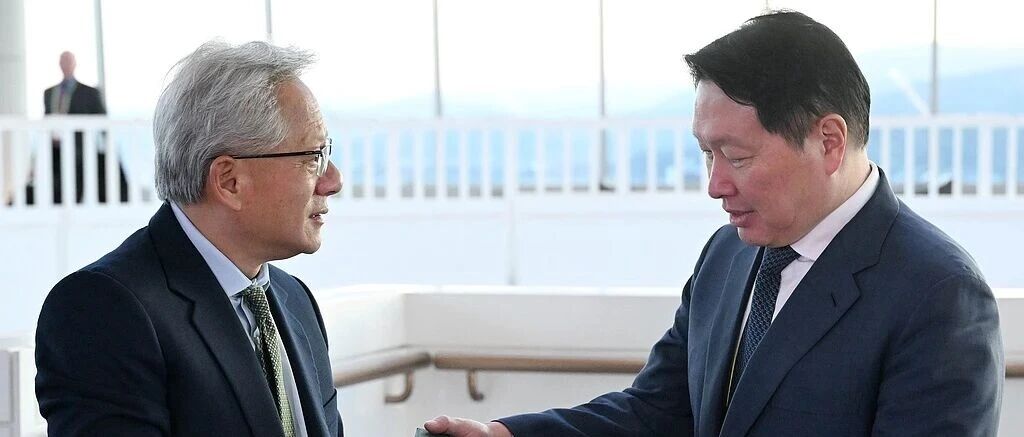
Core Viewpoint - The global memory chip shortage is expected to persist until 2030 due to systemic production bottlenecks in the semiconductor industry [1][5]. Group 1: Chip Shortage and Price Trends - The shortage of various memory chips, including DRAM, NAND, and HBM, is anticipated to lead to sustained price increases over an extended period [2]. - The current shortage rate for AI storage chips has exceeded 30%, indicating significant demand pressures [3]. - The increasing demand for AI is contributing to the ongoing semiconductor shortage, which is likely to continue for several years [4]. Group 2: Company Insights and Market Reactions - SK Hynix, one of the largest memory chip manufacturers globally, is a key supplier of HBM chips to NVIDIA [6]. - The chairman of SK Group, Choi Tae-won, mentioned that the company requires at least four to five years to increase wafer production capacity to meet the high demand for HBM chips driven by the AI sector [7]. - SK Hynix is considering measures to stabilize DRAM chip prices and is exploring the possibility of issuing American Depositary Receipts (ADRs) to broaden its global investor base, which could help reassess the company's value [8]. Group 3: Market Performance - Following the NVIDIA GTC conference, South Korean semiconductor stocks experienced strong performance, with Samsung Electronics' stock rising over 4% and SK Hynix's stock increasing by more than 2.5%, reaching the 1 million KRW mark for the first time in 11 trading days [9].
螺丝钉指数地图来啦:指数到底如何分类|2026年3月
银行螺丝钉· 2026-03-17 04:01
Core Viewpoint - The article introduces an index map that provides essential information about various stock indices, including their codes, selection rules, industry distribution, average and median market capitalization of constituent stocks, and the number of constituent stocks, which will be regularly updated for easy reference [1][2]. Group 1: Types of Indices - The index map includes several categories of stock indices: broad-based indices, strategy indices, industry indices, thematic indices, and overseas indices [4][2]. Group 2: Index Details - The article provides detailed information on specific indices, including: - CSI 300 (000300.SH): Average market cap of ¥215.22 billion, median market cap of ¥117.08 billion, consisting of 300 stocks [7]. - CSI 500 (000905.SH): Average market cap of ¥37.74 billion, median market cap of ¥32.61 billion, consisting of 500 stocks [7]. - CSI 800 (000906.SH): Average market cap of ¥104.29 billion, median market cap of ¥43.96 billion, consisting of 800 stocks [7]. - CSI 1000 (000852.SH): Average market cap of ¥16.08 billion, median market cap of ¥13.84 billion, consisting of 1000 stocks [7]. - CSI 2000 (932000.CSI): Average market cap of ¥6.56 billion, median market cap of ¥5.65 billion, consisting of 2000 stocks [7]. Group 3: Industry Distribution - The article highlights the distribution of various industries within the indices, showing the percentage representation of sectors such as: - Information Technology: 11.69% in CSI 300, 21.57% in CSI 500, 14.43% in CSI 800 [11]. - Consumer Discretionary: 6.34% in CSI 300, 5.65% in CSI 500, 6.15% in CSI 800 [11]. - Financials: 20.43% in CSI 300, 6.31% in CSI 500, 16.32% in CSI 800 [11]. Group 4: Dividend Indices - The article discusses various dividend indices, including: - CSI Dividend (000922.CSI): Average market cap of ¥220.78 billion, consisting of 100 stocks [10]. - Shanghai Dividend (000015.SH): Average market cap of ¥350.46 billion, consisting of 50 stocks [10]. - Shenzhen Dividend (399324.SZ): Average market cap of ¥77.09 billion, consisting of 40 stocks [10].

第一创业晨会纪要-20260317
First Capital Securities· 2026-03-17 03:52
Macroeconomic Overview - In January-February 2026, industrial added value increased by 6.3% year-on-year, rebounding by 1.1 percentage points from December 2025 and by 0.4 percentage points from the previous year [3] - The total retail sales of consumer goods in January-February 2026 nominally grew by 2.8% year-on-year, up by 1.9 percentage points from December 2025 but down by 0.9 percentage points from the previous year [3] - Fixed asset investment in January-February 2026 saw a cumulative year-on-year growth rate of 1.8%, rebounding by 5.6 percentage points from the previous year, with manufacturing investment growing by 3.1% and infrastructure investment (excluding electricity) growing by 11.4% [3] Real Estate Sector - Despite improvements in real estate investment in January-February 2026, specific data indicates ongoing challenges, with new housing starts down by 23.1% year-on-year and housing sales area down by 13.5% [4] - The funding sources for real estate development saw a year-on-year decline of 16.5%, with domestic loans down by 13.9% and other funding sources (prepayments) down by 25.1% [4] - The price index for new residential properties in 70 large and medium-sized cities in February 2026 was down by 3.5% year-on-year, while the second-hand housing price index fell by 6.3% [5] Trade and Export - Exports in January-February 2026 grew by 21.8%, significantly higher than the 5.5% growth in the previous year, with a trade surplus of 213.6 billion USD, an increase of 26.2% year-on-year [6] - The contribution rate of net exports to GDP reached 32.7% in 2025, the highest since 1998, indicating a strong reliance on external demand amidst rising trade protectionism and global trade complexities [6] Industry Insights - The Chinese Ministry of Commerce reported stable progress in US-China trade negotiations, with discussions on tariff levels and potential extensions of non-tariff measures [8] - Nvidia's GTC conference highlighted a projected demand of at least 1 trillion USD by 2027 for AI-related products, indicating a doubling of expected demand compared to previous forecasts [8] Consumer Sector - Chuangmeng Tiandi (1119.HK) announced a positive profit forecast for FY2025, expecting a net profit of 10 million to 30 million CNY, a significant turnaround from a loss of approximately 545 million CNY in FY2024 [10] - The improvement in profitability is attributed to successful commercialization of self-developed games, particularly "Karabichu," and a shift from high R&D investment to operational efficiency [10]
英伟达GTC大会聚焦AI技术发展,黄仁勋称Token为AI时代基础单元
Huan Qiu Wang Zi Xun· 2026-03-17 03:45
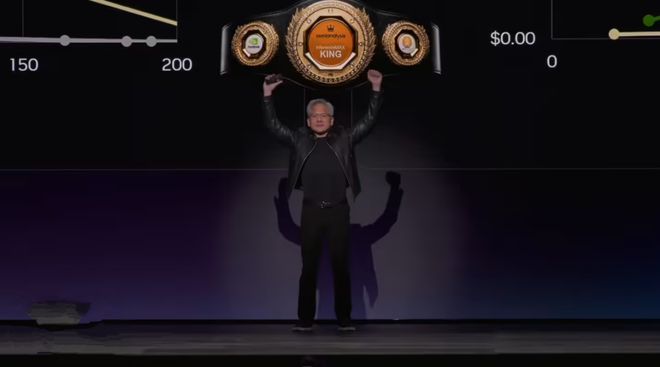
Core Insights - The NVIDIA GPU Technology Conference (GTC) commenced on March 17, celebrating the 20th anniversary of the CUDA architecture, with CEO Jensen Huang emphasizing the importance of Tokens as foundational units in the new AI era and highlighting CUDA's role in accelerating computing beyond Moore's Law [1][3] Group 1: CUDA Architecture and Its Impact - Over the past 20 years, NVIDIA has built millions of CUDA-enabled GPUs and computing systems globally, penetrating major cloud platforms and serving nearly all industries, establishing itself as a key player in accelerated computing [3] - NVIDIA positions itself as an algorithm platform company, with data acceleration libraries like cuDF and cuVS adopted by leading platforms such as Google Cloud, Azure, and AWS, showcasing significant technical advantages in data processing [3] Group 2: Performance Enhancements and Cost Savings - cuDF can enhance the speed of data engines by up to 5 times when processing structured data, while cuVS effectively accelerates the feature extraction process for unstructured data [3] - The deployment of cuDF by social platform Snap resulted in a 76% reduction in daily data processing costs, completing analysis of 10 PB of data in just three hours, saving millions of dollars and demonstrating the commercial and practical value of NVIDIA's data acceleration technology [3] Group 3: Business Strategy and Market Position - NVIDIA's business is currently focused 60% on large-scale enterprises, covering nearly all companies building AI GPU data centers, while the remaining 40% spans cloud computing, enterprise services, robotics, gaming, and supercomputing, creating a comprehensive and multidimensional business layout [4] - The company claims to have the lowest processing cost per Token globally, which can significantly reduce AI research and application costs for enterprises, thereby expanding profit margins [4] - NVIDIA is referred to as the "Token King" in the global AI sector, with a commitment to driving AI industry development through technological innovation, supporting digital and intelligent transformation across various industries [4]
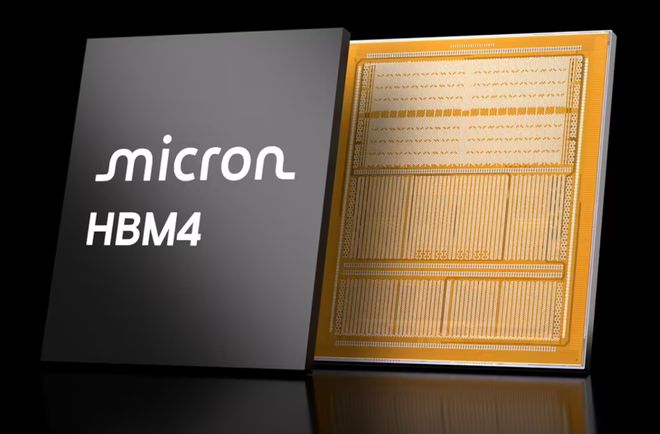
美光官宣:HBM4 等全系存储产品量产,深度适配英伟达 Vera Rubin 平台
Huan Qiu Wang Zi Xun· 2026-03-17 03:45
Core Insights - Micron Technology has announced the mass production of HBM4 memory, SOCAMM2 memory modules, and 9650 SSD data center solid-state drives, specifically designed for NVIDIA's Vera Rubin platform, enhancing storage performance for AI servers [1][3] Group 1: HBM4 Memory - Micron's HBM4 production line achieved mass production and shipment in Q1 of this year, with the first batch being a 36GB 12-layer stacked version [1] - The HBM4 product features a pin speed exceeding 11 Gb/s and offers over 2.8 TB/s memory bandwidth, representing a 2.3 times increase compared to the previous generation HBM3E, with over 20% improvement in power efficiency [1] - Early samples of a 48GB 16-layer stacked HBM4 have been provided to customers, increasing single HBM position memory capacity by 33% compared to the 12-layer version, catering to higher computational demands [1] Group 2: SOCAMM2 Memory Modules - Micron's SOCAMM2 has also entered mass production, with a 192GB version designed for the Vera Rubin NVL72 system and standalone Vera CPU platforms, providing up to 2TB memory capacity and 1.2 TB/s bandwidth per CPU [3] - The SOCAMM2 product line ranges from 48GB to 256GB, accommodating various AI server configurations and diverse market needs [3] Group 3: 9650 SSD - The Micron 9650 SSD has officially entered mass production, utilizing PCIe Gen 6 interface and optimized for NVIDIA's BlueField4 STX architecture [3] - This SSD achieves a maximum sequential read speed of 28 GB/s and random read performance of 5.5 million IOPS, nearly doubling the read performance compared to the previous PCIe Gen 5 SSD [3] - The unit power efficiency of the 9650 SSD has improved by approximately two times, aligning with the trend of green development in data centers while enhancing computational power [3]

新材料周报:1月全球半导体销售额增长46%,全尺寸人形机器人PEEK规模化应用突破:基础化工-20260317
Huafu Securities· 2026-03-17 03:36
Investment Rating - The industry rating is "Outperform the Market," indicating that the overall return of the industry is expected to exceed the market benchmark index by more than 5% in the next 6 months [56]. Core Insights - In January 2026, global semiconductor sales reached $82.5 billion, marking a 46.1% increase compared to January 2025 and a 3.7% increase from December 2025 [4][31]. - The semiconductor price increase trend continues, with major foundries planning to raise prices by up to 10% starting in April 2026 due to rising production costs driven by various factors including supply chain disruptions and raw material price hikes [30]. - The domestic manufacturing upgrade is ongoing, with high standards and high-performance material demands expected to be released gradually, indicating a rapid development potential for the new materials industry [4]. Market Overview - The Wind New Materials Index closed at 5900.37 points, up 0.87% week-on-week. Among the six sub-industries, the semiconductor materials index fell by 2.79%, while the carbon fiber index rose by 26.05% [3][11]. - The top five gainers in the week included Ruifeng High Materials (25.52%), Lianrui New Materials (21.33%), and Huate Gas (15.49%) [26][27]. Recent Industry Highlights - The launch of the full-size humanoid robot PEEK by Huaxiang Qiyuan represents a breakthrough in lightweight, high-endurance, and durable applications, reducing the robot's weight by 5.3 kg [4][35]. - Feikai Materials announced plans to invest in a new production base in Anhui, with a total investment of approximately 1 billion yuan, aimed at expanding its semiconductor materials strategy [35][36].