
橡胶

Search documents
南华期货天然橡胶产业周报:宏观利好情绪消退,基本面担忧主导胶价-20251103
Nan Hua Qi Huo· 2025-11-03 11:24
1. Report Industry Investment Rating - Not provided in the report 2. Core Views of the Report - In the short - term, the natural rubber market is expected to continue its wide - range oscillation. RU has low valuation and cost - side support but weak buying, while dark - colored rubbers like 20 - gauge rubber rely on downstream demand. In the medium - to - long - term, it is regarded as neutrally bearish due to supply pressure and uncertain demand [1][2] - The market has shifted from macro - driven to fundamentals - driven pricing. The current fundamentals show mixed signals, with some positive factors in the upstream and downstream but also significant supply and demand pressures [1] - Trade policies and international situations pose risks to the long - term demand for rubber, and downstream tire enterprises may restructure the supply - demand distribution of rubber [10] 3. Summary by Relevant Catalogs 3.1 Core Contradictions and Strategy Recommendations 3.1.1 Core Contradictions - Short - term: After the initial rise, rubber prices retraced due to the fading of macro - positive sentiment. The fundamentals show that although RU has cost - side support, the buying is weak, and 20 - gauge rubber depends on downstream demand. The supply of natural rubber is expected to increase, and the supply of synthetic rubber is loose, dragging down the price of the rubber system [1] - Medium - to - long - term: The global total production capacity cycle has not fully peaked, and the supply pressure is increasing. The demand needs continuous macro - positive support, and the export growth faces risks such as international situations and trade barriers [1][2] - Proximal trading: The price difference between Indonesian standard rubber and other standard rubbers has widened slightly, providing some support to NR. The risk of near - month delivery is small, but there is still an anti - arbitrage space for some standard rubbers [7] - Distal trading: The weather in production areas has improved, and the supply is expected to increase. The inventory in Qingdao has started to accumulate, increasing the supply pressure. The macro situation still has uncertainties, and the long - term demand may lead to a restructuring of the rubber supply - demand distribution [10] 3.1.2 Trading - Type Strategy Recommendations - **Price Range**: The short - term reference oscillation range for RU2601 is 14800 - 15400; for NR2511, it is 12000 - 12400 [15] - **Trend Judgement**: It is expected to maintain an oscillation, with the fundamentals as the main pricing factor. The support for RU01 is around 14600, and the pressure is around 15600; for NR12, the support is around 11800 [15] - **Strategy Recommendations**: Adopt a wait - and - see approach for unilateral trading, consider small - scale long - position trading when RU01 stabilizes. For hedging, combine with protective options or consider a long - volatility strategy. For basis trading, consider reverse arbitrage for some varieties. For calendar spread arbitrage, hold long - spread positions for RU and consider long - spread positions for NR11 - 01. For variety arbitrage, consider widening the spread at low levels [16] 3.1.3 Industry Customer Operation Recommendations - **Price Forecast**: The price range for rubber RU in the next two weeks is 14800 - 15700, and for 20 - gauge rubber NR, it is 11900 - 12900 [22] - **Risk Management Strategies**: For inventory management, when the inventory is high, short - sell rubber futures, buy out - of - the - money put options, and sell call options. For procurement management, when the inventory is low, buy long - term rubber futures and out - of - the - money call options, and sell put options [22] 3.2 Important Information and Attention Events 3.2.1 Last Week's Important Information - **Positive Information**: The US API and EIA crude oil inventories decreased, the Sino - US economic and trade consultations achieved results, the global automotive supporting demand was good, the Fed cut interest rates, the "15th Five - Year Plan" policies were introduced, and the demand for winter snow tires increased [24][25][26] - **Negative Information**: The Fed's decision on future interest rate cuts is uncertain, the increase in rubber prices has brought supply - demand pressure, the manufacturing PMI in China declined, the tire and automobile inventories are under pressure, and the weather may have a certain impact on production [27] 3.2.2 This Week's Attention Focus - Monitor the rainfall in production areas, changes in dry - rubber social inventory, downstream tire start - up conditions, and important macro data such as the US ISM manufacturing PMI and China's PPI and CPI reports [28] 3.3 Disk Interpretation 3.3.1 Price - Volume and Capital Interpretation - **Unilateral Trend**: Last week, rubber prices first rebounded and then declined. RU and NR found support at around 15000 and 12000 respectively. The liquidity problem of 20 - gauge rubber has been alleviated, and the spot price is still stronger than the disk price. RU's position remained flat, while NR's position continued to decrease [29] - **Capital Trend**: Since last Thursday, the short positions of RU and NR have increased, and the net positions have decreased [32] 3.3.2 Spot Market and Spread Analysis - **Spot Price Changes**: Last Friday, most spot prices fell, except for the increase in the price of whole milk latex. Among standard rubbers, the price of Thai standard rubber decreased significantly [35] - **Basis Structure**: The spread between whole milk latex and smoked sheet rubber narrowed, the basis of whole milk latex remained flat, and the basis of smoked sheet rubber decreased. The basis of some standard rubbers rebounded, and the term structure of NR has changed from a deep back to a shallower one [37][42] - **Calendar Spread Structure**: The calendar spread structure of RU changed little, and the center of gravity moved up slightly. The price of NR decreased, and the back structure became shallower, reflecting weak market expectations [42] - **External Market Conditions**: The price of Thai smoked sheet rubber increased, driving the near - month contracts of Japanese RSS3 to strengthen, and the monthly spread structure became flatter. The price and structure of Singapore TSR20 rubber changed little [48] - **Virtual - to - Physical Ratio and Sentiment Index**: Recently, the sentiment in the rubber market has fluctuated greatly. The bullish sentiment rose and then fell last week, and the demand sentiment for downstream tires was weak. The virtual - to - physical ratio of RU continued to rise, while that of NR decreased [57] - **Variety Spread Analysis**: The spread between light - colored and dark - colored rubbers widened and then stabilized. The spread between natural and synthetic rubbers increased and then corrected, dragging down the price of natural rubber [60][64] 3.4 Valuation and Profit Analysis 3.4.1 Industry Chain Profit Tracking - **Raw Material Cost**: Last week, rainfall in Hainan, Yunnan, and southern Thailand affected the supply, and raw material prices were firm. The price difference between water and cup in Thailand rebounded [66] - **Processing Profit - Domestic Rubber**: The delivery profit of whole milk latex and the profit of TSR9710 both decreased significantly [73] - **Processing Profit - Imported Rubber**: The overall center of rubber prices moved up last week. The import profit of Thai smoked sheet rubber remained flat, while the profits of 20 - gauge standard rubber and Thai mixed rubber decreased [75] 3.5 Supply - Demand and Inventory Deduction 3.5.1 Supply Side - **Production in Major Producing Countries**: The supply of natural rubber in major producing countries is expected to increase, and the weather in some areas has improved, which is conducive to production [10] - **Import Situation**: In September, the import of natural and synthetic rubber in China increased steadily. The import of Thai standard rubber decreased, while the import of Thai mixed rubber increased significantly [79] 3.5.2 Demand Side - **Total Demand in Major Producing Countries**: In August, the actual consumption of natural rubber in China remained stable year - on - year, while the demand in major producing countries such as Thailand, Indonesia, and Malaysia declined [86] - **Tire Production and Sales**: The demand for winter snow tires has increased, and most tire enterprises' start - up rates have remained stable. The inventory of semi - steel tires has decreased, while that of all - steel tires has increased slightly. The export of domestic tires has shown strong resilience but has declined month - on - month [91] - **Replacement Demand**: The domestic logistics industry has been stable, but the slowdown in fixed - asset investment may suppress the growth of replacement demand in the long term [96] - **Supporting Demand**: Domestic automobile sales have performed well, and the supporting demand for tires is expected to remain resilient. However, the long - term increase in the demand for truck - related tires may be limited [98][99] - **Overseas Tire Production**: Japan's tire production has remained stable overall, with strong performance in all - steel tires and a year - on - year decrease in semi - steel tires. Thailand's tire shipment index has increased year - on - year [102] - **Overseas Tire Demand**: US tire imports have increased despite the decline in automobile sales. The production and sales of European passenger cars have been stable, and the production of commercial vehicles has decreased. The automobile production in Japan and South Korea has shown different trends [104] - **Demand for Other Rubber Products**: The start - up rate of domestic conveyor belts has weakened, while that of rubber tubes is slightly higher than that of last year [111] 3.5.3 Inventory Side - **Futures Inventory**: Affected by the weather, the RU warehouse receipts have continued to decline, while the NR warehouse receipts have increased due to stable imports and weak downstream procurement [116] - **Social Inventory**: As of November 2, 2025, the total inventory of natural rubber in Qingdao has increased, with a decrease in bonded - area inventory and an increase in general - trade inventory [118]
外围宏观扰动,橡胶宽幅波动
Guo Mao Qi Huo· 2025-11-03 09:19
1. Report Industry Investment Rating - The investment view of the natural rubber industry is "oscillating", with a trading strategy of "going long" for single - side trading and "waiting and seeing" for arbitrage [3]. 2. Core Viewpoints of the Report - Affected by external macro - disturbances, rubber prices fluctuated widely. Driven by macro - level and fundamental factors in the natural rubber market, rubber prices continued to rise. However, due to the impact of typhoons and heavy rainfall in overseas and domestic production areas, raw material supply was restricted, and processing plants' eagerness to purchase raw materials at higher prices strengthened cost - side support [6]. - Currently, raw material prices have strong support, mid - stream inventories are continuously decreasing, downstream demand remains stable, and the sentiment in the commodity market has improved. In the short term, rubber prices may maintain a relatively strong performance [3]. 3. Summary According to Relevant Catalogs 3.1 Main Views and Strategy Overview - **Supply**: Bullish. In domestic production areas, raw material prices in Yunnan and Hainan increased. In Thailand, although the northeast had normal supply growth, the south faced supply constraints due to heavy rainfall, and raw material prices rose. In Vietnam, raw material supply was tight due to excessive rainfall, and prices were firm [3]. - **Demand**: Neutral. As of last week, the capacity utilization rates of Chinese all - steel and semi - steel tire sample enterprises decreased slightly. It is expected that the capacity utilization rates will fluctuate slightly in the next period, and some enterprises may reduce production or conduct maintenance in November [3]. - **Inventory**: Bullish. As of October 26, 2025, China's natural rubber social inventory decreased by 1.1 million tons, a decline of 1%. The warehouse receipt inventory of RU on the SHFE decreased, while that of 20 - number rubber increased [3]. - **Basis/Spread**: Bullish. After the holiday, the spread between RU and mixed rubber widened, and the spread between the main contracts of RU and NR also widened [3]. - **Profit**: Bullish. The theoretical production profit of Thai standard rubber and domestic concentrated latex narrowed, while the loss of the delivery profit of Yunnan whole - milk latex improved [3]. - **Valuation**: Neutral. The current absolute price is at a moderately high level, and the overall valuation is at a medium level [3]. - **Commodity Market**: Neutral. The suspension of relevant Sino - US tariff policies has reduced previous negative disturbances, and the sentiment in the commodity market has improved [3]. 3.2 Futures and Spot Market Review - **Futures Market**: Affected by macro and fundamental factors, rubber prices continued to rise. As of October 31, the RU main contract closed at 15,085 yuan/ton, a weekly decline of 250 yuan/ton (-1.63%), and the 20 - number rubber main contract closed at 12,230 yuan/ton, a weekly decline of 275 yuan/ton (-2.20%) [6]. - **Spot Market**: Spot prices rebounded and rose [9]. - **Position**: RU positions were low, and NR positions decreased. The spread between RU and NR widened [17][24][31]. 3.3 Rubber Supply and Demand Fundamental Data - **Production Area Weather**: Rainfall in production areas caused disturbances, affecting raw material supply [40]. - **Main Producing Countries' Output**: In August, the cumulative output of ANRPC was 6.855 million tons (+1.76%) [63]. - **Main Producing Countries' Exports**: In August, the cumulative export volume of ANRPC was 6.325 million tons (+4.25%) [73]. - **China's Imports**: From January to September, China imported 4.7172 million tons of natural rubber (+19.65%). In September, the import volume increased significantly, and Thailand was the largest source country [86][92][99]. - **Mid - stream Inventory**: China's social inventory continued to decline. As of October 26, 2025, the social inventory of natural rubber was 1.0389 million tons, a decline of 1% [100][108]. - **Downstream Tire Demand**: The capacity utilization rate of tire enterprises remained stable. As of last week, the capacity utilization rate of all - steel tire sample enterprises was 65.34%, and that of semi - steel tire sample enterprises was 72.12%. It is expected to fluctuate slightly in the next period [109][117]. - **Downstream Tire Inventory**: Tire inventories in Shandong decreased slightly [118]. - **Automobiles and Heavy Trucks**: In September, the growth rate of automobile sales expanded, and in August, heavy - truck sales increased significantly year - on - year [126][136]. - **Tire Exports**: From January to September, China exported 7.28 million tons of rubber tires (+5%) [137][145]. - **Cost and Profit**: The production profit of Thai standard rubber decreased, and the delivery profit of whole - milk latex was in a loss state [147]. - **Futures - Spot Spread**: The spread between Thai standard rubber and Thai mixed rubber declined [168].
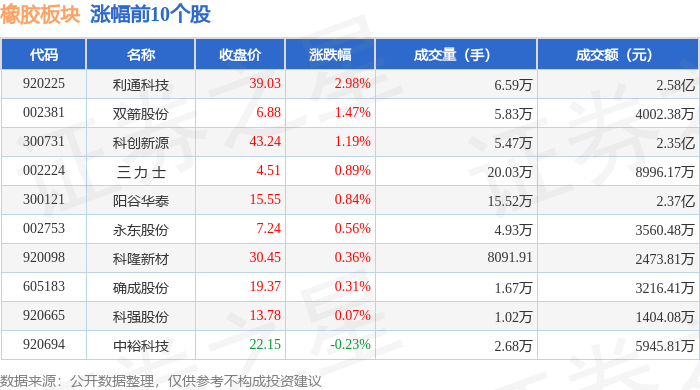
橡胶板块11月3日跌0.91%,三维装备领跌,主力资金净流出1.35亿元
Zheng Xing Xing Ye Ri Bao· 2025-11-03 08:40
Market Overview - The rubber sector experienced a decline of 0.91% on November 3, with Sanwei Equipment leading the drop [1] - The Shanghai Composite Index closed at 3976.52, up 0.55%, while the Shenzhen Component Index closed at 13404.06, up 0.19% [1] Individual Stock Performance - Notable gainers in the rubber sector included: - Litong Technology (code: 920225) with a closing price of 39.03, up 2.98% and a trading volume of 65,900 shares, totaling 258 million yuan [1] - Shuangjian Co. (code: 002381) closed at 6.88, up 1.47% with a trading volume of 58,300 shares, totaling 40.02 million yuan [1] - Kexin Source (code: 300731) closed at 43.24, up 1.19% with a trading volume of 54,700 shares, totaling 235 million yuan [1] - Major decliners included: - Sanwei Equipment (code: 920834) closed at 16.93, down 4.46% with a trading volume of 68,900 shares, totaling 117 million yuan [2] - Yuanxiang New Materials (code: 301300) closed at 41.54, down 2.49% with a trading volume of 26,400 shares, totaling 110 million yuan [2] - Tongcheng New Materials (code: 603650) closed at 40.26, down 2.33% with a trading volume of 126,700 shares, totaling 506 million yuan [2] Capital Flow Analysis - The rubber sector saw a net outflow of 135 million yuan from institutional investors, while retail investors experienced a net inflow of 83.62 million yuan [2][3] - Key stocks with significant capital flow included: - Kexin Source (code: 300731) had a net inflow of 7.97 million yuan from institutional investors, but a net outflow of 7.72 million yuan from retail investors [3] - Yuanxiang New Materials (code: 301300) had a net inflow of 4.68 million yuan from institutional investors, with a net outflow of 7.13 million yuan from retail investors [3] - Shuangjian Co. (code: 002381) had a net inflow of 3.55 million yuan from institutional investors, but a net outflow of 3.08 million yuan from retail investors [3]

《特殊商品》日报-20251103
Guang Fa Qi Huo· 2025-11-03 05:58
Group 1: Glass and Soda Ash Report Industry Investment Rating Not provided Core Viewpoints - For soda ash, the post - National Day price has been weakly oscillating, with low demand and obvious over - supply. The mid - term demand is expected to remain at the previous rigid level. It is recommended to take profit on previous short positions and wait for shorting opportunities on rebounds. [1] - For glass, the weekend news of production line shutdown in Shahe may have a positive impact on the market sentiment. Although there is still some peak - season demand expectation in November, the industry still needs capacity clearance in the long - term. It is recommended to close previous short positions and look for short - term long opportunities. [1] Summary by Directory - **Prices and Spreads**: Glass and soda ash spot prices in different regions remained unchanged on November 3, 2025. Glass 2505 decreased by 0.88%, and Glass 2509 increased by 0.08%. Soda ash 2505 decreased by 0.60%, and Soda ash 2509 increased by 0.08%. [1] - **Supply**: Soda ash's weekly output decreased by 1.71% to 75.76 tons, and its operating rate decreased by 1.72% to 86.89%. Floating - glass daily melting volume remained unchanged, while photovoltaic daily melting volume decreased by 0.84%. [1] - **Inventory**: Glass factory inventory increased by 4.72% to 65790,000 weight - cases, soda ash factory inventory increased by 2.54% to 1.702 million tons, and soda ash delivery - warehouse inventory decreased by 3.18% to 676,900 tons. [1] - **Real Estate Data**: New construction area increased by 0.09%, construction area decreased by 2.43%, completion area decreased by 0.03%, and sales area decreased by 6.50%. [1] Group 2: Natural Rubber Report Industry Investment Rating Not provided Core Viewpoints - In the short - term, rubber prices are under pressure due to the Fed's hawkish stance on December's interest - rate cut. The prices may decline further if raw - material supply is smooth; otherwise, they are expected to oscillate between 15,000 - 15,500. [2] Summary by Directory - **Prices and Spreads**: Most natural rubber spot prices decreased on October 31, 2025. The 9 - 1 spread decreased by 6.67%, the 1 - 5 spread increased by 22.22%, and the 5 - 9 spread decreased by 16.67%. [2] - **Fundamentals**: In August, Thailand's production decreased by 0.43%, Indonesia's decreased by 4.30%, India's increased by 11.11%, and China's increased. Tire production in August increased by 9.10%, and tire exports in September decreased by 10.65%. [2] - **Inventory Changes**: Bonded - area inventory decreased by 1.20%, and natural - rubber factory - warehouse futures inventory increased by 4.73%. [2] Group 3: Logs Report Industry Investment Rating Not provided Core Viewpoints - Although the log futures price is at a relatively low level and the import cost provides some support, the market is still expected to oscillate at the bottom due to the weak supply - demand situation. [3] Summary by Directory - **Prices and Spreads**: On October 31, 2025, most log futures prices changed slightly. The 11 - 01 spread decreased by 22.0, and the 11 - 03 spread decreased. [3] - **Supply**: From October 27 to November 2, 2025, the number of pre - arriving New Zealand log ships at 13 Chinese ports increased by 33% week - on - week, and the arrival volume increased by 19%. [3] - **Demand**: As of October 24, the national coniferous log inventory decreased by 80,000 cubic meters week - on - week, and the daily log delivery volume increased by 120,000 cubic meters. [3] Group 4: Industrial Silicon Report Industry Investment Rating Not provided Core Viewpoints - In November, the industrial silicon market still faces inventory pressure. Although supply may decline slightly and demand may remain stable, the flow of warehouse receipts to the spot market will increase supply. The price is expected to oscillate at a low level, with a main range of 8,500 - 9,500 yuan/ton. [5] Summary by Directory - **Prices and Spreads**: On October 31, 2025, most industrial silicon spot prices remained stable or increased slightly. The 2511 - 2512 spread decreased by 8.86%, and the 2601 - 2602 spread increased by 300.00%. [5] - **Fundamentals**: In October, the national industrial silicon production increased by 7.46%, the national operating rate increased by 10.86%. Organic silicon DMC production decreased by 0.29%, and polysilicon production increased by 3.08%. [5] - **Inventory Changes**: Most industrial silicon inventories decreased slightly, with the social inventory decreasing by 0.18% and the warehouse - receipt inventory decreasing by 0.33%. [5] Group 5: Polysilicon Report Industry Investment Rating Not provided Core Viewpoints - In November, the polysilicon market is expected to be in a situation of weak supply and demand, with a high - level range - bound oscillation. Investment strategies include short - term long positions in futures, selling put options, and buying ETFs or related stocks. [6] Summary by Directory - **Prices and Spreads**: On October 31, 2025, polysilicon spot prices decreased slightly, and the futures price increased by 2.66%. The month - to - month spreads changed to varying degrees. [6] - **Fundamentals**: Weekly silicon - wafer production decreased by 3.33%, and polysilicon production decreased by 4.41%. Monthly polysilicon production increased by 3.08%, and the net export volume decreased by 56.83%. [6] - **Inventory Changes**: Polysilicon inventory increased by 1.16%, silicon - wafer inventory increased by 2.49%, and polysilicon warehouse receipts increased by 2.79%. [6]
能源化工期权策略早报:能源化工期权-20251103
Wu Kuang Qi Huo· 2025-11-03 02:43
1. Report Industry Investment Rating - Not provided in the document 2. Core View of the Report - The energy and chemical sector is divided into energy, alcohols, polyolefins, rubber, polyesters, alkalis, and others. For each sector, options strategies and recommendations are provided for selected varieties. Options strategy reports are compiled based on the analysis of the underlying market, option factor research, and option strategy recommendations for each option variety. Strategies mainly involve constructing option combination strategies focused on sellers, as well as spot hedging or covered strategies to enhance returns [8]. 3. Summary by Relevant Catalogs 3.1 Futures Market Overview - The latest prices, price changes, price change percentages, trading volumes, volume changes, open interests, and open interest changes of various energy and chemical option underlying futures contracts are presented. For example, the latest price of crude oil (SC2512) is 464, with a price increase of 4 and a price change percentage of 0.91%, trading volume of 8.02 million lots, volume change of -2.85 million lots, open interest of 2.96 million lots, and open interest change of -0.19 million lots [3]. 3.2 Option Factors - Volume and Open Interest PCR - Volume and open interest PCR data for various energy and chemical options are provided. Volume PCR is used to describe whether the underlying market has a turning point, and open interest PCR is used to describe the strength of the option underlying market. For example, the volume PCR of crude oil options is 0.90, with a change of -0.03, and the open interest PCR is 0.66, with a change of -0.03 [4]. 3.3 Option Factors - Pressure and Support Levels - Pressure and support levels for various energy and chemical option underlying contracts are analyzed from the perspective of the strike prices with the largest open interest of call and put options. For example, the pressure level of crude oil (SC2512) is 500, and the support level is 440 [5]. 3.4 Option Factors - Implied Volatility - Implied volatility data for various energy and chemical options are presented, including at-the-money implied volatility, weighted implied volatility, weighted implied volatility changes, annual average implied volatility, call implied volatility, put implied volatility, historical 20 - day volatility, and the difference between implied and historical volatility. For example, the at-the-money implied volatility of crude oil options is 27.935%, the weighted implied volatility is 29.69%, with a change of -0.19% [6]. 3.5 Strategy and Recommendations 3.5.1 Energy Options - Crude Oil - Fundamental analysis: US refinery demand has stabilized and rebounded. During the recent oil price decline, shale oil production did not significantly decrease. OPEC exports have increased, but most are absorbed by China, so there is no obvious visible inventory in the market. In Europe, the overall refined oil inventory is in a low - level destocking state, and the crude oil inventory has increased, but refinery demand is about to enter the peak season, and the diesel crack spread remains high [7]. - Market analysis: Since July, crude oil prices have gradually weakened and then consolidated in a range. In August, prices first rose and then fell, showing short - term weak fluctuations. In September, the market continued to be weak and bearish before gradually rebounding. In October, prices fell sharply and then stopped falling and rebounded [7]. - Option factor research: The implied volatility of crude oil options has declined to near the average level. The open interest PCR of options is below 0.80, indicating that crude oil has been in a weak market recently. From the perspective of options, the pressure level of crude oil is 500, and the support level is 450 [7]. - Option strategy recommendations: Directional strategy: None. Volatility strategy: Construct a short - neutral call + put option combination strategy to obtain option time value and directional returns, and dynamically adjust the position to keep the position delta neutral. Spot long - hedging strategy: Construct a long collar strategy, holding a spot long position + buying a put option + selling an out - of - the - money call option [7]. 3.5.2 Energy Options - Liquefied Petroleum Gas (LPG) - Fundamental analysis: The cost - end crude oil is under pressure from oversupply on one hand and geopolitical issues on the other. Last week, the crude oil price fluctuated around the $65 mark, and OPEC maintained its production increase. US propane inventories continue to accumulate, and the inventory is at a historical high, waiting for an inventory inflection point [9]. - Market analysis: Since August, LPG prices have accelerated their decline, then rebounded and rose, but the upward movement was blocked and then declined. In September, prices first rose and then fell rapidly. In October, prices were first weak and then strong, gradually rebounding and rising, followed by slight fluctuations, showing an oversold rebound market with resistance above [9]. - Option factor research: The implied volatility of LPG options has significantly declined to near the lower - than - average level. The open interest PCR of LPG options is around 0.80, indicating that LPG has been in a weak market recently. From the perspective of options, the pressure level of LPG is 4500, and the support level is 4000 [9]. - Option strategy recommendations: Directional strategy: None. Volatility strategy: Construct a short - neutral call + put option combination strategy to obtain option time value and directional returns, and dynamically adjust the position to keep the position delta neutral. Spot long - hedging strategy: Construct a long collar strategy, holding a spot long position + buying a put option + selling an out - of - the - money call option [9]. 3.5.3 Alcohol Options - Methanol - Fundamental analysis: The port inventory of methanol is 150.65 million tons, with a month - on - month decrease of 0.57 million tons, remaining in a high - level shock state and difficult to effectively destock. The enterprise inventory is 37.61 million tons, with a month - on - month increase of 1.57 million tons, and the year - on - year level is low. The enterprise's pending orders are 21.56 million tons, with a month - on - month decrease of 0.01 million tons [9]. - Market analysis: In July, methanol prices rose and then fell, continuously declining and weakening, followed by significant fluctuations. Since August, prices have gradually weakened and trended downward. In September, prices consolidated at a low level and then rebounded. Since October, the market has continued to be weak and bearish, showing a weak market trend with resistance above [9]. - Option factor research: The implied volatility of methanol options fluctuates around the historical average level. The open interest PCR of methanol options is below 0.80, indicating that methanol has been in a weak and fluctuating market recently. From the perspective of options, the pressure level of methanol is 2300, and the support level is 2200 [9]. - Option strategy recommendations: Directional strategy: Construct a bear spread strategy of put options to obtain directional returns. Volatility strategy: Construct a short - bearish call + put option combination strategy to obtain option time value, and dynamically adjust the position to keep the position delta bearish. Spot long - hedging strategy: Construct a long collar strategy, holding a spot long position + buying a put option + selling an out - of - the - money call option. When the market rebounds to the high strike price, close the position in combination with spot sales [9]. 3.5.4 Alcohol Options - Ethylene Glycol - Fundamental analysis: The port inventory of ethylene glycol is 52.3 million tons, with a month - on - month destocking of 5.6 million tons; the downstream factory inventory days are 13.4 days, with a month - on - month decrease of 0.1 days. In the short term, the arrival volume was high last week, and the departure volume was moderately low. The port inventory is expected to accumulate. The domestic production load is at a high level, and the overseas arrival volume is increasing, so ethylene glycol has entered an inventory accumulation period [10]. - Market analysis: In July, ethylene glycol prices were in a low - level weak consolidation and gradually rose, then fell rapidly. In August, prices continued to show slight weak consolidation. Since September, the market has continued to be weak and bearish, showing a weak market trend with resistance above [10]. - Option factor research: The implied volatility of ethylene glycol options fluctuates around the lower - than - average level. The open interest PCR of options is around 0.70, indicating that the bearish force of ethylene glycol has been relatively strong recently. From the perspective of options, the pressure level of ethylene glycol is 4500, and the support level is 4050 [10]. - Option strategy recommendations: Directional strategy: Construct a bear spread strategy of put options to obtain directional returns. Volatility strategy: Construct a short - volatility strategy to obtain time value returns. Spot long - hedging strategy: Hold a spot long position + buy a put option + sell an out - of - the - money call option [10]. 3.5.5 Polyolefin Options - Polypropylene - Fundamental analysis: The inventory of PE production enterprises is 51.46 million tons, with a month - on - month destocking of - 2.81%, and a year - on - year inventory increase of 2.02%; the inventory of PE traders is 5.00 million tons, with a month - on - month destocking of - 0.70%. The inventory of PP production enterprises is 63.85 million tons, with a month - on - month destocking of - 5.92%, and a year - on - year inventory increase of 12.69%; the inventory of PP traders is 22.00 million tons, with a month - on - month destocking of - 7.80%; the port inventory of PP is 6.68 million tons, with a month - on - month destocking of - 1.62%. The overall inventory pressure of PP is higher than that of PE [10]. - Market analysis: Since July, the decline of polypropylene prices has narrowed, gradually stabilized, and slightly fluctuated upwards, then fell rapidly. In August, prices maintained slight weak fluctuations. Since September, the market has continued to be weak and bearish. In October, prices fell rapidly and then fluctuated at a low level, showing a weak market trend with bearish pressure above [10]. - Option factor research: The implied volatility of polypropylene options has declined to near the average level. The open interest PCR of options is around 0.70, indicating that polypropylene has been weak recently. From the perspective of options, the pressure level of polypropylene is 7000, and the support level is 6300 [10]. - Option strategy recommendations: Directional strategy: None. Volatility strategy: None. Spot long - hedging strategy: Hold a spot long position + buy an at - the - money put option + sell an out - of - the - money call option [10]. 3.5.6 Rubber Options - Rubber - Fundamental analysis: The social inventory of natural rubber in China is 103.89 million tons, with a month - on - month decrease of 1.1 million tons, a decline of 1%. The total inventory of natural rubber in bonded and general trade in Qingdao is 43.22 million tons, with a month - on - month decrease of 0.53 million tons, a decline of 1.2%. The bonded area inventory is 6.87 million tons, a decline of 1.29%; the general trade inventory is 36.35 million tons, a decline of 1.18% [11]. - Market analysis: Since July, rubber prices have continued to rise in the short term and then reached a peak and fell back. In August, prices gradually recovered and rose, then fluctuated in a range. Since September, the market has continued to be weak and bearish. In October, prices continued to be weak and fluctuated at a low level, showing a weak consolidation market trend with support below and resistance above [11]. - Option factor research: The implied volatility of rubber options has rapidly increased and then declined to near the lower - than - average level. The open interest PCR of rubber options is below 0.60. From the perspective of options, the pressure level of rubber has significantly moved down to 17000, and the support level is 14000 [11]. - Option strategy recommendations: Directional strategy: None. Volatility strategy: Construct a short - bearish call + put option combination strategy to obtain option time value and directional returns, and dynamically adjust the position to keep the position delta bearish. Spot hedging strategy: None [11]. 3.5.7 Polyester Options - PTA - Fundamental analysis: The operating load of PTA is 78%, with a month - on - month decrease of 0.8%. In terms of equipment, Yisheng Dalian and Weilian Chemical slightly reduced their loads, Zhongtai is restarting, and the new plant of Shanshan Energy has been put into production. The expected maintenance volume of PTA in November will increase significantly, and the overall load is under great pressure under low processing fees [11]. - Market analysis: In August, PTA prices fell back, then slightly consolidated, and then rebounded rapidly, but the upward movement was blocked and then declined. Since September, the market has continued to be weak and bearish. In October, prices first fell and then rose, followed by slight fluctuations, showing a weak and bearish market trend with resistance above [11]. - Option factor research: The implied volatility of PTA options fluctuates at a relatively high level compared to the average. The open interest PCR of PTA options is around 0.70, indicating that PTA has been in a fluctuating market recently. From the perspective of options, the pressure level of PTA is 4600, and the support level is 4300 [11]. - Option strategy recommendations: Directional strategy: None. Volatility strategy: Construct a short - bearish call + put option combination strategy to obtain option time value, and dynamically adjust the position to keep the position delta bearish. Spot hedging strategy: None [11]. 3.5.8 Energy and Chemical Options - Caustic Soda - Fundamental analysis: The average utilization rate of the production capacity of Chinese caustic soda sample enterprises with a capacity of 200,000 tons and above is 84.3%, a month - on - month increase of 3.5%. By region, the production loads in the northwest, north, east, northeast, and south have all increased [12]. - Market analysis: In July, caustic soda prices first rose and then fell. In August, prices fell rapidly and then gradually rebounded, showing short - term bullish upward movement and then high - level fluctuations. Since September, prices have continuously closed with negative candles and gradually weakened. In October, prices fell rapidly, showing a weak and bearish market trend with resistance above recently [12]. - Option factor research: The implied volatility of caustic soda options fluctuates at a relatively high level. The open interest PCR of caustic soda options is below 0.8, indicating that caustic soda has been in a weak and fluctuating market recently. From the perspective of options, the pressure level of caustic soda is 2600, and the support level is 2240 [12]. - Option strategy recommendations: Directional strategy: Construct a bear spread strategy to obtain directional returns. Volatility strategy: None. Spot collar hedging strategy: Hold a spot long position + buy a put option + sell an out - of - the - money call option [12]. 3.5.9 Energy and Chemical Options - Soda Ash - Fundamental analysis: As of October 31, 2025, the in - plant inventory of soda ash is 170.2 million tons, with a month - on - month decrease of 0.01 million tons; the inventory available days are 14.11 days, remaining unchanged month - on - month. The in - plant inventory of heavy soda ash is 88.64 yuan/ton, with a month - on - month decrease of 4.81 yuan/ton; the in - plant inventory of light soda ash is 81.56 yuan/ton, with a month - on - month increase of 4.80 yuan/ton [12]. - Market analysis: Since August, soda ash prices have continued to show weak consolidation. In September, prices fluctuated slightly at a low level and were weak. In October, the market continued to be weak, recently showing a low - level weak fluctuating market trend with support below [12]. - Option factor research: The implied volatility of soda ash options fluctuates at a relatively high historical level. The open interest PCR of soda ash options is below 0.60, indicating strong bearish pressure. From the perspective of options, the pressure level of soda ash is 1300, and the support level is 1100 [12]. - Option strategy recommendations: Directional strategy: Construct a bear spread strategy to obtain directional returns. Volatility strategy: Construct a short - volatility combination strategy to obtain volatility returns. Spot long - hedging strategy: Construct a long collar strategy, holding a spot long position + buying a put option + selling an out - of - the - money call option [12]. 3.5.10 Energy and Chemical Options - Urea - Fundamental analysis: The enterprise inventory of urea is 155.43 million tons, with a month - on - month decrease of 7.59 million tons. Some reserve demands have followed up, and the enterprise inventory has decreased from a high level. The port inventory is 11 million tons, with a month - on - month decrease of 10 million tons, and ports in many places have loaded and cleared the inventory [13]. - Market analysis: In July, urea prices fluctuated widely in a large range under the bearish pressure line and then rose rapidly. In August, prices continued to fluctuate widely
稳增长:激发市场潜能是关键
Zhong Guo Hua Gong Bao· 2025-11-03 02:01
Group 1: Industry Overview - The Ministry of Industry and Information Technology has released a work plan for the petrochemical industry, emphasizing the need to expand market demand and enhance supply-demand matching [1] - The plan encourages the establishment of long-term stable partnerships between petrochemical product manufacturers and downstream users in traditional sectors like construction and automotive [1] - Emerging industries such as new energy, low-altitude economy, and humanoid robots are highlighted for potential growth, with a focus on applications for new energy battery materials and specialty engineering plastics [1] Group 2: Company Strategies - Jinfa Technology has developed three collaboration models with automotive clients: strategic cooperation, project customization, and joint innovation [2] - The company is focusing on high-end, green, and integrated development in its green petrochemical sector, aiming to enhance product competitiveness by avoiding price competition in generic ABS resins [2] - Jinfa Technology is also investing in original technology research to meet the specific needs of high-value sectors like new energy vehicles and high-end home appliances [2][3] Group 3: Rubber Industry Insights - The rubber industry sees significant growth potential in the automotive sector, with approximately 80% of rubber products used in this industry [3] - The industry is urged to develop tires and rubber components that are more compatible with new energy vehicles, emphasizing the need for long-term partnerships with automotive manufacturers [3][4] - The rubber sector is also exploring opportunities in aerospace and healthcare, with a focus on domestic substitution for imported rubber products [4] Group 4: Coatings Industry Developments - The work plan calls for a transition in the coatings industry towards low or zero VOC content products, aligning with national environmental policies [5] - The coatings sector is expected to focus on high-performance, eco-friendly products, including water-based and powder coatings, to meet evolving market demands [6] - Companies in the coatings industry are encouraged to innovate and provide integrated solutions to enhance competitiveness and adapt to new market opportunities [6]

能源化工日报:2025-11-03-20251103
Wu Kuang Qi Huo· 2025-11-03 01:28
Report Summary 1. Report Industry Investment Rating No relevant content provided. 2. Core Viewpoints - For crude oil, although the geopolitical premium has dissipated and OPEC's production increase is minimal with supply not yet surging, short - term oil prices should not be overly bearish. A range strategy of buying low and selling high is maintained, but currently, it is advisable to wait and see as the market tests OPEC's export price - support willingness [2]. - For methanol, the port price has dropped rapidly, and the inventory remains high and difficult to deplete. With supply increasing and demand weakening, if the high - inventory issue persists, the market may decline further. It is recommended to wait and see as chasing short after the sharp decline is not cost - effective and there is no driving force for long positions [3]. - For urea, supply has returned and compound fertilizer production has increased. Although downstream demand has followed up and pre - orders have slightly risen, the supply - demand situation is still relatively loose. There is limited upward momentum, but the price downside is also restricted. It is advisable to look for short - term long opportunities on dips [7]. - For rubber, the price seems to have stabilized. Short - term long trading with quick entry and exit is recommended, and partial position building for the hedge of buying RU2601 and selling RU2609 is suggested [11]. - For PVC, the enterprise's comprehensive profit is at a low level, but supply is high with many new devices to be commissioned. Domestic demand is weak, and export expectations are poor. There is a risk of inventory accumulation, so it is advisable to short on rallies in the medium term [14]. - For pure benzene and styrene, the prices of both have declined. The BZN spread has room for upward repair. Although the supply of pure benzene is relatively abundant, the port inventory of styrene is decreasing significantly, and the price may stop falling periodically [17]. - For polyethylene, the futures price has declined. The spot price is stable, and the overall inventory is decreasing. The price may maintain a low - level oscillation as the long - term contradiction shifts to the South Korean ethylene clearance policy [20]. - For polypropylene, the futures price has declined. Supply pressure is high, and demand is in a seasonal rebound. With high inventory and a large number of warehouse receipts, the cost - side supply - surplus pattern suppresses the market [23]. - For PX, the load is high, but downstream PTA has many maintenance operations and low processing fees. PX inventory is difficult to deplete, and PXN is expected to be under pressure in November. It is recommended to wait and see [24]. - For PTA, supply maintenance is expected to increase in November, and there may be inventory depletion, but the processing fee expansion is limited. It is advisable to pay attention to the opportunity of processing fee repair in the short term [26]. - For ethylene glycol, the industry's supply is high, and imports are increasing. There is a risk of inventory accumulation in the fourth quarter, and the valuation is relatively high. It is recommended to short on rallies [30]. 3. Summary by Commodity Crude Oil - **Market Data**: On November 3, 2025, the INE main crude oil futures were reported at 458.90 yuan/barrel, high - sulfur fuel oil at 2751.00 yuan/ton, and low - sulfur fuel oil at 3255.00 yuan/ton [1]. - **Strategy**: Wait and see, test OPEC's export price - support willingness [2]. Methanol - **Market Data**: On November 3, 2025, the Taicang price dropped by 35 yuan, Inner Mongolia remained stable, and Lunan dropped by 5 yuan. The 01 - contract on the futures market dropped by 28 yuan to 2180 yuan/ton, with a basis of - 25 yuan. The 1 - 5 spread changed by - 4 to - 80 [2]. - **Strategy**: Wait and see due to high inventory, supply - demand imbalance [3]. Urea - **Market Data**: On November 3, 2025, the Shandong spot price dropped by 10 yuan, Henan remained unchanged, and Hubei dropped by 10 yuan. The 01 - contract on the futures market dropped by 2 yuan to 1625 yuan, with a basis of - 57 yuan. The 1 - 5 spread remained stable at - 78 [5]. - **Strategy**: Look for short - term long opportunities on dips as the supply - demand is relatively loose but the price downside is limited [7]. Rubber - **Market Data**: The rubber price has returned to the starting point and shows signs of stabilization. As of October 30, 2025, the full - steel tire operating rate of Shandong tire enterprises was 65.33%, up 0.04 percentage points from last week and 3.23 percentage points from the same period last year. The semi - steel tire operating rate was 74.69%, up 0.20 percentage points from last week but down 4.27 percentage points from the same period last year. As of October 26, 2025, China's natural rubber social inventory was 103.89 tons, a decrease of 1.1 tons or 1% [7][9]. - **Strategy**: Short - term long trading with quick entry and exit, partial position building for the hedge of buying RU2601 and selling RU2609 [11]. PVC - **Market Data**: On November 3, 2025, the PVC01 contract dropped by 65 yuan to 4701 yuan. The Changzhou SG - 5 spot price was 4610 yuan/ton, down 50 yuan. The basis was - 91 yuan, up 15 yuan. The 1 - 5 spread was - 292 yuan, down 8 yuan. The overall operating rate was 78.3%, up 1.7%. Factory inventory was 33.8 tons, up 0.4 tons, and social inventory was 103 tons, down 0.5 tons [11]. - **Strategy**: Short on rallies in the medium term due to high supply, weak demand, and poor export expectations [14]. Pure Benzene and Styrene - **Market Data**: On November 3, 2025, the spot price of pure benzene dropped by 144 yuan/ton to 5350 yuan/ton, and the futures price also dropped. The spot price of styrene dropped by 100 yuan/ton to 6400 yuan/ton, and the futures price dropped by 92 yuan/ton. The upstream operating rate of pure benzene was 66.72%, down 2.53%. The Jiangsu port inventory of styrene decreased by 0.95 tons to 19.30 tons [16]. - **Strategy**: The price of styrene may stop falling periodically as the port inventory decreases significantly [17]. Polyethylene - **Market Data**: On November 3, 2025, the futures price of polyethylene dropped by 69 yuan/ton to 6899 yuan/ton, while the spot price remained unchanged at 7010 yuan/ton. The upstream operating rate was 81.28%, down 0.56%. The production enterprise inventory decreased by 1.49 tons to 51.46 tons, and the trader inventory decreased by 0.04 tons to 5.00 tons [19]. - **Strategy**: The price may maintain a low - level oscillation as the long - term contradiction shifts to the South Korean ethylene clearance policy [20]. Polypropylene - **Market Data**: On November 3, 2025, the futures price of polypropylene dropped by 61 yuan/ton to 6590 yuan/ton, and the spot price remained unchanged at 6640 yuan/ton. The upstream operating rate was 75.17%, up 0.16%. The production enterprise inventory decreased by 4.02 tons to 63.85 tons, the trader inventory decreased by 1.86 tons to 22.00 tons, and the port inventory decreased by 0.11 tons to 6.68 tons [21][22]. - **Strategy**: The cost - side supply - surplus pattern suppresses the market, and it is in a supply - demand weak situation with high inventory [23]. PX - **Market Data**: On November 3, 2025, the PX01 contract rose by 30 yuan to 6618 yuan, and the PX CFR rose by 3 dollars to 820 dollars. The Chinese PX load was 87%, up 1.1%, and the Asian load was 78.1%, down 0.4%. The PTA load was 78%, down 0.8% [23]. - **Strategy**: PXN is expected to be under pressure in November, and it is recommended to wait and see as there is no driving force and the valuation is at a neutral level [24]. PTA - **Market Data**: On November 3, 2025, the PTA01 contract rose by 16 yuan to 4586 yuan, and the East China spot price dropped by 25 yuan/ton to 4510 yuan. The PTA load was 78%, down 0.8%, and the downstream load was 91.7%, up 0.3%. The social inventory (excluding credit warehouse receipts) on October 24 was 220.1 tons, an increase of 2.5 tons [25]. - **Strategy**: Pay attention to the opportunity of processing fee repair in the short term as the supply maintenance is expected to increase and there may be inventory depletion but limited processing fee expansion [26]. Ethylene Glycol - **Market Data**: On November 3, 2025, the EG01 contract dropped by 14 yuan to 4018 yuan, and the East China spot price dropped by 41 yuan to 4106 yuan. The supply - side load was 76.2%, up 2.9%. The port inventory decreased by 5.6 tons to 52.3 tons [29]. - **Strategy**: Short on rallies as the supply is high, imports are increasing, and there is a risk of inventory accumulation in the fourth quarter [30].
丰茂股份(301459):公司信息更新报告:利润短期承压,新兴领域布局多点开花
KAIYUAN SECURITIES· 2025-11-02 13:18
Investment Rating - The investment rating for the company is "Buy" (maintained) [1] Core Views - The company reported a slight year-on-year revenue increase of 0.6% for the first three quarters of 2025, totaling 674 million yuan, while the net profit attributable to shareholders decreased by 27.7% to 85 million yuan [4] - The third quarter of 2025 saw a revenue of 242 million yuan, reflecting a year-on-year increase of 4.5% and a quarter-on-quarter increase of 2.3%, but the net profit dropped by 31.1% year-on-year and 23.0% quarter-on-quarter [4] - The company is facing short-term profit pressure due to geopolitical uncertainties affecting high-margin overseas business, leading to a downward revision of profit forecasts for 2025-2027 [4] - The company is actively expanding into emerging sectors such as robotics, drones, and air suspension, which are expected to improve profitability in the long term [6] Financial Summary - For 2025, the company is projected to achieve a revenue of 1.083 billion yuan, with a year-on-year growth of 14.2%, and a net profit of 133 million yuan, reflecting a year-on-year decline of 17.6% [7] - The gross margin is expected to be 26.7% in 2025, down from 29.8% in 2023, while the net margin is projected to be 12.3% [7] - The price-to-earnings ratio (P/E) for 2025 is estimated at 34.2 times, decreasing to 19.3 times by 2027 [7] Emerging Business Developments - The company has invested in a subsidiary of Jianghuai Automobile, focusing on the liquid cooling pipeline sector, which is anticipated to enhance market integration and expand into high-growth areas such as automotive and data centers [5] - The company is experiencing increased sales, management, and R&D expense ratios due to business expansion, which is exerting short-term pressure on operations [6]
更好潍坊民营经济的样本价值——探析潍坊护航民营经济高质量发展的五个逻辑
Bei Jing Qing Nian Bao· 2025-11-01 16:36
Core Viewpoint - The private economy in Weifang has become a significant driving force for high-quality development, contributing to 63% of the city's GDP and playing a crucial role in innovation and job creation [1][2]. Group 1: Economic Contribution - Weifang's private economy comprises 1.468 million operating entities, with 83.9% of investments coming from private sources, maintaining the top position in the province for 14 consecutive months [1]. - The private sector contributes 60% of the regional GDP, 70% of investments, 80% of tax revenue, 90% of employment, and 99% of market entities [1]. Group 2: Business Environment - Weifang prioritizes optimizing the business environment as a "lifeline" for high-quality development, focusing on enhancing service levels and protecting the rights of private enterprises [3][4]. - The city has established a leadership group for optimizing the business environment and has implemented the "Weifang City Business Environment Optimization Regulations" in 2023, marking a significant legislative step [4]. Group 3: Institutional Support - Weifang is enhancing institutional support for the private economy by improving market access and streamlining approval processes, achieving a 90% increase in approval efficiency [7]. - The city has introduced a "one-stop" service model for opening flagship stores, significantly reducing the time required for business approvals [7][8]. Group 4: Financial Support - Weifang is addressing financing challenges for private enterprises by expanding financing channels and providing subsidies to lower financing costs, with a total of 28.891 billion yuan in new policy guarantee business this year [10][11]. - The city has established a financial service mechanism that has facilitated the listing of four private enterprises in capital markets, raising a total of 1.013 billion yuan [11]. Group 5: Innovation and Development - Innovation is identified as the core driver of vitality for the private economy, with Weifang supporting increased R&D investment and collaboration with educational institutions [12]. - The city has seen significant advancements in technology, with 13 enterprises recognized among the top innovative private enterprises in Shandong [12][13]. Group 6: Project Support - Weifang is enhancing project support for private enterprises, encouraging their participation in major projects and establishing a project reserve library to manage project lifecycles effectively [14]. - In 2023, the city initiated 2,985 new private projects, with several entering national key investment project databases [14].

中航期货橡胶月度报告-20251031
Zhong Hang Qi Huo· 2025-10-31 12:02
Group 1: Market Review - In October, natural rubber showed a "first decline then rise" trend, while synthetic rubber was weak. The main contract of natural rubber (RU) had a monthly increase of 0.37% with a decrease of 444 hands in positions; the main contract of 20 - rubber (NR) had a monthly increase of 1.07% with a decrease of 11,713 hands in positions; the main contract of synthetic rubber (BR) had a monthly decrease of 4.73% with an increase of 13,654 hands in positions [6]. - After the National Day holiday, multiple macro - factors led to a significant increase in the "gold" sector, and industrial products were under pressure. Rubber followed the adjustment. After the Fourth Plenary Session of the 20th CPC Central Committee, the macro - expectation improved, and rubber recovered its previous decline. The synthetic rubber declined significantly due to the cost collapse caused by the sharp decline of butadiene [6]. Group 2: Data Analysis Natural Rubber Raw Material Price - As of October 30, the glue price in Thailand was 56 Thai baht/kg, the cup - glue price was 53.3 Thai baht/kg, the glue price in Yunnan, China was 14,100 yuan/ton, and the raw material price in Hainan was 13,100 yuan/ton. Since October, affected by rainfall, rubber tapping was difficult, and raw material prices were strong, providing cost support. In November, if rainfall eases, the upside of raw material prices is limited; otherwise, cost support remains [8]. Natural Rubber Import Volume - In September 2025, China's natural rubber import volume was 595,900 tons, a month - on - month increase of 14.41% and a year - on - year increase of 20.92%. From January to September 2025, the cumulative import volume was 4.7172 million tons, a cumulative year - on - year increase of 19.65%. The top three import sources in September were Thailand, Vietnam, and Malaysia, with imports of 215,200 tons, 144,000 tons, and 55,600 tons respectively, all with significant month - on - month increases [10]. Rubber Inventory - As of October 24, the spot inventory in Qingdao Free Trade Zone was 68,705 tons, slightly decreased from the beginning of the month but increased by 14,780.8 tons compared with the same period last year; the general trade spot inventory was 363,524 tons, slightly decreased from the beginning of the month and increased by 85,478.52 tons compared with the same period last year; the domestic third - party inventory was 1,038,951 tons, slightly decreased from the beginning of the month and decreased by 1,634 tons compared with last year. Overall, the domestic natural rubber inventory decreased in October, and the inventory structure continued to improve [13]. Butadiene Price and Production Profit of Butadiene Rubber - In October 2025, the domestic butadiene market price declined. The supply was expected to be loose, and the inventory of upstream and downstream enterprises increased, intensifying the supply - demand contradiction. The decline of butadiene price improved the production profit of butadiene rubber enterprises. As of the week of October 31, the theoretical production gross profit of butadiene rubber enterprises was 153.714 yuan/ton, an increase of 48.43 yuan/ton compared with the same period last year, and turned from loss to profit compared with the beginning of October [15]. Butadiene Rubber Inventory - In October, the output of butadiene rubber enterprises was 137,579 tons, a month - on - month increase of 7,269 tons and a year - on - year increase of 26,703 tons. Due to limited downstream demand, the inventory of enterprises was under pressure to decline. As of the week of October 31, the inventory of sample butadiene rubber production enterprises was 27,200 tons, an increase from the beginning of the month and an increase of 3,400 tons compared with the same period last year. The inventory of traders continued to decline, but still increased compared with the same period last year [18]. Tire Export - In September 2025, China's truck and bus tire export volume was 400,000 tons, a month - on - month decrease of 8.86% and a year - on - year increase of 8.74%. The cumulative export volume from January to September was 3.6279 million tons, a cumulative year - on - year increase of 6.67%. The export volume of passenger car tires was 260,300 tons, a month - on - month decrease of 13.28% and a year - on - year increase of 2.87%. The cumulative export volume from January to September was 2.5008 million tons, a cumulative year - on - year increase of 1.26% with a narrowing increase. The export of truck and bus tires to the EU decreased by 25.70% month - on - month and 23.58% year - on - year, and the export of passenger car tires to the EU decreased by 38.9% month - on - month and 22.9% year - on - year, mainly due to the EU's anti - dumping policy [19]. Tire Inventory - As of the end of October, the inventory turnover days of all - steel tires were about 39.01 days, a decrease of about 0.2 days compared with the same period last year, and the inventory turnover days of semi - steel tires were about 44.82 days, an increase of about 8.33 days compared with the same period last year. After the "Double Festival" holiday in October, tire enterprises resumed production, but due to trade frictions, the export orders faced pressure, and the overall inventory declined slowly. The inventory pressure of all - steel tires was relatively small, while that of semi - steel tires was large [21]. Tire Capacity Utilization - As of October 31, the capacity utilization rate of all - steel tire sample enterprises was 65.34%, a year - on - year increase of 6.15%. The capacity utilization rate of semi - steel tire sample enterprises was 72.12%, a year - on - year decrease of 7.61%. After the holiday, the production capacity gradually recovered to the pre - holiday level. In the short term, the tire capacity utilization rate is expected to remain stable. The early snow in some areas stimulated the demand for snow tires, but the weak external demand and inventory pressure will limit the further increase of capacity utilization [23]. Group 3: Market Outlook - Macro - disturbances are expected to gradually decrease, and the market will return to fundamental expectation games - The short - term support from weather in rubber - producing areas exists, but the core contradiction is the combination of supply growth expectation and demand weakening risk. The seasonal supply increase due to improved weather in rubber - producing areas is the main pressure source. The EU's anti - dumping policy has led to a decline in tire exports, and domestic demand lacks bright performance. The cost collapse of synthetic rubber and its linkage effect will also drag down the price of natural rubber - In the short term, natural rubber will mainly fluctuate within a range. Pay attention to the development of Sino - US trade relations and US tariff policies, the weather in Southeast Asian main - producing areas on the supply side, and the start - up rate of domestic tire enterprises, inventory de - stocking, and the progress of the EU's anti - dumping policy on the demand side [27]