
能源

Search documents
今年跑出的“宝藏款”红利策略
Xin Lang Cai Jing· 2025-12-11 09:47
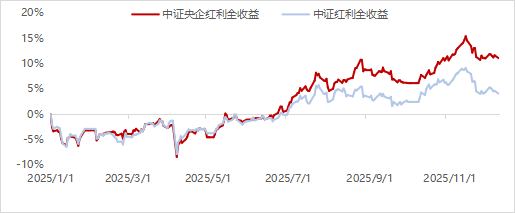
Group 1 - The core strategy of "Central Enterprises + Dividends" is gaining attention as a reliable investment approach amid increasing market volatility [1][2] - The China Securities Central Enterprises Dividend Total Return Index has shown a remarkable increase of 11.08% this year, significantly outperforming the China Securities Dividend Total Return Index, which only rose by 4.07% [2][37] - The combination of high dividend yields and 100% central enterprise attributes makes this index particularly attractive in the current low-interest-rate environment [6][42] Group 2 - Central enterprises are crucial to China's economic stability and are primarily concentrated in traditional industries, which are characterized by mature business models and stable competition [11][48] - The average return on equity (ROE) and net profit levels of the central enterprises in the dividend index have consistently exceeded those of the overall A-share market, indicating strong profitability and risk resilience [14][51] - In the first half of 2025, the total cash dividends from the central enterprises in the index reached 392.3 billion yuan, accounting for 57% of the total cash dividends in the A-share market [18][55] Group 3 - The current low-interest-rate environment, with the 10-year government bond yield at a historical low of 1.85%, enhances the attractiveness of the central enterprises dividend index, which has a dividend yield of 4.06% [23][59] - Recent policies from the State-owned Assets Supervision and Administration Commission (SASAC) are aimed at improving dividend distribution and enhancing shareholder returns, making it a priority for central enterprises [27][63] - The valuation of central enterprises is currently at a historical low, with the China Securities Central Enterprises Index having a price-to-earnings ratio of 12.33 and a price-to-book ratio of 1.16, indicating potential for value re-evaluation [31][66]

体育烧光了沙特的钱?
虎嗅APP· 2025-12-11 09:35
Core Viewpoint - Saudi Arabia's sports investment strategy is shifting from aggressive expansion to a more cautious approach, focusing on sustainable returns and long-term viability in the face of economic pressures and changing priorities [5][9][25]. Group 1: Economic Context and Strategy Shift - Saudi Arabia's GDP grew over tenfold from 1973 to 1981 due to oil price surges, but reliance on oil has made the economy vulnerable to price fluctuations [4]. - The introduction of the "Vision 2030" plan in 2016 aimed to diversify the economy away from oil dependency, with sports becoming a key component of this strategy [5][6]. - The Public Investment Fund (PIF), with assets exceeding $900 billion, is central to this diversification, but recent signals indicate a slowdown in spending on sports and entertainment [9][10]. Group 2: Impact on Sports Investments - PIF's investment contracts dropped by 84% in the first five months of the year, indicating a significant reduction in capital allocation for sports [9]. - The aggressive expansion in sports was initially aimed at enhancing Saudi Arabia's global image and influence, but the sustainability of such investments is now under scrutiny [10][25]. - LIV Golf, a major investment by PIF, has incurred over $1 billion in losses, raising questions about the long-term viability of such high-cost ventures [12][13]. Group 3: NEOM and Future Projects - NEOM, a $500 billion mega-project, is central to Saudi Arabia's post-oil growth strategy, but it faces significant cost overruns and operational challenges [15][18]. - The 2029 Asian Winter Games, planned to be held in NEOM, may be postponed due to these financial pressures, reflecting a broader reassessment of large-scale projects [17][21]. - The need for substantial resources, such as water for artificial snow, adds to the complexity and cost of NEOM, further straining the budget [20]. Group 4: Future of Sports in Saudi Arabia - The shift in investment strategy suggests a more selective approach to sports, focusing on areas with proven revenue potential, such as football, while reducing exposure in less sustainable sectors like boxing [25][26]. - Esports and gaming are emerging as potential focal points for future investments, indicating a strategic pivot towards digital entertainment [27]. - The overall trend suggests that the sports industry will need to adapt to a new reality of reduced funding, emphasizing self-sustainability and realistic financial models [29].
天壕能源与IndoSino公司签署战略合作协议
Zheng Quan Shi Bao Wang· 2025-12-11 06:08
Core Viewpoint - Tianhao Energy has signed a strategic cooperation agreement with PT Indo Sino Oil dan Gas, marking its entry into the Indonesian energy market and aiming to explore the potential of the regional energy industry [1] Group 1: Strategic Cooperation - The agreement involves multi-dimensional and in-depth collaboration in the energy sector [1] - The partnership aims to assist in the transformation and sustainable development of the regional energy industry [1] Group 2: Market Entry - This strategic cooperation signifies Tianhao Energy's official entry into the Indonesian energy market [1]

美国50%关税逼宫,印度转头访华,不做他国棋子
Sou Hu Cai Jing· 2025-12-11 06:07
Core Viewpoint - The article discusses how India is rapidly adjusting its foreign policy in response to the U.S. imposing a 50% tariff on Indian goods, particularly in the context of India's strategic partnerships with China and Europe, while rejecting the role of a pawn in great power games [1][3]. Group 1: U.S. Tariff Impact - The U.S. announced a 50% tariff on Indian goods, citing India's continued energy purchases from Russia as the reason, which disrupted India's diplomatic rhythm [1][8]. - The tariff specifically targeted key sectors such as textiles, pharmaceuticals, and electronic components, leading to a stalemate in ongoing trade negotiations [8]. - The U.S. also strengthened ties with Pakistan, signing multiple security and economic agreements, which further aggravated India's concerns about its influence in South Asia [8][10]. Group 2: India's Diplomatic Strategy - In response to U.S. pressure, India accelerated its engagement with China and Russia, while also deepening ties with Europe, indicating a multi-directional alliance strategy [3][10]. - India's diplomatic approach is characterized by a desire for strategic autonomy, avoiding becoming a pawn in the geopolitical rivalry between major powers [27]. - Despite the challenges, India remains committed to maintaining cooperation with the U.S. in high-tech investments and AI development, recognizing the importance of the U.S. market [19][21]. Group 3: Engagement with Russia and China - India has invited Russian President Putin for a visit, marking a significant moment since the Ukraine conflict began, and signed agreements on energy supply and military technology [12]. - Modi's attendance at the Shanghai Cooperation Organization summit and meetings with Chinese and Russian leaders were pre-planned, reflecting a cautious approach to repairing relations with China [13]. - India's military procurement strategy is diversifying, with a notable decrease in reliance on Russian arms, dropping from nearly 70% to below 40% over the past 15 years [15][17]. Group 4: Strengthening Ties with Europe - The EU has initiated a new strategic agenda with India, focusing on technology, investment, and security cooperation, marking a shift in the historically slow development of India-EU relations [23][25]. - The EU's advantages in renewable energy and technology sectors align with India's interests, fostering a collaborative environment [25]. - Upcoming agreements, including a new free trade deal, are expected to be finalized by early 2026, emphasizing energy cooperation to reduce India's dependence on Russian fossil fuels [25][27].
野村:韩国Kospi指数明年上半年料触及5000点 受AI资本支出激增推动
Xin Lang Cai Jing· 2025-12-11 04:00
Group 1 - Nomura forecasts that the South Korean benchmark Kospi index will rise to 5,000 points in the first half of 2026, driven by the semiconductor supercycle and ongoing corporate governance reforms [1][2] - The target price represents a 21% upside from the Wednesday closing level of 4,135 points [1][2] - Preferred buy recommendations for the first half of the year include Samsung Electronics and SK Hynix, followed by Hyundai Motor, Doosan Enerbility, Korea Electric Power Corporation, Samsung Biologics, and Hyundai Rotem [1][2] Group 2 - Nomura raised the target price for Hyundai Motor by 16% to 370,000 KRW, citing a narrowing valuation gap with peers [1][2]
上游价格持续分化,关注年末下游促销进展
Hua Tai Qi Huo· 2025-12-11 02:59
宏观日报 | 2025-12-11 上游价格持续分化,关注年末下游促销进展 中观事件总览 生产行业:1)国家统计局发布数据,2025年11月份,全国居民消费价格同比上涨0.7%,环比下降0.1%;全国工业 生产者出厂价格同比下降2.2%,环比上涨0.1%。 服务行业:1)北京时间周四凌晨03:00,美联储联邦公开市场委员会(FOMC)发布了最新的利率决议,宣布降息25 个基点,将联邦基金利率目标区间降至3.50%-3.75%,符合市场"鹰派降息"预期。"点阵图"显示,决策者预计2026 年只会再降息一次,2027年再降一次,然后利率将回到3%的长期水平。美联储主席鲍威尔表示,目前利率水平处 于良好位置,可应对经济前景变化,但他未对近期是否会再次降息提供指引。鲍威尔指出:"值得注意的是,自去 年9月以来,我们已累计降息175个基点,其中自今年9月以来就下调了75个基点。目前,联邦基金利率已位于中性 水平的一个大致区间,我们也处于有利位置,可以等待观察经济的进一步发展"。2)全国零售业创新发展大会12 月9日至10日在北京举行,商务部副部长盛秋平表示,"十五五"时期,要把零售业作为培育完整内需体系、做强国 内大循 ...
能源化工期权:能源化工期权策略早报-20251211
Wu Kuang Qi Huo· 2025-12-11 02:23
Group 1: Report Summary - The report is an Energy Chemical Options Strategy Morning Report dated December 11, 2025, covering various energy chemical options including energy, polyolefins, polyesters, alkali chemicals, and others [2][3] - The recommended strategy is to construct option portfolio strategies mainly as sellers, along with spot hedging or covered call strategies to enhance returns [4] Group 2: Underlying Futures Market Overview - The report provides the latest prices, price changes, trading volumes, and open interest for multiple energy chemical futures contracts such as crude oil, LPG, methanol, etc [5] Group 3: Option Factors - Volume and Open Interest PCR - The volume and open interest PCR data for different option varieties are presented, which are used to describe the strength of the underlying market and potential turning points [6] Group 4: Option Factors - Pressure and Support Levels - The pressure and support levels for each option variety are analyzed based on the strike prices with the maximum open interest of call and put options [7] Group 5: Option Factors - Implied Volatility - The implied volatility data, including at-the-money implied volatility, weighted implied volatility, and historical volatility, are provided for different option varieties [8] Group 6: Strategy and Recommendations Crude Oil Options - Fundamental analysis shows that US crude oil production slightly increased, refinery throughput rose, and global floating storage increased [9] - The market has been weak recently, with implied volatility below the average and the open interest PCR indicating a bearish trend [9] - Recommended strategies include a bearish spread using put options and a short volatility strategy [9] LPG Options - The supply of LPG is under pressure in the medium to long term, while the domestic market is relatively strong in the short term [10][11] - The market is in a sideways trend, with implied volatility around the average and the open interest PCR suggesting a neutral bias [11] - A short neutral volatility strategy and a long collar strategy for spot hedging are recommended [11] Methanol Options - The inventory of methanol has decreased, and the market has been weak [11] - The implied volatility is around the historical average, and the open interest PCR indicates a bearish trend [11] - A bearish spread using put options and a short volatility strategy are suggested [11] Ethylene Glycol Options - The inventory of ethylene glycol has increased, and the demand is limited, leading to a weak market [12] - The implied volatility is above the average and rising, and the open interest PCR shows strong bearish sentiment [12] - A bearish spread using put options and a short volatility strategy are recommended [12] PVC Options - The overall inventory of PVC is in a de-stocking cycle, and the market has been weak [12] - The implied volatility has decreased to below the average, and the open interest PCR indicates a continuous decline [12] - A bearish spread using put options and a long collar strategy for spot hedging are recommended [12] Rubber Options - The production capacity utilization rate of rubber tire enterprises has increased, and the market has been in a weak consolidation [13] - The implied volatility is approaching the average, and the open interest PCR indicates a weak market [13] - A short neutral volatility strategy is recommended [13] PTA Options - The inventory of PTA is expected to accumulate, and the market has been in a sideways trend [13] - The implied volatility is below the average, and the open interest PCR suggests a sideways market [13] - A short neutral volatility strategy is recommended [13] Caustic Soda Options - The production capacity utilization rate of caustic soda enterprises has increased, and the market has been weak [14] - The implied volatility is at a relatively high level, and the open interest PCR indicates a bearish trend [14] - A bearish spread using put options and a long collar strategy for spot hedging are recommended [14] Soda Ash Options - The production and inventory of soda ash are at relatively high levels, and the market has been in a low-level sideways trend [14] - The implied volatility is at a relatively high historical level, and the open interest PCR indicates a bearish market [14] - A bearish spread using put options, a short volatility strategy, and a long collar strategy for spot hedging are recommended [14] Urea Options - The supply pressure of urea has been relieved recently, and the market has been in a short-term weak trend [15] - The implied volatility is below the historical average, and the open interest PCR indicates strong bearish pressure [15] - A short neutral volatility strategy and a long collar strategy for spot hedging are recommended [15] Group 7: Option Charts - The report includes price charts, trading volume and open interest charts, open interest PCR charts, implied volatility charts, and historical volatility cone charts for various option varieties [16][34][52]
财信证券晨会纪要-20251211
Caixin Securities· 2025-12-10 23:30
Market Strategy - The market continues to experience a shrinking volume and fluctuating trend, with the Hainan Free Trade Zone concept leading the gains [6][8] - The overall performance of the market is mixed, with the Shanghai Composite Index down 0.23% and the Shenzhen Component Index up 0.29% [8][9] - The retail sector remains strong, supported by a 0.7% year-on-year increase in the Consumer Price Index (CPI) for November, the highest since March 2024 [10][11] Economic Insights - The International Monetary Fund (IMF) has raised its growth forecast for China's economy to 5.0% and 4.5% for 2025 and 2026, respectively, due to effective macroeconomic stimulus measures [16][17] - In November, the Producer Price Index (PPI) decreased by 2.2% year-on-year, while the CPI increased by 0.7% [18][21] - The People's Bank of China conducted a 189.8 billion yuan reverse repurchase operation, indicating ongoing liquidity management in the market [22][23] Industry Dynamics - Eni and Thailand's Gulf signed a ten-year LNG supply agreement, marking Eni's first long-term LNG contract in Thailand, reflecting the growing demand for imported natural gas [27][28] - The domestic electric bicycle market saw a significant decline, with November's internal sales volume dropping by 28.7% year-on-year, attributed to the impact of new national standards [29][30] - The projection for China's projector market indicates a decline to below 600,000 units in 2025, a 15% decrease from previous years, driven by weak demand and increased competition from alternative display technologies [31][32] Company Updates - Fosun Pharma signed a licensing agreement with Pfizer for the oral GLP-1 receptor agonist YP05002, with potential milestone payments totaling up to $350 million [37][38] - China Railway Construction Heavy Industry launched the "Canghe No. 1" shield machine, which will be used in a significant energy project in Zhejiang, showcasing advancements in construction technology [40][41] - Shaoyang Hydraulic plans to acquire 100% of Xincheng Hangrui's shares for 600 million yuan, indicating strategic expansion efforts [43][44]
瑞典三季度货物出口走弱
Shang Wu Bu Wang Zhan· 2025-12-10 18:12
Core Insights - Sweden's goods export value decreased by 1% year-on-year in Q3 2025, while export volume increased by 4% [1] - Import value also fell by 1% year-on-year, with import volume rising by 3% [1] Export Analysis - Passenger car export value dropped by 16%, with a 10% decline in export volume [1] - Mineral fuel export value decreased by 9%, but export volume grew by 4% [1] - Textile, clothing, and footwear export value fell by 12%, with a 17% decrease in export volume [1] Import Analysis - Passenger car import value declined by 6%, with a 5% drop in import volume [1] - Mineral fuel import value decreased significantly by 21%, while import volume fell by 2% [1] - Food, beverage, and tobacco imports saw a growth of 7% in both value and volume [1]
11月份CPI同比上涨0.7% 物价水平进一步企稳
Zheng Quan Ri Bao· 2025-12-10 16:25
Consumer Recovery - In November, the Consumer Price Index (CPI) decreased by 0.1% month-on-month but increased by 0.7% year-on-year, marking the highest growth since March 2024, indicating a continuous recovery in consumer spending [1][2] - The year-on-year increase in CPI was primarily driven by a shift in food prices from decline to growth, with food prices rising by 0.2% after a 2.9% drop in October [2][3] - Fresh vegetable prices saw a significant turnaround, increasing by 14.5% after a 7.3% decline in October, contributing approximately 0.49 percentage points to the CPI year-on-year [2][3] Core CPI and Industrial Prices - The core CPI, excluding food and energy, rose by 1.2% year-on-year, maintaining a growth rate above 1% for three consecutive months [3] - Prices for services and industrial consumer goods, excluding energy, increased by 0.7% and 2.1%, respectively, contributing approximately 0.29 and 0.53 percentage points to the CPI year-on-year [3] - The expansion of domestic demand policies has positively impacted prices, with household appliances and clothing prices rising by 4.9% and 2.0%, respectively [3] Producer Price Index (PPI) - The Producer Price Index (PPI) increased by 0.1% month-on-month in November, marking two consecutive months of growth, while the year-on-year decline was 2.2%, slightly widening from October [4][5] - The improvement in PPI is attributed to the optimization of supply and demand structures in certain domestic industries and the transmission of international commodity prices [4][5] Policy Impact and Market Dynamics - Continuous macroeconomic policies are showing positive effects, with a narrowing of price declines in key industries due to the ongoing governance of "involution" competition [5][6] - Emerging industries are driving price increases, with significant year-on-year price rises in sectors such as external storage devices (up 13.9%) and graphite products (up 3.8%) [5][6] - Consumer demand is being revitalized, leading to price increases in various manufacturing sectors, including a 20.6% rise in the price of arts and crafts products [6]