
债券

Search documents
欧债收益率多数下跌,英国10年期国债收益率跌2.2个基点
Mei Ri Jing Ji Xin Wen· 2025-12-03 21:58
Core Viewpoint - European bond yields mostly declined on December 3, with varying changes across different countries' 10-year government bonds [1] Group 1: Yield Changes - The UK 10-year government bond yield decreased by 2.2 basis points to 4.446% [1] - The French 10-year government bond yield increased slightly by 0.1 basis points to 3.490% [1] - The German 10-year government bond yield fell by 0.2 basis points to 2.745% [1] - The Italian 10-year government bond yield dropped by 1.8 basis points to 3.444% [1] - The Spanish 10-year government bond yield decreased by 0.4 basis points to 3.217% [1]
美国债市:国债上涨 ADP就业数据强化美联储降息预期
Xin Lang Cai Jing· 2025-12-03 21:25
美国国债周三走高,受美国早间发布的弱于预期的11月ADP私营部门就业数据推动。尽管随后遭遇阻 力,但收盘仍接近日间最佳水平。市场对美联储下周降息的预期依然完好,消化的12月10日美联储政策 会议降息25个基点的可能性约为90%。 纽约时间下午3点刚过,收益率全线下跌2-3个基点。中期国债领涨美债,5s30s利差扩大1个基点, 2s5s30s利差收窄1.5个基点。 ADP数据公布后几分钟内,收益率触及盘中低点,该数据使得合约押注的到明年年中美联储政策利率下 降几个基点,而预期的中性利率朝着3%小幅走低。 在国债期权方面,值得注意的资金流动包括对押注30年期国债收益率到下周五升至约4.8%的期权的大 笔买入。 截至纽约时间下午3:37,美国2年期国债收益率报3.4835%; 美国5年期国债收益率报3.6225%; 美国10年期国债收益率报4.0575%; 美国30年期国债收益率报4.7268%; 美国2年和10年国债收益率差报57.198个基点; 美国5年和30年国债收益率差报110.263个基点。 新浪合作大平台期货开户 安全快捷有保障 责任编辑:丁文武 美国国债周三走高,受美国早间发布的弱于预期的11月ADP ...
Weak jobs data pulls U.S. yields lower
Youtube· 2025-12-03 20:26
Group 1 - The labor market is showing signs of weakness, as indicated by the recent ADP data, suggesting a potential deterioration in economic conditions [1] - There was a brief increase in yields, correlated with a rise in S&P futures, but this momentum was not sustained, leading to a separation in trends [2] - Overall, there has been a three basis points deterioration across all maturities, reflecting the impact of weak jobs data on the bond market [3] Group 2 - Japanese 10-year yields have reached a fresh high, indicating a significant movement in the bond market over the past 18 years [3]


债券市场担心哈塞特通过降息来取悦特朗普,已就此警告财长贝森特
Sou Hu Cai Jing· 2025-12-03 18:36
英国金融时报援引多位知情人士报道称,债券投资者们针对哈塞特出任美联储主席的可能性警告美国财 政部。他们担心,哈塞特将为了取悦美国总统特朗普而降息。11月份,财长贝森特掌管的财政部曾集中 征求意见。12月2日内阁会议结束后,特朗普在白宫告诉记者们,在场的哈塞特是"潜在的美联储主 席",他可能会在1月份宣布任命决定。北京时间12月4日02:26,美国10年期国债收益率维持超过2个基 点的跌幅,两年期美债收益率维持超过1.6个基点的跌幅。 来源:滚动播报 ...
Dollar Does Not Deserve Its 'Very Rich Valuation,' Goldman Strategist Says
Youtube· 2025-12-03 16:34
Labor Market Concerns - There is a growing concern regarding the labor market, with indications that the layoff rate is beginning to pick up, despite previous stability in hiring and firing rates [2][3] - Upcoming reports are anticipated to confirm whether the tentative signals of increased layoffs are substantiated by comprehensive payroll and household survey data [3] Dollar Valuation and Economic Outlook - The US dollar is experiencing weakness due to a perception that the US economy is less exceptional than in the past, leading to a decline in its valuation [4][5] - The Federal Reserve is expected to ease policy further, which may contribute to continued dollar weakness [5][6] Bank of Japan (BOJ) Policy Considerations - The BOJ is considering a potential interest rate hike in December, influenced by the US economic performance and early signs of self-sustaining wage growth in Japan [10][11][12] - There is a concern regarding excessive yen weakening, prompting potential pushback from both the administration and the BOJ [12][13] Currency Trends and Investment Opportunities - The Chinese renminbi (CNY) is expected to appreciate gradually due to improved trade relations and significant growth in Chinese exports, which are seen as undervalued [16][17] - There are positive outlooks for the Chinese domestic equity market, particularly in high-tech industries, suggesting further growth potential [18][19] - Emerging markets, particularly Brazil, present investment opportunities in equities and bond markets as rate cuts are anticipated [21]
被忽视的风险:日本长端收益率失控,会否触发美股“10月式暴跌”?
Hua Er Jie Jian Wen· 2025-12-03 14:26
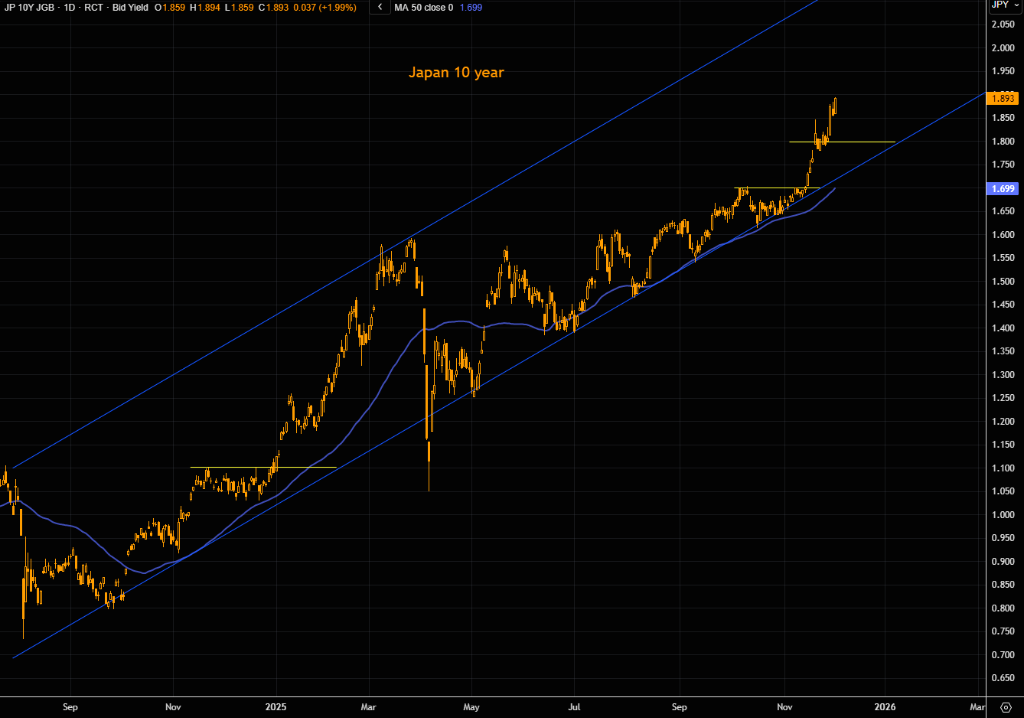
Core Viewpoint - Japan's long-term government bond yields are experiencing a significant and uncontrolled rise, with the 10-year yield approaching the critical 2% level and the 30-year yield soaring to 3.43%, indicating potential global market risks [1][4]. Group 1: Yield Trends - The 10-year government bond yield in Japan has been consistently reaching new highs, driven by a "magnet effect" around the 2% mark, with technical indicators suggesting a strong upward trend [2]. - The 30-year bond yield has shown even stronger performance, breaking through the 3.3% level and indicating substantial upward potential due to a lack of resistance above [4][6]. Group 2: Historical Context - Analysts recall the significant market drop in late October last year when Japanese rates began to rise, which coincided with a sharp decline in the Nasdaq 100 index, highlighting a historical correlation between Japanese rates and U.S. equity performance [5][8]. Group 3: Market Volatility - The current rise in Japanese bond yields is characterized by a clear trend, breaking through technical resistance levels and indicating strong upward momentum [6]. - Despite most traders not including Japanese rate changes in their daily risk assessments, this macro-level shift could significantly increase market volatility [9][11]. Group 4: Global Impact - The widening yield spread between Japanese and U.S. 10-year bonds is reshaping global capital allocation, reflecting deepening monetary policy divergence and potentially triggering large-scale cross-border capital flows [12]. - The increase in the yield spread may lead to adjustments in arbitrage trading, particularly affecting yen carry trades, which could have significant implications for global risk asset prices [12]. Group 5: Safe-Haven Assets - The gold market has begun to react to the rise in Japanese long-term yields, indicating that gold prices are sensitive to changes in Japanese government bonds and reflecting growing market concerns about potential risks [14][15]. - The movement in gold prices, whether measured in yen or dollars, signals an increase in demand for safe-haven assets, often foreshadowing broader market adjustments [15][17].
中国为何此时筑牢虚拟货币防线?从石油到稳定币美元找新锚
Sou Hu Cai Jing· 2025-12-03 14:21
Group 1: Digital Currency Regulations - The U.S. White House has established a presidential task force on digital asset markets while banning the development of central bank digital currencies (CBDCs) within the U.S. [1] - China has intensified its crackdown on virtual currencies, with over 150 cases of money laundering related to virtual currencies reported since 2025, involving amounts exceeding 10 billion RMB [3]. - The People's Bank of China has identified stablecoins as a significant risk, with global cryptocurrency market volatility exceeding 70% in 2025, raising concerns about the transparency and safety of the underlying assets of stablecoins [3]. Group 2: U.S. Debt and Stablecoins - The U.S. federal debt is growing at nearly $2 trillion annually, surpassing $37.2 trillion, with stablecoins being seen as a new anchor for the dollar [4]. - Currently, the global stablecoin market is approximately $267.4 billion, with 95% being dollar-pegged stablecoins, which are heavily invested in short-term U.S. Treasury bonds [4]. - The "Payment Stablecoin Act" mandates that stablecoin issuers must invest 100% of their reserves in U.S. cash or short-term Treasury bonds, creating a mechanism for debt absorption that links stablecoin growth to U.S. debt demand [4]. Group 3: Historical Context and Future Outlook - The evolution of the dollar's anchoring mechanisms has transitioned from the gold standard established in 1944 to the current reliance on stablecoins, with over 98% of stablecoin market value pegged to the dollar [5]. - The U.S. is working on establishing a "digital dollar anchor," as emerging digital economic scenarios increasingly depend on this framework [5]. - The competition between the U.S. and China in the digital currency space is expected to deepen over the next five years as dollar stablecoins approach the trillion-dollar mark [8]. Group 4: Strategic Considerations for China - China's recent actions to strengthen its defenses against virtual currencies reflect strategic considerations, including the potential financial risks associated with the deep integration of U.S. stablecoins and Treasury bonds [6]. - Cross-border capital flows through virtual currencies have increased by 150% in 2024, posing new challenges for traditional regulatory measures [6]. - The internationalization of the renminbi is at a critical stage, with cross-border trade settlements in renminbi surpassing 31.5% in Q3 2024, necessitating measures to prevent stablecoin systems from creating barriers to this process [6]. Group 5: Digital Currency Initiatives in China - The pilot program for China's digital currency has expanded to 26 regions, covering various scenarios such as cross-border trade and supply chain finance [7]. - China is actively participating in the formulation of international digital currency regulations while balancing risk management and cooperation [7]. - The approval of 16 virtual asset service providers in Hong Kong since 2023 supports China's differentiated strategy of strict domestic regulation while piloting overseas [7].

2026年利率债投资策略:破局而立,波段致胜
Guohai Securities· 2025-12-03 14:03
Group 1 - The bond market in 2025 experienced a "fast bull and slow bear" phase, with institutional behavior and market narratives becoming key factors in market pricing [3] - For 2026, three factors are expected to provide a ceiling for interest rates: real estate data, local government debt management, and bank interest margins [3] - Low interest rates are seen as essential for stabilizing the real estate market, reducing policy costs, and managing local government debt risks [3][4] Group 2 - The policy environment is expected to provide moderate support rather than strong stimulus, with fiscal and monetary policies likely to act in concert [4] - The economic growth target for 2026 is projected to be around 4.5%-5%, with fiscal policies maintaining a deficit rate near 4% and potential expansion of policy financial tools [4] - The balance between monetary easing and fiscal efforts will be crucial for identifying opportunities in the bond market [4] Group 3 - Institutional behavior and market narratives remain at the forefront of bond market strategies, with a focus on discovering trading strategies and interpreting market sentiments [4] - The current low net interest margin and the pressure on banks to manage liabilities indicate a challenging environment for bond investments [4] - The introduction of new regulations affecting fund redemptions may lead to short-term adjustments in the bond market [4] Group 4 - The real estate market is undergoing a slow recovery, with significant time needed to achieve repair goals [20] - The downward trend in real estate prices is impacting banks' collateral values, which could lead to increased risk exposure for banks [24] - The high leverage levels in both government and household sectors limit the potential for further demand in the real estate market [23]
国泰海通|固收:守正待变:数据真空下中久期高评级策略
国泰海通证券研究· 2025-12-03 13:47
Group 1 - The global bond market is focusing on three main themes: European fiscal risks, a data vacuum in the US, and credit improvement in emerging markets [1] - The European Central Bank warns of increasing sovereign debt supply pressure and a shrinking scale of central bank bond purchases, leading to rising interest rate risks [1] - The probability of a rate cut in December in the US has dropped from 95% to 50% due to government shutdown, creating policy uncertainty in the market [1] Group 2 - Major bond yields globally have generally declined, with US long-term yields falling more than short-term yields, exemplified by a 5.2 basis point drop in the 30-year yield [1] - The UK 10-year bond yield saw a significant drop of 9.34 basis points, leading declines in developed markets [1] - Credit spreads have compressed significantly, with investment-grade corporate bonds dropping by 11 basis points and high-yield bonds decreasing by 29 basis points to 6.58% [1] Group 3 - The issuance of Dim Sum bonds totaled 41, with a scale of 95.383 billion yuan, where central bank bills accounted for 47.2% of the issuance [2] - The overall issuance structure is dominated by bank financial bonds, with urban investment bonds' coupon rates concentrated in the 5-7% range [2] - Offshore RMB bonds show a flattening characteristic with short-end yields rising and long-end yields falling, while the sovereign bond 10-year spread narrowed from 8.95 basis points to 5.19 basis points [2] Group 4 - The global bond market is experiencing a stable credit environment with no major sovereign rating adjustments or systemic defaults [3] - The debt of high-risk US companies increased from $271 billion to $296 billion, a rise of 9.2%, indicating accumulating refinancing pressure [3] - The net outflow from high-yield bond funds was $333 million, and from leveraged loan funds was $89 million, indicating pressure on liquidity [3] Group 5 - The strategy suggests focusing on 5-7 year medium to long-term bonds to capture the benefits of a steepening yield curve and rolling down yields, while maintaining a defensive position in AAA/AA+ rated securities [4] - The preferred regional allocation includes US investment-grade corporate bonds and emerging market sovereign debt, while caution is advised for European bonds [4]

Gold News: Price Holds Key Support as 87% Fed Cut Odds Fuel Bullish Setup
FX Empire· 2025-12-03 12:38
Group 1 - The market is currently pricing an 87% chance of a December rate cut by the Federal Reserve, a significant increase from 30% two weeks ago, influenced by weaker jobs data and dovish comments from Fed Governor Christopher Waller [2] - Treasury yields are declining, with the 10-year yield at 4.063% and the 2-year yield at 3.49%, which supports non-yielding assets like gold due to lower opportunity costs [3] - The upcoming economic data releases, including ADP employment, ISM Services, and delayed September PCE, will determine if the Fed's dovish stance is confirmed or challenged, impacting gold prices [4] Group 2 - The dollar is experiencing its ninth consecutive daily loss, down 0.15% to 99.10 on the index, marking a nearly 9% decline for the year, primarily due to changing rate expectations [5] - The decline in the dollar is further influenced by the euro gaining strength on potential Ukraine peace deal hopes and the yen firming due to discussions of a Bank of Japan rate hike [5]
