
有色金属

Search documents
A股主线逻辑爆发 掀起涨停潮!
Zhong Guo Zheng Quan Bao· 2026-02-25 04:56
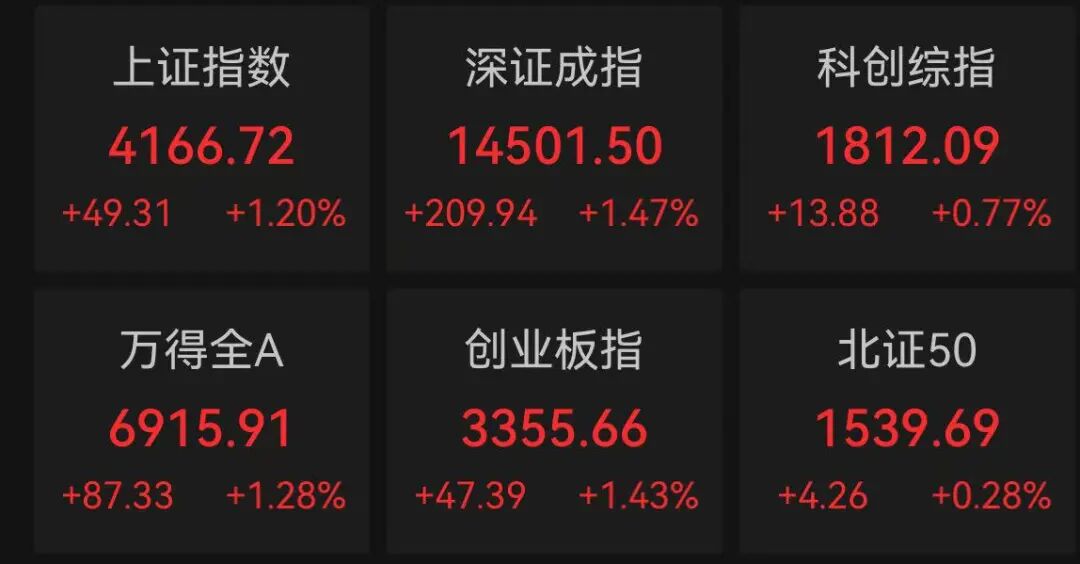
Group 1: Market Overview - The main trading logic in the market recently has been the price increase of electronic components and cyclical products [1] - Cyclical stocks showed strong performance, with sectors such as chemicals, non-ferrous metals, and port shipping rising significantly [1] - The Shanghai Composite Index rose by 1.2%, the Shenzhen Component Index by 1.47%, and the ChiNext Index by 1.43% [2] Group 2: Sector Performance - In the chemicals sector, significant gains were observed in phosphorous chemicals, titanium dioxide, fertilizers, and glyphosate, with stocks like Qing Shui Yuan and Chuan Jin Nuo seeing substantial increases [2][3] - The lithium carbonate futures continued to rise, supported by improved macro sentiment and strong fundamentals, with low inventory levels and robust demand in the lithium battery supply chain [7] - The oil price increase has also contributed to the price rise expectations in the chemicals sector [5] Group 3: Specific Stock Highlights - Notable stocks that hit the daily limit include Northern Rare Earth and Baogang Co., with significant price increases observed in various cyclical stocks [1] - In the non-ferrous metals sector, stocks like Huaxi Nonferrous and Xiyuan Tungsten Industry also saw substantial gains, with many stocks reaching their daily limit [6] - The shipping sector experienced strong performance, with companies like COSCO Shipping Energy and China Merchants Jinling also achieving significant price increases [8][9]

ETF午评 | 周期股全线霸屏,稀土ETF嘉实、稀有金属ETF涨超6%
Ge Long Hui· 2026-02-25 04:55
Market Performance - The Shanghai Composite Index rose by 1.2%, while the ChiNext Index increased by 1.43% [1] - Cyclical stocks, including steel, non-ferrous metals, chemicals, and construction, showed strong performance [1] Sector Highlights - The following ETFs saw significant gains: - Rare Earth ETF by 6.64% - Rare Metals ETF by 6.50% - Steel ETF by 5.76% - Industrial Non-Ferrous ETF by 5.49% - Non-Ferrous ETF by 4.91% - Mining ETF by 4.80% - Other related ETFs also reported increases ranging from 4.13% to 4.61% [1] - The semiconductor sector also performed well, with the following ETFs rising: - Sci-Tech Semiconductor ETF by 4.03% - Semiconductor Equipment ETF by 3.69% - Sino-Korean Semiconductor ETF by 3.69% [1] Weak Performers - The artificial intelligence sector experienced declines, with several ETFs dropping over 1%, including: - Sci-Tech AI ETF by Bosera - Sci-Tech Chip Design ETF - Online Consumption ETF by ICBC - Media ETF by Huaxia - Online Consumption ETF by Southern [1] - Other ETFs related to innovation and big data also reported declines [1]
港股午评:恒指涨0.75%,科技股回暖,内房股、钢铁股拉升,半导体回落
Ge Long Hui· 2026-02-25 04:04
科技股反弹提振美股,港股上午盘三大指数高开震荡,截止午盘,恒生指数涨0.75%,国企指数涨 0.9%,恒生科技指数涨0.34%。昨日低迷的大型科技股多数回暖支撑大市上涨,其中美团涨超2%,内房 股、建材水泥股、钢铁股等建筑类股均大幅上涨,尤其是重庆钢铁盘中一度飙涨27%,黄金股带领有色 金属股齐涨,灵宝黄金再创历史新高!另外,昨日领衔板块上涨的半导体存储概念股走低。(格隆汇) ...
多数保险机构对2026年A股市场持较乐观态度,计划小幅增配A股
Jin Rong Jie· 2026-02-25 03:58
Group 1 - The core viewpoint of the articles indicates that insurance institutions are optimistic about domestic investments in stocks and securities investment funds for 2026, with a tendency to slightly increase stock investments [1] - Most insurance institutions plan to maintain their allocation ratios for bank deposits, bonds, securities investment funds, and other financial assets similar to 2025, with some intending to moderately increase stock investments [1] - In the bond market, insurance institutions hold a neutral outlook for 2026, favoring high-grade corporate bonds, perpetual bonds, subordinated debt, and convertible bonds, primarily focusing on bonds with maturities between 10 to 30 years [1] Group 2 - Regarding the A-share market, insurance institutions are generally optimistic for 2026, favoring indices such as the Sci-Tech Innovation 50, CSI 300, and ChiNext, and industries like electronics, non-ferrous metals, and pharmaceuticals [1] - The main factors influencing the A-share market are expected to be corporate profit recovery and liquidity conditions, with most insurance institutions planning to slightly increase their allocation to A-shares [1] - In terms of fund investments, insurance asset management institutions prefer equity funds, secondary bond funds, and mixed equity funds, with nearly half planning to slightly increase their allocation to public funds [2] Group 3 - For overseas investments, Hong Kong stocks are the most favored by insurance institutions for 2026, with gold and US stocks also receiving attention [2] - About half of the insurance asset management institutions plan to slightly increase their allocation to Hong Kong stocks, while 40% of insurance companies intend to maintain their current allocation levels [2]
近4000股上涨
Di Yi Cai Jing Zi Xun· 2026-02-25 03:54
盘面上,周期股持续走强,钢铁、有色金属、化工、建筑涨幅靠前;白酒、券商、房地产表现不俗;半 导体、核聚变题材活跃。AI应用、超硬材料、CPO概念股走弱。 | 板块名称 | 张唱 | 涨速 | 张停数 | | --- | --- | --- | --- | | 小金属 | +6.48% | +0.15% | | | 能源金属 | +6.35% | +0.05% | | | 钢铁 | +5.51% | +0.08% | | | 磷化工 | +5.50% | +0.08% | 10 | | 金属锌 | +5.46% | +0.04% | 11 | | 金属铅 | 45.37% | +0.06% | ਰ | | 钛白粉概念 | 45.02% | +0.05% | 3 | | 金属钻 | +4.87% | +0.12% | | | 金属铜 | +4.75% | +0.08% | 11 | | 1 小金属概念 | 44.51% | +0.10% | 19 | | 稀土永磁 | +4.34% | +0.16% | Б | | 工业金属 | +4.24% | +0.06% | A | 沪深两市半日成交额1.52万亿,较上个交 ...

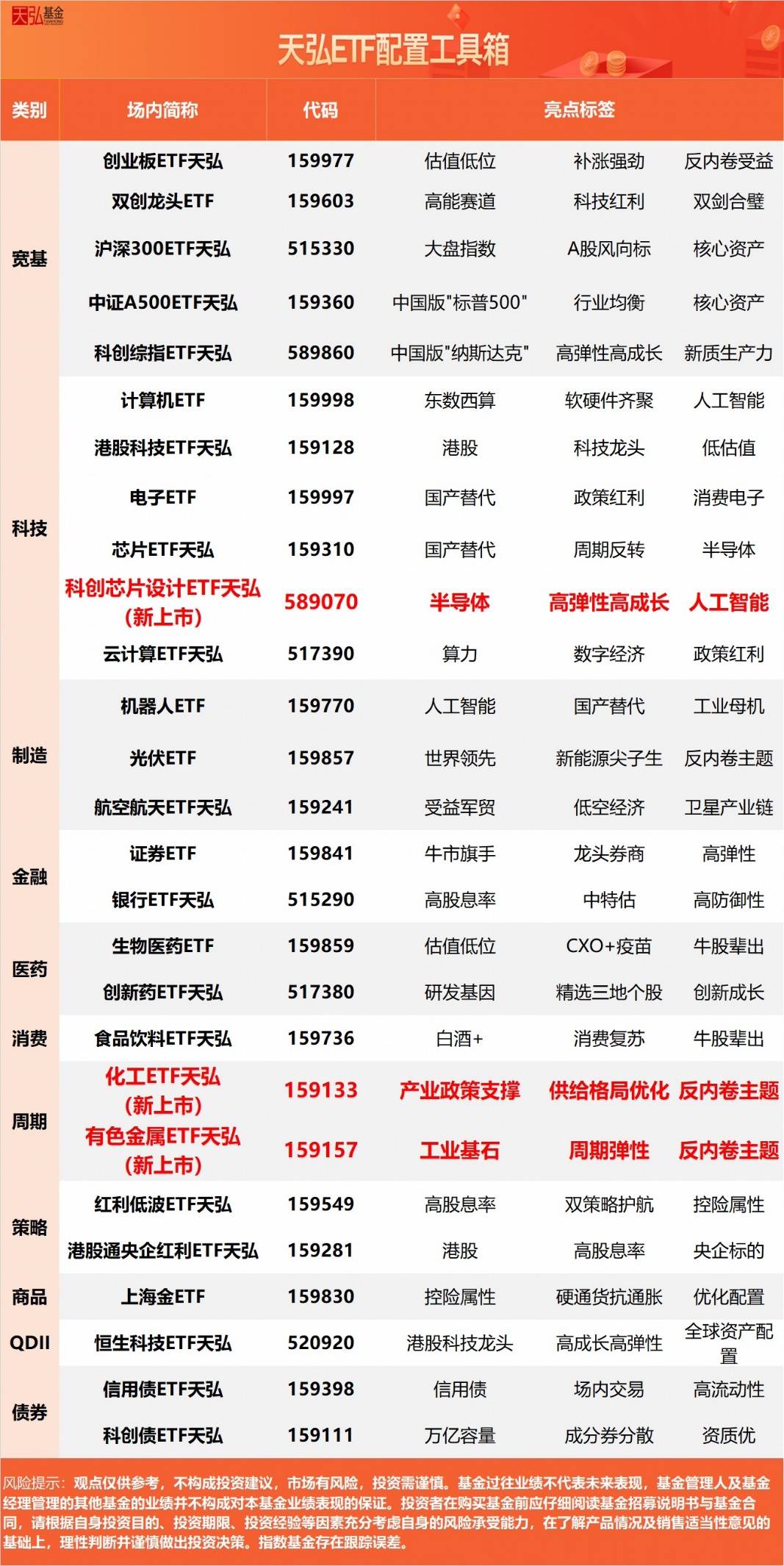
暴力拉升!有色金属ETF天弘(159157)标的指数大涨超5%,实时成交额、最新规模高居深市同类第一
Sou Hu Cai Jing· 2026-02-25 03:49
Core Viewpoint - The Tianhong Nonferrous Metals ETF (159157) has shown strong performance, leading the market in trading volume and net inflows, indicating a growing interest in the nonferrous metals sector driven by various market dynamics [1][2][3]. Group 1: ETF Performance - As of February 24, the Tianhong Nonferrous Metals ETF reached a record size of 2.159 billion yuan and a total of 2.173 billion shares, marking new highs since its inception [2]. - The ETF recorded a turnover of 9.37% with a trading volume of 208 million yuan, ranking first among similar products in the Shenzhen market [1]. - Over the past week, the ETF has seen continuous net inflows, with a peak single-day inflow of 269 million yuan, totaling 1.067 billion yuan in net inflows [3]. Group 2: Market Trends - The CSI Industrial Nonferrous Metals Theme Index, which the ETF tracks, surged by 5.40%, with notable increases in constituent stocks such as Chihong Zn & Ge (up 10.01%), Tin Industry Co. (up 10.00%), and Northern Rare Earth (up 9.99%) [1]. - The ETF focuses on key metals like copper, aluminum, and rare earths, covering 30 leading companies in the industry, thus providing a strategic investment opportunity amid AI-driven, strategic resource, and cyclical upturn trends [4]. Group 3: Relevant Events - The Trump administration plans to utilize AI to set reference prices for critical minerals, including germanium, gallium, antimony, and tungsten, aiming to establish a global metal trading group [5]. - This initiative is intended to attract allies and protect domestic mining companies through transparent pricing, although the effectiveness of AI pricing and international cooperation remains under scrutiny [5]. Group 4: Institutional Insights - Citic Securities has noted significant fluctuations in gold prices, attributing them to market concerns over the Federal Reserve's independence and geopolitical uncertainties, which may affect the broader precious and nonferrous metals market outlook [6].
有色金属ETF天弘(159157)标的指数暴涨超5%,成交额突破2亿元深市同标的第一
Mei Ri Jing Ji Xin Wen· 2026-02-25 03:37
Group 1 - The core viewpoint of the news highlights the strong performance of the non-ferrous metal sector, with significant inflows into the Tianhong Non-Ferrous Metal ETF, which has reached a new high in fund size since its listing [1][2] - The Tianhong Non-Ferrous Metal ETF (159157) has seen a net inflow of 1.067 billion yuan over the last ten trading days, indicating strong investor interest [1] - The ETF closely tracks the industrial non-ferrous index, with a composition that includes 61.93% industrial metals, 22.49% minor metals, and 3.72% precious metals, featuring major stocks like Luoyang Molybdenum and Northern Rare Earth [1] Group 2 - The current PE-TTM for the industrial non-ferrous index is 27.57 times, which is at the 44.67% historical percentile, suggesting that the valuation is relatively reasonable and offers a certain margin of safety for medium to long-term investment [2] - Recent geopolitical tensions in the Middle East and the U.S. Supreme Court's ruling on tariffs have contributed to increased risk aversion, which has positively impacted the financial attributes of non-ferrous metals [2] - Post-Spring Festival, there is a strong demand for inventory replenishment from downstream enterprises, while global copper supply remains constrained due to aging mines, supporting the price structure [2]
——金属周期品高频数据周报(2026.2.9-2026.2.15):SPDR黄金ETF持仓量春节期间总体微幅增加-20260225
EBSCN· 2026-02-25 03:35
Investment Rating - The report maintains a rating of "Overweight" for the steel and non-ferrous metals sectors [5] Core Insights - SPDR Gold ETF holdings saw a slight increase during the Spring Festival period, indicating a stable interest in gold as a safe-haven asset [1][10] - The BCI small and medium enterprises financing environment index for February 2026 is at 48.66, reflecting a month-on-month decrease of 3.20% [1][15] - The report highlights that the high furnace capacity utilization rate in January-February is expected to be at the highest level for the same period in five years [19][38] - The steel industry is experiencing tightening export policies, which may impact profitability in 2026 [4] Summary by Sections Liquidity - SPDR Gold ETF holdings increased to 1078.75 tons, a week-on-week rise of 0.16% [10] - The current price of London gold is $5042 per ounce, reflecting a week-on-week increase of 1.52% [10] - The M1 and M2 growth rate difference was -4.1 percentage points in January 2026, with a month-on-month increase of 0.6 percentage points [15] Infrastructure and Real Estate Chain - The national high furnace capacity utilization rate is at 86.41%, with a week-on-week increase of 0.72 percentage points [38] - The price of rebar is stable at 3210 yuan per ton, with no change week-on-week [38] - The construction completion rate for real estate is down 18.10% year-on-year [71] Industrial Products Chain - The national PMI new orders index for January is at 49.20% [2] - The price of electrolytic aluminum is 23100 yuan per ton, a week-on-week decrease of 0.04% [9] - The price of graphite electrodes remains stable at 19000 yuan per ton, with a gross profit of 1946.84 yuan per ton [2] Valuation Metrics - The Shanghai Composite Index increased by 0.36%, with the commercial vehicle sector showing the best performance at +3.59% [4] - The PB ratio of the steel sector relative to the Shanghai Composite is currently at 0.50, with a historical high of 0.82 [4] Investment Recommendations - The report suggests that the steel industry's supply-side adjustments are likely to strengthen in the short to medium term, with potential recovery in profitability to historical average levels [4]
周期板块点评:周期资源品配置正当时
Bank of China Securities· 2026-02-25 03:18
Core Insights - The report emphasizes that the current environment is favorable for allocating resources in cyclical sectors, particularly in the first quarter of 2026, due to rising overseas uncertainties and the expected resumption of domestic activities after the Spring Festival [1][2]. Group 1: Market Performance - The cyclical sector performed well, with significant gains in industries such as oil and petrochemicals, construction materials, basic chemicals, non-ferrous metals, and coal, driven by geopolitical tensions, U.S. tariff policy uncertainties, and domestic supply-demand expectations [2]. - The escalation of the U.S.-Iran situation has led to rising oil prices, with global crude oil prices reaching a six-month high during the Spring Festival, positively impacting the domestic oil and petrochemical sector [2]. - Uncertainties surrounding tariffs have provided strong support for precious metal prices, with international gold prices continuing to rise amid renewed global trade uncertainties [2]. Group 2: Supply Constraints and Price Expectations - Coal prices are expected to recover due to supply constraints, with domestic coal inventories at major ports dropping to low levels and signals of reduced coal supply from Indonesia, which may create price space for domestic coal [2]. - The resumption of work after the Spring Festival is anticipated to boost demand expectations, further supporting coal prices [2]. Group 3: Strategic Outlook - The report reiterates that the first quarter is a critical time for resource allocation, with the recent rise in overseas uncertainties likely to catalyze a new round of resource price movements [2]. - The evolution of the U.S.-Iran situation will be a significant factor influencing oil and precious metal prices, while the restart of U.S. trade policy uncertainties may provide strong support for precious metals [2]. - Domestic construction activity and macroeconomic policy developments ahead of the Two Sessions will significantly impact the sustainability of the coal sector and other domestic resource prices [2].
铝产业链日度数据跟踪-20260225
Zhong Xin Qi Huo· 2026-02-25 03:12
信期货有限公司 IC Futures Company Limited 2026年02月24日 铝产业链日度数据跟踪 一、氧化铝 (1) 据我的钢铁网,2月24日国产矿价格为491元/吨,环比0元/吨; 24日几内亚进口矿价格61美元/干吨,环比0美元/干吨; (2) 据我的钢铁网,2月24日现货价格指数为2647元/吨,环比+1元/吨。 (3) 据上期所,2月24日期货库存为327928吨,环比+18053吨。 图表 2: 几内亚铝土矿价格 美元/吨 2026 -- 2025 -- 2024 -- 2023 120 110 100 02 01/30 02/27 03/26 04/24 05/25 06/22 07/20 08/17 09/14 10/19 11/16 图表 5:氧化铝-仓单库存 世 2026 - 2025 -- 2024 350000 F 300000 250000 2000000 150000 1000000 50000 01/02 01/31 03/03 04/08 05/16 06/20 07/24 08/27 09/28 11/03 12/02 12/31 图表 3:氧化铝现货汇总均价 ...