
非银金融

Search documents
中信建投2026年A股投资策略展望:牛市有望持续 建议布局未来产业、紧抓关键资源与军工方向
Zheng Quan Shi Bao Wang· 2025-11-09 12:30
Core Viewpoint - The A-share bull market is expected to continue into 2026, with indices likely to experience a volatile upward trend but with slower growth rates, leading investors to focus more on fundamental improvements and verification of economic conditions [1] Industry Insights - The technology sector may face structural and phase-specific pullback risks, while resource commodities are likely to emerge as a new main investment direction following the technology sector [1] - The ongoing comprehensive competition between China and the U.S. could significantly impact A-share investments, suggesting a strategic focus on future industries and key resources, particularly in military-related sectors [1] Key Industry Focus - Key industries to watch include: - New Energy - Non-ferrous Metals - Basic Chemicals - Oil and Petrochemicals - Non-bank Financials - Military Industry - Machinery Equipment - Computers [1] Thematic Focus - Important themes to consider are: - New Materials - Solid-state Batteries - Commercial Aerospace - Nuclear Power - Cross-Strait Integration [1]

中信建投:2026年A股牛市有望持续 建议布局未来产业、紧抓关键资源与军工方向
Xin Lang Cai Jing· 2025-11-09 12:30
Core Viewpoint - The A-share bull market is expected to continue into 2026, with the index likely to experience a volatile upward trend but with slower growth, leading investors to focus more on fundamental improvements and economic verification [1] Industry Insights - There is a caution regarding structural and phase-based pullback risks in the technology sector, while resource products may emerge as a new main direction for A-shares following the technology theme [1] - The ongoing comprehensive competition between China and the U.S. could significantly impact A-share investments, suggesting a strategic focus on future industries and key resources, particularly in military and defense sectors [1] Key Industry Focus - Key industries to watch include: - New energy - Non-ferrous metals - Basic chemicals - Oil and petrochemicals - Non-bank financials - Military industry - Machinery and equipment - Computers [1] Thematic Focus - Thematic areas of interest include: - New materials - Solid-state batteries - Commercial aerospace - Nuclear power - Cross-strait integration [1]
基于财报盈利增速的行业配置模型
Xiangcai Securities· 2025-11-07 11:47
Quantitative Models and Construction - **Model Name**: Industry Allocation Model Based on Profit Growth Rate **Model Construction Idea**: The model uses profit growth rate as the primary criterion for industry selection, supplemented by valuation and trading crowding metrics as risk indicators[7][27][29] **Model Construction Process**: 1. **Profit Growth Metrics**: - Single-quarter net profit year-on-year growth rate - Marginal change in single-quarter net profit year-on-year growth rate Formula for marginal change: $ \text{Marginal Change} = \text{2025 Q3 Single-quarter YoY Growth} - \text{2024 Q3 Single-quarter YoY Growth} $[15][29] 2. **Valuation Metric**: - Historical PE_TTM percentile (2020 to present) is used to measure valuation levels across industries[18][21][29] 3. **Trading Crowding Metric**: - Standard deviation of turnover rate over the past three months is calculated to assess trading crowding[6][24][29] 4. **Comprehensive Scoring**: - Each metric is ranked, and weights are assigned: - Profit growth metrics: 0.3 each - Risk metrics (valuation and trading crowding): 0.2 each Formula for comprehensive scoring: $ \text{Comprehensive Score} = 0.3 \times \text{Net Profit YoY Growth} + 0.3 \times \text{Marginal Change} + 0.2 \times \text{Valuation Percentile} + 0.2 \times \text{Turnover Rate Std Dev} $[31][32] **Model Evaluation**: The model effectively identifies industries with high profit growth and moderate risk levels, providing actionable allocation recommendations[7][27][32] Model Backtesting Results - **Industry Allocation Model**: - Portfolio return: 2.38% - Benchmark (Wind All A Index) return: 0.63% - Excess return: 1.75%[7][32] Quantitative Factors and Construction - **Factor Name**: Profit Growth Rate **Factor Construction Idea**: Measures industry profitability through single-quarter net profit growth and marginal changes in growth rates[7][29] **Factor Construction Process**: 1. Single-quarter net profit year-on-year growth rate 2. Marginal change in single-quarter net profit year-on-year growth rate Formula: $ \text{Marginal Change} = \text{2025 Q3 Single-quarter YoY Growth} - \text{2024 Q3 Single-quarter YoY Growth} $[15][29] **Factor Evaluation**: Effectively captures industries with strong profitability and growth momentum[7][29] - **Factor Name**: Valuation Percentile **Factor Construction Idea**: Uses historical PE_TTM percentiles to compare valuation levels across industries[18][21] **Factor Construction Process**: 1. Calculate PE_TTM for each industry 2. Determine historical percentile (2020 to present) for PE_TTM values[18][21] **Factor Evaluation**: Provides a standardized comparison of valuation levels across industries, mitigating biases from absolute PE differences[21][29] - **Factor Name**: Turnover Rate Standard Deviation **Factor Construction Idea**: Measures trading crowding by assessing the volatility of turnover rates over the past three months[6][24] **Factor Construction Process**: 1. Calculate daily turnover rates for each industry over the past three months 2. Compute standard deviation of turnover rates[6][24] **Factor Evaluation**: Identifies industries with extreme trading behaviors, serving as a risk indicator[6][24] Factor Backtesting Results - **Profit Growth Rate Factor**: - Steel: 203.31% YoY growth, 380.75% marginal change[10][15] - Electronics: 57.42% YoY growth, 59.99% marginal change[10][15] - Media: 58.63% YoY growth, 82.75% marginal change[10][15] - Defense: 29.52% YoY growth, 83.60% marginal change[10][15] - Utilities: 17.77% YoY growth, 19.81% marginal change[10][15] - **Valuation Percentile Factor**: - Steel: 99.72%[21][29] - Electronics: 98.94%[21][29] - Media: 90.40%[21][29] - Defense: 97.10%[21][29] - Utilities: 55.31%[21][29] - **Turnover Rate Standard Deviation Factor**: - Steel: 50.48%[6][29] - Electronics: 96.51%[6][29] - Media: 84.50%[6][29] - Defense: 82.79%[6][29] - Utilities: 25.21%[6][29]
【7日资金路线图】两市主力资金净流出近300亿元 基础化工等行业实现净流入
证券时报· 2025-11-07 11:08
Market Overview - The A-share market experienced an overall decline on November 7, with the Shanghai Composite Index closing at 3997.56 points, down 0.25%, the Shenzhen Component Index at 13404.06 points, down 0.36%, and the ChiNext Index at 3208.21 points, down 0.51% [1] - The total trading volume for both markets was 19990.53 billion, a decrease of 561.94 billion compared to the previous trading day [1] Capital Flow - The net outflow of main funds from the Shanghai and Shenzhen markets reached nearly 300 billion, with a net outflow of 185.42 billion at the opening and 44.36 billion at the close, totaling 297.4 billion for the day [2][3] - In the last five trading days, the main funds have consistently shown a net outflow trend, particularly in the ChiNext, which saw a net outflow of 127.46 billion on November 7 [2][4] Sector Performance - The basic chemical industry saw a net inflow of 63.07 billion, with a growth of 1.53%, making it the top sector for capital inflow [5][6] - Other sectors with net inflows included building materials (13.39 billion, up 0.86%) and petroleum and petrochemicals (8.33 billion, up 0.67%) [6] - Conversely, the computer sector experienced the largest net outflow of 154.80 billion, down 1.34%, followed by the electronics sector with a net outflow of 153.61 billion, down 0.70% [6] Top Stocks by Fund Flow - The top stocks with significant net inflows included Duofluor (43.83 million), Huasheng Lithium (24.64 million), and Shengxin Lithium Energy (21.90 million) [7][9] - Notable stocks with net outflows included Zhongke Electric (25.93 million) and Yunnan Mingye (12.19 million) [7][9] Institutional Focus - Institutions have shown interest in stocks such as China Nuclear Power, Great Wall Motors, and Sifang Co., with target prices indicating potential upside [10]


11月7日深证国企股东回报R(470064)指数跌0.1%,成份股佛燃能源(002911)领跌
Sou Hu Cai Jing· 2025-11-07 09:57
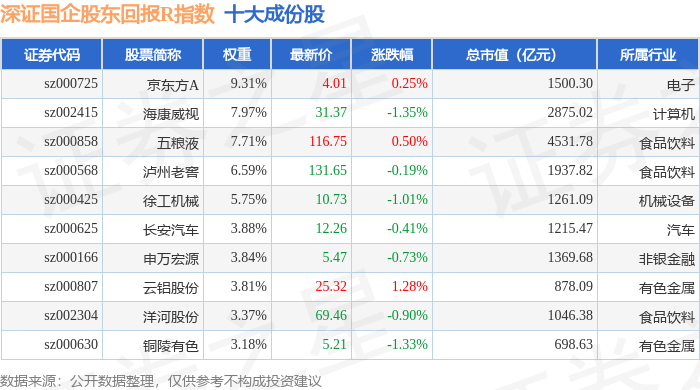
Core Points - The Shenzhen State-Owned Enterprises Shareholder Return Index (470064) closed at 2289.78 points, down 0.1% with a trading volume of 24.519 billion yuan and a turnover rate of 0.91% [1] - Among the index constituents, 20 stocks rose while 28 stocks fell, with Jiangsu Guotai leading the gainers at a 10.01% increase and Fuan Energy leading the decliners at a 4.13% decrease [1] Index Constituents Summary - The top ten constituents of the Shenzhen State-Owned Enterprises Shareholder Return Index include: - BOE Technology Group (sz000725) with a weight of 9.31%, latest price at 4.01 yuan, and a 0.25% increase [1] - Hikvision (sz002415) with a weight of 7.97%, latest price at 31.37 yuan, and a 1.35% decrease [1] - Wuliangye Yibin (sz000858) with a weight of 7.71%, latest price at 116.75 yuan, and a 0.50% increase [1] - Luzhou Laojiao (sz000568) with a weight of 6.59%, latest price at 131.65 yuan, and a 0.19% decrease [1] - XCMG Machinery (sz000425) with a weight of 5.75%, latest price at 10.73 yuan, and a 1.01% decrease [1] - Changan Automobile (sz000625) with a weight of 3.88%, latest price at 12.26 yuan, and a 0.41% decrease [1] - Shenwan Hongyuan (sz000166) with a weight of 3.84%, latest price at 5.47 yuan, and a 0.73% decrease [1] - Yunnan Aluminum (sz000807) with a weight of 3.81%, latest price at 25.32 yuan, and a 1.28% increase [1] - Yanghe Brewery (sz002304) with a weight of 3.37%, latest price at 69.46 yuan, and a 0.90% decrease [1] - Tongling Nonferrous Metals (sz000630) with a weight of 3.18%, latest price at 5.21 yuan, and a 1.33% decrease [1] Capital Flow Summary - The index constituents experienced a net outflow of 527 million yuan from institutional investors, while retail investors saw a net inflow of 399 million yuan [3] - Notable capital flows include: - Jiangsu Guotai (002091) with a net inflow of 180 million yuan from institutional investors [3] - BOE Technology Group (000725) with a net inflow of 86.93 million yuan from institutional investors [3] - Wuliangye Yibin (000858) with a net inflow of 32.59 million yuan from institutional investors [3]





中泰证券:三季度全A盈利改善 主线进一步聚焦“反内卷”战略扩散
Zhi Tong Cai Jing· 2025-11-07 09:10
Core Viewpoint - The overall revenue of A-shares is expected to improve, with a year-on-year increase of 1.16% in Q3 2025, and net profit growth rebounding to 5.34% compared to Q2 2025, indicating a recovery in performance across the market [1][2]. Group 1: A-share Performance - In Q3 2025, the overall revenue of A-shares increased by 1.16% year-on-year, showing significant improvement compared to Q2 [1]. - The net profit growth rate for the parent company rose to 5.34%, an increase of 2.88 percentage points from Q2 [1]. - The return on equity (ROE) for A-shares in Q3 was 7.95%, up 0.22 percentage points from Q2, driven by improvements in net profit margin and equity multiplier [1]. Group 2: Industry Performance - The performance of 30 first-level industries showed significant structural differentiation, with the highest net profit growth in industries such as steel, non-ferrous metals, non-bank financials, electronics, and media [2]. - The cyclical sectors displayed a "price drop, stable volume" pattern, with some industries like steel showing significant improvement in profit margins, while others like coal and petrochemicals faced declines [2][3]. - The technology sector remains a key driver of profit growth, with net profit growth rates for electronics, communications, and media at 38.3%, 8.8%, and 37.4% respectively [3]. Group 3: Investment Recommendations - The current investment focus may shift towards "anti-involution" strategies in upstream industries and the expansion of technology applications, with short-term attention on consumption-boosting policies leading to structural rebounds [5]. - Key investment themes include strengthening the technology sector, particularly in AI applications and terminal directions, and focusing on high-growth upstream sectors that are currently undervalued [5]. - There is potential for brokerage firms to benefit from market recovery and policy support, presenting a phase-specific investment opportunity [5].

为什么要从成长到红利?4000点之后,我们该配置什么
Sou Hu Cai Jing· 2025-11-07 06:20
Core Viewpoint - The fourth quarter often sees increased market volatility and style shifts, prompting investors to consider defensive strategies to protect profits as the year ends [1][3]. Market Dynamics - The fourth quarter is a critical assessment period for institutional investors, leading to profit-taking and asset reallocation, which can cause significant market fluctuations [1][3]. - Policy meetings and international economic conditions also contribute to market sensitivity and potential overreactions [1][3]. Dividend Strategy Viability - Dividend strategies focus on companies with stable dividend payouts, which are less affected by market volatility and external shocks, making them suitable for the current uncertain environment [3][4]. - The low interest rate environment and ongoing asset scarcity support the attractiveness of dividend-paying stocks [3][4]. Performance of Dividend Assets - Historical data shows that the total return of the CSI Dividend Index significantly outperformed the CSI 300 Index, indicating the potential for stable long-term returns through dividend investments [4]. Types of Dividend Strategies - **Hong Kong Dividend Strategy**: Focuses on high dividend yields from state-owned enterprises, with a recent 12-month dividend yield of 5.72%, outperforming the CSI Dividend Index [6][7]. - **Low Volatility Dividend Strategy**: Combines dividend yield with low volatility, offering a 12-month yield of 4.23% and lower maximum drawdown compared to other dividend strategies, making it suitable for risk-sensitive investors [9]. - **Cash Flow Strategy**: Targets companies with positive free cash flow, emphasizing financial stability and the ability to pay dividends, with historical performance showing strong returns [10][14]. Market Outlook - The current low valuation and high dividend yield of dividend stocks present a favorable investment opportunity, especially as liquidity is expected to remain loose in the long term [14].

中观高频景气图谱(2025.10):上游企稳回升,中游分化修复
Guoxin Securities· 2025-11-06 11:27
Group 1 - The overall performance of upstream resource products remains low, with internal structural differentiation continuing. The coal industry maintains stable conditions, with a slight month-on-month increase in thermal coal prices. The oil and petrochemical sector continues to show weakness, with a widening year-on-year decline in gasoline and natural gas prices. Basic chemicals are under pressure, with prices of PVC and methanol continuing to decline. Non-ferrous metals remain relatively stable, with slight increases in copper and aluminum prices. Demand for construction materials is weak, with cement and glass prices still in negative territory year-on-year [3][4][5] - In the midstream manufacturing sector, the new energy chain performs well, with improvements in power equipment and a rebound in prices of polysilicon and components. The machinery equipment industry continues its recovery, with marginal improvements in demand for transportation and engineering equipment. The automotive sector shows short-term recovery but remains weak overall, with operating rates and sales improving month-on-month but still below last year's levels. The textile and apparel sector shows significant differentiation, with stable raw material prices but slow recovery in downstream orders [3][4][5] - The downstream consumer sector continues to show a differentiated pattern, with the home appliance sector remaining robust, and sales of small household appliances and kitchen appliances performing well. The food and beverage sector shows a month-on-month rebound, with overall mild increases in agricultural product prices. The pharmaceutical and biotechnology sector experiences increased differentiation, with prices of traditional Chinese medicinal materials continuing to decline. The social services sector continues to recover, with hotel and tourism-related indicators improving month-on-month and increased consumer activity [3][4][5] Group 2 - Supportive services and finance show a continued recovery trend, with the banking system's performance improving month-on-month, and liquidity rebounding, leading to a marginal easing of the funding environment. Non-bank financial services remain highly active but with slowing growth. Transportation shows differentiation, with shipping and container freight rates rebounding while overall freight rates face slight pressure. The environmental protection sector continues to warm up, with improvements in air quality and related investment indicators [3][4][5]
A股三季报业绩有哪些看点?
Yin He Zheng Quan· 2025-11-06 07:59
Overall Performance of A-shares - A-shares showed an upward trend in both revenue and net profit growth rates, with total A-shares' revenue growth rate for the first three quarters of 2025 at 1.21%, an increase of 1.18 percentage points from the first half of the year [2][4] - The net profit growth rate for total A-shares was 5.34%, up by 2.90 percentage points compared to the first half of 2025 [8][12] - The return on equity (ROE) and net profit margin showed signs of recovery, indicating an overall improvement in corporate profitability [12][15] Performance by Market Segment - The ChiNext board led the revenue growth with an 8.88% increase, while the STAR Market also showed significant improvement with a 6.51% growth [19][22] - The net profit growth rate for the ChiNext board was 16.78%, significantly up by 7.82 percentage points from the first half of 2025 [22][24] - Major broad indices saw a general increase in net profit growth rates, with the ChiNext index exceeding 20% growth [24][25] Major Sector Performance - The TMT sector and midstream manufacturing sector exhibited high growth, with TMT sector revenue growth at 11.83% and net profit growth at 23.32% [26][27] - The financial sector's net profit growth rate was 9.52%, showing a significant recovery [26] - The consumer and infrastructure sectors experienced a decline in profit growth rates, with essential consumer goods turning negative [26][28] Industry Performance Overview - In the first three quarters of 2025, 21 primary industries reported positive revenue growth, with electronics, non-bank financials, and non-ferrous metals leading the way [29][30] - A total of 17 primary industries showed positive net profit growth, with comprehensive, steel, and non-bank financials among the top performers [30][31] - The real estate sector continued to face challenges, with a 21.88% decline in net profit [28][30] Sub-industry Insights - 80 secondary industries reported positive revenue growth, with securities, wind power equipment, and precious metals showing growth rates exceeding 30% [34][40] - 74 secondary industries had positive net profit growth, with comprehensive, energy metals, and cement industries leading with growth rates over 100% [40][41] - Significant improvements were noted in industries such as photovoltaic equipment and broadcasting, with net profit growth rates rising over 100 percentage points compared to the previous report [40]
超1.27万亿!南向资金加仓再创历史新高 非银、创新药、科技持续“吸金”
Zhong Guo Ji Jin Bao· 2025-11-06 07:37
Core Insights - Southbound capital has been a significant source of inflow into the Hong Kong stock market, with a cumulative net inflow exceeding 1.27 trillion HKD this year, marking a historical high for annual net inflows [1] - The innovative drug, technology, and non-bank sectors have seen substantial gains, with respective year-to-date increases of 79%, 53%, and 34%, compared to a 26% rise in the Hang Seng Index [1] - The largest Hong Kong innovative drug ETF (513120) received a net inflow of 585 million HKD in a single day, bringing its total size to 23.7 billion HKD [1] Fund Flows - The total net inflow for all ETFs in the market exceeded 3.777 billion HKD, with significant inflows into non-bank financials, innovative drugs, and technology sectors [1] - GF Fund Management led all public institutions with a total net inflow of 1.997 billion HKD across its ETFs, including those focused on A-shares and other sectors [2] - Notable ETFs under GF Fund Management include the innovative drug ETF (515120), low-fee创业板 ETF (159952), and the largest media ETF (512980), each receiving over 100 million HKD in net inflows [2] Market Outlook - Market volatility has increased entering November, with industry experts suggesting that fundamental improvements in 2026 may drive further gains in the Hong Kong stock market [2] - The AI industry is expected to catalyze improvements in net asset return rates (ROE) for sectors represented by the Hang Seng Technology Index, potentially leading to higher market valuations [2] - In terms of asset allocation, while the technology sector remains favorable, innovative drugs, non-bank financials, and certain cyclical assets are also worth attention [2]