
稀土

Search documents
重要成果!稀土大消息!
Mei Ri Jing Ji Xin Wen· 2025-11-24 23:28
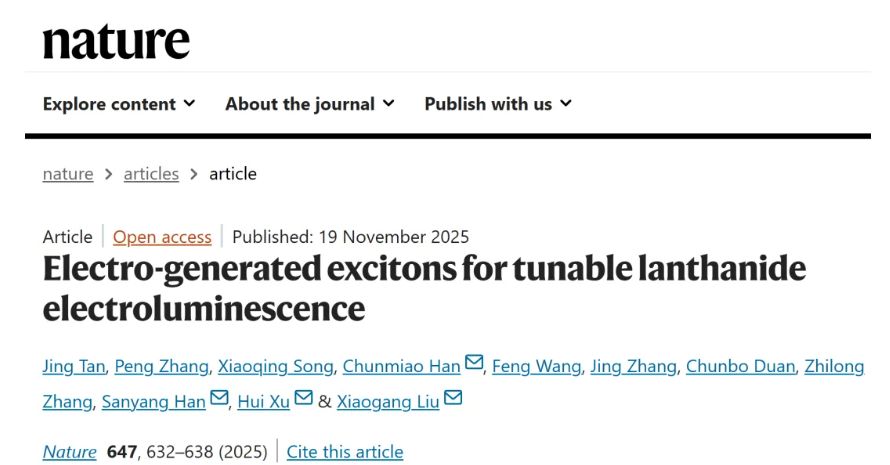
Group 1 - A groundbreaking research collaboration between Heilongjiang University, Tsinghua University, and the National University of Singapore has successfully addressed the challenge of efficient electroluminescence in insulating rare earth nanocrystals, as published in Nature [1][3] - The research provides critical technological support for China's strategic shift from "raw material export" to "high value-added technology output" in rare earth resources [1][3] - Rare earth elements are deemed irreplaceable strategic resources, often referred to as "industrial vitamins," with China holding advantages in resource reserves and smelting, but facing bottlenecks in high-end functional materials and devices [3][5] Group 2 - The research team introduced an organic semiconductor sensitization strategy, using functionalized organic ligands as a "photoelectric bridge" to efficiently transfer energy to insulating rare earth nanocrystals, enabling high-efficiency electroluminescence driven by electric current [3][5] - The new technology demonstrated a 76-fold increase in electroluminescent device efficiency and allows for full-spectrum light emission through rare earth ion modulation within a single device [5] - This breakthrough paves the way for advancements in autonomous and controllable ultra-high-definition displays, near-infrared communication, and biomedical applications, contributing significantly to enhancing China's rare earth industry chain's innovation capability and product value [5] Group 3 - Researchers discovered a significant accumulation of rare earth elements in a fern species called "Wumaozhe," observing a phenomenon of biogenic mineralization where these elements self-assemble into a mineral known as "lanthanite" within plant tissues [6] - This finding marks the first observation of biogenic mineralization of rare earth elements in natural plants, offering a new pathway for sustainable utilization of rare earth resources [6] - The study highlights the potential of "super-accumulating plants" like Wumaozhe, which can efficiently absorb and concentrate rare earth elements from the environment, presenting a cleaner and more sustainable method for rare earth extraction [6]

能源早新闻丨国家新兴产业发展示范基地,启动建设!
中国能源报· 2025-11-24 22:33
Group 1: Energy Sector Developments - As of the end of October, the total installed power generation capacity in China reached 3.75 billion kilowatts, a year-on-year increase of 17.3%. Solar power capacity was 1.14 billion kilowatts, up 43.8%, and wind power capacity was 590 million kilowatts, up 21.4% [2] - The "Chuan Dian Ru Su" project has delivered over 500 billion kilowatt-hours of clean hydropower to Jiangsu, equivalent to saving over 150 million tons of standard coal and reducing CO2 emissions by over 475 million tons [4] - Beijing's 2026 new energy increment project mechanism has set a bidding price cap of 0.3598 yuan per kilowatt-hour for wind and solar projects, with a planned scale of 1.2 billion kilowatt-hours [6] Group 2: Industrial and Technological Advancements - The Ministry of Industry and Information Technology (MIIT) has initiated the creation of approximately 100 national emerging industry development demonstration bases by 2035, focusing on sectors such as new information technology, renewable energy, and high-end equipment [2] - A significant breakthrough in rare earth research has been achieved, enabling efficient electroluminescence in insulating rare earth nanocrystals, supporting China's strategic shift from raw material exports to high-value technology exports [5] - The MIIT has launched a "chain-network collaboration" initiative to promote the integration of industrial internet with key industry chains, covering 15 industrial sectors including electricity and petrochemicals [3] Group 3: Regional Energy Initiatives - Inner Mongolia's 14th Five-Year Plan emphasizes strengthening natural gas pipeline infrastructure and developing long-distance hydrogen and ammonia pipelines to enhance energy security and efficiency [7] - Heilongjiang Province aims to achieve a new energy storage capacity of over 6 million kilowatts by 2027, transitioning from isolated applications to integrated solutions [7] Group 4: International Energy Outlook - The International Energy Agency (IEA) projects that global demand for energy services, particularly electricity, will continue to rise in the coming decades, driven by needs in transportation, heating, cooling, and industrial applications [8]

中国北方稀土(集团)高科技股份有限公司
Shang Hai Zheng Quan Bao· 2025-11-24 17:41
Group 1 - The board of directors of China Northern Rare Earth (Group) High-Tech Co., Ltd. held its eighth meeting of the ninth session on November 24, 2025, with all 12 directors present, complying with relevant laws and regulations [2][5]. - The board approved the proposal to cancel the supervisory board and amend the company's articles of association, transferring the supervisory responsibilities to the audit committee of the board [3][4]. - The board also approved the revision of the rules for the shareholders' meeting, changing the terminology from "shareholders' general meeting" to "shareholders' meeting" and removing references to the supervisory board [6][7]. Group 2 - The board approved the revision of the rules for board meetings, aligning the terminology with the changes made in the shareholders' meeting rules and defining the types of regular and temporary meetings [9][10]. - The board approved the revision of the independent director's working rules, which also removed references to the supervisory board [12][13]. - The board proposed the re-election of independent director Xu Jiabin due to the resignation of Du Ying, ensuring compliance with relevant regulations [15][17]. Group 3 - The board proposed the re-election of directors Yang Zhiqiang and Li Xiaoyan following the resignation of Bai Baosheng and Zhang Lihua, ensuring the board's composition remains compliant with legal requirements [18][19]. - The board agreed to convene the second extraordinary general meeting of shareholders on December 10, 2025, to approve the aforementioned proposals [22][29].

北方稀土:11月24日召开董事会会议
Mei Ri Jing Ji Xin Wen· 2025-11-24 17:19
每经AI快讯,北方稀土(SH 600111,收盘价:44.84元)11月24日晚间发布公告称,公司第九届第八次 董事会会议于2025年11月24日以通讯表决方式召开。会议审议了《关于取消监事会及修订公司 <章程> 的议案》等文件。 2024年1至12月份,北方稀土的营业收入构成为:工业占比73.61%,商业占比21.39%,环保板块占比 4.51%,其他业务占比0.49%。 截至发稿,北方稀土市值为1621亿元。 每经头条(nbdtoutiao)——大鹏工业战略配售"肥"了自家人!认购价9元,上市首日涨到118元,实控 人和亲哥哥凭配售一天浮盈2492万元 (记者 曾健辉) ...
广晟有色拟将证券简称变更为“中稀有色”
Zhi Tong Cai Jing· 2025-11-24 09:48
Core Viewpoint - The company, Guangsheng Nonferrous Metals Co., Ltd., is changing its name to Zhong Rare Nonferrous Metals Co., Ltd. to better align with its focus on the rare earth industry and enhance its brand recognition [1] Group 1: Company Name Change - The company will change its Chinese name from "广晟有色金属股份有限公司" to "中稀有色金属股份有限公司" and its stock abbreviation from "广晟有色" to "中稀有色," while maintaining the stock code "600259" [1] Group 2: Strategic Focus - The company aims to focus on the upstream and downstream of the rare earth industry while also expanding into tungsten, copper, and other strategic rare metal resources [1] - The name change is intended to enhance the company's integration with China Rare Earth Group Co., Ltd. and leverage its upstream rare earth resource advantages [1] Group 3: Brand and Competitive Advantage - The new name and abbreviation are expected to improve the company's brand recognition and reputation, thereby deepening its brand effect [1] - The company seeks to enhance its core functions and competitiveness in the market [1]

内蒙古“十五五”规划建议:建成全国最大的稀土新材料基地和全球领先的稀土应用基地
Ge Long Hui· 2025-11-24 05:15
Core Insights - The Inner Mongolia Autonomous Region is focusing on the development and utilization of strategic mineral resources, particularly rare earth elements, as part of its 15th Five-Year Plan [1] Group 1: Strategic Development - Emphasis on protective development, high-quality utilization, and standardized management of mineral resources [1] - Plans to enhance research and application of new technologies, processes, products, materials, and equipment related to rare earth elements [1] - Aiming to establish a national rare earth new materials innovation center and trading center, positioning Inner Mongolia as the largest base for rare earth new materials and a global leader in rare earth applications [1] Group 2: Industry Growth - Focus on expanding the rare earth permanent magnet motor industry and implementing replacement projects for rare earth permanent magnet motors [1] - Commitment to a new round of exploration strategies to boost mineral resource discovery and enhance the exploration system [1] - Plans to increase the proportion of large and medium-sized mines and foster integrated mining groups and industrial clusters [1]
盛和资源跌2.04%,成交额4.53亿元,主力资金净流出5450.29万元
Xin Lang Cai Jing· 2025-11-24 03:42
Core Viewpoint - The stock of Shenghe Resources has experienced a significant increase of 94.37% year-to-date, but has recently faced declines in the short term, with a drop of 7.17% over the last five trading days and 15.67% over the last 20 days [1] Financial Performance - For the period from January to September 2025, Shenghe Resources reported a revenue of 10.456 billion yuan, representing a year-on-year growth of 26.87%. The net profit attributable to shareholders reached 788 million yuan, showing a substantial increase of 748.07% compared to the previous year [2] Shareholder Information - As of November 10, 2025, the number of shareholders for Shenghe Resources was 239,700, a slight decrease of 0.08% from the previous period. The average number of circulating shares per shareholder increased by 0.07% to 7,312 shares [2] - The company has distributed a total of 1.039 billion yuan in dividends since its A-share listing, with 561 million yuan distributed over the last three years [3] Institutional Holdings - As of September 30, 2025, the top ten circulating shareholders included Hong Kong Central Clearing Limited as the sixth largest shareholder with 35.4767 million shares, an increase of 12.0087 million shares from the previous period. The Southern CSI 500 ETF held 20.4321 million shares, a decrease of 353,500 shares, while the Harvest CSI Rare Earth Industry ETF increased its holdings by 795,400 shares to 15.095 million shares [3]

中国稀土11月21日获融资买入7248.33万元,融资余额20.74亿元
Xin Lang Cai Jing· 2025-11-24 03:37
Core Insights - China Rare Earth experienced a decline of 5.12% on November 21, with a trading volume of 1.675 billion yuan [1] - The company reported a net financing outflow of 61.234 million yuan on the same day, with a total financing balance of 2.093 billion yuan [1] - For the period from January to September 2025, China Rare Earth achieved a revenue of 2.494 billion yuan, representing a year-on-year growth of 27.73%, and a net profit of 192 million yuan, reflecting a significant increase of 194.67% [2] Financing and Trading Activity - On November 21, the financing buy-in for China Rare Earth was 72.483 million yuan, while the financing repayment amounted to 134 million yuan, resulting in a net financing buy-in of -61.234 million yuan [1] - The current financing balance of 2.074 billion yuan accounts for 4.20% of the circulating market value, which is above the 70th percentile level over the past year [1] - In terms of securities lending, 12,800 shares were repaid, and 49,800 shares were sold short, with a total short selling amount of 2.3177 million yuan [1] Shareholder and Dividend Information - As of November 10, the number of shareholders for China Rare Earth reached 254,200, an increase of 2.14%, while the average circulating shares per person decreased by 2.09% to 4,174 shares [2] - Since its A-share listing, the company has distributed a total of 346 million yuan in dividends, with 124 million yuan distributed over the past three years [3] - Among the top ten circulating shareholders, Hong Kong Central Clearing Limited holds 29.0694 million shares, an increase of 9.4669 million shares compared to the previous period [3]

中泰证券:本轮“反内卷”政策或更加聚焦于具备全球“类稀土”特征的重点领域
智通财经网· 2025-11-23 23:39
智通财经APP获悉,中泰证券发布研究报告称,2024年以来,光伏、电池、汽车等行业低价竞争加剧, 引发政策关注。"反内卷"从部门倡导逐步制度化。本轮"反内卷"政策或更加聚焦于具备全球"类稀土"特 征的重点领域,或有三个特征:一是在全球市场占据产能与技术主导权,具备"不可替代性";二是存在 无序扩张与低价竞争的现实困境,威胁产业可健康发展;三是具备外部需求驱动的中长期增长空间,具 备演变为国家之间的战略工具或议价筹码的潜力。 中泰证券主要观点如下: 一、从政府工作报告到"十五五"规划:"反内卷"政策脉络 2010年以前稀土行业内部陷入无序竞争,稀土价格持续低迷,"白菜价"出口不仅造成资源浪费,也导致 我国在全球稀土价值链中处于低端位置。2014年,工信部正式启动组建大型稀土企业集团的政策部署。 到2016年,全国稀土产业基本完成由六大国有集团主导的整合框架。2021年底中国稀土集团组建完成, 与北方稀土形成"一南一北"双龙头格局,显著改善了过去低效重复建设和无序竞争的局面。随着产业格 局优化与整合机制成熟,中国稀土成为全球高科技产业链的重要战略环节。在中美科技竞争加剧背景 下,稀土作为中国可控的重要资源杠杆,具 ...

“反内卷”:治理逻辑与产业影响
ZHONGTAI SECURITIES· 2025-11-23 12:04
"反内卷" :治理逻辑与产业影响 证券研究报告/策略专题报告 2025 年 11 月 23 日 * [10] M. C. 执业证书编号:S0740519080003 Email:xuchi@zts.com.cn 执业证书编号:S0740520120003 Email:zhangwy01@zts.com.cn 3、《利率下行周期中的高股息增强 策略》2025-09-10 2025-11-07 报告摘要 2025-09-12 | 引言: | 4 | | --- | --- | | 一、从政府工作报告到"十五五"规划:"反内卷"政策脉络 | 4 | | 二、"反内卷"宏观背景:内需不足导致"价格"压力显现 | 5 | | 三、上一轮"供给侧"政策如何演绎? | 9 | | 四、本轮"反内卷"政策宏观环境有何不同? | 12 | | 4.1 宏观环境的根本变化 12 | | | 4.2 产业基础的全新格局 14 | | | 4.3 政策取向的结构性调整 | 15 | | 五、本轮"反内卷"的战略逻辑:"扭转通缩"转向"提高产业议价权" 16 | | | 5.1 为何本轮"反内卷"或成为服务于国家竞争力提升的关键抓手? ...