债券

Search documents
英国抛售393亿,中国继续减持5亿,美债最大的“接盘侠”出现
Sou Hu Cai Jing· 2025-11-23 13:26
Core Viewpoint - The global landscape of U.S. Treasury bond holdings is shifting dramatically, with significant sell-offs by major foreign investors like the UK and China, indicating a reevaluation of the dollar's status as a safe haven asset [1][10][11]. Group 1: Foreign Investor Behavior - The UK has notably reduced its holdings of U.S. Treasuries, selling off $39.3 billion in September, bringing its total holdings down to approximately $865 billion, marking a new low [13][18]. - China has also quietly reduced its U.S. Treasury holdings, but the amount is relatively small, around $5 billion, indicating a more strategic adjustment rather than a panic sell-off [31][33]. - Japan, in contrast, has increased its holdings by $8.9 billion in September, maintaining its position as the largest foreign holder of U.S. Treasuries at approximately $1.19 trillion [20][24]. Group 2: Market Dynamics and Implications - The perception of U.S. Treasuries as a "safe haven" is changing, with international buyers becoming more cautious and reevaluating the risks associated with holding U.S. debt [11][16]. - The global shift in asset allocation is evident, as central banks are increasingly investing in gold, which has surpassed the total value of U.S. Treasuries held by governments, reflecting a broader trend towards diversifying away from dollar-denominated assets [29][37]. - The current situation suggests a potential end to the era of relying on credit expansion for global wealth accumulation, as investors seek more tangible assets to safeguard their wealth [39][41].


可转债周度追踪:调整中的韧性-20251123
ZHESHANG SECURITIES· 2025-11-23 13:04
Group 1: Report Industry Investment Rating - No information about the report industry investment rating is provided in the content Group 2: Core Views of the Report - Convertible bonds demonstrated defensiveness during the equity adjustment and there was an obvious "high-to-low" shift within the convertible bond market. The short - term adjustment does not change the long - term bullish trend of the equity market, and investors can choose the right time to deploy after the adjustment is sufficient [1][2][7] - In the short - term, the decline in sentiment caused by the significant stock market adjustment may bring phased pressure, but convertible bonds can show resilience due to the unchanged long - term optimistic expectations of the stock market and the supply - demand contradiction of convertible bonds [2][8] - It is recommended to maintain the convertible bond position, balance the style allocation, and use a trading mindset for individual convertible bonds. For balanced convertible bonds, select those with strong underlying stock logic; for non - callable equity - biased convertible bonds, focus on low - premium ones [2][8] Group 3: Summary According to the Catalog 1. Convertible Bond Weekly Thinking - Convertible bonds showed defensiveness during the equity adjustment. Last week, the A - share market adjusted significantly, but convertible bonds had a smaller decline than their underlying stocks. The price center of convertible bonds fell but remained above 130 yuan, and the valuation was passively lifted, especially for equity - based convertible bond targets [7] - There was an obvious "high - to - low" shift within convertible bonds. Defensive sectors such as low - price, large - cap, and high - grade convertible bonds performed better, while high - premium and high - price varieties were weaker. Funds shifted to low - level and low - valuation targets. The market concentrated on traditional cyclical industries, especially upstream metal targets, while the technology sector fluctuated more. Some newly issued convertible bonds had rising premium rates and short - term valuation pressure [2][7] - In the short - term, the stock market adjustment may bring phased pressure. If the stock market continues to weaken, convertible bonds may still follow the adjustment. Currently, the convertible bond market has high valuation and price, with limited bond - selection space and concentrated institutional holdings, so the market may face short - term pressure [2][8] - The short - term adjustment does not change the long - term bullish trend of the equity market. It is recommended to maintain a convertible bond position, balance the style between technology growth and low - price defense, and use a trading mindset for individual convertible bonds. For balanced convertible bonds, choose those with strong underlying stock logic; for non - callable equity - biased convertible bonds, focus on low - premium ones [2][8] - In November, it is recommended to pay attention to convertible bonds such as Shangyin, Shouhua, ALa, Jingke, Baolong, Keshun, Yingbo, Yiwei, Jin 25, and Anji [9] 2. Convertible Bond Market Tracking 2.1 Convertible Bond Market Conditions - The performance of different convertible bond indexes varied in different time periods. For example, the wind convertible bond energy index decreased by 3.55% in the past week, while the wind convertible bond financial index decreased by 0.57% [15] 2.2 Convertible Bond Individual Bonds - The content shows the top ten and bottom ten individual convertible bonds in terms of price increase and decrease in the past week, but specific bond names are not provided [18] 2.3 Convertible Bond Valuation - Information about the valuation trends of bond - based, balanced, and equity - based convertible bonds is presented, including their four - week moving average of conversion premium rates [21][23][27] 2.4 Convertible Bond Price - The price median trend of convertible bonds is shown, and the proportion trend of high - price bonds is also presented [25][31]
股弱债不强,意味着什么
GUOTAI HAITONG SECURITIES· 2025-11-23 12:19
股债定价各有独立逻辑,定价的结果或均偏向止盈。 投资要点: 市 场 策 略 周 报 股弱债不强,意味着什么 [Table_Authors] 唐元懋(分析师) 本报告导读: 证 券 研 究 报 告 | | 0755-23976753 | | --- | --- | | | tangyuanmao@gtht.com | | 登记编号 | S0880524040002 | | | 杜润琛(研究助理) | | | 021-38031034 | | | durunchen@gtht.com | | 登记编号 | S0880123090079 | | | 孙越(分析师) | | | 021-38031033 | | | sunyue6@gtht.com | | 登记编号 | S0880525080004 | [Table_Report] 相关报告 区间震荡行情延续 2025.11.22 美元流动性收紧何时缓解 2025.11.18 大行短端买入力度减弱 2025.11.18 本轮移仓有何特征和机会 20251117 2025.11.17 大行融出回落,存单发行提升,6M 期限最多 2025.11.17 请务必阅读正文之后 ...
信用债市场周度回顾 251122:市场偏好短端下沉,而非拉久期-20251123
GUOTAI HAITONG SECURITIES· 2025-11-23 12:18
Group 1 - The report indicates a cooling sentiment in the credit bond market, with institutions adopting a more conservative trading behavior, favoring short-term bonds over extending durations [1][6] - Overall performance in the credit bond market remains balanced, with credit spreads for bonds maturing within 5 years reaching their lowest point of the year [1][6] Group 2 - In the primary issuance segment, net financing increased to 1290.8 billion yuan for the week of November 17-21, 2025, compared to 361.2 billion yuan in the previous week [6][10] - The total issuance of major credit bond varieties amounted to 3846.4 billion yuan, with 2555.6 billion yuan maturing during the same period [6][10] - The distribution of issuers by credit rating shows that AAA-rated issuers accounted for the largest share at 60.1%, with diversified industries represented [6][7] Group 3 - In the secondary trading segment, total transactions decreased to 7783.28 billion yuan, down from 8032.22 billion yuan in the previous week [10][13] - The yields on medium-term notes (MTNs) generally declined, with the 3-year AAA MTN yield falling by 2.33 basis points to 1.86% [10][13] - The report notes a continued narrowing of spreads for short-term bonds, while long-term spreads showed limited movement [10][13] Group 4 - The report tracked credit rating adjustments, noting two upgrades for issuers in the municipal investment platform sector, with no downgrades reported [6][10] - There were two new extensions of bonds, with no new defaults recorded during the week [6][10]
固收周报:关注机构季节性配置会否开启-20251123
Yin He Zheng Quan· 2025-11-23 11:13
固收研究报告 关注机构季节性配置会否开启 —— 固收周报(11 月 17 日-11 月 21 日) 2025 证 11 证 22 证 ⚫ 本周债市回顾: 利率震荡回 升,收益率曲线走陡 本周( 11/17 -11/21 )债市收益率整体上行,主要受股债跷跷板、地缘影响与地产贴息 预期等影响 , 截至 11/21 ,30Y、10Y 、1Y 国债收益率分别变化 +1.85BP 、+0.57BP 、 -0.56BP 收于 2.16% 、1.82% 、1.40% ,30Y-10Y 、10Y -1Y 期限利差分别较上周变 化+0.69BP 、+1.22BP 收于 34.1BP 、41.6BP 。证证 10Y 证证证证证证证证证证证证 1证证证证证证证证证证证证证证证证证证证证 2证证证证证证证证证证证证 证 ⚫ 下周 债市展望: 临近月末关注资金面跨月情况 基本面来看, 证证证证证证证证证证证证证证证证证证证证证证证证证证证证证证证证 证证证证证证证证证证证证证证证证证证证证证证证证证证证证证证证证证证证证证证 证证证证证证证证证证证证证证证证证证证证证 证 后续关注 四方面变化: 1 )经济数据显示供需收缩,后续 P ...
中方大手一挥,再抛5亿美债,美方发现不妙,全球疯抢中国债券
Sou Hu Cai Jing· 2025-11-23 06:42
Group 1 - China has reduced its holdings of US Treasury bonds by $500 million, marking the fifth reduction this year, while Japan increased its holdings by $8.9 billion, maintaining its position as the largest foreign holder of US debt at $1.1893 trillion [1][3] - The reduction in US Treasury holdings by China and the UK, alongside Japan's increase, indicates a divergence in the investment strategies of these countries, reflecting varying levels of confidence in US debt [3][5] - The downgrade of the US sovereign credit rating from "AA" to "AA-" by a European credit rating agency has raised concerns about the US financial stability, potentially impacting the dollar's status in the international monetary system [3][5] Group 2 - The issuance of €4 billion in euro-denominated sovereign bonds by China, which was oversubscribed by more than 26 times, indicates a growing global interest in Chinese sovereign debt and an increasing willingness to invest in Chinese assets [5][7] - The strong demand for Chinese bonds suggests a rising confidence in China's creditworthiness and long-term economic stability, contrasting with the declining trust in US Treasury bonds [5][7] - China's successful bond issuance and the global appetite for its debt reflect the resilience of its economy and financial system, positioning China to further integrate into the global financial framework and promote the internationalization of the renminbi [7]

LPR连续6个月保持不变,资金面继续转松,债市以震荡为主
Dong Fang Jin Cheng· 2025-11-23 01:58
Report Summary Industry Investment Rating No information provided on the industry investment rating. Core View On November 20, the liquidity continued to ease, the bond market mainly oscillated, the yields of interest - rate bonds changed within 1bp, the main indices of the convertible bond market declined collectively, most convertible bond issues fell, the yields of US Treasury bonds across maturities generally declined, and the yields of 10 - year government bonds in major European economies generally rose [1]. Summary by Section 1. Bond Market News - **Domestic News** - The 1 - year and 5 - year - plus LPR remained unchanged at 3.0% and 3.5% respectively, marking six consecutive months of no change [3]. - The Ministry of Commerce urged Japan to correct its wrong remarks on Taiwan. If Japan persists, China will take necessary measures [3]. - The Ministry of Commerce hoped that the Netherlands would take practical actions to solve the Nexperia issue and restore the security and stability of the global semiconductor supply chain [4]. - 50 cities were short - listed for the pilot program of new consumption models, and the central government will provide up to 400 million yuan per city in subsidies [4][5]. - **International News** - The US added 119,000 non - farm jobs in September, more than double the expected 51,000, but the unemployment rate reached 4.4%, the highest since October 2021. The September non - farm report deepened the Fed's internal division [6]. - **Commodities** - On November 20, WTI December crude futures fell 0.50% to $59.14/barrel, Brent January crude futures fell 0.20% to $63.38/barrel, COMEX December gold futures fell 0.56% to $4,060/ounce, and NYMEX natural gas prices fell 1.62% to $4.490/ounce [7]. 2. Liquidity - **Open - Market Operations** - On November 20, the central bank conducted 300 billion yuan of 7 - day reverse repurchase operations at a fixed interest rate of 1.40%, with a net injection of 110 billion yuan after 190 billion yuan of reverse repurchases matured [9]. - **Funding Rates** - On November 20, the liquidity continued to ease, and major repurchase rates continued to decline. DR001 dropped 5.69bp to 1.365%, and DR007 dropped 2.74bp to 1.486%. Other rates such as Shibor also showed varying degrees of decline [10][11]. 3. Bond Market Dynamics - **Interest - Rate Bonds** - **Spot Bond Yield Trends** - On November 20, the bond market mainly oscillated, and the yield changes of interest - rate bonds were within 1bp. The yield of the 10 - year Treasury bond active issue 250016 rose 0.30bp to 1.8100%, and the yield of the 10 - year CDB bond active issue 250215 rose 0.25bp to 1.8720% [13]. - **Bond Tendering** - Various bonds such as 25 Guokai Qingfa bonds and 25 Jinchujian bonds were tendered, with different issuance scales, winning yields, and multiples [14]. - **Credit Bonds** - **Secondary - Market Transaction Anomalies** - On November 20, the trading price of one industrial bond, "21 Taixin 06", deviated by more than 10%, rising more than 11% [15]. - **Credit Bond Events** - Events such as bond payment extension proposals, issuance cancellations, commercial paper overdue payments, and companies being restricted from high - end consumption or undergoing reorganization occurred among multiple companies [18]. - **Convertible Bonds** - **Equity and Convertible Bond Indices** - On November 20, the A - share market declined, with the Shanghai Composite Index, Shenzhen Component Index, and ChiNext Index falling 0.40%, 0.76%, and 1.12% respectively. The main indices of the convertible bond market also declined, with the CSI Convertible Bond Index, Shanghai Convertible Bond Index, and Shenzhen Convertible Bond Index falling 0.23%, 0.27%, and 0.23% respectively [19]. - **Convertible Bond Tracking** - On November 21, Maolai Convertible Bond started online subscription, and Qizhong Convertible Bond was listed. Multiple convertible bonds announced redemption - related matters [22]. - **Overseas Bond Markets** - **US Treasury Bonds** - On November 20, the yields of US Treasury bonds across maturities generally declined. The 2 - year yield dropped 3bp to 3.55%, and the 10 - year yield dropped 3bp to 4.10%. The inflation - adjusted break - even inflation rate of 10 - year US Treasury bonds dropped 3bp to 2.24% [23][25]. - **European Bonds** - On November 20, except for the 10 - year UK government bond yield which dropped 1bp, the 10 - year government bond yields of other major European economies generally rose [26]. - **Chinese - Issued US - Dollar Bonds** - As of the close on November 20, the daily price changes of Chinese - issued US - dollar bonds varied, with some bonds rising and some falling [28].
机构行为观察周报 20251121:中长期债基久期上升,机构杠杆率多数上行-20251122
Shenwan Hongyuan Securities· 2025-11-22 11:42
Group 1 - The duration of medium to long-term pure bond funds has increased, while short-term bond funds have decreased. The median duration for all medium to long-term pure bond funds reached 2.58 years, up 0.08 years week-on-week, placing it at the 80.40th percentile over the past three years [1][4][7] - The median duration for medium to long-term interest rate bond funds reached 3.69 years, increasing by 0.12 years week-on-week, and is at the 84.50th percentile over the past three years [1][7][8] - The median duration for short-term pure bond funds decreased to 0.95 years, down 0.02 years week-on-week, and is at the 83.50th percentile over the past three years [1][7][12] Group 2 - The turnover rate for interest rate bonds has decreased, while the turnover rate for credit bonds has increased. The turnover rate for 10-year and above government bonds decreased by 0.19 percentage points to 1.92%, placing it at the 49.6th percentile over the past three years [1][14][18] - The turnover rate for 5-7 year medium-term notes increased by 0.03 percentage points to 1.23%, at the 28.7th percentile over the past three years [1][14][18] - Local government bonds in Qingdao, Jiangxi, and Jiangsu have shown higher turnover rates, with valuation spreads of 13.81 bps, 10.93 bps, and 11.36 bps respectively [1][21][22] Group 3 - The leverage ratio in the interbank bond market has increased by 0.12 percentage points to 107.17%. The leverage ratio for insurance companies rose by 0.12 percentage points to 128.87%, while the leverage ratio for banks increased by 0.03 percentage points to 102.66% [1][23][28] - The leverage ratio for securities companies decreased by 0.94 percentage points to 224.13%, and the broad fund leverage ratio increased by 0.42 percentage points to 111.89% [1][23][31] Group 4 - The total market's existing wealth management scale increased by 30.252 billion yuan week-on-week, consistent with seasonal levels, while the net value breaking rate slightly decreased [1][29][30] - The scale of fixed-income wealth management products saw significant growth, while other investment types experienced minor fluctuations [1][33][34] - The performance comparison benchmarks for wealth management products showed a decline for 1 month (inclusive) and 1-3 years (inclusive), while remaining stable for 6 months-1 year (inclusive) and over 3 years [1][39][40]
债市策略思考:如何理解股跌债不涨?
ZHESHANG SECURITIES· 2025-11-22 08:00
Core Insights - The transition from "stocks rise, bonds fall" to "stocks fall, bonds do not rise" reflects the disparity in asset trends, indicating a lack of strong bullish drivers in the bond market while the equity market focuses on restoring investor confidence [1][3][11] - The bond market has seen a rebound from low levels, but the momentum for further increases is weak due to limited expectations for monetary policy easing and a generally low investor sentiment after a year of significant volatility [1][3][14] - The equity market, despite the Shanghai Composite Index reaching new highs, lacks strong trading logic to support its rise, leading to pressure from high absolute index levels and recent volatility in overseas markets [1][3][14] Understanding U.S. Rate Cut Expectations - The Federal Reserve faces a dilemma between employment and inflation, with mixed signals from the labor market suggesting that a significant recession is not imminent, which may not justify a rate cut in December [2][15][16] - The absence of key labor data due to government shutdowns means the Fed may adopt a cautious stance, waiting for clearer signals before making decisions on rate cuts [2][18][22] - The fluctuation in rate cut expectations has impacted global asset pricing, with the potential for volatility in the rate cut timeline, although the overall direction towards easing remains unchanged [2][22] Bond Market Dynamics - The bond market currently lacks a clear bullish trading narrative, making it susceptible to profit-taking after minor gains, with the potential for a breakout dependent on consistent bullish signals from policy or market trends [3][26] - Investor sentiment in the equity market is low due to ongoing declines, emphasizing the need to restore confidence to avoid a downward spiral in market perceptions [3][26]
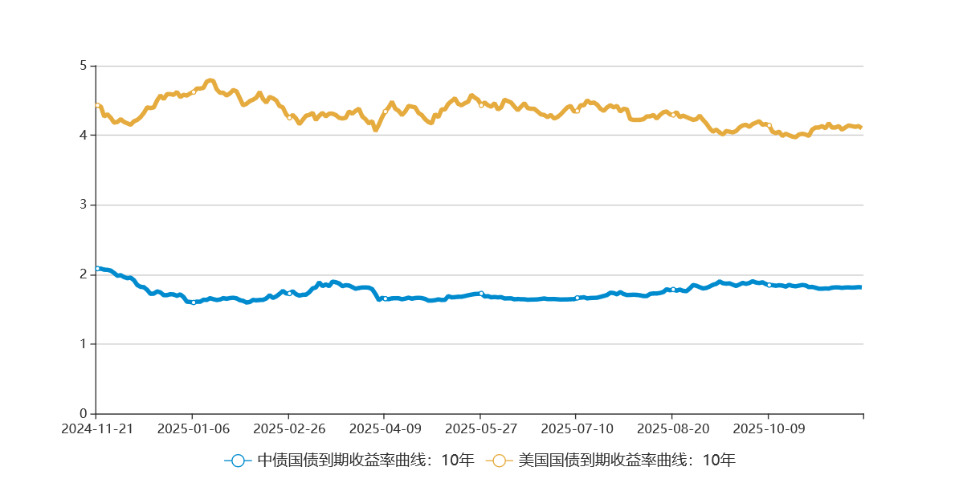
中资离岸债风控周报(11月17日至21日):一级市场小幅走暖 二级市场涨跌不一
Xin Hua Cai Jing· 2025-11-22 06:06
Primary Market - A total of 24 offshore bonds were issued this week, including 6 RMB bonds, 10 USD bonds, 3 HKD bonds, and 5 EUR bonds, with issuance scales of 8.842 billion RMB, 3.2032 billion USD, 13.195 billion HKD, and 4.85 billion EUR respectively [1] - The largest single issuance in the offshore RMB bond market was 5 billion RMB by Hong Kong Mortgage Corporation Limited, while the highest coupon rate for RMB bonds was 6.9% issued by Zibo High-tech State-owned Capital Investment Co., Ltd [1] - In the USD bond market, the largest single issuance was 1.07197 billion USD, with the highest coupon rate of 9% issued by New World Development Company Limited [1] Secondary Market - The Markit iBoxx China USD Bond Composite Index rose by 0.06% to 251.16, while the investment-grade USD bond index increased by 0.07% to 243.85. The high-yield USD bond index decreased by 0.05% to 244.11 [2] - The real estate USD bond index fell by 0.12% to 183.44, while the city investment bond index rose by 0.09% to 153.36, and the financial bond index increased by 0.08% to 290.78 [2] Benchmark Spread - The spread between the 10-year benchmark government bonds of China and the US narrowed to 228.76 basis points, a decrease of 5.52 basis points from the previous week [3] Rating Changes - Moody's confirmed the "A1" issuer rating for Hong Kong and China Gas Company Limited, changing the outlook from "stable" to "negative" on November 17 [5] Domestic News - The Ministry of Finance and the People's Bank of China announced that savings bonds (electronic) will be included in the personal pension product range starting June 2026 [6] - The Ministry of Finance successfully issued 4 billion euros in sovereign bonds in Luxembourg, with a total subscription amount of 100.1 billion euros, 25 times the issuance amount [7] - The Bond Connect Northbound trading volume reached 572.3 billion RMB in October, with an average daily trading volume of 31.8 billion RMB [8] Overseas News - Major overseas investors held 9.25 trillion USD in US Treasury bonds as of September, with Japan continuing to increase its holdings [9] - Japan's 10-year government bond yield reached 1.765%, the highest since the financial crisis, driven by concerns over potential large-scale fiscal stimulus [10] Default and Restructuring - 78% of creditors have signed a restructuring support agreement with Zhongjun Group Holdings [11] - Western Cement announced a cash offer to repurchase its 4.95% senior notes due in 2026 while issuing new senior notes [12] - Road King Group's subsidiary received a winding-up petition related to approximately 442 million USD in unpaid principal and interest [13]