
服务业

Search documents
国常会最新部署!
证券时报· 2025-07-31 12:35
Core Viewpoint - The article emphasizes the Chinese government's commitment to advancing the "Artificial Intelligence +" initiative and implementing personal consumption and service industry loan interest subsidy policies to stimulate economic growth and enhance market vitality [1][3][5]. Group 1: "Artificial Intelligence +" Initiative - The government aims to deeply implement the "Artificial Intelligence +" initiative, promoting large-scale commercial applications of AI across various sectors, fostering a virtuous cycle of innovation and application [2][5]. - The initiative includes optimizing the AI innovation ecosystem by strengthening computing power, algorithms, and data supply, increasing policy support, and enhancing talent development [5]. - The AI industry in China is projected to exceed 700 billion yuan by 2024, maintaining a growth rate of over 20% for several consecutive years [6]. Group 2: Loan Interest Subsidy Policies - The implementation of personal consumption loan and service industry loan interest subsidy policies is expected to lower credit costs for residents and financing costs for service industry entities, thereby stimulating consumption potential and enhancing market vitality [3][9]. - The policies are designed to leverage fiscal and financial collaboration to improve the efficiency of fund utilization and ensure that financial resources are effectively allocated [9][12]. - The Ministry of Finance has indicated that these subsidy policies will have a leveraging effect on consumption, enhancing demand for end products and improving public service supply capabilities [12].


GDP增速全市第一!广州白云上半年经济成绩单出炉
Nan Fang Du Shi Bao· 2025-07-31 12:23
Economic Performance - In the first half of 2025, Baiyun District's GDP reached 153.28 billion, with a year-on-year growth of 5.3%, ranking first in the city [1] - The primary industry added value was 1.53 billion, growing by 4.8%; the secondary industry added value was 29.44 billion, growing by 3.9%; and the tertiary industry added value was 122.31 billion, growing by 5.7% [1] Agricultural Sector - The total output value of agriculture, forestry, animal husbandry, and fishery in Baiyun District was 3.24 billion, a year-on-year increase of 5.1% [1] - Notably, the vegetable and edible fungus sector saw a production of 226,000 tons and an output value of 1.77 billion, both increasing by 6.6% year-on-year [1] Industrial Sector - The total industrial output value in the district grew by 2.9% year-on-year, with traditional industries like furniture manufacturing and electrical machinery showing significant growth of 8.1% and 19.3%, respectively [1] - New production capacities in industrial robots, solar cells, and medical instruments saw remarkable increases of 91.6%, 72.4%, and 33% in production [1] Aviation Industry - Baiyun Airport's passenger and cargo throughput reached 4.09 million tons, with a year-on-year growth of 7.1% [2] - The air cargo turnover increased by 7.0% year-on-year, indicating a steady growth trend in the aviation sector [2] Consumer Market - The total retail sales of consumer goods in Baiyun District amounted to 58.54 billion, with a slight year-on-year increase of 0.1% [2] - Significant growth was observed in essential goods, with daily necessities, hardware, and pharmaceuticals increasing by 33.1%, 10.0%, and 41.8%, respectively [2] Service Industry - From January to May, the revenue of the profitable service industry in Baiyun District grew by 19.0% year-on-year, ranking second in the city [2] - The advertising and application software development sectors showed exceptional growth, with revenues increasing by 90.3% and 44.3%, respectively [2] Fixed Asset Investment - Fixed asset investment in Baiyun District exceeded 64 billion, with a year-on-year growth of 5.1% [3] - Investment in industrial projects grew significantly, reaching 24.51 billion, a year-on-year increase of 16.1% [3] - Industrial investment completed 8.82 billion, growing by 25.7%, while manufacturing investment reached 6.23 billion, increasing by 11.8% [3]

万业企业:股东国盛资本减持186.12万股,减持计划实施完毕
Mei Ri Jing Ji Xin Wen· 2025-07-31 12:16
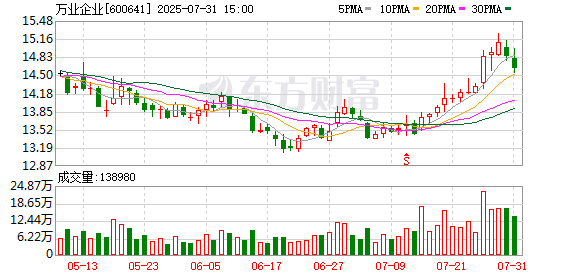
(文章来源:每日经济新闻) 万业企业(SH 600641,收盘价:14.62元)7月31日晚间发布公告称,本次减持股份计划实施前,公司 股东上海国盛资本管理有限公司-上海国盛海通股权投资基金合伙企业(有限合伙)(以下简称"国盛 资本")持有公司股份46,531,500股,占公司总股本比例为5.00%。上述股份通过协议转让取得,均为无 限售条件流通股。 前期,公司披露了《股东集中竞价减持股份计划公告》。截至本公告披露日,国盛资本通过集中竞价交 易方式合计减持公司股份1,861,200股,合计减持比例为0.20%,本次减持计划已实施完毕。 2024年1至12月份,万业企业的营业收入构成为:房地产业占比48.34%,制造业占比41.44%,服务业占 比8.72%,其他业务占比1.49%。 ...

宏观点评:7月PMI超季节性回落的背后-20250731
GOLDEN SUN SECURITIES· 2025-07-31 11:33
Group 1: PMI Trends - July manufacturing PMI decreased to 49.3%, down 0.4 percentage points from the previous value, indicating a contraction for the fourth consecutive month[2] - Non-manufacturing PMI fell to 50.1%, a decline of 0.4 percentage points, with service and construction sectors dropping by 0.1 and 2.2 percentage points respectively[2] - Composite PMI output index decreased by 0.5 percentage points to 50.2%, suggesting a slowdown in overall economic expansion[2] Group 2: Supply and Demand Signals - July PMI production index was 50.5%, down 0.5 percentage points, indicating continued expansion but with weakening demand[3] - New orders index fell by 0.8 percentage points to 49.4%, entering contraction territory, with new export orders down by 0.6 percentage points[3] - New export orders index dropped to 47.1%, remaining in contraction, while import orders held steady at 47.8%[3] Group 3: Price and Employment Insights - Price indices rebounded, with raw material and factory price indices rising by 3.1 and 2.1 percentage points respectively, indicating a narrowing decline in PPI[4] - Employment pressure eased slightly, with manufacturing, service, and construction employment indices increasing by 0.1, 0.0, and 1.0 percentage points respectively[4] - Service sector PMI fell to 50.0%, while construction PMI dropped 2.2 percentage points to 50.6%, the second-lowest this year[6] Group 4: Economic Outlook - The July Politburo meeting indicated a focus on policy implementation, with potential new policies expected but not strong stimulus measures[6] - Economic pressures are anticipated to increase in the second half of the year, particularly in August and September, due to prior "export rush" effects and short-term contraction[6] - Continued monitoring of US-China trade negotiations is advised, as potential developments may impact market conditions[6]
2025年7月PMI分析:7月PMI为什么下降?
Yin He Zheng Quan· 2025-07-31 11:28
Group 1: PMI Overview - In July 2025, the manufacturing PMI decreased to 49.3%, down 0.4 percentage points from the previous month, indicating a decline in manufacturing activity[1] - The construction business activity index was at 50.6%, down from 52.8%, while the services business activity index remained stable at 50.0%, slightly down from 50.1%[1] Group 2: Production and Demand Factors - The production index for July was 50.5%, down from 51%, while the new orders index fell to 49.4% from 50.2%, indicating a contraction in new orders[2] - Extreme weather events in July, including heavy rains and heatwaves, impacted outdoor construction activities, contributing to the decline in production and new orders[2] - Passenger car sales dropped by 21.9% month-on-month in July, reflecting weakened consumer demand post the June shopping festival[2] Group 3: Price Indices and Inventory - The PMI output price index rose by 2.1 percentage points to 48.3%, and the raw material purchase price index increased by 3.1 percentage points to 51.5%, indicating rising input costs[3] - The gap between raw material prices and finished product prices widened to 3.2 percentage points, up from 2.2 percentage points, which is detrimental to corporate profit recovery[3] - The inventory indices for finished goods and raw materials both declined, with finished goods at 47.4% and raw materials at 47.7%, indicating a contraction in inventory levels[4] Group 4: Business Sentiment and Future Outlook - Small enterprises faced significant pressure, with their PMI dropping to 46.4%, while large and medium enterprises saw slight increases[4] - The outlook for future demand remains cautious, with businesses responding primarily to short-term orders and maintaining low inventory levels[5] - The political bureau meeting emphasized consolidating economic recovery and addressing prominent issues, with a focus on nurturing emerging industries and avoiding debt-driven growth[5]
7月PMI:反内卷的“悖论”?
申万宏源宏观· 2025-07-31 10:58
Core Viewpoint - The "anti-involution" policy has boosted prices, but supply and demand performance is counterintuitive [2][7][67] - The manufacturing PMI decreased by 0.4 percentage points to 49.3%, exceeding the average decline since 2017 [2][67] - The increase in commodity prices is reflected in the raw material purchase price index (+3.1 percentage points to 51.5%) and the factory price index (+2.1 percentage points to 48.3%) [2][67] Manufacturing Sector - The manufacturing PMI has marginally declined, with production and new order indices both decreasing [4][70] - The production index fell by 0.5 percentage points to 50.5%, while the new order index dropped by 0.8 percentage points to 49.4% [4][70] - The new export order index decreased by 0.6 percentage points to 47.1%, indicating a slowdown in market demand [4][70][35] Key Industries - High-energy-consuming industries are showing production strength despite price increases, with the steel industry PMI rising by 4.6 percentage points to return to the expansion zone [3][18][69] - The equipment manufacturing and consumer goods industries saw PMIs decline by 1.1 and 0.9 percentage points to 50.3% and 49.5%, respectively [3][18][69] - Investment demand weakened significantly, contrasting with the strong production performance in high-energy-consuming sectors [21][69] Non-Manufacturing Sector - The non-manufacturing PMI decreased by 0.4 percentage points to 50.1%, primarily due to a significant drop in the construction PMI [42][70] - The construction PMI fell by 2.2 percentage points to 50.6%, with the new order index dropping sharply by 2.2 percentage points to 42.7% [5][58][70] - The service sector PMI slightly declined, with the new order index remaining weak at 46.3% [5][46][70] Future Outlook - The political bureau meeting in July emphasized the need for further implementation of the "anti-involution" policy, focusing on the effects in downstream sectors and marginal changes in domestic demand [27][69] - The current situation indicates that the "anti-involution" policy in the upper reaches still requires further advancement, while high-energy-consuming industries are undergoing significant transformations [27][69]
中采PMI点评(25.07):7月PMI:反内卷的“悖论”?
Shenwan Hongyuan Securities· 2025-07-31 10:43
Group 1: PMI Data Overview - In July, the manufacturing PMI decreased by 0.4 percentage points to 49.3%, while the non-manufacturing PMI fell by 0.4 percentage points to 50.1%[6][28] - The decline in manufacturing PMI is greater than the average drop of 0.1 percentage points since 2017[7][28] - The purchasing price index for major raw materials rose by 3.1 percentage points to 51.5%, marking the first increase above the critical point since March[7][18] Group 2: Sector Performance - The production index in July remained in the expansion zone at 50.5%, despite a 0.5 percentage point decline[2][13] - The new orders index fell into the contraction zone, decreasing by 0.8 percentage points to 49.4%[2][14] - High-energy-consuming industries, particularly the steel sector, saw a PMI increase of 4.6 percentage points, returning to the expansion zone at 48%[18][21] Group 3: Investment and Demand Trends - Investment demand weakened significantly in July, contrasting with the strong performance of high-energy-consuming industries[21] - The construction PMI dropped by 2.2 percentage points to 50.6%, with new orders falling sharply to 42.7%[21][42] - The business activity expectation index for the construction sector decreased by 2.3 percentage points to 51.6%[21] Group 4: Future Outlook - The political bureau meeting in July emphasized the need for further implementation of "anti-involution" policies, particularly focusing on mid- and downstream sectors[23] - The report suggests that the effectiveness of "anti-involution" policies in stimulating domestic demand will be crucial for future manufacturing performance[23]
6月经济数据表现分化
Capital Securities· 2025-07-31 10:42
Group 1: Economic Growth - In Q2, China's actual GDP grew by 5.2% year-on-year, with a target of around 5% for the full year, indicating manageable pressure to meet this goal[3] - The GDP deflator index fell to -1.2% in Q2, marking the ninth consecutive quarter of negative growth, suggesting ongoing price pressures[9] - The contribution of consumption to GDP growth in Q2 was 2.7 percentage points, making it the primary driver of economic expansion[10] Group 2: Industrial Performance - In June, the industrial added value of large-scale enterprises increased by 6.8% year-on-year, exceeding expectations of 5.5%[15] - The export delivery value of large-scale industrial enterprises rose by 4% in June, a 3.4 percentage point increase from the previous value[15] - Key sectors such as automotive manufacturing and electronic equipment manufacturing saw year-on-year growth rates of 11.4% and 11.0%, respectively[15] Group 3: Investment Trends - From January to June, fixed asset investment growth slowed to 2.8%, down 0.9 percentage points, with significant declines in manufacturing and infrastructure investment[21] - Manufacturing investment growth decreased to 7.5%, while infrastructure investment fell to 8.9%, with real estate investment declining by 11.5%[21] - Water management sector investment growth dropped significantly, down 11.2 percentage points to 15.4% year-on-year[25] Group 4: Consumer Spending - In June, the total retail sales of consumer goods grew by 4.8% year-on-year, a decline of 1.6 percentage points from the previous month[29] - Restaurant revenue in June recorded a year-on-year increase of only 0.9%, a drop of 5 percentage points from the previous value[29] - The retail sales of household appliances and communication equipment fell by 20.6% and 19.1%, respectively, indicating weakening consumer demand[29] Group 5: Risk Factors - Potential risks include changes in the external environment and the possibility that the "old-for-new" policy may not meet expectations[34]
7月PMI数据点评:“反内卷”逐步向现实传导
Huachuang Securities· 2025-07-31 09:48
1. Report Industry Investment Rating No relevant information provided. 2. Core Viewpoints of the Report - In July 2025, extreme weather affected the release of downstream demand, causing a decline in new orders and production, with demand sub - items returning to the contraction zone. However, there were also increasing positive factors such as rising price indicators and improved macro - confidence. For the bond market, attention should be paid to the seesaw effect between data verification and risk - preference boosting, and the transmission effect of "strong expectations" to reality after August [4][10][11]. 3. Summary by Related Catalogs 3.1 Manufacturing PMI: Weather Factors Disturb, and the Boom Declines Temporarily 3.1.1 Supply and Demand: Demand Declines More Than Production - Production slowed down, with a month - on - month decrease of 0.5 pct to 50.5%. Factors included the weakening of the June rush - to - deliver effect, extreme high - temperature weather affecting demand and restocking, and industry "anti - involution" measures [2][16]. - New orders fell into the contraction zone, with a month - on - month decrease of 0.8 pct to 49.4%. The gap between new orders and new export orders narrowed to 2.3 pct, and domestic demand orders slowed more than export orders due to extreme weather [2][19]. 3.1.2 Foreign Trade: The Marginal Effect of "Rushing to Export" Weakens - New export orders declined month - on - month by 0.6 pct to 47.1%, and imports remained flat at 47.8%. The concentrated release of previous back - logged export orders in May - June weakened in July [2][22]. 3.1.3 Price: The Expectation of "Anti - Involution" and Rising Commodity Prices Lead to Accelerated Price Repair - The purchase price of raw materials and the ex - factory price increased by 3.1 pct and 2.1 pct month - on - month to 51.5% and 48.3% respectively. The increase was larger than in June, and it was expected that the PPI in July would improve marginally [2][27]. 3.1.4 Inventory: The De - stocking Rhythm Accelerates Relatively - Raw material inventory decreased by 0.3 pct month - on - month to 47.7%, and finished - product inventory decreased by 0.7%. Production restocking slowed down, and enterprises de - stocked faster [2][30]. 3.2 Non - manufacturing PMI: Construction Slows Down, and Service Consumption Differentiates Widely - In July, the non - manufacturing PMI was 50.1%, a month - on - month decrease of 0.4 pct. The service industry PMI decreased by 0.1 pct to 50.0%, and the construction industry PMI decreased by 2.2 pct to 50.6%. - The construction industry PMI declined due to the influence of the rainy season, with housing construction activities falling below the boom - bust line and civil engineering construction remaining above 55%. After the rainy season, there may be a rush - to - work effect, and the PMI is expected to recover. - The service industry PMI dropped to the boom - bust line. Retail and transportation industries were boosted by summer consumption, while the accommodation and catering industries had relatively weak demand growth [3][37].
49.3%!
Jing Ji Wang· 2025-07-31 09:28
Core Insights - The Purchasing Managers' Index (PMI) for July indicates a slight decline in China's manufacturing and non-manufacturing sectors, reflecting economic pressures [1][2][4] Manufacturing Sector - The manufacturing PMI for July is reported at 49.3%, a decrease of 0.4 percentage points from the previous month, indicating contraction [1][2] - Factors contributing to the decline include seasonal production slowdowns and extreme weather conditions such as heatwaves and floods, which have impacted market demand [4] - The production index and new orders index are at 50.5% and 49.4%, respectively, showing a decrease of 0.5 and 0.8 percentage points, while the overall production activity remains in expansion territory [4] - Despite challenges, the high-tech manufacturing and equipment manufacturing sectors continue to show resilience, with PMIs remaining above the critical point [4] Non-Manufacturing Sector - The non-manufacturing business activity index stands at 50.1%, down 0.4 percentage points from the previous month, but still above the critical threshold [5] - The construction sector has experienced a slowdown due to rainy season impacts, although it remains in expansion territory with a business activity index of 50.6% [5][6] - The summer holiday effect has positively influenced service-related sectors, with indices for transportation and entertainment exceeding 60.0%, indicating robust growth [5] Economic Outlook - Analysts suggest that the July PMI fluctuations are primarily influenced by short-term factors, and the foundation for economic recovery remains solid [3] - There is an expectation for construction activities to rebound as the rainy season concludes, with infrastructure-related demands anticipated to grow in the second half of the year [6]