
非金信用债

Search documents
中加基金固收周报|银行配置行情推动债市震荡走强
Xin Lang Cai Jing· 2026-02-03 07:41
Market Overview and Analysis - The issuance scale of government bonds, local bonds, and policy financial bonds in the primary market last week was 0 billion, 439.3 billion, and 185 billion respectively, with net financing amounts of -113.3 billion, 310.9 billion, and 183 billion [1] - Financial bonds (excluding policy financial bonds) had a total issuance scale of 71.8 billion, with a net financing amount of 52.6 billion. Non-financial credit bonds had a total issuance scale of 294.5 billion, with a net financing amount of 149.8 billion [1] Secondary Market Review - The sentiment in the bond market continues to recover, with the yield on 10-year government bonds approaching 1.8%. Key influencing factors include institutional behavior, real estate policies, and stock market volatility [2] - The liquidity situation is tightening due to accelerated local bond issuance and month-end disturbances, with R001 and R007 rising by 4.3 basis points and 10.4 basis points respectively compared to the previous week [2][8] Policy and Fundamentals - The manufacturing PMI for January recorded 49.3, indicating a further decline in economic sentiment. High-frequency data shows stable performance on the production side at the beginning of the year, slight improvement in real estate demand, and price differentiation in food and a pullback in the prices of non-ferrous metals [3][9] Overseas Market - President Trump announced the nomination of hawkish member Kevin Walsh for the next Federal Reserve Chair. The yield on 10-year U.S. Treasury bonds closed at 4.26%, up 2 basis points from the previous week [4][10] Equity Market - Last week, A-shares experienced a pullback after reaching a peak, with the total A-share index down by 1.59%. There was sector divergence, with military, automotive, and computer sectors leading the decline, while the non-ferrous sector fell sharply after extreme trading conditions. The average daily trading volume increased to 3.06 trillion, up by 264.3 billion from the previous week. As of January 29, 2026, the total financing balance for all A-shares was 27,221.87 billion, an increase of 14.679 billion from January 22 [5][11] Bond Market Strategy Outlook - In February, the short-term downward space for bond market yields may be limited as the 10-year government bond approaches the lower range of 1.8-1.9%. There is expected to be an increase in profit-taking demand. The supply-demand dynamics in the bond market are anticipated to change, with local bond issuance accelerating again. Seasonal tightening pressure on liquidity before the Spring Festival remains a concern. Overall, the bond market's supply-demand performance at the beginning of 2026 is better than previously expected, with insufficient social credit demand and a slowdown in government bond supply growth. The banking sector's stabilization supports high demand for bond allocation, particularly in the long end, which is under less pressure than previously judged at the end of last year. The bond market is expected to show high certainty in the short and medium term, with long-end fluctuations. Potential directional changes should focus on external inflation transmission and real estate stabilization. There are slightly positive signals in real estate in January, but sustainability remains to be observed in the spring. The PPI for non-ferrous and energy prices shows a trend of rapid recovery [6][12]
中加基金固收周报|存单利率下行,债市情绪继续走暖
Xin Lang Cai Jing· 2026-01-28 07:38
Market Overview and Analysis - The issuance scale of government bonds, local bonds, and policy financial bonds in the primary market last week was 515 billion, 231.6 billion, and 187.5 billion respectively, with net financing amounts of 344.3 billion, 203.2 billion, and 187.5 billion [1][8] - The total issuance scale of non-financial credit bonds was 322.6 billion, with a net financing amount of 151.9 billion. Two new convertible bonds were issued, with an expected financing scale of 2.9 billion [1][8] Secondary Market Review - Interest rates generally declined last week, with long-term bonds and public bonds performing well. Key influencing factors included strong bond allocation demand, increased central bank injections, and stock market fluctuations [2][9] Liquidity Tracking - The net injection in the open market last week was 229.5 billion, with the central bank conducting an excess of 700 billion in MLF, and 150 billion in treasury cash deposits maturing, indicating a relaxed funding environment [3][10] Policy and Fundamentals - The Ministry of Finance stated that the overall fiscal expenditure in 2026 will "only increase, not decrease." The central bank indicated that there is still room for rate cuts and reserve requirement ratio reductions this year. The actual GDP growth for Q4 2025 is projected at 4.5%, with an annual growth of 5% [4][11] Overseas Market - Disputes arose between the US and Europe over Greenland, coupled with Japan's government preparing for fiscal expansion by dissolving the House of Representatives. US and Japanese long-term bond yields rose significantly, while the dollar index fell by 1.9% over the week, and precious metals surged [5][12] Equity Market - The A-share market continued to rise last week, with the total A-share index increasing by 1.81%. The CSI 500 saw a significant rise of 4.34%, while the CSI 300 and SSE 50 fell by 0.62% and 1.54% respectively. The construction, chemical, and real estate sectors led the gains, while communication and banking sectors lagged [6][13] Bond Market Strategy Outlook - The recent recovery in the bond market is essentially a correction of previous overly pessimistic sentiments. However, the urgency for total easing policies remains to be observed as structural policies are gradually implemented. The continuous rise in commodity prices makes short-term inflation expectations difficult to dismiss [7][14] - Attention should be paid to policy signals released during local two sessions and the demand for allocation following the increase in local bond issuance next week. The overall outlook on whether the interest rate center can break downward still requires more confirmation signals [7][14]
中加基金固收周报|结构性降息政策落地,债券配置力量增强
Xin Lang Cai Jing· 2026-01-27 04:04
Primary Market Review - The issuance scale of government bonds, local government bonds, and policy financial bonds last week was 207 billion, 74.8 billion, and 169.8 billion respectively, with net financing amounts of -299.2 billion, 65.6 billion, and 41.1 billion [1][8] - The total issuance scale of non-financial credit bonds was 278.6 billion, with a net financing amount of 49 billion [1][8] - Two new convertible bonds were issued, with an expected financing scale of 2.18 billion [1][8] Secondary Market Review - Last week, the yield on interest rate bonds decreased, with government bonds and secondary perpetual bonds performing well [2][9] - Key influencing factors included the implementation of structural interest rate cuts, increased central bank injections, and stock market fluctuations [2][9] Liquidity Tracking - The net injection in the open market last week was 812.8 billion, with the central bank conducting a 6-month reverse repurchase operation exceeding 300 billion, indicating a loosening of funds [3][10] Policy and Fundamentals - The central bank lowered the interest rates on structural monetary policy tools, and the policy for tax refunds on housing purchases was postponed for the second time [4][11] - December's export and financial data exceeded expectations, but the M1 growth rate continued to decline [4][11] Overseas Market - The situation in the Middle East continues to evolve, with U.S. core inflation cooling and Powell stating he received a subpoena from the U.S. Department of Justice [5][13] - Last week, the U.S. dollar appreciated slightly, U.S. stocks fell, and U.S. Treasury yields rose [5][13] Equity Market - Last week, the A-share index experienced high volatility, with the Wind All A index rising by 0.49% [6][14] - The electronics and non-ferrous metals sectors led the gains, with funds returning to performance and economic growth-oriented directions [6][14] - The average daily trading volume last week was 3.47 trillion, an increase of 613.11 billion from the previous week [6][14] - As of January 15, 2026, the total financing balance for the entire A-share market was 27,012.16 billion, a significant increase of 980.73 billion from January 8 [6][14] Bond Market Strategy Outlook - The policy support for the "14th Five-Year Plan" continues, with the current monetary policy focusing on the quantity and price adjustment of structural tools, indicating a lower probability of total policy tools being implemented in the short term [7][15] - The current policy focus remains on maintaining reasonable liquidity to stabilize market expectations and keep overall interest rates relatively stable [7][15] - The bond market is expected to continue with limited long-end interest rate decline space, while the mid-short end shows more certainty [7][15] - The next phase will see a shift in policy focus from monetary policy to local two sessions, with attention on whether there are expectation differences in the 2026 economic growth targets set by various regions [7][15] - The convertible bond index is rising, and in the long term, convertible bonds are preferred for equity asset allocation, but short-term caution is advised against overheating trading and valuation bubble risks, especially around the end of January financial report pre-disclosure window [7][15]
中加基金权益周报|结构性降息政策落地,债券配置力量增强
Xin Lang Cai Jing· 2026-01-22 08:23
Market Overview and Analysis - The issuance scale of government bonds, local government bonds, and policy financial bonds in the primary market last week was 207 billion, 74.8 billion, and 169.8 billion respectively, with net financing amounts of -299.2 billion, 65.6 billion, and 41.1 billion [1][8] - The total issuance scale of non-financial credit bonds was 278.6 billion, with a net financing amount of 49 billion [1][8] - Two new convertible bonds were issued, with an expected financing scale of 2.18 billion [1][8] Secondary Market Review - Last week, the yield on interest rate bonds decreased, with government bonds and perpetual bonds performing well, influenced by structural interest rate cuts, increased central bank injections, and stock market fluctuations [2][9] Liquidity Tracking - The net injection in the open market last week was 812.8 billion, with the central bank conducting a 6-month reverse repurchase operation exceeding 300 billion, indicating a loosening of funds [3][10] Policy and Fundamentals - The central bank lowered the interest rates on structural monetary policy tools, and the policy for tax refunds on housing purchases was postponed for the second time [4][11] - December's export and financial data exceeded expectations, but the M1 growth rate continued to decline [4][11] Overseas Market - The situation in the Middle East continues to evolve, with U.S. core inflation cooling and Powell stating he received a subpoena from the U.S. Department of Justice [5][12] - The U.S. dollar appreciated slightly last week, while U.S. stocks fell and bond yields rose [5][12] Equity Market - The A-share index experienced high volatility last week, with the Wind All A index rising by 0.49%. The electronics and non-ferrous sectors led the gains, with funds returning to performance and economic growth-oriented directions [6][13] - The average daily trading volume last week was 3.47 trillion, an increase of 613.11 billion from the previous week [6][13] - As of January 15, 2026, the total financing balance for the entire A-share market was 2.701216 trillion, a significant increase of 98.073 billion from January 8 [6][13] Bond Market Strategy Outlook - The policy support for the "14th Five-Year Plan" continues, with the current monetary policy focusing on the quantity and price adjustment of structural tools, suggesting a lower probability of total policy tools being implemented in the short term [7][14] - The current policy focus remains on maintaining reasonable liquidity to stabilize market expectations and keep overall interest rates relatively stable [7][14] - The bond market is expected to continue with limited downward space for long-term rates, while the short-term performance is more certain, with stable funding expectations potentially aiding in the trading of spread varieties [7][14] - The next phase will see a shift in policy focus from monetary policy to local two sessions, with attention on whether there are expectation differences in the economic growth targets set for 2026 and corresponding trading opportunities [7][14] - The convertible bond index is rising, and in the long term, convertible bonds are preferred for equity asset allocation, but short-term caution is advised against overheating trading and valuation bubble risks, especially around the end of January when financial report pre-disclosure windows may significantly amplify the volatility of small and mid-cap stocks [7][14]
中加基金权益周报|资金面维持平稳,债市继续转暖
Xin Lang Cai Jing· 2025-12-25 08:55
Market Overview and Analysis - The issuance scale of government bonds, local government bonds, and policy financial bonds in the primary market last week was 296 billion, 40 billion, and 40.1 billion respectively, with net financing amounts of -47.3 billion, 28.1 billion, and 40.1 billion [1][6] - Financial bonds (excluding policy financial bonds) totaled an issuance scale of 135.6 billion, with a net financing amount of 25 billion. Non-financial credit bonds had an issuance scale of 251.1 billion, with a net financing amount of 56.7 billion. No new convertible bonds were issued [1][6] Secondary Market Review - The sentiment in the bond market continues to recover, with short- to medium-term interest rates performing well. Key influencing factors include central bank open market operations, expectations of interest rate cuts, and institutional behavior in bond allocation [2][7] - The central bank restarted the 14-day reverse repurchase agreement, signaling support for the year-end funding situation. The final R001 and R007 rates increased by 0.4 basis points and 0.7 basis points respectively compared to the previous week [2][7] Policy and Fundamentals - November economic data fell short of expectations, with weak performance in investment and consumption. High-frequency data indicates a weak production sector towards year-end, a downturn in real estate demand, a rebound in exports, and a mixed price trend with food prices diverging and most production material prices strengthening [3][8] Overseas Market - The U.S. non-farm payroll data for November showed resilience, but the Consumer Price Index (CPI) weakened beyond expectations. The 10-year U.S. Treasury bond closed at 4.16%, down 3 basis points from the previous week [4][9] Equity Market - The A-share index experienced significant fluctuations last week, with the Wind All A index slightly down by 0.15%. There was structural differentiation, with retail trade and basic chemicals leading gains, while electronics and power equipment lagged. The market lacked major sector opportunities, with average daily trading volume decreasing to 1.76 trillion, down 192.5 billion from the previous week. As of December 18, 2025, the total financing balance for All A was 24,825.32 billion, a decrease of 7.597 billion from December 11 [5][10] Bond Market Strategy Outlook - The bond market remains in a volatile state. The central bank's willingness to cut reserve requirements or interest rates in the short term is limited, focusing instead on facilitating the monetary transmission mechanism. The downward space for bond yields is yet to be opened, while the upward space remains constrained. The adjustment of long-term interest rates at year-end is primarily driven by sell-off operations to balance duration risk in a volatile market. The current yield spread for 10-30 year government bonds has risen to 40 basis points, approaching a risk balance point. However, the bond market is expected to trend towards a stronger stance as year-end approaches, with continued allocation from banks and insurance companies. The convertible bond index is also experiencing fluctuations, with a shift from "extraordinary" to "normal" settings in important meetings. Liquidity and institutional behavior remain key indicators, with a focus on risk-reward ratios in the convertible bond market [11]
短端继续飘红,10年国债收益率窄幅震荡小幅上行
Xin Lang Cai Jing· 2025-12-24 09:36
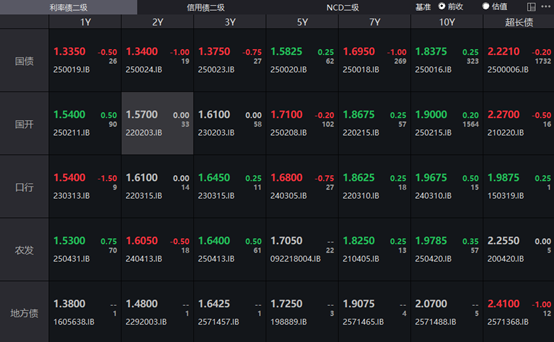
Group 1 - Short-term bond rates continue to rise, while long-term bond rates fluctuate narrowly, indicating a mixed market sentiment [1][4] - As of 16:30, the yield on the 10-year government bond increased by 0.25 basis points to 1.8375%, while the 30-year government bond yield decreased by 0.2 basis points to 2.221% [1][2] - The People's Bank of China conducted a 260 billion yuan reverse repurchase operation at a fixed rate of 1.40%, with the same amount of bids and successful bids [4][5] Group 2 - The trading market for non-financial credit bonds saw significant movements, with the top five gainers including 22 Vanke 04, which rose by 18.46% [3] - The yield to maturity (YTM) for the top gainer, 22 Vanke 04, is reported at 55.4134%, with a decrease of 850.35 basis points [3] - The market is experiencing a mixed sentiment with expectations of moderate monetary policy adjustments, limiting significant declines in interest rates [4][5]

中加基金权益周报|债市情绪偏弱,长债对利空敏感性提高
Xin Lang Cai Jing· 2025-12-12 08:02
Market Overview and Analysis - The issuance scale of government bonds, local government bonds, and policy financial bonds in the primary market last week was 223 billion, 108.7 billion, and 99 billion respectively, with net financing amounts of -33.8 billion, 60.5 billion, and -106.5 billion [1] - Financial bonds (excluding policy financial bonds) totaled an issuance scale of 134.6 billion, with a net financing amount of 71.4 billion. Non-financial credit bonds had an issuance scale of 220.7 billion, with a net financing amount of 61 billion [1] - Two new convertible bonds were issued, with an expected financing scale of 270 million [1] Secondary Market Review - Long-term bonds continue to face pressure, leading to another adjustment in the bond market. Key influencing factors include the central bank's November government bond trading volume, the Vanke incident, and the political bureau meeting [2] Liquidity Tracking - At the beginning of December, the funding environment is seasonally loose. The final R001 and R007 rates decreased by 5.3 basis points and 2.6 basis points respectively compared to the previous week [3] Policy and Fundamentals - He Lifeng held a video call with the U.S. Treasury Secretary and Trade Representative to promote stable and positive Sino-U.S. economic and trade relations. High-frequency data shows a mixed performance on the production side, weak demand in real estate exports, and a mixed price trend with most production material prices rebounding [4] Overseas Market - U.S. employment data showed mixed results, while expectations for interest rate hikes in Japan increased, leading to a decline in U.S. long-term bonds. The 10-year U.S. Treasury bond closed at 4.14%, up 12 basis points from the previous week [5] Equity Market - Last week, A-shares were positively influenced by the dovish stance of the Federal Reserve, with prices of silver, copper, and aluminum rising, resulting in a notable performance in the non-ferrous sector with a weekly increase of 5.35%. The average daily trading volume decreased to 1.70 trillion, down 40.745 billion from the previous week. As of December 4, 2025, the total financing balance across A-shares was 24,664.78 billion, an increase of 11.493 billion from November 27 [6] Bond Market Strategy Outlook - The bond market's oscillating pattern remains unbroken, but short-term pressure on long-term bonds continues. On one hand, the basic economic outlook for 2026 suggests marginal stabilization, but the upward slope is not steep. Before a clear recovery in fundamentals, the central bank's monetary policy is expected to remain accommodative, with a necessity for further cuts in reserve requirements and interest rates. The market's short-term expectations for monetary policy are relatively pessimistic [7] - On the other hand, the trend of deposit liquidity has increased the instability of banks' liabilities but has also effectively reduced their costs. After the disturbances from deposit disintermediation dissipate, the cost-effectiveness of banks in bond allocation is expected to rise again. Additionally, the central bank's resumption of government bond trading serves dual purposes of fiscal and monetary coordination and yield curve adjustment, indicating that bond yields still have an upper limit [7] - The traditional bond market configuration in mid to late December is still anticipated. The convertible bond index is experiencing high-level fluctuations, with recent movements in convertible bond funding being a major focus. The long-term logic of convertible bonds remains intact, with no reversal in supply-demand relationships and policy support for economic stability not fully dissipated [7]
中加基金权益周报︱利空消息扰动,长债表现承压
Xin Lang Cai Jing· 2025-12-04 09:11
Market Overview and Analysis - The issuance scale of government bonds, local government bonds, and policy financial bonds in the primary market last week was 252.2 billion, 351.4 billion, and 112.5 billion respectively, with net financing amounts of 39.1 billion, 325.9 billion, and 112.5 billion [1] - Financial bonds (excluding policy financial bonds) totaled an issuance scale of 195.7 billion with a net financing amount of 143.9 billion, while non-financial credit bonds had an issuance scale of 328.1 billion and a net financing amount of 113.5 billion [1] Secondary Market Review - The bond market showed weak performance due to concerns over bond fund redemptions and risks associated with real estate bonds, influenced by rumors of new redemption fees and the Vanke incident [2][9] Liquidity Tracking - The central bank's MLF operations released signals of support, maintaining a stable funding environment across the month, with R001 and R007 rates rising by 3.8 basis points and 2.7 basis points respectively compared to the previous week [3][11] Policy and Fundamentals - Industrial profits significantly declined in October, and the manufacturing PMI for November remained weak. High-frequency data indicates a divergence in production performance, with weak demand in real estate and exports but strong consumer spending related to travel. Prices for food and production materials have mostly rebounded [4][12] Overseas Market - Federal Reserve officials expressed dovish sentiments, and weak performance in the U.S. September PPI and sales data led to increased expectations for a rate cut in December FOMC. The 10-year U.S. Treasury yield closed at 4.02%, down 4 basis points from the previous week [5][13] Equity Market - A-shares rebounded significantly last week, influenced by gains in U.S. tech stocks, with leading increases in the communication, electronics, and non-ferrous sectors. The average daily trading volume decreased to 1.74 trillion, down 128.1 billion from the previous week, with market activity concentrated in communication and non-ferrous sectors [6][14] Bond Market Strategy Outlook - The bond market has shown weak performance since November, primarily due to the market's weak capacity to absorb long-term bonds. The duration of fiscal bond issuance has been increasing, and some banks' interest rate risk indicators are nearing regulatory limits. As year-end approaches, the ability of banks to absorb long-term bonds is further weakened, compounded by poor performance in insurance products. The bond market curve may continue to steepen, with cautious investor sentiment expected to persist [7][15]
风险资产强势,10年国债收益率上行0.4BP
Xin Lang Cai Jing· 2025-11-13 09:13
Market Overview - The Shanghai Composite Index closed at a new high, influenced by the strong performance of risk assets [1] - Bond market yields rose, with the 5-7 year government bond yields increasing significantly, and the 10-year yield up by 0.4 basis points [1] Bond Market Performance - Government bond futures closed lower across the board, with the 30-year main contract down by 0.26%, the 10-year down by 0.10%, the 5-year down by 0.08%, and the 2-year down by 0.01% [1] - As of 16:30, the yield on the 10-year government bond was reported at 1.805%, up by 0.4 basis points, while the 10-year policy bank bond yield was at 1.8765%, also up by 0.4 basis points [1] Auction Results - The weighted average rates for recent bond auctions were as follows: 1-year government bond at 1.4847%, 5-year at 1.7201%, and 10-year at 1.8921% [3] - The bid-to-cover ratios for these auctions were 2.86 for the 1-year bond, 2.82 for the 5-year bond, and 4.03 for the 10-year bond, indicating strong demand [3] Credit Bond Market - The top five gainers in the non-financial credit bond market included H0中骏02, 23万科01, and 23产融06, with respective price increases of 4.29% and 3.25% [4] - Conversely, the top five losers included 24金隅K1 and 22万科04, with declines of 5.77% and 4.99% respectively [4] Monetary Policy and Liquidity - The central bank conducted a 190 billion yuan reverse repo operation at a fixed rate of 1.40%, resulting in a net injection of 972 billion yuan for the day [5] - Overnight SHIBOR fell to 1.3150%, down by 10 basis points, while the 7-day SHIBOR remained unchanged at 1.4740% [5] Interbank Rates - Most interbank repo rates declined, with FR001 down by 8 basis points to 1.4% and FR007 down by 1 basis point to 1.5% [5] - The rates for various tenors showed a general downward trend, indicating easing liquidity conditions in the market [5]

中加基金权益周报︱国债买卖重启落地,债市走强
Xin Lang Ji Jin· 2025-11-06 07:46
Market Overview and Analysis - The primary market saw the issuance of government bonds, local government bonds, and policy financial bonds amounting to 0 billion, 270.7 billion, and 142 billion respectively, with net financing of 0 billion, 178 billion, and 142 billion [1] - Financial bonds (excluding policy financial bonds) totaled an issuance of 92.1 billion with a net financing of 24.7 billion, while non-financial credit bonds had an issuance of 218.7 billion and a net financing of 3.6 billion [1] Secondary Market Review - The central bank announced the resumption of government bond trading operations, leading to a decline in bond market yields, influenced by signals of monetary easing and weak economic data [2] Liquidity Tracking - As the month-end approaches, the funding environment remains stable, with R001 and R007 rates rising by 2.7 basis points each compared to the previous week [3] Policy and Fundamentals - The October manufacturing PMI indicates significant downward pressure on traditional industries, with high-frequency data showing stable production at month-end, continued weakness in real estate consumption, and a mixed price performance [4] Overseas Market - The trade sentiment between China and the U.S. has improved, while Federal Reserve Chairman Powell has adopted a hawkish stance. The 10-year U.S. Treasury yield closed at 4.11%, up 9 basis points from the previous week [5] Equity Market - A-shares experienced a pullback after initially rising due to positive developments in U.S.-China negotiations and overcrowding in the tech sector. The Wind All A index fell by 0.52%, with power equipment and non-ferrous metals leading gains, while communications lagged [6] - The average daily trading volume increased significantly to 2.33 trillion, with a weekly average decrease of 528.02 billion. As of October 30, 2025, the total financing balance for all A-shares was 24,811.49 billion, an increase of 47.25 billion from October 23 [6] Bond Market Strategy Outlook - The resumption of government bond trading is expected to lead to a recovery period in the bond market, but caution is advised against chasing high prices. The central bank's focus on medium to short-term bonds is more certain, while long-term bonds may not perform as strongly in the short term [7] - In the credit bond sector, increased liquidity suggests a potential for higher allocation in flexible medium-duration investment-grade bonds and secondary capital bonds to capture capital gain opportunities [7] - For convertible bonds, the market has shown volatility influenced by U.S.-China tensions and domestic policy expectations, making it challenging to navigate. A risk-reward framework is recommended, focusing on dividend and value convertible bonds when the index approaches the upper range and on high-growth technology and export sectors when nearing the lower range [7]