Jing Ji Ri Bao

Search documents
吸引更多境外投资者参与我国债券市场
Jing Ji Ri Bao· 2026-01-03 22:00
登录新浪财经APP 搜索【信披】查看更多考评等级 在大公国际首席宏观分析师刘祥东看来,熊猫债市场扩容提质离不开制度型开放的持续深化,以及便利 度的明显提升。近年来,资金跨境使用、会计审计与信息披露等规则与国际接轨,便利化举措持续落 地。此外,产品谱系更丰富,绿色、可持续挂钩等创新品种增多,期限结构趋于中长期化,市场功能由 融资通道向高质量投融资平台演进。 "首个系列指数的发布具有里程碑式的意义,将显著提升市场透明度和流动性,为熊猫债市场发展注入 新动能。"上海金融与发展实验室主任曾刚认为,从市场影响来看,该系列指数将为熊猫债市场参与者 提供权威基准和跟踪标的,有助于吸引更多境外投资者参与我国债券市场。更重要的是,该系列指数的 推出对推进人民币国际化、扩大高水平对外开放具有积极意义,将进一步推动熊猫债市场扩容提质和规 范发展。 中国工商银行与中央国债登记结算有限责任公司近日联合发布"中债—工行熊猫债系列指数",这是国内 首个反映熊猫债市场情况的债券系列指数。其中,"中债—工行熊猫债AAA指数"旨在反映熊猫债市场 整体走势,指数成分券覆盖市场80%发行人和全部发行人类型;"中债—工行熊猫债30指数"旨在反映代 表 ...

加大消费重点领域金融支持
Jing Ji Ri Bao· 2026-01-03 22:00
Core Viewpoint - The joint notice issued by the Ministry of Commerce, the People's Bank of China, and the Financial Regulatory Administration aims to enhance financial support for key consumption areas to stimulate domestic demand and consumption [2] Group 1: Support for Consumption - Various departments have implemented targeted measures to boost consumption, integrating financial services with consumer needs through a comprehensive approach involving credit, payment, and derivative services [3] - The notice emphasizes collaboration between financial institutions and key merchants to enhance payment options like installment payments and digital currencies, addressing consumer demand for upgrading products [3] - Consumer finance is recognized as a crucial financial force in stimulating consumption, with its growth providing stable funding for industrial upgrades and encouraging consumers to choose high-quality products [3] Group 2: Innovation in Consumption Scenarios - The notice suggests developing specialized loan products to enhance rural e-commerce and improve payment convenience for inbound consumption [5] - Financial institutions are encouraged to create diverse financial products that cater to new consumption patterns, including green and digital consumption, and to support innovative consumption models [6] - The collaboration with Shanghai Lego Land to promote digital RMB usage exemplifies efforts to create convenient payment environments and enhance consumer experiences [5][6] Group 3: Strengthening Supply and Demand Connection - Financial institutions are urged to optimize their product offerings to better align with consumer needs and support new consumption scenarios [7] - The transition from standardized to personalized financial products is necessary to meet diverse consumer demands, with a focus on tailored solutions for specific consumption scenarios [7] - A collaborative approach among business, finance, and industrial policies is essential to foster a healthy consumer finance market, reducing financing costs and encouraging consumer spending [7]


安徽马鞍山绿色发展动能强劲
Jing Ji Ri Bao· 2026-01-03 22:00
Group 1 - The core viewpoint of the articles highlights Ma'anshan's commitment to ecological priority and green development, leading to significant improvements in environmental indicators and the production and living environment [1][2] - Ma'anshan has transitioned from "manufacturing along the river" to "intelligent manufacturing along the river," achieving a cumulative elimination of 4.99 million tons of outdated steel production capacity over the past decade [1] - The city has established a green manufacturing system, with 23 national-level green factories and 3 national-level green parks, where the output value of green factories accounts for over 40% of the total industrial output value [1] Group 2 - A total of 1,432 industrial enterprises above designated size have undergone digital transformation, achieving a transformation rate of 86.4%, with the CNC rate of key processes reaching 74.9% [1] - The implementation of smart sensing devices and 5G technology has led to a 90% reduction in dust emissions at the Ma Steel special steel plant compared to before the transformation [1] - Ma'anshan is advancing the "waste-free city" initiative, utilizing various technological means for pollution source detection and management, with PM2.5 average concentration meeting national secondary standards for four consecutive years [2]

奏响中国制造转型升级时代强音
Jing Ji Ri Bao· 2026-01-03 21:53
Group 1: Core Insights - The article highlights significant advancements in China's manufacturing sector, showcasing achievements such as the CR450 train setting a speed record and the successful launch of the reusable Zhuque-3 rocket, emphasizing the global impact of Chinese manufacturing by 2025 [1] - The "14th Five-Year Plan" is set to begin in 2026, focusing on integrating technological and industrial innovation to foster emerging pillar industries and promote the "AI + manufacturing" initiative [1][2] Group 2: Manufacturing Industry Development - The manufacturing industry is deemed the foundation of the national economy, with a focus on high-quality development of key industrial chains and breakthroughs in significant technologies and products by 2025 [2] - The "14th Five-Year Plan" suggests accelerating the construction of a manufacturing powerhouse, maintaining a reasonable proportion of manufacturing, and building a modern industrial system centered on advanced manufacturing [2][3] Group 3: Advanced Manufacturing - Advanced manufacturing is characterized by the deep integration of technological advancement, innovative models, and high value, shifting from scale expansion to quality enhancement and from factor-driven to innovation-driven growth [2][3] - A three-in-one ecosystem of "technological innovation - industrial ecology - institutional support" is essential for developing advanced manufacturing, focusing on foundational and original innovations, cluster cultivation, and supportive policies [3] Group 4: Traditional Industry Optimization - The application of new-generation information technology in traditional industries has significantly improved their intelligence levels, with ongoing green transformation in sectors like steel and petrochemicals [4] - The focus for 2026 includes optimizing traditional industries through equipment updates, process upgrades, and management innovations, targeting high-end, intelligent, green, integrated, and clustered development [4] Group 5: Digital Transformation - By 2025, the digital transformation of China's manufacturing sector is progressing, with over 7,000 advanced and 500 excellent smart factories established, and more than 20,000 industrial 5G networks deployed [6] - The industrial internet is crucial for digital transformation, linking production equipment with resource elements, enhancing service capabilities, and achieving comprehensive coverage across various industrial categories [6][7] Group 6: Future Directions - The digital transformation is still in its early stages, focusing on single-point applications and independent data storage, with the ultimate goal of innovating industrial models and transforming organizational structures [7] - Future efforts will involve building an open innovation ecosystem, collaborating with educational and research institutions, and establishing a robust industrial internet platform to support manufacturing enterprises in their digital transition [7]
广东虚拟电厂参与电力现货市场交易
Jing Ji Ri Bao· 2026-01-03 21:52
Core Insights - The first batch of power generation virtual power plants in Guangdong, with a total capacity of approximately 33 million kilowatts, officially participated in the electricity spot market trading using a "quantity and price reporting" method, marking a significant step in integrating distributed renewable energy resources into the market [1][2] Group 1: Market Participation - The participation of virtual power plants signifies that distributed renewable energy resources are no longer passive entities but active market players responding to price signals [1] - The total capacity of renewable energy directly entering the market exceeds 33 million kilowatts, accounting for about 40% of the total installed capacity of wind and solar power in the province [1] Group 2: Technological and Regulatory Framework - The Guangdong power grid has implemented a digital management system for the entire trading process of virtual power plants, ensuring a smooth entry into the market [3] - A series of supportive regulations were established in June 2025 to facilitate virtual power plants' participation in market trading, creating a conducive environment for decentralized resource aggregation [2][3] Group 3: Ecosystem Development - Local governments in Guangdong are actively building virtual power plant ecosystems, with initiatives such as financial support for market development and demonstration projects for smart low-carbon public institutions [3][4] - The collaboration between various stakeholders, including energy service providers and local governments, is accelerating the formation of a comprehensive virtual power plant industry value chain in Guangdong [4]
托育服务法草案公开征求意见——推动托育服务“从有到优”
Jing Ji Ri Bao· 2026-01-03 02:18
Core Viewpoint - The introduction of the Childcare Services Law aims to alleviate parental anxiety regarding childcare and enhance the legal framework supporting childcare services in China, addressing existing challenges in the sector [1][2]. Group 1: Legislative Framework - The draft of the Childcare Services Law consists of 8 chapters and 76 articles, covering various aspects such as childcare institutions, personnel, service provision, and legal responsibilities [1]. - The law is intended to provide a solid legal guarantee for the development of childcare services for children under three years old, which is crucial for improving birth support policies and reducing family rearing costs [2]. Group 2: Demand and Supply Issues - A significant portion of families with infants express a strong need for childcare services, with one-third indicating this demand, highlighting the lack of care for children under three as a major factor limiting birth rates [3]. - The draft law emphasizes the need for government-led initiatives to address the mismatch between supply and demand in childcare services, advocating for increased fiscal support and community involvement [2][4]. Group 3: Multi-Supply Promotion - The draft law encourages diverse supply sources for childcare services, including public and private partnerships, and supports the integration of childcare services into urban communities [4]. - Recommendations include incorporating childcare service funding into government budgets and providing various subsidies to lower operational costs, ensuring affordability for families [4]. Group 4: Regulatory Framework - The draft law aims to enhance the quality of childcare services by establishing standards and a comprehensive regulatory framework, including the creation of a statistical survey system for childcare services [5][6]. - It emphasizes the protection of children's rights and the establishment of a multi-tiered oversight system involving government, social, and institutional self-regulation [6].
医保商保“双目录”大力支持创新 好药新药加速惠及百姓
Jing Ji Ri Bao· 2026-01-03 02:05
Core Insights - The new National Basic Medical Insurance, Maternity Insurance, and Work Injury Insurance Drug Catalog (2025) and the first Commercial Health Insurance Innovative Drug Catalog (2025) will be implemented nationwide starting January 1, 2026, adding 114 new drugs to the basic insurance catalog and 19 to the commercial insurance catalog [1][2]. Group 1: Drug Catalog Adjustments - The updated basic medical insurance catalog includes 114 new drugs, with significant representation from oncology (36 drugs), chronic diseases (12 drugs), anti-infectives (13 drugs), and rare diseases (10 drugs) [2]. - The total number of drugs in the national medical insurance catalog has increased to 3,253, comprising 1,857 Western medicines and 1,396 traditional Chinese medicines [2]. - The adjustment aims to address clinical treatment gaps and enhance drug accessibility for patients, particularly for previously hard-to-treat conditions like triple-negative breast cancer and pancreatic cancer [2][4]. Group 2: Policy Implementation - A combination of policies will ensure that newly added drugs are available in hospitals by February 2026, including the establishment of temporary green channels for procurement [3]. - Negotiated drugs will not be subject to administrative restrictions such as "one product, two regulations" or overall medical insurance caps, allowing for more flexible access [3]. Group 3: Support for Innovation - Among the new drugs, 50 are classified as first-class innovative drugs, with an overall success rate of 88%, up from 76% in 2024, indicating a shift towards strategic purchasing and value-based reimbursement [4]. - The inclusion of both domestic and foreign innovative products in the catalog reflects a commitment to enhancing drug accessibility and supporting pharmaceutical innovation [4]. Group 4: Commercial Health Insurance - The newly established commercial health insurance innovative drug catalog includes 19 drugs, focusing on high-innovation, clinically valuable treatments that complement the basic medical insurance offerings [7]. - The catalog features advanced therapies such as CAR-T cell treatments and drugs for rare diseases, which are expected to reduce patient financial burdens and enhance market attractiveness for pharmaceutical companies [7][8]. Group 5: Future Directions - The policy signals strong government support for independent innovation and aims to encourage pharmaceutical companies to invest more in original and differentiated research and development [8]. - The National Medical Insurance Administration plans to refine policies and strengthen management to ensure the effective implementation of the drug catalogs, enhancing public access to necessary medications [8].
比亚迪,超越特斯拉!世界第一
Jing Ji Ri Bao· 2026-01-03 01:55
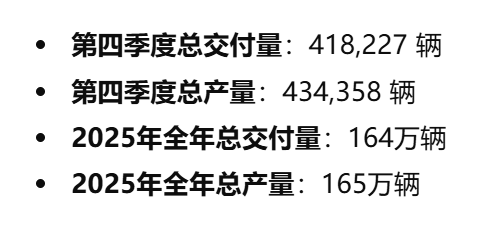
Group 1 - BYD is projected to surpass Tesla in pure electric vehicle sales by 2025, with an expected sales volume of 2.25 million units, representing a 28% year-on-year increase [1] - Tesla's total deliveries for the year were 1.64 million units, showing an 8.6% decline compared to the previous year [1][2] - In Q4, Tesla's delivery numbers fell to 418,227 units, a 16% decrease year-on-year, which was below analyst expectations and the company's own targets [2][4] Group 2 - BYD's overall new vehicle sales for 2025 are estimated at 4.6 million units, an approximate 8% increase, with 2.25 million being pure electric vehicles and 2.28 million being plug-in hybrid vehicles [4] - In Europe, Tesla's new car registrations dropped by 39% in the first 11 months of 2025, while BYD's registrations surged by 240% [4] - The acceptance rate of pure electric vehicles in Europe is projected to reach 16% of all new car sales by 2025 [4]


老味新传
Jing Ji Ri Bao· 2026-01-03 01:07
Core Viewpoint - The article discusses how traditional brands, referred to as "old brands," are innovating their business models and customer experiences to attract younger consumers while preserving their cultural heritage and traditional flavors [1][9]. Group 1: Innovation in Traditional Brands - Traditional brands are creating engaging spaces that blend cultural experiences with modern interactive elements, as seen in Beijing Daoxiangcun's "Zero No. Treasure Museum" [1][2]. - The focus is on enhancing customer experiences through immersive environments that evoke nostalgia while introducing new cultural narratives [2][3]. - Brands are shifting from merely replicating traditional stores to creating unique, culturally rich experiences that resonate with contemporary consumer interests [2][7]. Group 2: Customer Engagement and Retention - The success of these innovations relies on creating memorable experiences that encourage repeat visits, moving beyond superficial attractions [3][4]. - Effective training and motivation for staff are crucial to ensure that customer interactions are meaningful and engaging, rather than just aesthetic [4][5]. - The integration of local culture and community interaction enhances the overall customer experience, making it more than just a transaction [4][5]. Group 3: Balancing Tradition and Modernity - Traditional brands face the challenge of maintaining their core flavors and techniques while adapting to modern consumer preferences and competitive pressures [6][7]. - The approach involves a commitment to preserving traditional recipes and methods while also innovating in presentation and cultural storytelling [7][8]. - Brands like Huo Gong Dian and Beijing Daoxiangcun exemplify this balance by combining classic culinary techniques with contemporary marketing strategies to appeal to a broader audience [7][8]. Group 4: Cultural Significance and Brand Identity - Old brands are positioned as guardians of cultural heritage, tasked with preserving and narrating historical flavors and stories for future generations [9]. - The ongoing innovation within these brands is essential for their survival and relevance in a rapidly changing market landscape [9].
经济日报聚焦:AI驱动前景如何?投资泡沫出现了吗?
Jing Ji Ri Bao· 2026-01-03 00:28
Group 1: AI Landscape in 2025 - The year 2025 marked significant advancements in AI, with DeepSeek emerging as a major player, positioning China as a key leader in the global AI landscape [1] - The commercialization of embodied intelligence applications, such as humanoid robots, opened new avenues for business [1] - The rapid iteration of AI large models has led to both excitement and anxiety regarding investment bubbles [1] Group 2: AI Adoption Challenges - Many companies struggle with AI adoption, with two-thirds of surveyed firms reporting they have not achieved scalable AI applications [2] - A significant number of companies believe AI applications have not yet made a notable impact on profits, indicating that most are still in the early stages of realizing AI's value [2] - The concept of "AI-native" has emerged, emphasizing a complete rethinking of business processes and models centered around AI [2] Group 3: Embodied Intelligence - Embodied intelligence gained traction in 2025, with competition among tech companies intensifying [4] - Predictions suggest a significant explosion in the market for embodied intelligence by 2026, with the humanoid robot market potentially reaching $5 trillion by 2050 [4] - Analysts caution that the gap between technological vision and market reality may pose challenges for the development of embodied intelligence [4] Group 4: Investment Bubble Concerns - The AI sector has sparked debates about potential investment bubbles, with optimists viewing current investments as foundational for future growth, while pessimists warn of overheating [7] - By the third quarter of 2025, concerns about overvaluation in the AI market became pronounced, with significant stock price fluctuations among AI-related companies [7] - The World Economic Forum highlighted that while $500 billion was invested in AI in 2025, tangible returns have yet to materialize [7] Group 5: Safety and Ethical Concerns - Experts predict the imminent arrival of a superintelligent era, raising concerns about the boundaries of AI capabilities [9] - Current AI models exhibit limitations in complex task handling, leading to discussions about the fundamental flaws in existing technologies [9] - A call for a pause in the development of superintelligent systems was made by over 800 experts, emphasizing the need for a consensus on safe and controllable AI development [10]