
Hua Er Jie Jian Wen

Search documents
涉及46国!雀巢宣布全球大范围召回婴儿奶粉,或面临12亿瑞郎销售损失
Hua Er Jie Jian Wen· 2026-01-08 13:32
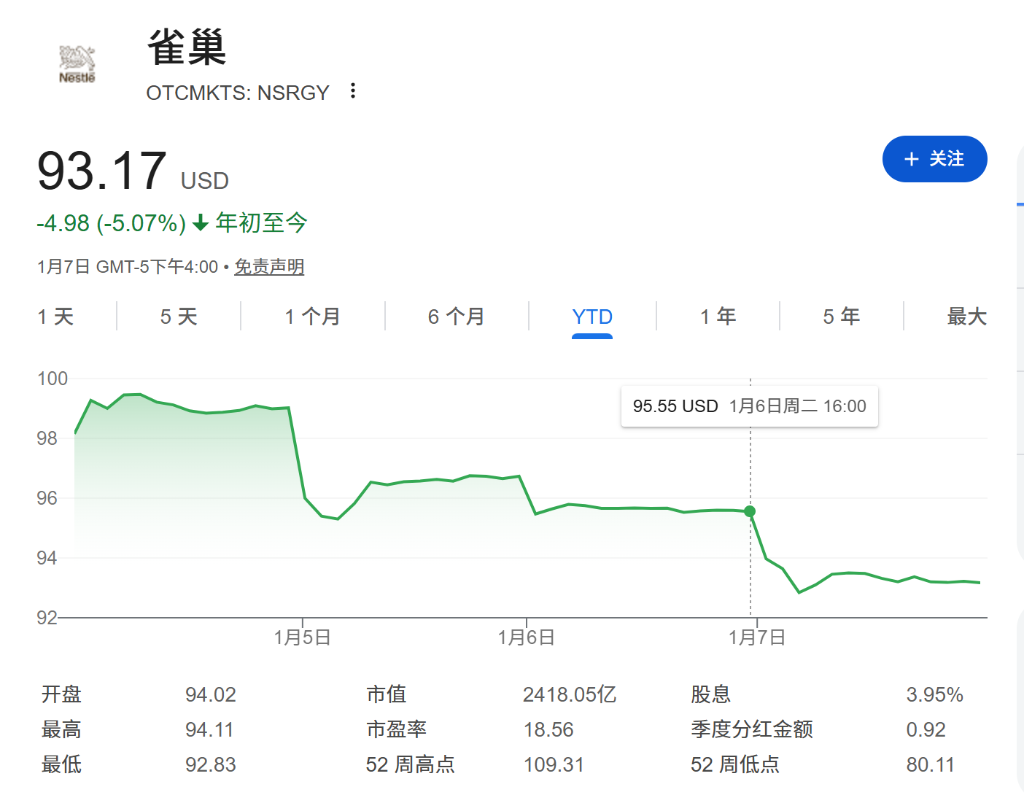
Core Insights - Nestlé is facing a significant trust crisis and financial challenge due to a large-scale recall of infant formula products across 46 countries, potentially leading to sales losses of up to 1.2 billion Swiss francs (approximately 1.35 billion USD) [1][2] - The recall was initiated due to concerns over possible contamination by Bacillus cereus toxins, which can cause nausea and vomiting, and has rapidly expanded from Europe to Asia, Latin America, the Middle East, and Africa [1] - The company's new CEO, Philipp Navratil, is under pressure to restore investor confidence and manage operational issues, with this recall exacerbating concerns about the company's internal controls and execution capabilities [5][6] Financial Impact - Analysts estimate that the recall could impact approximately 1.3% of Nestlé's group sales, with risk exposure reaching up to 1.2 billion Swiss francs [2] - Barclays analyst Warren Ackerman predicts total risk could account for 0.8% to 1.5% of group sales, while Nestlé claims the recalled products represent "far less than 0.5%" of annual sales [2] Brand Reputation - Market analysts express greater concern over the long-term damage to Nestlé's brand reputation than the immediate financial impact, highlighting disappointment in the company's execution and communication abilities [6] - Previous compliance and operational issues have already put pressure on Nestlé's reputation, including investigations by French authorities and recalls in the U.S. due to contamination concerns [6] Contamination Source - The contamination was traced back to a quality issue with arachidonic acid oil, affecting well-known brands such as NAN, BEBA, Guigoz, SMA, and Alfamino [7] Market Recovery Outlook - Analysts predict varying consumer responses in different countries, with potential risks highlighted in the Chinese market, referencing a past incident involving Danone that resulted in significant sales losses [8] - In contrast, the U.S. market has shown stronger recovery capabilities, as evidenced by Abbott's quick rebound after a similar recall [8]


欧元区失业率七个月来首度下滑,11月意外降至6.3%
Hua Er Jie Jian Wen· 2026-01-08 13:32
Group 1 - The Eurozone labor market shows strong resilience, with the unemployment rate unexpectedly declining from 6.4% in October to 6.3% in November, marking the first decrease in seven months [1][2] - The number of unemployed individuals in the Eurozone decreased by 71,000 from October to November, indicating sustained demand for labor despite economic uncertainties [2] - Analysts express cautious optimism regarding the employment outlook for the coming year, with expectations that the unemployment rate will not experience significant fluctuations through 2026 [1][3] Group 2 - Private sector employment prospects have shown slight improvement, as indicated by the Eurozone Purchasing Managers' Index, which reported an increase in employment numbers in December [3] - There is a disparity in performance among core economies, with Germany showing signs of labor market weakness despite a stable unemployment rate, suggesting regional differences in economic recovery [4] - The overall positive employment data contrasts with the long-term trend, as the total number of unemployed in the Eurozone has increased by approximately 416,000 compared to November 2024 [2]
美国1月3日当周首次申请失业救济人数 20.8万人,预期 21.2万人,前值 19.9万人
Hua Er Jie Jian Wen· 2026-01-08 13:32
风险提示及免责条款 美国1月3日当周首次申请失业救济人数 20.8万人,预期 21.2万人,前值 19.9万人。 市场有风险,投资需谨慎。本文不构成个人投资建议,也未考虑到个别用户特殊的投资目标、财务状况或需要。用户应考虑本文中的任何 意见、观点或结论是否符合其特定状况。据此投资,责任自负。 ...
德国走上“去工业化”不归路:资本外流、绿色政策重创制造业
Hua Er Jie Jian Wen· 2026-01-08 13:16
尽管商界领袖呼吁改革,但并未触及绿色转型政策这一核心问题,这使得工业衰退的风险在2026年进一 步加剧。 据德国工商总会(DIHK)针对2.3万家会员企业的最新调查显示,德国经济危机已延续至2026年,仅有六 分之一的企业预计经济会出现好转,而四分之一的企业正计划进一步裁员。DIHK的数据指出,自2019 年以来,德国工业部门已流失约40万个就业岗位。DIHK主席Helena Melnikov警告称,如果政策制定者 不能采取果断行动,德国面临价值创造和就业机会进一步大规模流失的风险,形势已十分严峻。 这种衰退正在对德国经济结构造成连锁反应,从工业相关服务业到区域贸易,甚至公共财政均受波及。 斯图加特、埃尔朗根和沃尔夫斯堡等传统工业中心的市政财政正面临赤字挑战,营业税收入显著萎缩。 与此同时,资本外流趋势并未减缓,虽然2025年的具体流出规模尚不完全明朗,但2024年的净直接投资 流出额为645亿欧元,2023年更是超过1000亿欧元。 市场的深层担忧在于,持续的经济衰退和明显的去工业化迹象表明,德国经济可能已经跨过了一个关键 的"临界点"。投资者和企业正在逃离高昂的监管成本和财政负担,而政府通过大量举债和补贴 ...
摩根大通美光调研:新厂提前投产也只能满足一半需求,上下文窗口存储成NAND新增长点
Hua Er Jie Jian Wen· 2026-01-08 13:07
美光科技高管在最新投资者会议上发出明确信号:即便新建晶圆厂在2027年投产,DRAM和HBM的供 需紧张状况仍难以解决。 据追风交易台,美光首席财务官Mark Murphy、首席商务官Sumit Sadana在摩根大通最近组织的投资者 会议上重申,公司目前仅能满足关键客户中期需求的50%至三分之二。即使爱达荷州新建的Idaho 1晶 圆厂将于2027年中期提前一个季度量产,但产能爬坡将是渐进式的,而需求仍在持续攀升。 这一供需失衡格局将为存储器价格提供持续支撑。据摩根大通预测,2026年DRAM平均价格将同比上 涨近60%。 美光管理层表示,竞争对手的新建产能要到2027年底和2028年才能陆续投产,且同样面临产能爬坡的物 理限制。摩根大通认为供应紧张将延续至2026年之后,支撑价格进一步走强。 供应缺口难以弥合,新产能爬坡缓慢 美光管理层在会议上透露,公司已将Idaho 1晶圆厂的首片晶圆产出时间提前约一个季度至2027年中 期。但管理层强调,这座新建晶圆厂的产能爬坡将是渐进式的,并非受资本限制,而是受物理条件制 约。 竞争对手的新建产能同样面临类似挑战。摩根大通指出,其他厂商的新建晶圆厂要到2027年底和 ...

AI投资引燃融资热潮,全球可转债发行规模创24年新高
Hua Er Jie Jian Wen· 2026-01-08 13:06
Core Insights - The artificial intelligence (AI) boom is rapidly reshaping the global financing market, leading companies to raise significant funds through convertible bonds, with global issuance expected to reach approximately $166.5 billion by 2025, marking a 24-year high since 2001 and nearing historical records [1] - The surge in financing is driven by substantial investments in AI infrastructure and related technologies, with companies like Alibaba, Lumentum Holdings, and Super Micro utilizing convertible bonds to fund their AI-related bets [1] - Convertible bonds, which combine features of debt and equity, are projected to outperform large-cap stocks and traditional bonds in 2025 after years of low returns [1] Group 1: AI-Driven Financing - AI-related companies are becoming increasingly dominant in the convertible bond market, contributing significantly to issuance volumes and investment returns, with approximately 40% of last year's benchmark convertible bond index returns driven by AI-related firms [3] - Companies such as Lumentum, Super Micro, and CoreWeave have raised billions through convertible bonds, while even cryptocurrency miners like Bitfarms Ltd. are turning to this financing method to support their transition to AI and high-performance computing [3] Group 2: Refinancing Demand and Mature Companies - The pressure from maturing debt is another key factor driving market recovery, with about a quarter of outstanding convertible bonds set to mature in the next two years, sustaining market activity [4] - In a high-interest rate environment, mature companies are reassessing the attractiveness of convertible bonds, which allow borrowing at lower interest costs despite potential equity dilution, as seen with European firms like Lufthansa and Ferrovial SE entering the market [4] Group 3: Rise and Resilience of the Asian Market - While North America remains the dominant player in the convertible bond market, the Asian market has played a crucial role in recent recovery, with Alibaba raising $3.2 billion and other insurance giants like Pacific and Ping An raising $2 billion and $1.5 billion respectively [5] - The Asian market is expected to provide more opportunities in 2026 as stock markets stabilize and interest rates level off, with convertible bonds becoming a mainstream financing tool in the region [5] - Despite concerns about the sustainability of AI spending, the convertible bond asset class has shown resilience against market volatility, with Bloomberg data indicating that the Bloomberg Global Convertible Bond Index's decline was less than that of the MSCI World Index during last year's market fluctuations [5]
美联储理事米兰:预计2026年将降息约150个基点
Hua Er Jie Jian Wen· 2026-01-08 13:06
美联储理事米兰:预计2026年将降息约150个基点。 风险提示及免责条款 市场有风险,投资需谨慎。本文不构成个人投资建议,也未考虑到个别用户特殊的投资目标、财务状况或需要。用户应考虑本文中的任何 意见、观点或结论是否符合其特定状况。据此投资,责任自负。 ...
万科官宣:郁亮辞职,因到龄退休!
Hua Er Jie Jian Wen· 2026-01-08 12:33
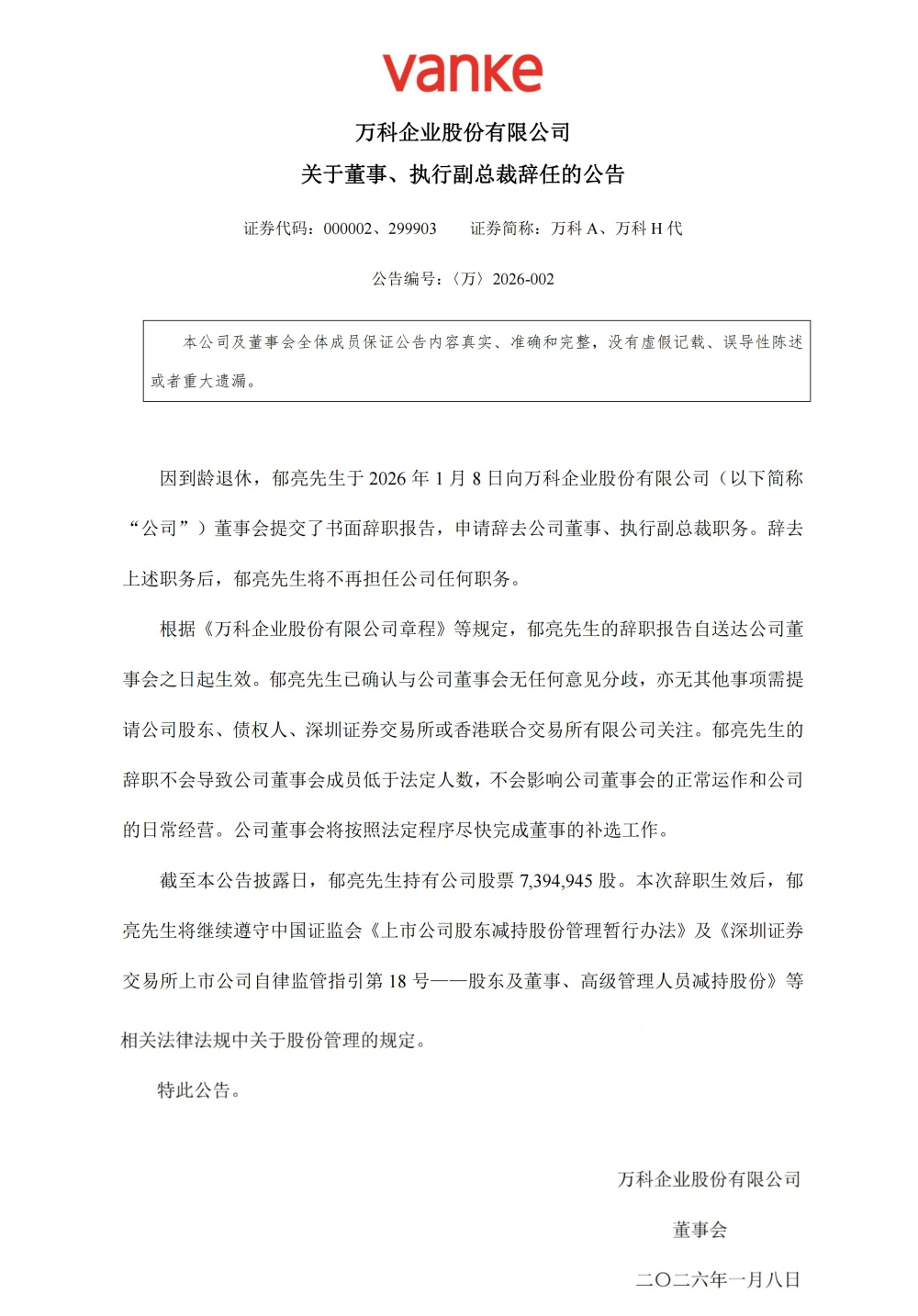
本公司及董事会全体成员保证公告内容真实、准确和完整,没有虚假记载、误导性陈述 或者重大遗漏。 因到龄退休,郁亮先生于2026年1月8日向万科企业股份有限公司(以下简称 "公司")董事会提交了书面辞职报告,申请辞去公司董事、执行副总裁职务。辞去 上述职务后,郁亮先生将不再担任公司任何职务。 根据《万科企业股份有限公司章程》等规定,郁亮先生的辞职报告自送达公司董 事会之日起生效。郁亮先生已确认与公司董事会无任何意见分歧,亦无其他事项需提 请公司股东、债权人、深圳证券交易所或香港联合交易所有限公司关注。郁亮先生的 辞职不会导致公司董事会成员低于法定人数,不会影响公司董事会的正常运作和公司 的日常经营。公司董事会将按照法定程序尽快完成董事的补选工作。 万科1月8日公告,执行副总裁郁亮因到龄退休向董事会提交书面辞职报告,申请辞去公司董事及执行副总裁职务。辞职后,这位在万科工作36 年、曾执掌公司长达17年的职业经理人将不再担任公司任何职务。 根据公司公告,郁亮的辞职报告自送达董事会之日起生效。郁亮已确认与公司董事会无任何意见分歧,亦无其他事项需提请股东、债权人及交易 所关注。 vanke 万科企业股份有限公司 关于董事 ...

2026年IPO“超级大年”将至:2.9万亿美元独角兽蓄势待发,OpenAI、SpaceX领衔
Hua Er Jie Jian Wen· 2026-01-08 12:26
Group 1 - The US IPO market is on the verge of recovery, with an estimated $2.9 trillion worth of private companies expected to enter the public market by 2026, marking a significant turning point for capital markets [1] - The anticipated IPO wave includes notable tech giants like SpaceX, OpenAI, and Anthropic, as well as many lesser-known tech companies, driven by pent-up demand and expectations of a market rebound in 2026 [1][2] - The private equity (PE) industry may face "survival risks" as portfolio companies go public, testing the promised returns against real market prices, which could lead to a historic contraction in the industry [1][3] Group 2 - The recent downturn in the IPO market is attributed more to cyclical factors rather than structural issues, with high interest rates suppressing valuations and listing intentions [2] - Despite the likelihood of a high long-term interest rate environment, short-term rates are expected to decline, creating conditions for the return of IPO activities due to accumulated listing demand [2] - The private equity market, currently exceeding $16 trillion, has seen significant growth but faces pressure to return cash to investors, necessitating accelerated exits as companies go public [3] Group 3 - The long-term trend of declining IPO numbers since the early 2000s may be reversing, although returning to 1980s levels of IPO activity remains unlikely, indicating that public markets are still a vital financing channel for high-growth companies [4] - The upcoming IPO wave will primarily feature smaller companies, with concerns that heavily indebted marginal firms may struggle in the current investment environment [5] - The market's cautious sentiment towards the viability of AI-driven business models will be tested, as the IPOs will reveal investor enthusiasm and willingness to pay premiums for emerging technologies [5]
1000家企业“围攻”白宫:要求退还千亿美元关税,最高法院本周或定生死
Hua Er Jie Jian Wen· 2026-01-08 12:19
Core Viewpoint - A significant legal battle is unfolding in Washington as over 1,000 companies have filed lawsuits against President Trump's controversial tariff policy, seeking refunds for substantial taxes paid in recent months [1][2]. Group 1: Legal Developments - The wave of lawsuits began after the Supreme Court expressed skepticism about Trump's trade policies during a hearing on November 5, leading many companies to join the legal fight [1][3]. - As of January 6, at least 914 lawsuits have been filed, with most submitted after the November hearing, indicating a surge in legal actions from companies previously hesitant to act [3]. - The Supreme Court's upcoming decision will not only impact billions of dollars in cash flow for thousands of importers but will also define the legal boundaries of U.S. trade policy [2]. Group 2: Industry Participation - The coalition of companies opposing Trump's tariff policy spans a wide range of industries, including major retail and manufacturing firms such as Costco, EssilorLuxottica, and Goodyear [3][4]. - Analysis of 327 plaintiff companies shows participation from various sectors, including sports brands, beauty giants, and food companies, highlighting the extensive impact of the tariffs on global supply chains [4]. - Approximately 25% of the companies involved have foreign parent companies, underscoring the global implications of the Supreme Court's ruling [4]. Group 3: Refund Process and Legal Implications - The core issue of the legal battle revolves around whether Trump overstepped his authority under the International Emergency Economic Powers Act (IEEPA) to impose global tariffs [5]. - If the Supreme Court upholds lower court rulings declaring the tariffs illegal, the U.S. International Trade Court will likely handle the refund process [5][6]. - The government has assured the trade court that it will not use customs procedures to obstruct the recalculation of tariffs and payment of refunds [6]. Group 4: Financial Impact on Companies - For many companies, litigation is not just a legal strategy but a necessity for survival, as seen in the case of Ibis Cycles, which paid $800,000 in tariffs [7]. - The financial burden of tariffs has forced some businesses, like B. Stuyvesant Champagne LLC, to raise prices and reduce hiring due to unexpected costs [7]. - Historical precedents indicate that large-scale refunds are possible, as demonstrated by a 1998 Supreme Court ruling that led to a refund process involving $750 million [7].