Zhong Guo Qi Che Bao Wang

Search documents
中国汽车流通协会:预计乘用车2025年终端销量2355万辆,与2024年持平
Zhong Guo Qi Che Bao Wang· 2026-01-07 02:37
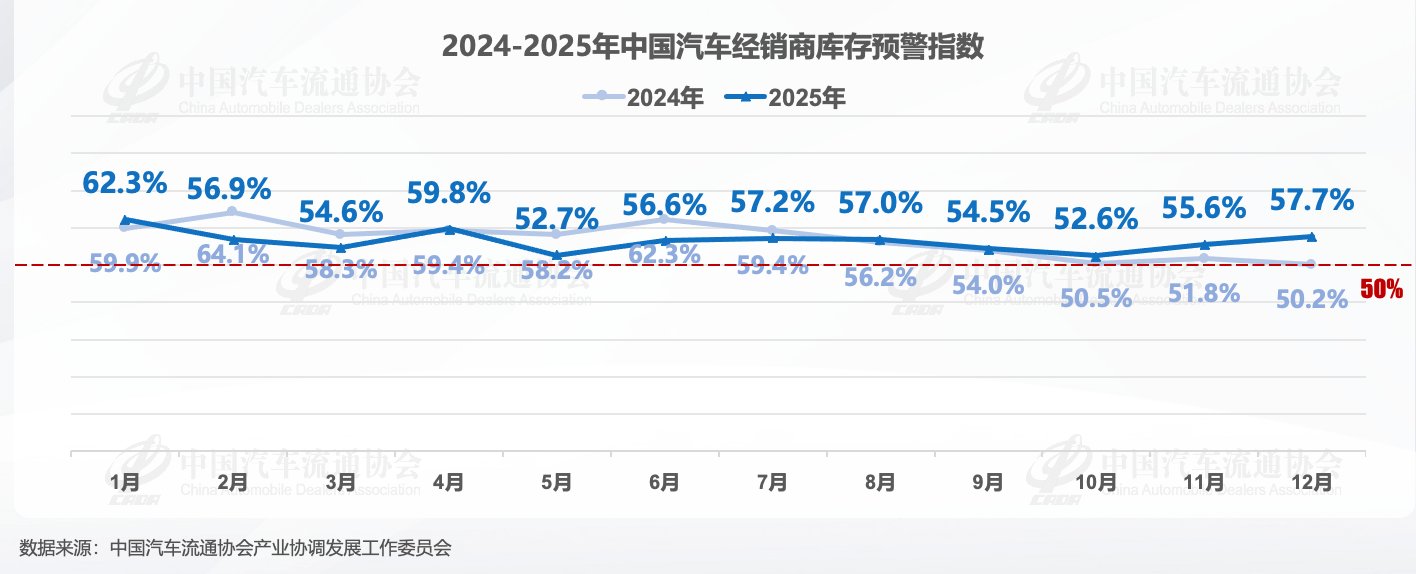
Core Viewpoint - The automotive circulation industry in China is experiencing a decline in market sentiment, as indicated by an increase in the inventory warning index and a lack of year-end sales momentum [1][3]. Inventory and Sales Data - As of December 2025, the inventory warning index for automotive dealers is at 57.7%, which is a year-on-year increase of 7.5 percentage points and a month-on-month increase of 2.1 percentage points [1]. - The predicted retail volume for passenger cars in December is approximately 2.2 million units, with an annual forecast of 23.55 million units for 2025, remaining stable compared to 2024 [3]. Market Demand and Dealer Sentiment - The inventory sub-index has significantly increased, while the market demand and personnel sub-indices have shown slight month-on-month increases. Conversely, average daily sales and operational status indices have decreased [5]. - In December, 41.7% of dealers reported a decline in transaction rates, while 32.6% indicated stability, and 25.7% noted an increase [7]. - A majority of dealers (53.5%) expect prices to decrease, while 43.8% believe prices will remain stable [7]. Regional and Brand Performance - The national index for December stands at 57.7%, with regional indices showing variations: North at 55.6%, East at 57.6%, West at 57.0%, and South at 61.2% [6]. - The index for luxury and joint venture brands has decreased, while the index for domestic brands has increased [6]. Future Outlook and Challenges - Dealers anticipate that market demand in January 2026 will remain stable, with 60.3% expecting no change, while 20.3% foresee a decrease [9]. - The automotive industry faces significant challenges, including reduced customer traffic, tightening consumer spending, and pressure from manufacturers to meet sales targets, leading to increased inventory and financial strain [11]. - The continuation of new policies in 2026 is expected to release pent-up demand, but dealers are cautious about sales targets, with 41.0% expecting a downward adjustment [12].

沐光前行 次第绽放
Zhong Guo Qi Che Bao Wang· 2026-01-07 02:28
Group 1 - The core viewpoint emphasizes that China's automotive industry is transitioning into a new phase characterized by innovation and resilience, maintaining its global leadership in the new energy and intelligent connected vehicle sectors [2][3] - The industry is experiencing a transformation that involves a return to fundamentals and a redefinition of its approach, focusing on wisdom and adaptability in the face of changing circumstances [3] - The introduction of L3-level autonomous driving vehicles and the implementation of stringent regulations on battery standards signify a shift towards a more regulated and responsible innovation environment in the automotive sector [4] Group 2 - The combination of rapid development and strong regulation is seen as a necessary approach for the evolution of China's automotive industry, ensuring that innovation does not compromise safety and standards [4] - A new consensus is emerging within the industry, promoting a balanced and orderly new order amidst global uncertainties, highlighting the importance of collaboration and shared growth [4] - The automotive sector is poised for significant breakthroughs, driven by a commitment to continuous improvement and a collective effort to navigate challenges and seize opportunities [2][4]

“Alpamayo”推理平台出炉!英伟达为何急于布局自动驾驶?
Zhong Guo Qi Che Bao Wang· 2026-01-07 01:54
Core Viewpoint - Nvidia has launched the Alpamayo series of open-source AI autonomous driving models, simulation tools, and datasets aimed at enhancing decision-making capabilities in complex driving scenarios, marking a significant innovation in the autonomous driving sector [2][3][5]. Group 1: Technology and Innovation - The Alpamayo platform represents a shift from traditional "perception-execution" models to a more human-like reasoning approach, integrating a 10 billion parameter model and over 1700 hours of real-world driving data [5]. - The platform enhances decision transparency and can generate driving trajectories based on video inputs, facilitating research and model development [3][4]. - The introduction of Alpamayo allows for a 40% improvement in the resolution of long-tail problems, significantly enhancing the safety and reliability of autonomous driving systems [5]. Group 2: Open Source Strategy - Nvidia's open-source strategy lowers the barriers to entry for automakers, allowing them to bypass 5-8 years of algorithm development and rapidly build Level 4 autonomous driving systems [6]. - Companies using the Alpamayo platform can reduce R&D costs by 65% and shorten development cycles to 18 months, reshaping the industry's technical entry barriers [6]. Group 3: Market Position and Competition - Nvidia's Drive Thor chip offers dynamic computing power distribution, supporting a range from Level 2+ to Level 4 autonomous driving needs, showcasing its robust hardware capabilities [7]. - The company has established a strong presence in the automotive sector, covering 70% of mainstream automakers globally, although its automotive business revenue share is not the highest yet [8]. - Competitors like Tesla and Mobileye are ramping up their market presence, prompting Nvidia to solidify its technological position in the face of increasing competition [8]. Group 4: Regulatory Challenges - Nvidia faces challenges in global expansion due to varying autonomous driving regulations across different regions, necessitating adjustments to its technology and products [9]. - The company must navigate safety, ethical, and regulatory requirements while advancing autonomous driving technology [9]. Group 5: Future Outlook - Nvidia's CEO predicts that most cars will achieve autonomous or highly autonomous driving within the next decade, indicating a transformative phase for the automotive industry [10]. - The launch of Alpamayo is seen as a redefinition of the automotive industry, aligning with the new market demand for "computing power as productivity" [10].


停业风波落定,保时捷终止授权!
Zhong Guo Qi Che Bao Wang· 2026-01-07 01:45
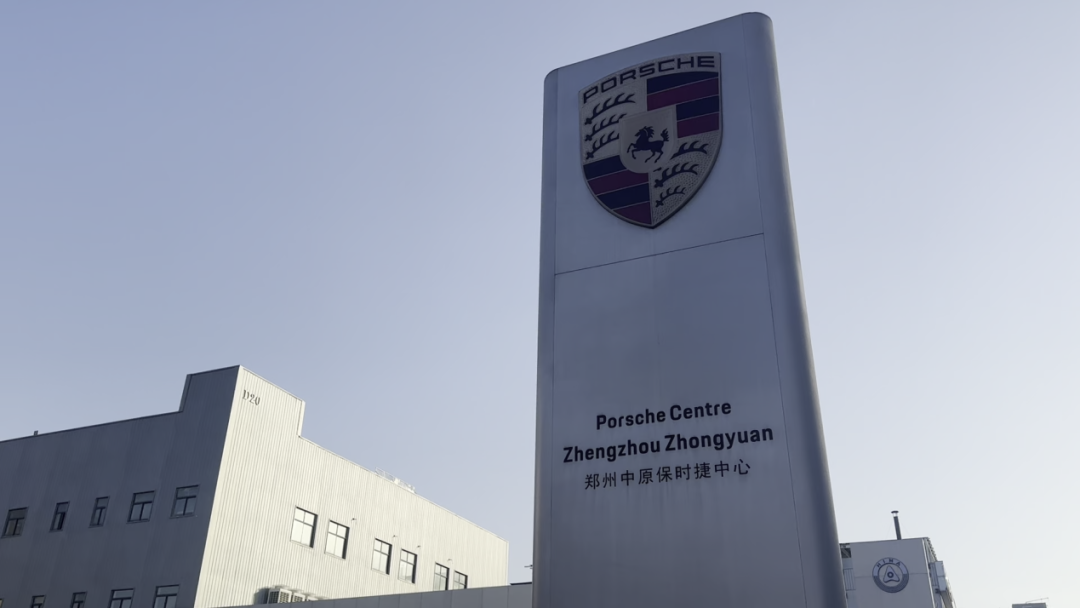
Core Viewpoint - Porsche China has officially terminated the dealership authorization for the Zhengzhou Central Porsche Center, marking a significant shift in the luxury brand's distribution strategy in China [2][4]. Group 1: Incident Overview - The closure of the Zhengzhou Central Porsche Center began with a sudden "clearance" event on December 23, 2025, where vehicles were removed from the showroom, and staff went missing, leaving customers unable to retrieve their vehicles or service packages [3]. - The Zhengzhou Business Bureau and local police initiated investigations, suggesting that the closure was likely due to a financial crisis [3]. - On December 25, Porsche China apologized to customers and committed to protecting consumer rights while investigating the situation [4]. Group 2: Company Response - On January 5, 2026, Porsche China confirmed the termination of the dealership agreement due to serious violations and damage to brand reputation, while also outlining solutions for affected customers [4]. - Customers can transfer their service packages to nearby dealerships, but self-issued packages by the dealership are not included in this transfer [4]. Group 3: Market Context - The termination of the Zhengzhou dealership is part of a broader trend of channel contraction among luxury brands in China, with Porsche planning to reduce its sales outlets from 150 to around 80 by the end of 2026 [7]. - Financial reports indicate a significant decline in Porsche's profitability, with operating profit dropping from €4.035 billion in 2024 to €0.04 billion in 2025, and a sales return rate plummeting from 14.1% to 0.2% [7]. - The overall sales volume for Porsche decreased by 6% globally, with a staggering 26% drop in the Chinese market, highlighting the challenges faced by luxury brands in adapting to market changes [7]. Group 4: Industry Trends - Other luxury brands, such as Mercedes-Benz and BMW, are also undergoing strategic network reductions to enhance efficiency and profitability in response to market pressures [8]. - The closure of the Zhengzhou dealership serves as a warning for luxury brands to optimize their channel strategies while balancing scale, efficiency, brand reputation, and consumer rights [8].
汽车早餐 | 江汽集团董事长项兴初拜访任正非;蔚来第100万辆量产车正式下线;英伟达L4级自动驾驶出租车将于2027年上路
Zhong Guo Qi Che Bao Wang· 2026-01-07 01:38
Group 1: Domestic News - The Ministry of Commerce announced that from 2024 to 2025, China aims to achieve 18.3 million vehicle trade-ins, with nearly 60% being new energy vehicles [2] - In 2024, the national scrapped vehicle recovery is projected to reach 17.67 million units, with an annual growth rate of 45.8% [2] - The second-hand vehicle transactions are expected to reach 39.686 million units [2] Group 2: Traffic and Safety Initiatives - Beijing is planning to implement a "no-cost first aid" policy for traffic accident victims, ensuring they receive immediate medical care without upfront costs [3] Group 3: Insurance and Financial Support - Guangdong is optimizing insurance services for new energy vehicles and exploring the development of intelligent driving liability insurance products to support the growth of the new energy vehicle industry [4] - The province is encouraging insurance institutions to provide various insurance products related to consumer goods [4] Group 4: Transportation Policies - Henan province will exempt hydrogen-powered trucks from toll fees on expressways until the end of 2027 and offer a 50% discount for electric trucks [5] Group 5: Automotive Industry Performance - In the UK, new car registrations are projected to reach 2.02 million in 2025, a 3.5% increase from 2024, with pure electric vehicle sales growing approximately 25% [6] - Lucid Motors reported a total production of 18,378 vehicles in 2025, a 104% increase, and deliveries of 15,841 vehicles, a 55% increase [9] - Chery Group set a sales target of 3.2 million vehicles for 2026, representing a 14.03% growth from 2025 [10] - NIO's one-millionth production vehicle has been officially launched, marking a significant milestone for the company [11] Group 6: Technological Advancements - NVIDIA announced plans to test its Level 4 autonomous taxi service in 2027, utilizing its full-stack autonomous driving technology [7] - Hyundai Motor Group plans to deploy Boston Dynamics' Atlas robots in its U.S. factories starting in 2028 [8] - Geely and Qianli Zhijia jointly launched a new smart driving brand, G-ASD, covering intelligent driving capabilities from Level 2 to Level 4 [13] - Hesai Technology has been selected by NVIDIA as a lidar partner for its DRIVE AGX Hyperion 10 platform, aimed at enabling Level 4 autonomous driving [14]





本土化与生态“出海”将是破局关键
Zhong Guo Qi Che Bao Wang· 2026-01-07 01:35
Core Insights - In 2025, China's automobile exports reached 6.343 million units, a year-on-year increase of 18.7%, with new energy vehicle (NEV) exports at 2.315 million units, growing by 102.9% [2] - The growth momentum is expected to continue into 2026, with a transition towards "stable quantity and improved quality" as the industry expands export scale and deepens localization [2] Group 1: Export Predictions - Multiple organizations predict optimistic growth for China's automobile exports in 2026, with estimates ranging from 680,000 to 800,000 units, and NEV exports projected at 350,000 units [3] - The China Automobile Industry Association anticipates continued growth in exports but with a slowing growth rate, while Morgan Stanley forecasts 6.97 million passenger car exports, focusing on Europe, Southeast Asia, and Latin America as key markets [3] - The export strategy has evolved into a dual-driven model of "emerging market expansion + developed market breakthroughs," with countries like Mexico, UAE, Brazil, and the UK becoming significant growth contributors [3] Group 2: Localization Efforts - The localization process for Chinese automakers is accelerating, with companies increasing investments in overseas factories, such as BYD's plant in Hungary and Chery's joint venture in Spain [4] - Key components supply chains are also being localized, with companies like CATL and Fuyao Glass establishing production bases abroad to enhance local manufacturing capabilities and reduce supply chain risks [4] - The deepening of localization is crucial for building a collaborative manufacturing system that integrates vehicle and component production [4] Group 3: Market Adaptation and Challenges - Chinese automakers are optimizing product configurations to meet diverse market demands and are developing comprehensive service ecosystems, including sales, after-sales, and charging networks [5] - The EU's stringent localization requirements pose challenges, necessitating deep local R&D and production capabilities rather than simple assembly [5] - Trade protectionism, particularly Mexico's increased tariffs on imports from non-free trade agreement countries, threatens to undermine the competitive advantage of Chinese brands [5] Group 4: Supply Chain Risks - Supply chain risks, particularly in automotive-grade chips and power semiconductors, are significant challenges for global automakers, including Chinese companies [6] - Variations in technical standards and consumer habits across different markets, along with geopolitical policy fluctuations, demand higher operational standards from Chinese automakers [6] - The year 2026 is characterized by both growth and challenges, requiring Chinese automakers to focus on technological innovation and diversified ecosystems to achieve high-quality development [6]
七部门联合发布《再生材料应用推广行动方案》,中汽数据携手行业精准破局共建全链追溯体系
Zhong Guo Qi Che Bao Wang· 2026-01-07 01:21
Core Viewpoint - The recent issuance of the "Recycled Materials Application Promotion Action Plan" by seven government departments aims to enhance the use of recycled materials in the automotive industry, particularly in vehicle manufacturing and battery production, while establishing a data traceability management system for recycled materials [1][2]. Group 1: Importance of Recycled Materials and Traceability Systems - There is a significant global emphasis on the utilization of recycled materials in the automotive sector, with the EU implementing regulations that mandate minimum usage ratios for recycled metals and plastics in batteries and vehicles, alongside requirements for digital traceability throughout the product lifecycle [2]. - Domestic policies have been progressively encouraging the use of recycled raw materials in automotive products and battery products, with the recent "Action Plan" expected to accelerate the standardization and transparency of recycled materials application in China's automotive industry [2][6]. Group 2: Role of Zhongqi Data - Zhongqi Data, as a key technical research institution in the automotive industry, is committed to addressing the challenges of establishing a comprehensive traceability system for recycled materials, focusing on integrating industry resources and innovating technical methods [3][4]. - The company is leading the development of a "Recycled Materials Traceability and Certification Publicity Platform (CRP)" to enhance data traceability capabilities across the automotive industry's recycled materials supply chain [3][4]. Group 3: Technical and Standardization Efforts - Zhongqi Data is developing a "Material Flow-Based Recycled Materials Potential Prediction Model" to support the establishment of a national standard system for recycled materials, which includes specific requirements for application ratios and traceability methods [4][5]. - The company is collaborating with major certification institutions to initiate evaluation work for recycled materials in the automotive sector, providing a practical framework for the standardized verification of recycled materials applications [5]. Group 4: Recommendations for Industry Development - The "Action Plan" encourages collaboration among industry organizations and research institutions to explore the construction of a data traceability platform for recycled materials, aiming to achieve comprehensive information management throughout the application process [6][7]. - Recommendations include strengthening demonstration projects, improving traceability management mechanisms, enhancing policy and standard systems, and fostering international cooperation to address challenges in the application and recognition of recycled materials [6][7][8]. Conclusion - The rapid development of China's automotive industry is driving the accelerated formation of a scaled development pattern for recycled materials, with precise traceability being a crucial link to enhance market vitality from "scrap recovery" to "recycled application" [8].
不追短期浪头 只筑长期河床——零米轻卡的2026进击方法论
Zhong Guo Qi Che Bao Wang· 2026-01-07 01:05
Core Viewpoint - The article highlights the impressive growth and strategic positioning of Chery Commercial Vehicle's Zero Mi Light Truck in the competitive new energy vehicle market, emphasizing its commitment to customer-centric long-term value and innovative product offerings [1][3]. Group 1: Sales Performance - Zero Mi Light Truck achieved a sales milestone of over 5,000 units in 2025, ranking among the top seven in the industry [1]. - In November 2025, it recorded a monthly sales surge of 1,000 units, representing a year-on-year increase of 1008.7%, setting a record for the fastest growth in the startup pure electric light truck segment [1]. Group 2: Strategic Direction - The company has adopted a "de-assetization, de-platformization, and de-leasing" strategy to resist short-term profit temptations, reflecting a deep understanding of industry trends [3]. - Zero Mi Light Truck focuses on building brand strength, product capability, channel power, and service quality, establishing a solid foundation for market growth [5]. Group 3: Product Innovation - The company addresses core user concerns regarding battery reliability and service convenience through three key innovations: a partnership with CATL for battery supply, a "million-kilometer customized version" to assure durability, and a commitment to customer service excellence [6][8]. - The introduction of the Jin Mi version, designed to meet the needs of platform users transitioning from 3.8m to 4.2m vehicles, offers competitive performance at a price point accessible to mainstream users [8]. Group 4: Service and Team Development - Zero Mi Light Truck has implemented service guarantees such as "three-hour rescue response" and "repairs completed overnight," enhancing customer service efficiency [9]. - The company emphasizes team building by attracting diverse talent and fostering a unified culture, which aids in overcoming challenges in channel development, service coverage, and product innovation [11]. Group 5: Future Outlook - Positioned for a "year of rapid growth" in 2026, Zero Mi Light Truck is set to leverage its strategic focus, product innovations, and collaborative ecosystem to achieve significant scale and value in the new energy commercial vehicle market [11].
2026年车圈这三大趋势藏不住
Zhong Guo Qi Che Bao Wang· 2026-01-06 08:02
Core Insights - The automotive industry in China is transitioning from "scale expansion" to "quality enhancement," indicating a shift in focus towards technological transparency and user trust as key competitive factors [1][3][4] Group 1: Technological Transparency - Companies are moving away from abstract innovation slogans to concrete technological commitments and public demonstrations, with firms like FAW aiming to become technology companies and SAIC focusing on electrification and intelligence [1] - The concept of "technological transparency" is becoming a competitive threshold, where companies must publicly verify their core component performance and manufacturing standards to build market trust [1] Group 2: Smart Technology as a Necessity - Smart technology is no longer an optional enhancement but a critical requirement for survival in the industry, as evidenced by leaders like Li Shufu and Yin Tongyue emphasizing the importance of emotional and intelligent vehicles [2] - The automotive value proposition is shifting from mere transportation to mobile intelligent terminals, with AI and advanced driving capabilities becoming essential for competitive advantage [2] Group 3: Trust as a Core Asset - The Chinese automotive market has transitioned to a stock competition phase, with a 52.7% penetration rate for new energy vehicles by 2025, shifting the focus from acquiring new customers to retaining existing ones [3] - Building user trust is now a fundamental asset for companies, requiring substantial investment in product quality, service experience, and commitment fulfillment [3] Group 4: Industry Implications - The ongoing competition around technology, intelligence, and trust is expected to enhance the resilience and security of the supply chain, fostering a modern automotive industry with international competitiveness [4][5] - As companies deepen their focus on core technologies and optimize user experiences, the Chinese automotive industry is poised to occupy a higher position in the global value chain, contributing significantly to the nation's automotive ambitions [5]
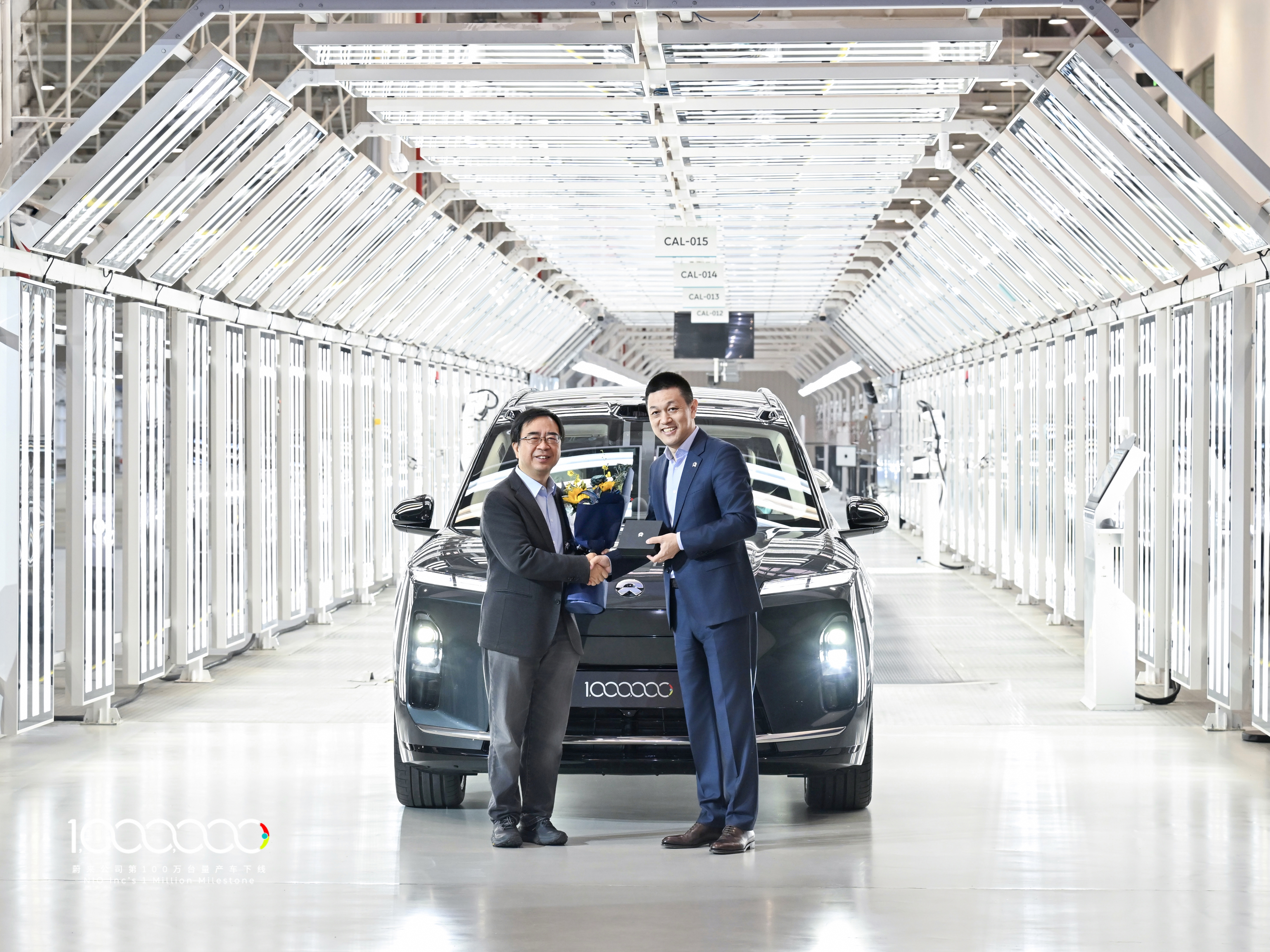
蔚来公司第100万辆量产车下线!
Zhong Guo Qi Che Bao Wang· 2026-01-06 06:24
Core Insights - NIO has achieved a significant milestone with the production of its one millionth vehicle, marking a key point in the company's development since its establishment in 2014 [1][5][6] - The production of the one millionth vehicle reflects not only NIO's growth but also the upward trajectory of China's smart electric vehicle industry, with projections indicating that China's new energy vehicle production will exceed 15 million units by 2025 [5][6] Company Achievements - The one millionth vehicle, a starry green NIO ES8, was donated to the Anhui Mozi Quantum Technology Foundation to support innovation in quantum technology [1] - NIO has launched a limited edition ET9 to commemorate this milestone, honoring innovators across various sectors [1] Industry Impact - NIO's achievement is seen as a representation of the technological and brand advancements within China's automotive industry, contributing positively to the transformation and upgrading of the sector [6][7] - The automotive industry in Anhui has experienced rapid development, becoming a leader in production and export of new energy vehicles, with NIO's operations significantly supported by the local government [6][7] Future Plans - NIO aims to enter a new phase focused on high-quality growth, with plans to enhance its technological and product leadership, expand its infrastructure, and deepen collaboration among its three brands [11] - The company has committed to investing in 12 core technologies and aims to build over 10,000 charging and battery swap stations by 2030 [11]