
Qi Huo Ri Bao

Search documents
国家能源局:促进油气管网等设施提质增效
Qi Huo Ri Bao· 2025-11-13 16:08
"坚持系统观念,促进油气管网等基础设施提质增效。"国家能源局有关负责同志就《办法》答记者问时 表示,《办法》坚持硬设施、软环境两手抓,一方面加快设施投资建设,发挥政府和市场、中央和地 方、国有资本和社会资本多方面作用联网、补网、强链。另一方面,规范设施运营,对油气干线管网等 已经实现独立运营的自然垄断环节,强化事前事中事后全链条全领域监管,严格公平开放;对暂未独立 运营的,通过健全接入和使用机制等方式,加快推进竞争性环节市场化改革,具备条件的尽快独立运 营。(齐宣) 本报讯 11月13日,据国家发展改革委官网消息,《石油天然气基础设施规划建设与运营管理办法》 (下称《办法》)已经2025年10月28日第24次委务会议审议通过,自2026年1月1日起施行。 ...
期货工具为制造业装上“稳压器”
Qi Huo Ri Bao· 2025-11-13 16:03
Group 1 - The core issue facing the manufacturing industry in China is the volatility of raw material prices, particularly lithium carbonate, which directly impacts profit margins for companies [1] - Companies are increasingly turning to innovative financial tools provided by futures companies to manage market fluctuations and stabilize their operations [1][6] Group 2 - South China Futures customized a hedging system for a lithium carbonate company, enabling them to understand hedging principles and utilize complex tools like "circuit breaker enhanced cumulative put options" [2] - In a practical application, the company achieved an opening average price of 82,490 yuan/ton with an initial hedging volume of 30 tons, resulting in a 490 yuan/ton advantage compared to direct futures short selling [2] Group 3 - Dongwu Futures provided a "price lock without quantity lock" solution for a cable company, allowing them to cap procurement costs while retaining profit opportunities if prices fell [3] - This approach helped the company save 1.2 million yuan in procurement costs over a period, translating to approximately 461 yuan saved per ton [3] Group 4 - Guotai Junan Futures assisted Ningbo X Group in managing funding costs by recommending the use of 30-year government bond futures to hedge against high funding costs during a declining interest rate cycle [4] - The simulation indicated that holding the TL contract could reduce annual funding costs by 0.95% for a capital scale of 500 million yuan, with a margin requirement of about 1.15 million yuan [4] Group 5 - The use of futures tools is driving a significant shift in corporate management philosophy from passive pressure acceptance to active risk management [6] - Futures companies are evolving from mere channel providers to comprehensive service providers, offering a full suite of financial services that includes diagnosis, design, execution, and evaluation [6] - As more companies adopt these tools, the risk management capabilities and international competitiveness of Chinese manufacturing are improving [6]
期货之水精准滴灌希望的田野 | “期货赋能产业创新”优秀投教案例
Qi Huo Ri Bao· 2025-11-13 08:03
Core Insights - The article highlights the innovative "insurance + futures" model that connects farmers with financial markets, providing a safety net against price fluctuations in agricultural products [1][2][5] - This model has been successfully implemented in various regions, including Yunnan and Inner Mongolia, demonstrating its effectiveness in stabilizing farmers' incomes and promoting agricultural development [2][3][4] Group 1: "Insurance + Futures" Model Implementation - In Yunnan's YuanYang, the introduction of the "insurance + futures" model has alleviated the financial stress of sugarcane farmers, allowing them to continue cultivation despite previous price volatility [2] - The model involves a closed-loop risk management system where insurance companies design price insurance based on futures prices, and farmers purchase this insurance to mitigate risks [2] - By 2025, the project has compensated over 1,400 farmers with more than 1.6 million yuan, stabilizing their financial situation and injecting capital into the local sugar industry [2] Group 2: Multi-Dimensional Risk Management - In Inner Mongolia, a dual risk management project combines "weather risk" and "price risk" for corn farmers, providing coverage against extreme weather and low market prices [3] - This project has covered 198,000 acres of corn, offering over 230 million yuan in risk protection to hundreds of farmers and new agricultural entities [3] - The efficiency of this model is enhanced by using official weather data and futures prices for quick claims processing, addressing farmers' primary concerns [3] Group 3: Comprehensive Agricultural Support - In Heilongjiang, a four-dimensional mechanism integrating "insurance + futures + credit + orders" has been established to support agricultural cooperatives facing challenges like unstable land transfer and financing difficulties [4] - This approach centers on income insurance, enabling banks to provide low-interest loans based on insurance policies, while futures companies manage price risks [4] - The model has created a comprehensive risk management system for 42 agricultural cooperatives, covering 140,400 acres of soybeans and 188,000 acres of corn [4] Group 4: Impact on Agricultural Practices - Despite rising land costs, the project in Heilongjiang is expected to achieve a loss reduction effect of 50.45%, with estimated compensation of approximately 13 million yuan [5] - The "insurance + futures" model is transforming traditional agricultural practices by effectively linking small-scale farmers with dynamic market conditions [5] - The integration of financial tools into agriculture is increasingly recognized as a valuable resource for ensuring stable income and promoting rural revitalization [5]
美联储停止缩表+政府停摆结束:黄金上涨的“两大引擎”重启?
Qi Huo Ri Bao· 2025-11-13 05:56
Core Viewpoint - The recent fluctuations in gold prices are influenced by the potential end of the U.S. government shutdown, easing geopolitical tensions, tightening dollar liquidity, and profit-taking by long positions. Gold prices have rebounded as market expectations for a Federal Reserve rate cut in December increase, stabilizing investment demand [2][11]. Group 1: U.S. Government Shutdown and Dollar Liquidity - The U.S. government shutdown has led to significant selling pressure on gold, with COMEX gold futures dropping below $4000 per ounce, reaching a low of $3901.3 per ounce [2]. - The Federal Reserve's announcement to halt balance sheet reduction in December is expected to alleviate the low reserve issue in the U.S. banking system, where bank reserves fell below the "ample liquidity" threshold of $3.1 trillion, reaching $2.85 trillion by November 5 [3]. - The U.S. Congress passed a temporary funding bill on November 9, which is expected to end the government shutdown and reduce the fiscal liquidity siphoning effect [3]. Group 2: Economic Indicators and Rate Cut Expectations - Economic indicators suggest a slowdown, with October's job cuts reaching the highest level for that month in nearly 20 years, increasing by 175.3% year-over-year [5]. - October's inflation data showed a mild increase, with the CPI rising 0.3% month-over-month, which is below market expectations and previous months, reinforcing the market's anticipation of a Federal Reserve rate cut [5][6]. - The Supreme Court's ruling on IEEPA tariffs may exacerbate the U.S. debt issue, potentially forcing the Federal Reserve to consider rate cuts [5]. Group 3: Gold Market Dynamics - Central bank gold purchases are on the rise, with a reported 220 tons bought in Q3 2025, a 28% increase from the previous quarter, reversing earlier declines [7]. - Global gold demand reached a record high of 1313 tons in Q3 2025, with total demand valued at $146 billion, driven by significant inflows into gold ETFs, which saw a historic high of $26 billion [7][8]. - The SPDR gold ETF's holdings rebounded to 1042.06 tons by November 10, after a drop to 1036.05 tons in late October due to selling pressure [8]. Group 4: Market Outlook and Trading Strategies - The easing of dollar liquidity concerns and the potential for a Federal Reserve rate cut have shifted the macro narrative towards optimism, reducing the selling pressure on gold [11]. - Investors are advised to monitor COMEX gold options to hedge against increased volatility, with trading volumes reaching a historical high of 175,000 contracts [11].


尿素 供应持续增长
Qi Huo Ri Bao· 2025-11-13 01:54
Group 1 - Urea prices have been weak this year, with production profits for fixed-bed and natural gas-based urea at -210 CNY/ton and -167 CNY/ton respectively [1] - Since mid-October, urea prices have started to rise due to news from Indian tenders, but high inventory levels in urea plants limit the potential for price rebounds [1] - From January to September 2025, China's urea production reached 53.18 million tons, an increase of 4.31 million tons or 8.1% year-on-year, with daily operating rates at 85.15%, up 3.58 percentage points year-on-year [1] Group 2 - The urea industry has experienced severe overcapacity after years of rapid growth, leading to significant losses for companies [2] - The government has implemented supply-side structural reforms, eliminating 16.22 million tons of urea capacity during the 13th Five-Year Plan [2] - New capacity additions are planned for the coming years, with 394,000 tons in 2024, 380,000 tons in 2025, 688,000 tons in 2026, and 590,000 tons in 2027, resulting in an average annual production growth of about 5% [2] Group 3 - In 2024, domestic controls on urea exports will be strengthened, with a complete suspension of exports in the second half of the year [3] - The export policy is expected to remain unchanged, with a limited and orderly export model, and the total export volume is anticipated to be constrained [3] - Overall demand growth for urea is expected to remain around 3%, while production growth is projected at approximately 5%, leading to excess supply that needs to be managed through exports [3]
20号胶短期弱势难改
Qi Huo Ri Bao· 2025-11-13 01:54
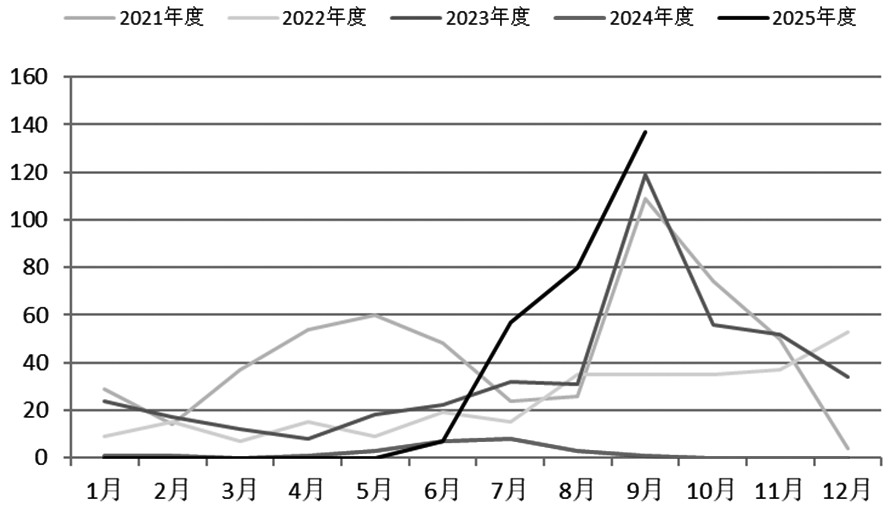
(文章来源:期货日报) 库存持续累积 宏观预期减弱 尽管欧盟"零毁林法规"(EUDR)实施前引发部分泰国橡胶分流至欧洲市场,导致我国到港量短暂下 降,但整体供应增长趋势明确。我国橡胶进口依赖度维持在90%左右,国内供给宽松的格局难以改变。 海关总署公布的数据显示,2025年9月我国天然橡胶进口量为59.59万吨,环比增加14.41%,同比增加 20.92%,2025年1—9月累计进口471.72万吨,同比增加19.65%。 下游需求复苏不及预期导致库存去化速度放缓。数据显示,2025年9月ANRPC成员国合计消费量为 92.11万吨,环比略微增加0.15万吨,较去年同期的93.12万吨小幅减少1.01万吨。2025年1—9月ANRPC 成员国合计消费量为818.33万吨,较去年同期的837.39万吨减少19.06万吨,降幅为2.28%。在需求转弱 的背景下,供应压力正在库存端凸显。值得关注的是,近期青岛保税区结束此前的去库周期,开始进入 累库周期。数据显示,截至11月2日当周,青岛地区天胶保税和一般贸易合计库存量为44.77万吨,环比 小幅增加1.54万吨,增幅为3.57%,这反映出国内到港量增加而下游需求不 ...
以期货为翼 “重庆鸽”在转型中稳健飞翔 | “一品一企”看期货服务实体
Qi Huo Ri Bao· 2025-11-13 01:30
Core Viewpoint - The article highlights the transformation of Chongqing Ge Pai Electric Wire and Cable Co., Ltd. into a model of risk management and innovation in the traditional cable industry, leveraging futures markets to navigate price volatility and enhance operational resilience [1][12]. Company History and Transformation - Founded in 1956, Ge Pai was the first producer of electric wires and cables in Chongqing, playing a crucial role in national infrastructure during the planned economy era [2]. - The company faced severe challenges in the late 1990s, leading to a restructuring in 2001 that shifted its focus to the booming real estate market and introduced a quality-centric brand strategy [2][3]. Market Adaptation and Technological Advancements - Ge Pai has successfully transitioned from a consumer-focused (C-end) business model to a project-oriented (B-end) approach, targeting sectors like power, railways, and special equipment [4]. - The company has implemented a digital transformation, achieving a 60% increase in automation and an 18% improvement in labor efficiency through the establishment of a "digital workshop" [4][5]. Risk Management through Futures - Copper, which constitutes over 70% of production costs, has been subject to significant price fluctuations, prompting Ge Pai to adopt futures trading as a risk management strategy [7][8]. - The company established a dedicated futures trading team in 2018, enhancing its understanding and application of futures tools to stabilize operations and mitigate risks associated with raw material price volatility [9][10]. Collaborative Ecosystem and Future Outlook - Ge Pai promotes a collaborative approach with upstream and downstream partners, sharing risks and benefits through long-term contracts and joint hedging strategies [11]. - Looking ahead, the company aims to leverage futures as a strategic "risk shield" while focusing on high-quality development in line with national initiatives in new energy and smart grid sectors [12][13].
储能需求爆发式增长 碳酸锂能否迎来下一个风口
Qi Huo Ri Bao· 2025-11-13 00:27
Core Insights - The recent strong rebound in lithium carbonate prices has brought the energy storage industry back into the market spotlight, highlighting its critical role in the green energy system and new power system construction [1] - The new energy storage sector in China is experiencing rapid development, with significant policy support and increasing market demand, particularly for lithium batteries [2][3] Industry Development - As of September 2023, China's new energy storage installed capacity exceeded 100 million kilowatts, accounting for over 40% of the global total, making it the largest in the world [2] - The National Development and Reform Commission and the National Energy Administration have set a target for new energy storage capacity to reach over 30GW by 2025, indicating a clear growth trajectory for the industry [2] - The new energy storage market is expected to grow significantly, with a target of 180GW cumulative installed capacity by 2027, marking a new phase of dual-driven development by policy and market forces [3] Demand for Lithium Carbonate - The demand for lithium carbonate is shifting from supplementary to core demand due to the rapid expansion of energy storage installations [6] - Each GWh of lithium-ion storage battery consumes approximately 0.8 to 1.0 million tons of lithium carbonate, with projections indicating that energy storage could account for over 30% of global lithium carbonate demand by 2025 [6] - The energy storage market is expected to grow at a compound annual growth rate of 24% from 2025 to 2030, significantly impacting lithium carbonate demand [7] Market Dynamics - The surge in energy storage demand has led to a significant increase in orders for related companies, with a reported 308 overseas energy storage contracts signed by Chinese companies in the first nine months of 2025, representing a year-on-year growth of 131.75% [4][5] - The production of energy storage cells in China reached 355.1GWh in the first three quarters of 2025, a 57.5% increase year-on-year, driven by strong order demand [8] Challenges in the Industry - Despite the growth potential, the energy storage industry faces challenges such as intensified competition, safety risks, and uncertainties in profitability models [10][11] - The industry is experiencing price wars, with nearly 30% of system integrators selling below cost in the first half of 2025, which compresses profit margins and raises safety concerns [12] - The reliance on government subsidies for profitability poses risks, especially for companies like Hai Chen Energy, which faced significant declines in revenue and profit due to policy changes [13] Future Outlook - Industry experts emphasize the need for improved market mechanisms, technological innovation, and safety standards to ensure sustainable growth in the energy storage sector [14]



几内亚西芒杜项目正式投产 重塑全球铁矿石供应格局
Qi Huo Ri Bao· 2025-11-13 00:11
Core Insights - The Simandou iron ore project in Guinea, one of the largest and highest-quality undeveloped mines globally, has commenced commercial operations after nearly 30 years of dormancy, with an expected annual shipment of 2.5 to 3 million tons in 2025 [1] - The project is set to significantly alter the global iron ore supply landscape, adding 12 million tons of high-grade iron ore annually, which will account for approximately 5% of global supply, positioning Africa as the third-largest supplier after Australia and Brazil [2] - The project will enhance China's bargaining power in iron ore pricing, reducing its dependency on Australian and Brazilian imports from 84% to below 65%, and allowing for more favorable negotiations with traditional mining giants [3] Supply Dynamics - The Simandou project is expected to reach a combined annual production of 60 million tons by 2025, with further increases to 120 million tons by 2026 [1] - The successful launch of Simandou is anticipated to stimulate iron ore development across Africa, with other countries like Sierra Leone, Liberia, and Mauritania having significant untapped resources [2] Pricing Structure - The introduction of the "North Iron Index," priced in RMB, challenges the traditional Platts index, indicating a shift in the pricing dynamics of the iron ore market [4] - The project is expected to lead to a structural adjustment in pricing, with long-term contracts becoming more prevalent, reducing reliance on spot market fluctuations [4] Industry Transformation - The high iron content and low impurity levels of Simandou's ore will drive upgrades in the steel industry, enhancing the competitiveness of electric arc furnace steel production in China [5][6] - The project is projected to lower steel production costs by 10% to 15%, saving over 20 billion RMB annually for Chinese steel companies [6] Environmental Impact - The high-grade iron ore from Simandou is particularly suitable for hydrogen metallurgy, potentially reducing carbon emissions by 5% to 8% per ton of steel produced, aligning with China's carbon neutrality goals [6] - The project supports the transition to low-carbon steel production, with plans for hydrogen reduction iron facilities to be established [6] Cost Competitiveness - The production cost of Simandou is estimated to be between 60 to 70 USD per ton, which, while higher than some Australian mines, remains competitive due to the quality premium and reduced exchange costs for Chinese buyers [8] - The project is expected to provide new cost support for the iron ore market, with short-term price stability anticipated despite current high global inventories [9] Long-term Market Outlook - In the medium to long term, as Simandou's capacity is fully realized, the global iron ore supply is expected to increase, leading to a downward pressure on prices, potentially stabilizing around 70 to 80 USD per ton [9] - The introduction of Simandou's high-grade supply may widen the price gap between high and low-grade ores, influencing regional price disparities in the Asian and European markets [9]
国际油价短暂反弹后大跌
Qi Huo Ri Bao· 2025-11-13 00:01
Core Viewpoint - Recent geopolitical conflicts and a strong refined oil market have contributed to a rebound in international oil prices, although concerns about oversupply have led to a sharp decline in prices [1] Group 1: Oil Price Dynamics - International oil prices rebounded due to multiple factors, including new U.S. sanctions on Russian oil and India's cessation of Russian oil purchases, raising supply concerns [1] - The recent sanctions on Russian oil companies, including Lukoil, have directly restricted Russian oil exports, with India previously importing approximately 1.7 million barrels per day from Russia [1] - The unexpected operational challenges faced by Lukoil in Iraq, with a production capacity of around 400,000 barrels per day, have further supported oil prices in the short term [1] Group 2: Refined Oil Market Influence - The strong performance of the refined oil market, particularly in Europe and the U.S., has provided significant support for crude oil prices, with recent price movements closely mirroring those of refined products [2] Group 3: Supply and Demand Outlook - Despite the recent price increases, the fundamental conditions in the crude oil market have not fundamentally improved, with rising inventory pressures and a seasonal decline in demand expected [3] - U.S. crude oil inventories increased by approximately 1.2 million barrels as of the week ending November 7, indicating weakening demand [3] - OPEC+ plans to continue increasing production in December, which will exert additional pressure on oil prices [3] Group 4: Future Projections - Significant inventory pressures are anticipated from late 2025 to early 2026, with oil prices expected to have room for decline during this period [4] - OPEC+ is projected to reach a production plateau of nearly 3 million barrels per day by December 2025, while seasonal demand lows are expected in February to March 2026 [4] - Long-term supply pressures remain, with a downward trend in oil prices expected, although short-term fluctuations may occur due to geopolitical factors and market dynamics [4]