Wen Hua Cai Jing

Search documents
印尼Arsari公司将目光投向加拿大矿业资产
Wen Hua Cai Jing· 2025-10-16 01:53
Group 1 - The core point of the article is that PT Arsari Tambang, an Indonesian tin mining company, is in discussions to acquire a mining asset in Canada, leveraging a recent economic partnership agreement between Indonesia and Canada [1][2] - The acquisition is valued at approximately 70 trillion Indonesian Rupiah, equivalent to about 422.71 million USD, with plans to complete the transaction by June 2026 [2] - Indonesia is the world's second-largest tin producer, and Arsari Tambang primarily operates in the Bangka-Belitung region, which is a key area for tin production [2] Group 2 - Arsari Tambang's subsidiary, Mitra Stania Prima, is projected to have a tin smelting capacity of 3,811 tons by 2024 [2]


WBMS:8月全球精炼锡供应短缺0.49万吨
Wen Hua Cai Jing· 2025-10-16 01:46
Core Insights - The World Bureau of Metal Statistics (WBMS) reported a global refined tin supply shortage of 0.49 million tons in August 2025, with production at 23.5 thousand tons and consumption at 28.4 thousand tons [2] - For the period from January to August 2025, global refined tin production was 226.8 thousand tons, while consumption reached 242.6 thousand tons, resulting in a supply shortfall of 15.8 thousand tons [2] - In August 2025, global tin ore production was recorded at 20.9 thousand tons, with a total of 195.8 thousand tons produced from January to August 2025 [2]
WBMS:2025年8月全球精锌市供应短缺2.1万吨
Wen Hua Cai Jing· 2025-10-16 01:44
Core Insights - The World Bureau of Metal Statistics (WBMS) reported a global zinc plate supply shortage of 21,000 tons in August 2025, with production at 1,150,700 tons and consumption at 1,171,700 tons [1] - For the period from January to August 2025, global zinc plate production totaled 9,088,500 tons, while consumption reached 9,369,800 tons, resulting in a supply shortfall of 281,300 tons [1] - In August 2025, global zinc mine production was recorded at 1,069,600 tons, with total production from January to August 2025 amounting to 8,445,700 tons [1]
WBMS:2025年8月全球精炼镍供应过剩4.99万吨
Wen Hua Cai Jing· 2025-10-16 01:44
Core Insights - The World Bureau of Metal Statistics (WBMS) reported a global refined nickel surplus of 49,900 tons in August 2025, with production at 323,300 tons and consumption at 273,400 tons [1] - For the period from January to August 2025, global refined nickel production reached 2,549,400 tons, while consumption was 2,244,300 tons, resulting in a surplus of 305,100 tons [1] - In August 2025, global nickel ore production was 338,600 tons, and for the first eight months of 2025, it totaled 2,615,200 tons [1]
金属普涨,期铜窄幅波动,受美元走软和美联储降息押注支撑【10月15日LME收盘】
Wen Hua Cai Jing· 2025-10-16 00:34
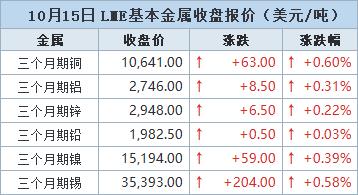
Core Viewpoint - The London Metal Exchange (LME) copper prices rose due to a weaker dollar and expectations of further interest rate cuts by the Federal Reserve [1] Group 1: Market Performance - On October 15, LME three-month copper increased by $63, or 0.6%, closing at $10,641 per ton [1] - Other base metals also saw price increases, with three-month aluminum up by $8.50 (0.31%), zinc up by $6.50 (0.22%), lead up by $0.50 (0.03%), tin up by $204 (0.58%), and nickel up by $59 (0.39%) [2] Group 2: Supply and Demand Dynamics - Concerns over reduced copper supply from Indonesia, the Democratic Republic of Congo, and Chile have contributed to a recent price surge, with copper reaching a 16-month high of $11,000 on October 9 [4] - Morgan Stanley's commodity strategist indicated that further changes in the market could lead to tighter conditions by the end of the year [4] - Fitch Solutions raised its 2025 average copper price forecast to $9,650 per ton, up from a previous estimate of $9,500, citing ongoing supply disruptions and strong industrial demand [4] Group 3: Market Premiums and Inventory - The premium of LME spot copper contracts over three-month contracts has been declining, with a recent peak of $227, the highest since June [4] - The premium for LME spot zinc contracts decreased from $202 to $150 per ton, indicating tight inventory levels, which are at their lowest since the beginning of 2023 [4]
自由港将退出其主导数十年的铜价基准体系
Wen Hua Cai Jing· 2025-10-15 12:52
Group 1 - Freeport-McMoRan plans to exit the benchmark pricing system for copper concentrate to protect smelter profitability [2] - The TC/RC fees, crucial for smelter operations, typically account for nearly one-third of smelter revenue [2] - Historical low TC/RC fees are expected to continue into 2026, with predictions of a potential negative pricing scenario [2][3] Group 2 - Javier Targhetta, responsible for large supply agreements for over 30 years, expresses concern over the sharp decline in processing fees [3] - China, as the largest copper consumer, faces three major challenges: rising dependence on foreign resources, overcapacity in the midstream processing sector, and suppressed downstream demand due to high copper prices [3]


沪伦两市锡库存双双下滑 沪锡库存降至近两年新低
Wen Hua Cai Jing· 2025-10-15 12:46
Group 1 - The London Metal Exchange (LME) reported a continued decline in tin inventory, with the latest level at 2,385 tons, marking a new low in over a month [2] - The Shanghai Futures Exchange indicated that during the week of October 10, tin inventory decreased by 8.55% to 5,879 tons, reaching a near two-year low [2] - Generally, a continuous decline in inventories on domestic and international exchanges tends to support price levels, while an increase may exert downward pressure on prices [2]
原料供应偏紧格局维持 沪锡窄幅波动【10月15日SHFE市场收盘评论】
Wen Hua Cai Jing· 2025-10-15 12:39
Group 1 - The core viewpoint indicates that the tin market is experiencing a decline in prices due to weak demand and macroeconomic uncertainties, despite tight supply conditions [1][2] - The main contract for tin closed at 281,710 yuan/ton, reflecting a decrease of 0.15% [1] - The Federal Reserve's indication of a potential easing in monetary policy has heightened risk aversion in the market, contributing to a decline in market sentiment [1] Group 2 - China's refined tin production saw a significant decline in September due to maintenance by leading enterprises, impacting overall supply [2] - Current tin prices remain relatively high, but downstream and end-user acceptance of these prices is low, leading to limited spot transactions [2] - The market is characterized by weak overall demand, particularly in the consumer electronics and home appliance sectors, with a noticeable reduction in orders [2] Group 3 - There is an expectation of supply recovery as major enterprises complete maintenance and resume operations, which could lead to a substantial increase in domestic refined tin production [2] - Despite tight supply conditions at the mining level, the release of production from Myanmar remains limited [2] - The short-term market dynamics are influenced by mixed fundamental factors, with a lack of strong drivers and significant reliance on macroeconomic sentiment [2]
BMI上调2025年铜价预估,助于工业需求和供应中断
Wen Hua Cai Jing· 2025-10-15 12:36
Core Insights - Fitch Solutions' BMI has raised its 2025 copper price forecast to $9,650 per ton from a previous estimate of $9,500, driven by ongoing supply disruptions and strong industrial demand [2] - Current average copper prices are at $9,609 per ton, with trading prices exceeding $10,000 due to macroeconomic factors, particularly U.S. interest rate cuts, which are expected to stimulate manufacturing and investment activities until 2026 [3] Demand Drivers - China remains the dominant force in global copper consumption, with significant increases in demand driven by the expansion of green energy [4] - Solar power installations surged by 212 gigawatts in the first half of 2025, nearly doubling year-on-year, alongside a substantial rise in electric vehicle sales [4] - The dual surge in renewable energy and electric vehicles has pushed Shanghai Futures Exchange copper inventories to multi-year lows, while global inventories at the London Metal Exchange are expected to halve to nearly 140,000 tons by 2025 [4] Supply Constraints - BMI indicates that copper prices will continue to be supported by supply disruptions from major producers [5] - The Grasberg copper mine, the second-largest globally, experienced a landslide in September, invoking force majeure and reducing 2026 production forecasts by 35% [6] - Chile's production has also seen significant declines, with Codelco's El Teniente mine experiencing a 25% year-on-year drop in August, reaching a 20-year low of 93,400 tons [7] - The Collahuasi mine, a joint venture between Anglo American and Glencore, reported a 27% production decline, prompting both companies to lower their 2025-2026 production targets [7] Long-term Outlook - BMI anticipates a 2.4% growth in global refined copper production by 2025, but expects this year's global copper surplus to be smaller than in 2024 [8] - Over the next decade, BMI believes that a significant number of new projects will inject additional copper supply into the market, although supply growth will lag behind demand growth [9] - The International Energy Agency notes that each electric vehicle contains over 50 kilograms of copper, more than double that of traditional vehicles, and offshore wind energy facilities require up to 8 tons of copper per megawatt of installed capacity [9] - Consequently, BMI forecasts that accelerating electrification and clean energy infrastructure development will lead to a long-term supply gap, pushing copper prices to $17,000 per ton by 2034 [10]

10月14日LME金属库存及注销仓单数据
Wen Hua Cai Jing· 2025-10-15 08:41
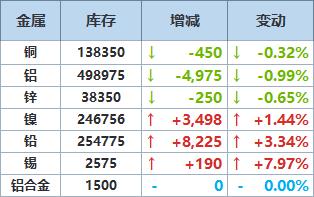
Core Insights - The report highlights the changes in inventory levels for various metals, including copper, aluminum, zinc, nickel, and tin, indicating fluctuations in supply and demand dynamics in the market [1][3][5][7][9][11][13]. Inventory Changes - **Copper**: The total inventory decreased from 138,800 to 138,350 tons, a reduction of 450 tons, with a registered warehouse inventory of 129,800 tons and a cancellation ratio of 6.18% [1][3]. - **Aluminum**: The inventory remained stable at 498,975 tons, with a slight decrease of 4,975 tons from the previous day. The registered warehouse inventory is 405,700 tons, and the cancellation ratio is 18.69% [1][5]. - **Zinc**: The inventory decreased from 38,600 to 38,350 tons, a drop of 250 tons, with a registered warehouse inventory of 24,400 tons and a cancellation ratio of 36.38% [1][9]. - **Nickel**: The inventory increased from 243,258 to 246,756 tons, an increase of 3,498 tons, with a registered warehouse inventory of 240,486 tons and a cancellation ratio of 2.54% [1][13]. - **Tin**: The inventory rose from 2,385 to 2,575 tons, an increase of 190 tons, with a registered warehouse inventory of 2,340 tons and a cancellation ratio of 9.13% [1][11]. Regional Inventory Insights - **Copper**: Significant changes were noted in various locations, with the highest cancellation ratio observed in the location "हा" at 14.39% [3]. - **Aluminum**: The highest cancellation ratio was recorded in Rotterdam at 31.47%, indicating potential supply constraints in that region [5]. - **Zinc**: The inventory in Singapore showed a decrease, reflecting a tightening supply in that market [9]. - **Nickel**: The inventory in high-demand regions like Singapore and 高雄 showed increases, suggesting a potential shift in market dynamics [13].