半导体芯闻

Search documents
高通与小米签署多年期协议
半导体芯闻· 2025-05-21 10:29
Core Viewpoint - Qualcomm Technologies, Inc. and Xiaomi celebrate their 15-year partnership and sign a multi-year agreement to drive innovation in the tech industry, focusing on high-end smartphones and various connected devices [1][2]. Group 1: Partnership Highlights - The collaboration has been pivotal in Xiaomi's growth from a startup to a global tech leader, with Qualcomm being a trusted partner throughout this journey [1]. - Both companies aim to enhance the integration of artificial intelligence in edge devices, including smartphones, cars, AR/VR glasses, wearables, and tablets [2]. Group 2: Product Innovations - Qualcomm's Snapdragon platform has supported millions of Xiaomi products, contributing to Xiaomi becoming the third-largest smartphone brand globally [2]. - Xiaomi's recent launch of the Xiaomi 15 series, powered by the Snapdragon 8 Gen 1 chip, has achieved significant commercial success [2]. - In the automotive sector, Xiaomi's first car, the SU7, utilizes Qualcomm's next-generation Snapdragon digital cockpit platform for an advanced in-car experience [2]. Group 3: Expanding Product Categories - Qualcomm's Wi-Fi solutions, including the latest Wi-Fi 7 technology, enable Xiaomi to deliver faster and more reliable connectivity in its smart home products [3]. - The collaboration extends to wearables, with several commercial headphones and smartwatches featuring Snapdragon platforms, such as the Xiaomi Buds 5 Pro and Xiaomi Watch 2 Pro [3].




马斯克:要买100万颗GPU
半导体芯闻· 2025-05-21 10:29
Core Viewpoint - Elon Musk anticipates that Tesla and xAI will continue to purchase chips from semiconductor giants Nvidia and AMD, with xAI planning to establish a factory with 1 million GPUs in Memphis [1][2]. Group 1: Company Developments - xAI has installed 200,000 GPUs at its Colossus facility in Memphis, which Musk claims is currently the world's most powerful training cluster [1]. - Tesla's Dojo supercomputer in Buffalo is being utilized for training its autonomous driving and Optimus robot systems [1]. - xAI has spent approximately $191 million in 2024 and $36.8 million by February 2025 on Tesla Megapacks, a utility-scale energy storage system [3]. Group 2: Industry Insights - Musk believes that the current limiting factor for AI development is chips, but predicts that by mid-2026, the primary constraint will shift to electrical equipment, leading to a fundamental power shortage for AI companies [2]. - Musk noted that China currently invests more in power generation than the U.S., although he asserts that the U.S. still holds an advantage in breakthrough innovations [2]. - Environmental concerns have been raised regarding xAI's reliance on natural gas turbines for powering its supercomputers, which may violate the Clean Air Act and local pollution permits [2].


台积电拒绝去这三个国家建厂
半导体芯闻· 2025-05-21 10:29
如果您希望可以时常见面,欢迎标星收藏哦~ 来源:内容来自 digitimes ,谢谢 。 半导体已成「国安战略物资」,主权AI日益重要,各国激烈竞逐。遭美国等大国锁定的台积电, 近期已确立在台湾、美国、日本和德国的未来扩产蓝图。然据供应链透露,至今欲与台积合作的国 家仍多,包括印度、新加坡与中东的卡达,然而,台积电已经婉拒这三个国家的设厂邀约。 对台积电而言,台湾是最完美的生产据点,海外建厂是逼不得已的决定,最终选择美、日、德,主 要还是大国压力巨大,以及考量这三个国家在设备、材料与IC设计等半导体产业链中拥有领先实 力,且在分身乏术与全球产能调配必须控制,避免供过于求下,因此婉拒其他国家邀约。 据供应链业者透露,中东多国可说是诚意满满,只要台积愿意前往设厂,「钱不是问题」。 但对台积来说,除了国安与复杂政治问题外,中东在半导体领域部署几乎是零,台积电为了美国、 日本与德国扩产,台湾团队与供应链已全员出动,目前人力缺口仍相当大,已无法再筹建一支团 队,助力他国建置半导体聚落与长期营运。 关键更在于,中东国家期望的是先进制程产能,而非成熟制程技术。 不过近期随着中东国家对于AI、半导体产业发展企图心强劲,台积电 ...

黄仁勋直言:对华的芯片出口政策失败
半导体芯闻· 2025-05-21 10:29
Core Viewpoint - NVIDIA's CEO Jensen Huang criticized the U.S. government's restrictions on semiconductor exports to China as a "failure" and welcomed recent comments from former President Donald Trump about potentially repealing these policies. Huang emphasized the need for the U.S. to reclaim its leadership in the AI semiconductor sector, which is projected to grow to $50 billion this year [1][2]. Group 1: U.S. Export Restrictions - Huang stated that the U.S. government's export restrictions have led to significant losses for NVIDIA, amounting to billions of dollars, which exceeds the sales of many semiconductor companies [1]. - He pointed out that the initial assumptions behind the AI diffusion rules were fundamentally flawed, leading to misguided policies [1][2]. Group 2: AI Infrastructure and Market Dynamics - Huang highlighted that over 50% of the world's AI researchers are based in China, and the export restrictions have forced many to turn to domestic technologies [2]. - He praised Trump's understanding that U.S. companies are not the sole providers of such technologies, indicating a shift in perspective regarding AI development [2]. - Huang noted that the investment in AI infrastructure is still in its early stages, and the emerging reasoning AI models will significantly increase the demand for computational resources, potentially by up to 1,000 times [2][3]. Group 3: Future Strategies - During his keynote speech at Computex 2025, Huang described AI infrastructure as the next critical infrastructure following electricity and the internet, stressing that investment in this area is just beginning [3]. - He urged the U.S. to accelerate its efforts to surpass China in AI technology, emphasizing the need for widespread adoption and rapid advancement in AI capabilities [3].

乌克兰打击俄罗斯芯片厂
半导体芯闻· 2025-05-21 10:29
Core Viewpoint - Ukrainian drones launched a large-scale nighttime attack targeting a Russian military electronics factory, disrupting mobile internet services near Moscow [1][2] Group 1: Attack Details - The attack specifically targeted the Bolkhov semiconductor plant, located approximately 200 kilometers from the Ukrainian border, which produces components for Russian electronic warfare systems [1] - The Russian Defense Ministry reported the destruction of 159 Ukrainian drones across nine regions, including Moscow [1] - No casualties were reported from the attack on the Bolkhov plant, according to the governor of the Oryol region [1] Group 2: Impact on Services - Residents in Moscow, Vladimir, and Lipetsk regions experienced mobile internet disruptions during the drone attack [1] - The governor of Lipetsk stated that the military decided to temporarily cut mobile internet services for security reasons, with plans to restore them as soon as possible [1] Group 3: Related Military Actions - Concurrently, Russian ballistic missile strikes targeted a training base in the Sumy border region, resulting in the deaths of six soldiers and injuries to at least ten others [2]
关于半导体,最新预测
半导体芯闻· 2025-05-21 10:29
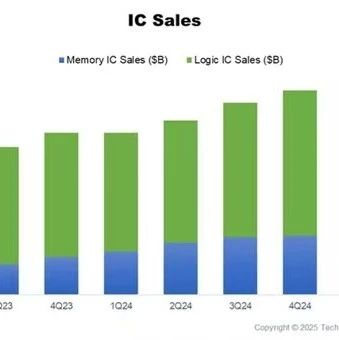
Core Insights - The semiconductor manufacturing industry is experiencing seasonal patterns, but uncertainties related to tariffs may lead to irregular seasonal fluctuations in various sectors [1][2] - In Q1 2025, electronic device sales decreased by 16% compared to the previous quarter but remained flat year-over-year. Integrated Circuit (IC) sales fell by 2% quarter-over-quarter but increased by 23% year-over-year [1] - Capital investment in semiconductor equipment declined by 7% quarter-over-quarter in Q1 2025 but grew by 27% year-over-year, driven by investments in advanced logic, high bandwidth memory (HBM), and advanced packaging [1][2] Investment Trends - Investment in wafer fabrication equipment (WFE) is accelerating, with a 19% year-over-year increase in Q1 2025, and a projected 12% growth in Q2 2025 [2] - Test equipment sales surged by 56% year-over-year in Q1 2025, with expectations of a further 53% increase in Q2 2025 [2] - Assembly and packaging equipment also experienced double-digit growth [2] Capacity Expansion - Positive capital investments are expected to lead to global wafer fabrication capacity expansion, with 300mm wafer production projected to exceed 42.5 million units per quarter in Q1 2025, marking a 2% increase quarter-over-quarter and a 7% increase year-over-year [2] - Japan is investing to enhance power semiconductor production, while Taiwan continues to invest in its advanced foundry capacity [2] Market Outlook - Despite a bright demand outlook for artificial intelligence and data centers, other sectors may see delayed investments or changing demand due to uncertainties in trade policies [2]
美方调整芯片出口管制有关表述,商务部正式回应
半导体芯闻· 2025-05-20 11:00
如果您希望可以时常见面,欢迎标星收藏哦~ 来源:内容来自半导体芯闻综合 ,谢谢 。 5月19日,有记者问针对美国商务部调整芯片出口管制提问称,美国商务部网站调整了其5月12日 发布的AI芯片出口管制指南新闻稿相关表述,将"在世界任何地方使用华为昇腾芯片均违反美国出 口管制法规"调整为"警告业界使用中国先进计算机芯片,包括特定华为昇腾芯片的风险"。请问中 方对此有何评论? 商务部新闻发言人回答表示,5月15日商务部例行新闻发布会上,中方已就相关问题阐明严正立 场。美方发布有关指南后,中方通过中美经贸磋商机制,在各层级与美方进行交涉沟通,指出美方 行为严重破坏中美日内瓦高层会谈共识,要求美方纠偏纠错。中方注意到,近日美方对指南新闻稿 相关表述进行了调整,但指南本身的歧视性措施和扭曲市场本质并没有改变。 美方滥用出口管制措施,以莫须有的罪名对中国芯片产品加严管制,甚至干涉中国公司在中国境内 使用中国自己生产的芯片,美方的手伸得太长,是典型的单边霸凌行径,中方坚决反对。美方行为 严重损害中国企业正当权益,严重威胁全球半导体产供链安全稳定,严重冲击全球科技创新。给别 人"下绊子",不会让自己跑的更快。这种以单边保护主义 ...
芯片巨头,清仓大甩卖!
半导体芯闻· 2025-05-20 11:00
Core Viewpoint - Intel is considering divesting its Networking and Edge Computing (NEX) business as part of a strategy under new CEO Pat Gelsinger, who aims to focus on the company's strongest areas: PC and data center chips [1][2]. Group 1: Business Strategy - The NEX business, previously significant, is now deemed less critical to Intel's core strategy, particularly in the context of competition from dominant players like Broadcom [2]. - Intel is exploring whether to collaborate with other companies or sell part of its stake in the NEX business, indicating a strategic reassessment of its business portfolio [2]. - Discussions regarding the potential sale of the NEX business are still in early stages, and Intel may consider alternatives to divestiture [2]. Group 2: Financial Performance - Intel has integrated NEX's financial data into its data center and PC business segments, ceasing to disclose NEX's performance separately [2]. - The revenue for the NEX business in 2024 is projected to be $5.8 billion [2]. - In April, Intel sold a majority stake in its Altera division to SilverLake for $4.46 billion as part of its business revitalization efforts [2][3]. Group 3: Market Position - Intel holds approximately 68% market share in the PC chip market and about 55% in the data center market [1]. - Despite the focus on core business areas, Intel has experienced a significant decline in market share within the data center and PC sectors [3].

联发科:首颗 2nm 芯片将于 9 月流片
半导体芯闻· 2025-05-20 11:00
Group 1 - MediaTek will start using TSMC's latest 2nm chip manufacturing technology from September this year and plans to continue utilizing all of TSMC's advanced process technologies to maintain competitiveness in the AI era [1] - MediaTek's CEO, Cai Lixing, announced that the company will begin trial production of chips using the 2nm node in the second half of this year, targeting "high shipment volume" end devices [1] - The term "Tape-out" refers to the stage where chip design is finalized and ready for mass production [1] Group 2 - MediaTek plans to enter the laptop market by using TSMC's 3nm process to manufacture chips for Google's high-end Chromebook professional series [2] - The company aims to create customized AI accelerators for data centers and has partnered with NVIDIA to develop Spark, an AI computer for personal desktops, expected to ship this summer [2]
AMD:台积电虽好,但并非唯一选择
半导体芯闻· 2025-05-20 11:00
Core Viewpoint - AMD is focusing on expanding its market share in South Korea by leveraging its performance and energy efficiency advantages in various sectors, including AI, cloud services, and telecommunications [1][2]. Group 1: Market Performance - In Q1 of this year, AMD's data center business grew by 57% year-over-year, achieving a market share of 40% in terms of revenue [1]. - AMD's total revenue for Q1 reached $7.44 billion (approximately 10.3 trillion KRW), surpassing the forecast of $7.13 billion by financial information company LSEG [1]. Group 2: Product Strategy - AMD plans to expand its product line with the "EPYC 4005" series aimed at small and medium-sized enterprises, focusing on energy efficiency and cost-effectiveness [2]. - The next-generation "EPYC" processor, codenamed Venice, is set to be launched next year and will utilize TSMC's 2nm process technology, marking the first use of N2 technology in high-performance computing (HPC) chips [2][3]. Group 3: Collaboration and Development - AMD is developing the new processor with a focus on optimal watt efficiency and semiconductor performance, maintaining a long-term partnership with TSMC while remaining open to collaborations with other companies [3].