申万宏源研究

Search documents
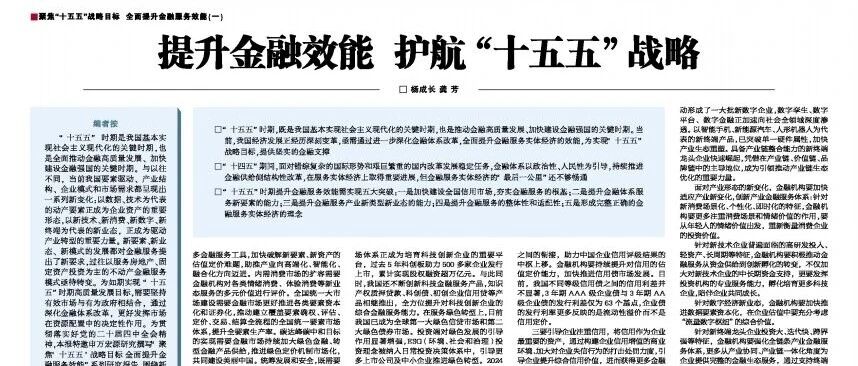
提升金融效能 护航“十五五”战略
申万宏源研究· 2025-11-13 06:52
Core Viewpoint - The article emphasizes the importance of enhancing financial service efficiency to achieve the "15th Five-Year Plan" strategic goals, highlighting the need for deepening financial system reforms and improving support for the real economy [3][5][7]. Group 1: Financial Role in Economic Development - The "15th Five-Year Plan" is a critical period for achieving socialist modernization and promoting high-quality financial development [5][6]. - Financial services must play a key role in supporting technological innovation and the development of new productive forces, requiring better resource allocation in capital markets [7][8]. - The financial system needs to continue reforms to address structural contradictions in funding and project financing, ensuring effective capital conversion [4][8]. Group 2: Achievements During the "14th Five-Year Plan" - Significant progress was made in the financial system, including improvements in the financial institutional framework and market scale, with China becoming the world's largest credit market by September 2025 [9][10]. - The direct financing ratio increased to 31.6%, and the asset management scale of various institutions grew by 35% compared to the end of 2020 [9][10]. - Financial institutions have enhanced their service capabilities, particularly in supporting technological innovation and green transformation [11][12]. Group 3: Five Breakthroughs for the "15th Five-Year Plan" - The article outlines five key breakthroughs needed to enhance financial service efficiency: building a national credit market, improving service capabilities for new factors, enhancing services for new industries and business models, increasing overall service adaptability, and forming a correct understanding of financial services for the real economy [13][14][17]. Group 4: Building a National Credit Market - A national credit market is essential for the financial system and the unified market, requiring improvements in credit data collection and sharing [14][15]. - Financial institutions need to enhance their credit rating and assessment capabilities to better support small and medium-sized enterprises [16][17]. Group 5: Enhancing Services for New Factors - Financial institutions must adapt to the shift towards new asset forms, such as data and technology, and improve their service capabilities accordingly [17][18]. - There is a need for a comprehensive valuation system for new asset types, focusing on technology and data-driven industries [19][20]. Group 6: Adapting to New Industries and Business Models - The financial sector must innovate its service offerings to meet the demands of new consumption patterns and technological advancements [20][21]. - Financial institutions should focus on providing integrated financial services that align with the characteristics of new industries and business models [22][23]. Group 7: Overall Service Integration and Adaptability - Financial products need to be more integrated and adaptable to meet the diverse needs of enterprises, particularly in terms of financing options [22][23]. - Collaboration among financial institutions is essential to create a more cohesive service environment that supports various financing needs [23][24]. Group 8: Correct Understanding of Financial Services - There is a need for a correct understanding of the relationship between finance and the real economy, emphasizing that finance should serve the real economy effectively [24][25]. - Financial institutions must balance profitability with their role in supporting national strategic goals and local economic needs [24].




数据点评 | 通胀回升的三大因素(申万宏观·赵伟团队)
申万宏源研究· 2025-11-12 01:12
Core Viewpoints - The inflation rebound in October is primarily driven by factors other than the anti-involution effect, with significant contributions from commodity price increases [2][60] - The Consumer Price Index (CPI) rose to 0.2% year-on-year, up from -0.3% previously, while the Producer Price Index (PPI) decreased by 2.1% year-on-year, showing a slight improvement from -2.3% [9][59] Factors Influencing Inflation - **Factor One**: The anti-involution effect has led to an increase in coal prices, but its impact on downstream PPI is limited. In October, PPI increased by 0.1% month-on-month, with a year-on-year improvement of 0.2 percentage points to -2.1%. The significant rise in copper prices, which increased by 7% month-on-month, was a major contributor to the PPI increase [2][10][60] - **Factor Two**: The CPI's rise above zero is attributed to a low base and reduced supply in certain food categories, which pushed food CPI up. The year-on-year food CPI improved by 1.5 percentage points to -2.9%, with fresh vegetables and fruits seeing increases of 6.4 and 2.2 percentage points, respectively [2][17][61] - **Factor Three**: Core CPI continued to rise, supported by improved travel demand and rising gold prices. In October, core CPI increased to 1.2% year-on-year, with significant price increases in accommodation, airfares, and tourism due to the overlapping National Day and Mid-Autumn Festival [3][24][61] Future Outlook - The price increases in bulk commodities are expected to continue influencing inflation, but the anti-involution effect on downstream prices may take time to manifest. It is anticipated that the PPI will remain around -2.2% year-on-year in the fourth quarter, while the CPI's year-on-year increase may be limited due to the tapering of national subsidies and slow recovery in downstream PPI [4][37][62] Regular Tracking - The CPI showed a rebound, with contributions from both food and non-food items. In October, the CPI rose by 0.5 percentage points to 0.2% year-on-year, with food CPI at -2.9%, reflecting a 1.5 percentage point increase from the previous month [5][43][63] - Non-food consumer goods saw a decline in CPI for household appliances and communication tools, with respective decreases of 0.5 percentage points to 5.0% and 0.3 percentage points to 1.2% [5][48][63] - Overall service CPI increased, with core service CPI performing better than seasonal trends, rising by 0.2 percentage points to 0.8% year-on-year [7][52][63]

货政报告解读|保持社会融资条件相对宽松(申万宏观·赵伟团队)
申万宏源研究· 2025-11-12 01:12
Core Viewpoint - The central theme of the report emphasizes the need for strategic determination and confidence in the face of external uncertainties and challenges to the international economic and trade order, while also highlighting the importance of consolidating the foundation for domestic economic recovery [2][20]. Economic Situation Analysis - The report indicates that external uncertainties have increased, with the international economic growth momentum described as "insufficient" compared to the previous quarter's "weakened" assessment, reflecting heightened concerns about global economic prospects [2][20]. - Domestically, while risks and challenges remain, there is a new emphasis on the need to strengthen the foundation for economic recovery, indicating a commitment to achieving annual economic growth targets despite some slowing in economic indicators [20][21]. Policy Tone - The monetary policy tone has shifted from "implementing detailed and appropriate monetary policy" to "implementing effective monetary policy," focusing on the ultimate effectiveness of policies rather than just their execution [3][21]. - The report introduces a comprehensive approach to maintaining relatively loose social financing conditions, emphasizing the coordination between monetary and fiscal policies, particularly in the context of government bond issuance [3][21]. Monetary Policy Operations - The report highlights the need to maintain liquidity and ensure that the growth of social financing and money supply aligns with economic growth and price level expectations [7][21]. - It stresses the importance of structural monetary policy tools to support key areas such as technological innovation, consumption, small and micro enterprises, and stabilizing foreign trade [7][21]. Exchange Rate and Risk Prevention - The report reiterates the importance of maintaining exchange rate flexibility and has removed previous mentions of preventing fund circularity, suggesting that related risks may have been controlled [3][22]. - The focus has shifted to strengthening expectations guidance and maintaining a stable RMB exchange rate at a reasonable equilibrium level [7][22]. Hot Topics - The report discusses the importance of understanding financial aggregate indicators, noting that the growth of social financing and money supply is generally aligned with nominal economic growth, while also acknowledging the natural decline in financial aggregate growth due to the larger base [8][23]. - It emphasizes maintaining reasonable interest rate relationships to support banks' net interest margins and enhance the counter-cyclical adjustment space for monetary policy [23].

国内高频 | 生产边际改善,需求保持韧性(申万宏观·赵伟团队)
申万宏源研究· 2025-10-28 01:36
Core Viewpoint - The article highlights the overall improvement in industrial production, with specific sectors showing varying performance, particularly in steel and construction industries [1][11][21]. Industrial Production - The blast furnace operating rate increased by 0.5% week-on-week to 84.7%, remaining stable year-on-year [1][4]. - Apparent steel consumption rose by 2% week-on-week, with a narrowing year-on-year decline of 3.8 percentage points to -0.1% [1][6]. - Social inventory continued to decline, down 2.3% week-on-week [1]. Chemical and Textile Industries - The soda ash operating rate remained stable at 84.9%, with a year-on-year decline narrowing to -2.2% [11][12]. - PTA operating rate increased by 0.4% week-on-week to 76.0%, with a year-on-year improvement of 1.3 percentage points to -4.8% [11][14]. - The operating rate for polyester filament remained stable at 91%, with a year-on-year increase of 1.7% [11]. Construction Industry - Cement production and demand were below last year's levels, with the nationwide grinding operating rate increasing by 1.6% week-on-week to 45.4% [21][22]. - Cement shipment rates remained stable at 44.8%, with a year-on-year decline of 9.3% [21][24]. - Cement inventory ratio slightly increased, up 1.2% week-on-week [21]. Glass and Asphalt Production - Glass production remained stable week-on-week, with a year-on-year decline of 0.6% [31]. - Asphalt operating rate increased by 1.5% week-on-week [31]. Demand Tracking - National commodity housing transactions decreased, primarily due to significant declines in second-tier cities, with a daily average transaction area down 5.7% week-on-week [40]. - National road freight volume increased year-on-year, with rail freight volume up 1.8 percentage points to 1.5% [44][49]. - Passenger car retail sales decreased by 0.5% week-on-week, with a year-on-year decline of 0.7% to 25.4% [59]. Price Tracking - Agricultural product prices generally fell, with vegetable prices rising by 4.3% week-on-week [74]. - Industrial product prices showed an overall upward trend, with the South China Industrial Price Index increasing by 0.4% week-on-week [82][83].

数据点评 | 9月利润再度上行,如何理解?(申万宏观·赵伟团队)
申万宏源研究· 2025-10-28 01:36
Core Viewpoint - In September, industrial profits showed a weak performance compared to previous years when adjusted for low base effects, with current cost rates remaining at historically high levels [2][8]. Overall Performance - In September, industrial profits continued to rise due to short-term factors such as expenses, with a year-on-year increase of 2.6 percentage points to 22.5% under low base conditions. However, on a two-year compound basis, profit growth fell by 5.3 percentage points to -5.9%, and the month-on-month profit increase was only 1.1%, significantly lower than the same period last year (11.3%) [2][8]. - The profit margin increased year-on-year, primarily driven by short-term indicators like expense ratios, which rose by 9.5 percentage points to 11.6% [2][8]. Revenue Analysis - In September, industrial revenue improved, with nominal revenue rising due to marginal improvements in the Producer Price Index (PPI). The actual revenue growth rate, adjusted for price changes, increased by 0.2 percentage points to 5.4%, contributing an additional 0.3 percentage points to the year-on-year profit growth [2][16]. - Revenue growth varied across industrial chains, with the consumer chain showing a notable increase of 2.2 percentage points to 8.1%, while the petrochemical and metallurgy chains also saw improvements [2][16]. Cost Structure - Industrial enterprises faced increasing cost pressures in September, with cost rates for the metallurgy and consumer chains at historically high levels, indicating that the effects of anti-involution policies are yet to be realized. The overall cost rate for industrial enterprises was 85.4%, remaining relatively high compared to previous years [3][22]. - The cost contribution to year-on-year profit growth decreased by 0.3 percentage points to -3.6% [3][22]. Industry Insights - Industries with significant profit improvements were primarily influenced by revenue and expenses, despite ongoing cost pressures. Notable profit recoveries were observed in the computer communication and automotive sectors, contributing 3.5 and 2.8 percentage points to overall profit, respectively [3][33]. - Other sectors such as general equipment, non-metallic products, and rubber and plastics also contributed positively to profit growth, while the beverage industry saw a significant decline in profit growth [3][33]. Future Outlook - Industrial enterprises are expected to continue facing substantial cost pressures, with the effectiveness of anti-involution policies still to be seen. The current profit pressures are largely attributed to rigid cost increases driven by downstream investment [4][48]. - Future policies aimed at stabilizing growth in sectors like construction materials and steel are anticipated to gradually alleviate cost pressures, alongside a recovery in domestic demand [4][48].

热点思考 | 投资“失速”的真相?(申万宏观·赵伟团队)
申万宏源研究· 2025-10-28 01:36
Group 1 - The core viewpoint of the article highlights a significant decline in fixed asset investment growth across various sectors, reaching historical lows in the second half of 2025, with a notable drop of 9.1 percentage points to -6.5% by September, marking the lowest point in five years [1][10][19] - Investment in broad infrastructure, services, real estate, and manufacturing has all seen substantial declines, with respective drops of 13.1, 11.1, 9.3, and 9.1 percentage points, leading to negative growth rates of -3.3%, -6.6%, -21.2%, and -1.5% [1][10][19] - The decline in investment is attributed to several factors, including accelerated debt resolution efforts that have occupied investment funds, with over half of the investment decline explained by this issue [2][29] Group 2 - The construction and installation investment has decreased significantly, contributing to the overall decline in fixed asset investment, with a drop of 16.4 percentage points to -15.7% by September [2][19] - The eastern region has experienced a more pronounced decline in construction and installation investment compared to central and western regions, with cumulative declines of 3.9, 3, and 2.3 percentage points respectively [2][19] - The article identifies that the push for debt resolution has led to a requirement for enterprises to expedite the repayment of debts, further impacting investment negatively [3][40] Group 3 - The lack of new projects is also affecting current investment levels, with renovation projects maintaining high growth while new construction investments have significantly declined [4][44] - The article notes that the yield rates for investments in transportation, public utilities, and environmental management have fallen into negative territory, indicating poor returns on investment in these sectors [4][44] - Recent fiscal measures have been implemented to alleviate the pressure on investment caused by debt resolution, including the allocation of 500 billion yuan for local projects aimed at addressing debt issues [6][66] Group 4 - The article discusses the potential for policy optimization to improve corporate financial health, as high accounts receivable ratios have been noted, particularly among private enterprises [5][53] - The reduction in accounts receivable growth rates for both joint-stock and private enterprises suggests a potential recovery in cash flow, which could support investment revitalization [5][59] - Historical precedents indicate that effective debt repayment policies can lead to significant improvements in corporate investment activity, as seen in past government initiatives [5][60]

申万宏源2026年度博士后招聘
申万宏源研究· 2025-10-23 05:10
Company Overview - Shenwan Hongyuan Group is a state-owned investment holding group listed in both A and H shares, primarily relying on capital markets with a core focus on securities business [2] - Shenwan Hongyuan Securities, a wholly-owned subsidiary of the group, is one of the leading large securities companies in China, benefiting from strong shareholder advantages, substantial capital strength, extensive brand influence, and rich customer resources [2] Postdoctoral Research Station - The Shenwan Hongyuan Postdoctoral Research Station was established in 2008, approved by the Ministry of Human Resources and Social Security of China, serving as an important platform for nurturing high-level young talents [3][4] Research Directions and Topics - The research topics include: 1. Strengthening political and cultural guidance to cultivate and practice the path of Chinese financial culture 2. Research on high-quality party building leading to high-quality development in state-owned financial enterprises 3. Commercialization paths and investment nodes for the integration of high-end equipment and AI technology 4. Innovation of tools supporting the "dual carbon" goals through green finance [6][8] Application Requirements - Applicants must meet the following basic conditions: 1. Good political and ideological quality, with no illegal or disciplinary violations 2. Hold a doctoral degree obtained in the last three years or soon to be obtained from domestic or international institutions 3. Generally under 35 years of age and in good health 4. Proficient in English reading, writing, listening, and translation 5. Able to work full-time at the station for postdoctoral research 6. Preference for candidates with interdisciplinary backgrounds [7] Application Process - Applicants can choose one research topic from the provided list and must submit their application materials electronically by October 31, 2025 [11] - Required materials include a personal resume, two expert recommendation letters, a research plan, doctoral thesis directory and abstract, two academic representative works, and scanned copies of doctoral graduation and degree certificates [11]

网申最后1天!申万宏源研究2026届秋季校园招聘火热进行中!
申万宏源研究· 2025-09-30 01:05
Group 1 - The article announces the launch of the 2026 autumn campus recruitment by Shenwan Hongyuan Research, emphasizing the company's commitment to nurturing talent and building a long-term professional research team [5][7]. - Shenwan Hongyuan Research, established in 1992, is one of the earliest and largest comprehensive securities research institutions in mainland China, focusing on a wide range of investment research areas including macroeconomics, industry analysis, and investment strategies [7]. - The company boasts a research team of over 300 professionals, covering more than a thousand key listed companies both domestically and internationally [7]. Group 2 - The recruitment program includes various positions such as macroeconomic analysts, bond analysts, strategy analysts, financial engineering analysts, stock analysts, market analysts, and researchers in the industry research institute [11]. - The training program for new employees is comprehensive, featuring a dual capability system that combines innovation and traditional skills, and includes mentorship from senior employees to facilitate integration into the company [9][10]. - The recruitment is targeted at graduates from domestic and overseas institutions, with specific graduation dates outlined for eligibility [14].


【申万宏源策略】美股科技板块资金出现大幅流出——全球资产配置每周聚焦 (20250919-20250926)
申万宏源研究· 2025-09-29 01:56
Core Viewpoint - The article emphasizes the significant outflow of funds from the US technology sector and highlights the resilience of the US economy as indicated by the revised GDP growth rate, which has implications for global interest rate expectations [2][9]. Economic Data - The US Q2 GDP annualized growth rate was revised up to 3.8%, surpassing the previous 3.3% estimate, marking the strongest performance since Q3 2023 [2][9]. - Strong consumer spending and a decline in imports contributed to this upward revision, indicating economic resilience and cooling global rate cut expectations [2][9]. - The 10-year US Treasury yield rose by 6 basis points to 4.20%, while the US dollar index increased by 0.55% to 98.2, remaining below 100 [2][9]. Market Movements - The article notes that the Asia-Pacific stock markets, including the Hang Seng Index, KOSPI, and Sensex, experienced significant declines, while commodities saw gains, with Brent crude oil rising by 4.60% and COMEX gold increasing by 2.83% [2][9]. - In the past week, there was a notable inflow of both domestic and foreign capital into the Chinese stock market, with domestic inflows of $29.83 million and foreign inflows of $24.80 million [3][11]. Fund Flows - The article reports that US equity funds saw inflows into real estate, industrials, and healthcare, while experiencing outflows from financials, communications, and technology sectors. Conversely, Chinese equity markets saw inflows into technology, finance, and consumer sectors, with outflows from infrastructure, energy, and real estate [3][11]. - Specifically, the US technology sector experienced an outflow of $43.3 million, while the Chinese technology sector saw an inflow of $35.5 million [3][11]. Valuation Metrics - As of September 26, 2025, the PE ratio percentiles for the S&P 500 and DAX were at 93.0% and 89.5%, respectively, indicating high valuations compared to historical levels. In contrast, the Shanghai Composite Index and Hang Seng Index have recovered to above 50% but still have room for growth compared to US valuations [4][18]. - The article highlights that the equity risk premium (ERP) for the Shanghai Composite and other indices remains relatively high, suggesting better value in the Chinese stock market compared to global markets [4][18]. Risk Indicators - The S&P 500 index closed at 6643.70, above the 20-day moving average, with an increase in the put-call ratio indicating a more cautious market sentiment [5][9]. - The implied volatility for the Shanghai Composite options decreased significantly compared to the previous week, reflecting a stable outlook for the market [5][9]. Upcoming Economic Indicators - Key upcoming economic indicators include China's September manufacturing PMI and the US September non-farm payrolls and ISM services PMI [6][17].

网申倒计时|申万宏源研究2026届秋季校园招聘火热进行中!
申万宏源研究· 2025-09-29 01:56
Group 1 - The article announces the launch of the 2026 autumn campus recruitment by Shenwan Hongyuan Research, emphasizing the company's commitment to nurturing talent and building a long-term professional research team [5][7]. - Shenwan Hongyuan Research, established in 1992, is one of the earliest and largest comprehensive securities research institutions in mainland China, focusing on a wide range of investment research areas including macroeconomics, industry analysis, and investment strategies [7]. - The company boasts a research team of over 300 professionals, dedicated to providing systematic and stable professional research services to the capital market [7]. Group 2 - The recruitment program includes various positions such as macroeconomic analysts, bond analysts, strategy analysts, financial engineering analysts, stock analysts, market analysts, and researchers in the industry research institute [11]. - The training program for new employees is comprehensive, featuring a dual capability system that combines innovation and tradition, and aims to facilitate continuous development through structured training [9][10]. - The recruitment is targeted at graduates from domestic and overseas institutions, with specific graduation dates outlined for eligibility [14].