虎嗅APP

Search documents
早报|官方通报蔡国强烟花秀调查情况;山东聊城醉驾车祸致8人死亡;苹果宣布推出M5芯片;美司法部没收近13万枚比特币
虎嗅APP· 2025-10-16 00:09
Group 1 - Apple announced the launch of the M5 chip, which has over 4 times the peak GPU computing performance compared to the M4 chip and a 45% increase in graphics performance [2] - Apple also introduced the 14-inch MacBook Pro, iPad Pro, and Apple Vision Pro equipped with the M5 chip, available for pre-order immediately [3] Group 2 - The U.S. Department of Justice seized approximately 127,271 bitcoins valued at $15 billion, marking the largest seizure in its history, linked to a transnational cryptocurrency scam involving forced labor [4] - The scam was orchestrated by a businessman with dual citizenship in the UK and Cambodia, who built and operated multiple fraud centers in Cambodia [4] Group 3 - Xiaomi launched an independent short drama app called "Weiguan Short Drama," which offers ad-free access to a large volume of short dramas, currently available only to Xiaomi phone users [5] Group 4 - A U.S. judge temporarily blocked the federal government from laying off employees during the government shutdown, affecting over 4,100 federal workers who had received layoff notices [6][7] - The ruling requires the government to pause actions on the layoff notices while the judge considers a longer-term injunction [7] Group 5 - The U.S. government confirmed that the CIA has been authorized to conduct operations in Venezuela against drug trafficking groups, with potential ground actions being prepared [8] Group 6 - A tragic drunk driving incident in Shandong resulted in 8 deaths, with the driver having a blood alcohol content of 195.3 mg/100ml [19][20] Group 7 - The Chinese police have made significant progress in combating crime in northern Myanmar, capturing over 57,000 Chinese suspects involved in fraud, with major crime groups facing severe crackdowns [23] Group 8 - A court ruled that a long-term employee of a retail company was legally dismissed for failing to prioritize customer service, affirming the company's internal regulations [24][25] Group 9 - An investigation was launched into a procurement project at Jiangxi University of Traditional Chinese Medicine, where a budget of 3 million yuan was reportedly awarded to a bid of only 1,000 yuan [26][27] Group 10 - Reports emerged of a company requiring employees to submit self-reflections to avoid salary deductions after implementing significant pay cuts without prior negotiation [29][30] Group 11 - A controversial fine imposed by a delivery service for uncollected packages was clarified as unauthorized by local postal authorities [31][33] Group 12 - A food safety incident involving a cake sold at a membership store raised concerns after a customer found a tooth in the product, prompting an investigation by the store [34] Group 13 - Authorities in Shaanxi province took action against individuals spreading false information about a recent incident, leading to criminal investigations [35] Group 14 - The Sichuan Provincial Education Examination Institute denied involvement in a fraudulent invitation for schools to participate in a mock exam, clarifying that no such activities were authorized [36] Group 15 - The 2025 World Intelligent Connected Vehicle Conference and other significant events are set to take place, focusing on advancements in technology and innovation [37]



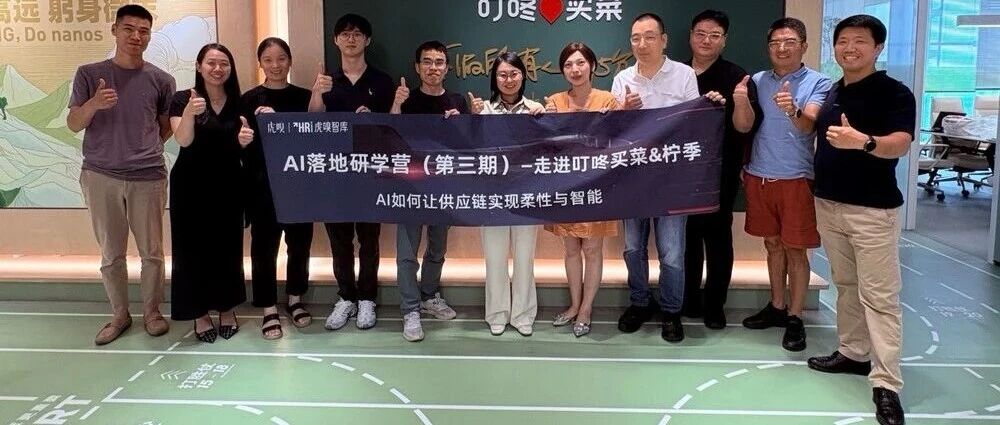
走进叮咚买菜与柠季,找到AI落地柔性供应链的解法【AI落地研学营】
虎嗅APP· 2025-10-16 00:09
Core Insights - The article emphasizes the importance of integrating AI into business operations, particularly in supply chain management, to transform it from a cost center to a value center [5][23][24]. Group 1: AI Implementation in Supply Chain - Dingdong Maicai utilizes Agentic AI to enhance traceability and accountability in its fresh supply chain, addressing issues of high loss, volatility, and time sensitivity [7][8]. - The company has achieved a 95% accuracy rate in sales forecasting for overall orders and popular items, showcasing the effectiveness of AI in decision-making processes [8]. - The approach involves a full-chain upgrade from human-driven processes to algorithm-driven operations, ensuring clarity and accountability at every stage [8]. Group 2: Digital Transformation Strategies - Ningji adopts a light-asset, rapid expansion model, focusing on data-driven decision-making to reduce reliance on individual expertise, allowing the CEO to "work less" [9][10]. - The company emphasizes the importance of completing foundational steps like information and online transformation before advancing to AI applications [10]. - AI applications at Ningji are centered around efficiency and revenue generation, with practical implementations in customer service and site selection [10]. Group 3: Content Supply Chain Innovation - Tezign views content as a new SKU, advocating for a content supply chain that allows for the reuse and combination of creative assets [13][14]. - The company employs AI to manage and produce marketing content efficiently, enabling rapid generation without requiring design skills from operators [14]. - This approach positions content production as a core asset for businesses, moving away from one-time use to reusable modules [14]. Group 4: Gradual AI Integration - Shuhai Supply Chain emphasizes a methodical approach to AI integration, focusing on cost reduction, efficiency enhancement, and quality improvement [15][17]. - The company has invested over 400 million yuan in developing a comprehensive SaaS system to streamline operations across various business functions [17]. - AI implementation is approached in stages, starting with simpler tasks to build a foundation before tackling more complex scenarios [17][21]. Group 5: Industry Challenges and Consensus - Participants in the roundtable discussion highlighted the challenges of aligning consumer demands with supply chain capabilities, particularly in the fashion industry [18][19]. - There is a shared concern about measuring the value of AI, as business growth results from multiple factors, complicating the attribution of success to specific AI tools [19][20]. - A consensus emerged that AI is not a panacea but rather a complex system engineering challenge that requires a structured approach to implementation [20][22].

米其林酒店榜单,为何没人买账?
虎嗅APP· 2025-10-15 13:40
以下文章来源于旅界 ,作者theodore熙少 旅界 . 跟踪时代浪潮,讲述文旅商业好故事。 本文来自微信公众号: 旅界 (ID:tourismzonenews) ,作者:theodore熙少,题图来自:AI生成 01 上周末,几个国内高奢酒店圈的朋友都在和我聊同一件事: 怎么看待米其林首版全球酒店榜单? 说起来,米其林这份酒店榜单的确来得挺突然。 10月9日,米其林官网正式公布的酒店版"米其林指南"中,全球近100个目的地的2457家酒店获得星 钥,其中1742家酒店为一星钥、572家酒店为二星钥、143家酒店为三星钥。 部分米其林上榜中国酒店 值得一提的是,中国酒店也被纳入评选,共有64家酒店上榜。 其中,四川九寨沟的日赛谷丽思卡尔顿隐世酒店和香港瑰丽酒店拿下了三星钥,北京前门文华东方、 杭州西子湖四季、上海嘉佩乐建业里等则摘得二星钥,更多一星钥分布在上海、深圳、三亚、南京等 城市。 从名单来看,该有的酒店品牌基本都在,价格也都不便宜。 上榜的几家头部酒店,价格基本在每晚4000元到11000元之间,属于标准的"有能力住的早就住过, 住不起的也不会因为评了星钥就来一晚"的档位。 但越往下聊,我越觉得哪里不 ...

“跳下悬崖造飞机”的狠人,用一个未来的故事打动苹果代工厂
虎嗅APP· 2025-10-15 13:40
Core Insights - The article discusses the journey of a startup, Future Intelligence, which focuses on AI headphones and the challenges faced in the hardware and AI integration space [5][8][9]. Group 1: Company Overview - Future Intelligence was founded in 2022, during a time when the venture capital community was primarily focused on large AI models, leading to initial difficulties in securing investment [9][34]. - The company has since doubled its valuation and secured new funding led by Ant Group, indicating a shift in investor interest towards practical AI applications [8][35]. - The founder, Ma Xiao, emphasizes the importance of integrating AI into hardware design from the outset, rather than as an afterthought [10][12]. Group 2: Product Development Challenges - Developing AI headphones involves significant challenges, including rethinking hardware design, supply chain management, and navigating a competitive market [10][39]. - The product development cycle for hardware is lengthy, typically taking 6 to 9 months, which contrasts sharply with the rapid iteration cycles seen in software [10][50]. - Future Intelligence initially faced skepticism from top-tier manufacturers due to low order volumes, but eventually secured a partnership with a major OEM by presenting a compelling vision for AI-driven headphones [39][40]. Group 3: Market Positioning and Strategy - The company has strategically focused on the office and meeting scenarios, simplifying its product offerings to meet specific user needs, such as recording and translating conversations [41][42]. - Future Intelligence has iterated its product multiple times, responding to user feedback and evolving market demands, particularly with the advent of large language models [44][46]. - The company aims to differentiate itself by positioning its headphones as "AI ears," capable of capturing audio in a way that traditional headphones cannot [50][52]. Group 4: Competitive Landscape - Future Intelligence views itself as a hybrid of hardware and AI software, contrasting with traditional tech giants that focus on broader consumer electronics [52][59]. - The company anticipates competition not just from other hardware manufacturers but increasingly from software companies that may venture into hardware [58][59]. - The founder believes that the future of AI assistants will require a combination of structured and unstructured data, which necessitates a close relationship with users to gather comprehensive insights [60][64].

人生六十多的感悟:国家、趋势与自己
虎嗅APP· 2025-10-15 13:40
本文来自微信公众号: 秦朔朋友圈 (ID:qspyq2015) ,作者:南人,头图来自:AI生成 走过大半辈子,经历了六十年人生路 (含三十多年职场路) ,一路走来一路思考,多多少少有些感 想,在这里写出来跟大家探讨。无所谓对错,都是个人的看法。 一、中国必然强大,但不等于人 人都好过 世界并不太平,并没有朝越来越好的方向演变,不确定性很高,谁都没法预测未来。世界格局正在经 历调整,由一家独大到双雄相争,带来一系列的动荡是不可避免的。 我认为,不管怎样,中国超越美国,成为全球第一大经济体,是必然的事。只要保持稳定,内部不出 乱子,哪怕中国暂时也面临很大挑战,但长远看,超越基本就是铁板钉钉的事。 一方面,中国现在已经打好了基础,有了很好的底子,第一制造大国的优势将会持续,而且还具备4 个有利条件: 一则中国人是聪明、勤劳、进取心极强的群体,自尊心强,民族自豪感也强。与前面30年相比会有 所放缓,但跟世界其他国家比,这种前进的动力仍然是最强的。 二则中国具备集中力量办大事的体制,决策力强,又有调节地区发展不平衡的能力,还有激发个体发 挥潜能的机制,因此有能力平衡各方诉求和发展。 三则中国是统一的大市场,本国市场就 ...

“百度一下”,变成了创作工厂?
虎嗅APP· 2025-10-15 13:40
Core Viewpoint - The article discusses the significant transformation of search engines, particularly focusing on Baidu's recent upgrade of its search capabilities, marking a shift from traditional information retrieval to AI-driven task resolution and content creation [2][4][16]. Group 1: Industry Trends - The global AI search market is projected to exceed $28 billion by 2024, with China being the fastest-growing region [4]. - Gartner predicts that by 2026, over 50% of users will prefer AI over traditional search engines for information retrieval [5]. - A paradigm shift is occurring in the search engine industry, moving from "information retrieval" to "task resolution and content creation" [6][16]. Group 2: Baidu's Strategic Upgrade - Baidu's recent upgrade is described as the "largest revision in ten years," transitioning the search function from a passive query interface to an active "task workstation" [7][9]. - The upgrade enhances user experience by allowing seamless integration of various tasks, such as travel planning and health consultations, within a single interface [9][10]. - Baidu's "Wenxin Assistant" is positioned as an "AI all-round partner," significantly improving the speed and efficiency of search result generation [9][10]. Group 3: AIGC Capabilities - Baidu's AIGC capabilities allow users to create high-quality video content and other media with minimal effort, democratizing content creation [11][12]. - The introduction of digital human agents enhances user interaction by providing emotional support and expert consultations in various fields [13][14]. - Baidu's search platform is evolving from a consumption space to a creative space, fostering user loyalty and engagement [12][16]. Group 4: Future Outlook - The transformation of Baidu's search capabilities is seen as a prelude to the future of search, where traditional search boxes will merge with AI tools and services [16]. - The competition in the AI search landscape will not only focus on market share but also on defining the industry [16]. - Baidu's advancements may serve as a valuable case study for human-AI interaction in the AI era [16].


《羊蹄山之魂》:编剧真该给其他同事磕一个
虎嗅APP· 2025-10-15 09:50
Core Viewpoint - The article discusses the reception and performance of the game "Soul of the Sheep Mountain," highlighting its artistic merits and shortcomings in storytelling, which ultimately affect its overall impact and reception in the gaming community [12][44][56]. Group 1: Game Performance - "Soul of the Sheep Mountain" achieved impressive financial success, with nearly $100 million in revenue in its first week and recouped $60 million of its development costs within just two days of release [12]. - The game is noted as the largest PS5 release since Marvel's "Spider-Man 2" [13]. Group 2: Artistic Merits - The game is praised for its exceptional art and music, described as "textbook-level," with stunning visuals that could serve as desktop wallpapers [15][18]. - The attention to detail in weaponry and cultural elements, such as the realistic portrayal of the protagonist's sword and traditional Japanese cultural symbols, enhances the immersive experience for players [30][34][37]. Group 3: Storytelling and Narrative Issues - The narrative of "Soul of the Sheep Mountain" is criticized for being convoluted and failing to deliver a coherent story, which detracts from the overall gaming experience [44][55]. - The game attempts to tackle complex themes of revenge and forgiveness but falls short due to poorly developed characters and an unclear narrative direction [55][59]. Group 4: Cultural Impact - The game has sparked discussions in Japanese social media about leveraging its popularity for tourism promotion, suggesting potential AR activities related to the game [23][24]. - It reflects broader societal themes of forgiveness and reconciliation, paralleling real-world challenges in addressing these issues [59][60].

该治好AI的健忘症了
虎嗅APP· 2025-10-15 09:50
Core Viewpoint - The article discusses the concept of "anterograde amnesia" in both a cinematic context and its parallel in AI technology, emphasizing the importance of memory in AI systems for enhancing user experience and task execution [4][6][35]. Group 1: AI and Memory Issues - Anterograde amnesia refers to the inability to form new long-term memories, which affects both individuals in films and early AI systems that struggled to retain user information [6][8]. - The emergence of AI agents capable of understanding tasks and executing them autonomously is hindered by the lack of memory, leading to a "chatbot" experience rather than a fully functional assistant [8][12]. - The computational cost of maintaining context in conversations increases significantly as the complexity of tasks rises, making memory a critical factor for AI development [9][12]. Group 2: Competitive Landscape in AI Memory - Major tech companies are competing to enhance AI memory capabilities, with significant investments being made to address the limitations of current models [13][14]. - The introduction of memory features by companies like Apple, OpenAI, OPPO, and others indicates a shift towards creating AI that can remember user preferences and context over time [15][16][18][19]. - The competition is not limited to traditional internet companies; hardware manufacturers are also entering the fray, recognizing the importance of AI memory in user engagement [19][20]. Group 3: OPPO's Approach to AI Memory - OPPO's "Little Bu Memory" system utilizes a hybrid architecture that balances on-device and cloud-based memory, allowing for efficient data processing while ensuring user privacy [22][23]. - The system is designed to capture and organize user information seamlessly across applications, addressing the "information island" problem prevalent in mobile ecosystems [30][31]. - OPPO aims to create a long-term relationship with users through continuous interaction, enabling the AI to understand and adapt to user preferences over time [26][27]. Group 4: Future Implications - The article posits that memory is not just a technical advancement but a core competitive advantage in the AI landscape, with companies that excel in memory capabilities likely to dominate the market [35][36]. - The ongoing development of AI memory systems is expected to break down barriers between applications and enhance the personalization of services, ultimately leading to a more intuitive user experience [34][35].

当中国“卷王”遇见“松弛感”沙特工人
虎嗅APP· 2025-10-15 09:50
Core Viewpoint - The article discusses the cultural clash between Chinese workers and Saudi labor practices in the context of large-scale construction projects in Saudi Arabia, highlighting the differences in work ethics, labor conditions, and the impact of local regulations on foreign labor [2][3][4]. Group 1: Labor Dynamics - Saudi Arabia has approximately 15.7 million foreign residents, making up 44.4% of the total population, with foreign labor being crucial to the economy [3]. - Chinese workers in Saudi Arabia often work over 12 hours a day under extreme conditions, earning around 28,000 RMB per month, which is double the domestic salary for similar positions [5][6]. - The work culture in Saudi Arabia is influenced by religious practices, with local employees adhering to a more relaxed schedule, including multiple prayer breaks and shorter working hours during Ramadan [6][7]. Group 2: Wage Disparities - The article highlights a significant wage gap based on nationality, with Western experts earning up to five-digit salaries in USD, while experienced Chinese engineers earn between 3,000 to 8,000 USD per month [11]. - South Asian workers earn significantly less, with monthly salaries ranging from 200 to 600 USD, illustrating a stark contrast in living conditions and opportunities based on nationality [11][10]. Group 3: Cultural Integration Challenges - The "Kafala" sponsorship system in Saudi Arabia creates a divide between local and foreign workers, limiting the autonomy of foreign laborers [9][10]. - Chinese companies are adapting by localizing their workforce and respecting local customs, such as prayer times, to improve integration and productivity [17][18]. Group 4: Business Environment - Business operations in Saudi Arabia heavily rely on personal networks and relationships, making it essential for foreign companies to establish local partnerships to succeed [14][15]. - The article emphasizes the need for Chinese companies to adapt their business strategies to the local context, moving away from a purely efficiency-driven approach to one that respects local customs and practices [22][21].

奢侈品的“软着陆”来了?
虎嗅APP· 2025-10-15 09:50
Core Viewpoint - The luxury goods industry is experiencing a "soft landing" after a period of stagnation, with signs of recovery in the U.S. market and stabilization in China, despite ongoing challenges in consumer confidence and investment sentiment [4]. Group 1: Market Overview - Analysts expect moderate growth in Q3, with HSBC predicting a 1.3% quarter-on-quarter increase in global luxury goods sales, following declines of 0.4% and 0.8% in the first two quarters [5]. - The consensus indicates that recovery will be uneven across brands, with some brands performing better than others, signaling that the worst phase has passed [5][6]. Group 2: China Market Dynamics - The Chinese market remains a critical variable for the luxury goods sector, with current improvements seen as a "mechanical" recovery from a low base, despite ongoing issues like a weak real estate market and high youth unemployment [6]. - While most brands in mainland China still report negative growth, the decline has narrowed significantly, with some leading brands, such as Louis Vuitton, returning to positive growth [7]. Group 3: U.S. Market Recovery - The U.S. market is a key driver of the industry's rebound, recovering quickly from earlier trade policy disruptions, with strong domestic brands performing well [9]. - Factors such as a stable dollar, declining interest rates, and rising stock markets have alleviated pricing pressures on luxury goods [9]. Group 4: Brand Performance Differentiation - LVMH is expected to see a slight decline of about 0.8% in Q3, but its fashion and leather goods division has improved, with a reduction in decline from -9% in Q2 to -4% [10]. - Kering's performance shows a significant improvement, with Gucci's decline narrowing from -25% to -12%, driven by the introduction of more accessible handbag lines [10][13]. Group 5: Creative Cycle and Future Outlook - Analysts are looking forward to the Spring/Summer 2026 collections, anticipating a "creative refresh" with new creative directors at major brands, which could lead to increased consumer interest [15]. - The current season's new products emphasize accessories, which may help drive foot traffic back to stores, indicating a potential for sales rebound [15].