GEELY AUTO(00175)

Search documents
固态电池行情纵贯全年 主机厂“卡位”2026上车节点
Xin Lang Cai Jing· 2025-12-24 09:35
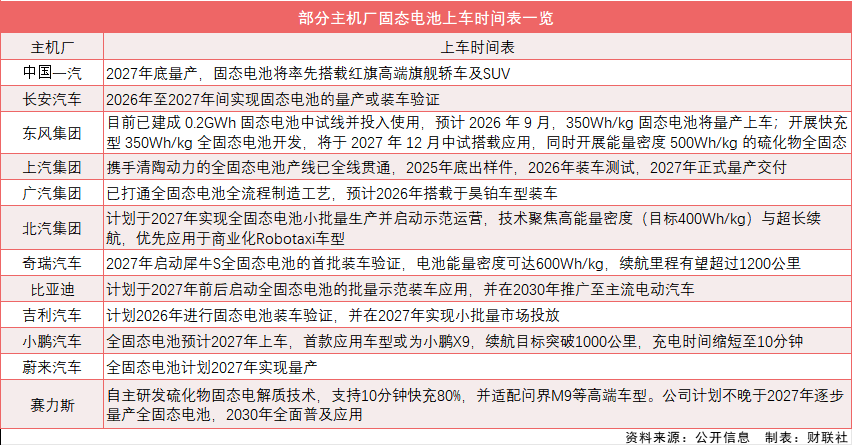
Core Viewpoint - The solid-state battery sector is gaining momentum in the electric vehicle industry, driven by the need to address range anxiety and enhance safety and efficiency. The market has seen a significant increase in solid-state battery stocks, with a 57.3% rise in the index over the past year, highlighting the growing interest and investment in this technology [1]. Group 1: Market Performance - The solid-state battery index rose from 696.24 in April 2025 to 1314.15 by the end of November 2025, reflecting a 57.3% increase [1]. - Companies such as Haike New Energy, Shanghai Xiba, and others have seen their stock prices increase by over 100% within the year [1]. Group 2: Manufacturer Plans - Twelve major automakers, including state-owned enterprises and companies like BYD and Geely, have disclosed their timelines for integrating solid-state batteries, targeting vehicle validation in 2026 and initial mass production in 2027 [1]. - Specific timelines include: - China FAW plans to mass-produce solid-state batteries by the end of 2027 for high-end vehicles [2]. - Changan Automobile aims for mass production or vehicle validation between 2026 and 2027 [2]. - Dongfeng Group has established a pilot line and expects to produce 350Wh/kg solid-state batteries by September 2026 [2]. - SAIC Group plans to deliver samples by the end of 2025 and conduct vehicle tests in 2026 [2]. - GAC Group has completed the manufacturing process for solid-state batteries and aims for vehicle integration in 2026 [2]. - BYD and Geely also have plans for solid-state battery applications around 2027 [2]. Group 3: Policy Support - The development of solid-state batteries is closely linked to government policies, with initiatives aimed at strengthening innovation in the electronic information manufacturing sector [3]. - The Ministry of Industry and Information Technology has emphasized the importance of technological innovation and the acceleration of new technology commercialization in the solid-state battery sector [3]. Group 4: Technical Innovations - The industry is focusing on replacing liquid electrolytes in lithium batteries with solid electrolytes to meet demands for higher energy density and faster charging [4]. - Experts suggest that achieving large-scale application of solid-state batteries will require three to five years of further development [4].



港股评级汇总:招商证券(香港)将巨子生物评级降至中性
Xin Lang Cai Jing· 2025-12-24 07:31
Group 1 - China Merchants Securities (Hong Kong) downgraded the rating of Giant Bio to neutral due to challenges such as a reputation crisis and a decline in sales during the Double Eleven shopping festival, indicating a potential strategic adjustment period in 2026 with no clear catalysts for rebound [1] Group 2 - CICC maintained a "outperform" rating for He Yu-B, setting a target price of 20 HKD, highlighting the approval of its first self-developed innovative drug, with an overall response rate (ORR) of 54%, which could provide new growth momentum for the company [2] Group 3 - CICC maintained a "outperform" rating for Mixue Group with a target price of 555 HKD, noting the brand's resilience in growth despite reduced delivery subsidies and the rapid expansion of its stores, indicating strong growth potential [3] Group 4 - CICC maintained a "outperform" rating for Tmall with a target price of 3.88 HKD, reporting that Q3 sales met expectations with healthy inventory and stable discounts, suggesting a potential stabilization in the channel [4] Group 5 - Huachuang Securities maintained a "strong buy" rating for Geely Automobile with a target price of 27.01 HKD, citing the completion of the Zeekr privatization significantly enhancing profits and brand synergy, with multiple flagship new models driving sales and average selling price (ASP) increases [5] Group 6 - Changjiang Securities maintained a "buy" rating for Aikang Medical, emphasizing its leading position in orthopedics and revenue surpassing pre-collection levels, with effective overseas expansion strategies [6] Group 7 - Changjiang Securities maintained a "buy" rating for Genscript Biotech, highlighting the establishment of a high-barrier pipeline in tumor vaccines and CAR-T therapies, with significant clinical trials expected to start soon [7] Group 8 - Shenwan Hongyuan maintained a "buy" rating for Tmall, noting improvements in channel efficiency and the end of a large-scale store closure phase, with a clear trend of recovery in the terminal market [8] Group 9 - Shenwan Hongyuan initiated coverage on China Railway with a "buy" rating, citing a substantial order backlog of 7.54 trillion, a high gross margin of 59.45% in its resource segment, and attractive valuation due to significant H-share discounts [9] Group 10 - Guosen Securities maintained an "outperform" rating for Zhongxin Innovation, reporting that the company's power battery installation volume ranked among the top three globally in October, with a year-on-year increase of over 75% in energy storage battery shipments [10]

榜单公布|2025 EDGE AWARDS年度上市公司价值榜正式揭晓
Sou Hu Cai Jing· 2025-12-24 02:38
Group 1 - The core viewpoint emphasizes that listed companies in China are not only the main force behind data growth but also serve as a stabilizing factor in the industry ecosystem, focusing on long-term value and comprehensive governance [2] - In 2025, the capital market aims for steady progress and quality improvement amidst multiple risks, enhancing market resilience and risk resistance, leading to reasonable quantitative growth and effective qualitative enhancement [2] - The market's expectations for listed companies have shifted from short-term performance to long-termism and comprehensive value, including governance structure, stable returns, strategic layout in frontier fields, and deep ESG practices [2] Group 2 - The 2025 T-EDGE Global Dialogue, organized by Titanium Media Group, NextFin.AI, and Barron’s China, highlights the importance of recognizing companies that redefine industry boundaries and emphasizes the core logic of "value investment" [3] - The EDGE AWARDS annual list includes categories such as Most Socially Responsible Company, Best Board Secretary, Most Investment Value Company, and Best Investor Relations Management Company, recognizing outstanding performance in governance, investment value, social responsibility, and investor relations [3][4] Group 3 - Aier Eye Hospital is recognized as a leader in ESG practices, integrating ESG into its core business and governance structure, while actively engaging in public welfare projects to enhance national eye health [5] - Betaini Group focuses on creating a skin health ecosystem and incorporates green development into its strategy, promoting biodiversity and sustainable practices [6] - Kweichow Moutai leads the liquor industry with a brand value of 468.718 billion, actively engaging in ecological protection and social responsibility initiatives [7] - JD Group has created significant employment opportunities and is committed to improving living conditions for its delivery personnel, with plans to invest 22 billion in housing projects [8] - Quantitative Group, listed on the Hong Kong Stock Exchange, leverages AI technology to reshape online consumption and has achieved a compound annual growth rate of 44.59% in revenue from 2022 to 2024 [9] - Seres focuses on new energy vehicles and has established a robust ESG governance framework, with significant growth in revenue and sales projected for 2024 [10] - Shui Jing Fang integrates social responsibility into its corporate strategy, setting clear environmental goals and contributing to community development [11] - China Baoan actively engages in social responsibility through its subsidiaries, contributing to community welfare and healthcare improvements [13] Group 4 - The Best Board Secretary category highlights the importance of effective communication between listed companies and the public, emphasizing the role of board secretaries in enhancing corporate governance [14] - Ren Shunying from Anfu Technology is recognized for her expertise in capital operations and corporate governance, significantly contributing to the company's compliance and investor relations [15] - Xia Ping from Jiahe Intelligent is noted for her effective investor relations management and participation in strategic planning [16] - Li Liangyu from Robotech is acknowledged for his role in maintaining corporate governance and enhancing market recognition [17] - Zhang Wenyu from Tianqi Lithium is recognized for his contributions to market value management and investor relations [18] Group 5 - The Most Investment Value Company category identifies companies with clear business models and significant breakthroughs in technology or policy, indicating strong growth potential [19][20] - Orbbec, a leader in 3D vision technology, has achieved over 70% market share in key sectors and continues to lead industry advancements [20] - BYD maintains its position as a global leader in new energy, with significant growth in overseas markets and a strong investment outlook [21] - Cambrian has entered a critical profitability phase, with substantial revenue growth and a strong market position in AI chips [22] - Hanlan Environment focuses on environmental services and has achieved consistent profit growth, attracting long-term investors [23] - Geely Auto has demonstrated strong financial performance and strategic integration, positioning itself for sustained growth [24] - Kanghong Pharmaceutical emphasizes innovation in drug development and has shown robust revenue growth, indicating long-term investment value [25] - Lens Technology maintains a strong market position with solid cash flow and growth potential in the automotive and consumer electronics sectors [26]


首批L3级车型获批上路,产业链升级在即 | 投研报告
Zhong Guo Neng Yuan Wang· 2025-12-24 02:04
Core Insights - The transition from L2 to L3 represents a critical leap from driver assistance to autonomous driving, with responsibility potentially shared among drivers, manufacturers, and autonomous system suppliers [2] Investment Summary - The first L3-level vehicles have been approved for road use, marking a significant milestone in China's autonomous driving industry, transitioning from laboratory testing to legitimate road applications [3] - The approval establishes a clear safety baseline by allowing conditional and limited scenarios for testing, promoting innovation while ensuring safety [3] - The high reliability and safety redundancy requirements of L3 systems will drive technological upgrades across the entire supply chain, including perception hardware, computing platforms, and software algorithms [3] Future Outlook - Pilot programs are expected to expand from current highway and congested scenarios to more complex urban roads, with legal and technical standards evolving based on pilot experiences to support broader adoption [3] - The high costs associated with vehicles equipped with advanced autonomous driving features need to decrease through technological advancements and economies of scale for widespread consumer adoption [3][4] Investment Strategy and Focus - The automotive sector should focus on undervalued leading manufacturers and component suppliers benefiting from performance improvements, particularly in the fields of new energy and intelligent vehicles [5] - Recommended companies include early movers in the new energy sector such as BYD, Changan Automobile, Geely, and Li Auto; stable low-valuation component leaders like Huayu Automotive and Fuyao Glass; and key players in electrification and intelligence like Desay SV, Ruikeda, and Kobot [5] - The strategy also highlights opportunities arising from domestic substitution due to the "domestic circulation" initiative, with companies like Lingdian Electric Control and Sanhua Intelligent Control being of interest [5] Key Focus Companies - The investment focus for the week includes BYD, Li Auto, Top Group, Desay SV, and Shangsheng Electronics [6]



汽车早餐 | 极氪完成私有化;沃尔沃中国回应“换帅”;启境首款车型开启全国路测
Zhong Guo Qi Che Bao Wang· 2025-12-24 01:47
Group 1: Electric Vehicle Infrastructure - As of the end of November, China's electric vehicle charging infrastructure reached 19.322 million units, a year-on-year increase of 52.0% [2] - Public charging facilities accounted for 4.625 million units, growing by 36.0%, while private charging facilities reached 14.697 million units, with a growth of 57.8% [2] - By 2026, China plans to build over 10,000 charging units in national highway service areas, with at least 25% being high-power chargers [5] Group 2: Autonomous Driving and Vehicle Technology - Beijing issued the first L3-level highway autonomous vehicle special license plates, marking a significant milestone in the mass production of autonomous vehicles in China [4] - Samsung SDI announced a partnership with KG Mobility to develop advanced battery pack technology for electric vehicles, focusing on safety and durability [6] Group 3: Automotive Industry Developments - The "Yue Che Nan Xia" policy allows private cars from four cities in Guangdong to enter Hong Kong, with a maximum stay of three days [3] - Geely Auto completed the privatization of Zeekr, which is now a wholly-owned subsidiary, and management adjustments have been finalized [10] - Volvo China clarified that recent changes in legal representation are administrative and do not affect the management team or daily operations [11] Group 4: Market Trends and Regulatory Issues - European new car sales increased for the fifth consecutive month in November, driven by rising electric vehicle registrations in Germany, Italy, and Spain [9] - Concerns over electric vehicle door handle designs have led to safety reviews by regulators across three continents, impacting companies like Tesla [7] - Mercedes-Benz reached a $120 million settlement with multiple U.S. states regarding emissions cheating allegations [8] Group 5: Company Innovations and Projects - EVE Energy launched a project for sodium-ion batteries and AI robotics, aiming to fill market gaps and promote large-scale applications in energy storage and automation [13] - Qijun Automotive announced the nationwide road testing of its first model, a hunting-style coupe, set to launch in June 2026 [14]

金融界财经早餐:超高规格央企负责人会议释放关键战略信号!贵金属牛市继续;中芯国际对部分产能涨价;北京发放首批L3级车辆专用号牌(12月24日)
Jin Rong Jie· 2025-12-24 01:33
Economic Policy and Market Overview - President Xi Jinping emphasized the need for central enterprises to focus on their main responsibilities and enhance core competitiveness, while promoting technological innovation and deepening reforms [1] - Premier Li Qiang highlighted the importance of providing strong support for major infrastructure projects and ensuring the resilience of industrial supply chains [1] - The Ministry of Housing and Urban-Rural Development aims to stabilize the real estate market by implementing city-specific policies to control inventory and improve supply [1] Capital Market Developments - A-shares have achieved a historic annual trading volume exceeding 400 trillion yuan, with an average turnover rate approaching 1.74% [4] - Major foreign institutions, including Goldman Sachs and Morgan Stanley, have released optimistic forecasts for the Chinese stock market in 2026, citing improving corporate earnings and attractive valuations [4] - The issuance of Sci-Tech bonds surpassed 1.7 trillion yuan in 2025, enhancing financing channels for innovative enterprises [4] Industry Highlights - The commercial aerospace sector is witnessing growth, with the Long March 12 rocket achieving a 90% domestic production rate and a design for 50 reuses [6] - The medical device industry is set for improvement as a new round of high-value medical consumables procurement begins, with expectations for performance recovery in Q4 and 2026 [6] - The launch of L3-level autonomous driving vehicle license plates in Beijing marks a significant milestone in the mass production of autonomous vehicles [6] Company News - Semiconductor manufacturer SMIC has implemented a price increase of approximately 10% on certain production capacities [8] - Sunac China has completed all prerequisites for its overseas debt restructuring, resulting in the release of approximately 9.6 billion USD in existing debt [8] - Geely Automobile has officially merged with Zeekr, with the transaction valued at approximately 2.399 billion USD [10] - Shanghai Birun Technology is seeking to raise up to 623 million USD through a Hong Kong IPO, marking a potential significant year for AI company listings [10] - Tesla's sales in Europe continued to decline, while its competitor BYD saw a significant increase in sales, capturing a growing market share [12]



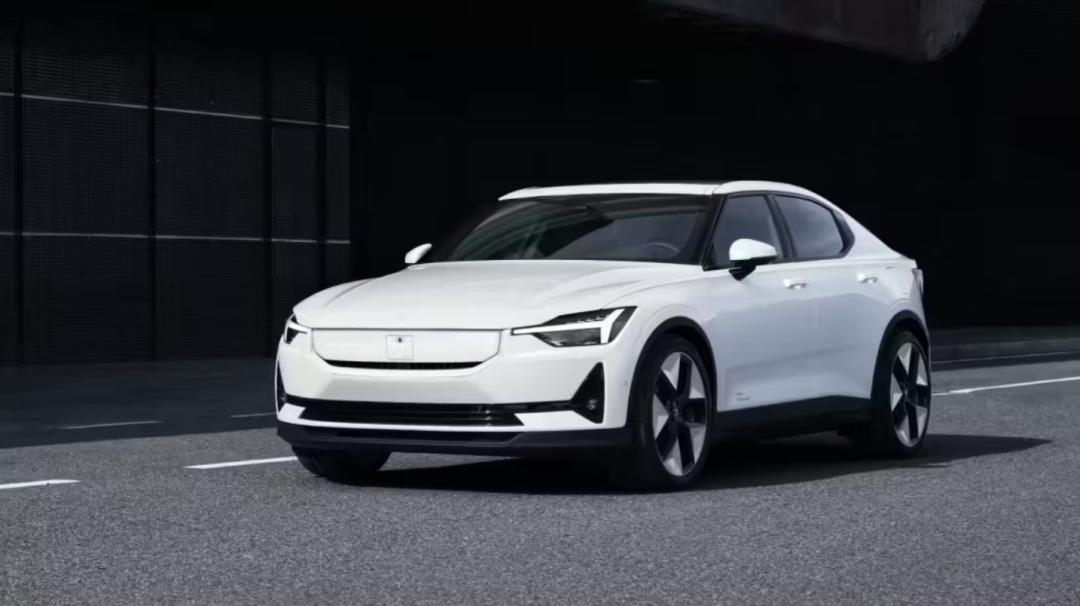
李书福42亿出手,“国内月销16辆”车企续上了
3 6 Ke· 2025-12-24 01:32
Core Viewpoint - Polestar has received a significant financial lifeline of approximately 6.3 billion yuan, primarily from its major shareholder Geely, to address its ongoing financial struggles and low sales performance in China [1][2]. Financial Situation - Polestar's cash reserves were reported at 9.95 billion yuan as of the end of Q3, indicating a critical need for funding to sustain operations [4][5]. - The company experienced a net loss of 15.58 billion yuan in the first three quarters of the year, a 79.7% increase compared to the previous year [4][5]. - Despite a 49% year-on-year revenue growth to 21.7 billion yuan, the gross margin plummeted to -34.5%, significantly lower than the previous year's -2.1% [4][5]. Sales Performance - In the first nine months of the year, Polestar's global sales reached 44,482 vehicles, marking a 36.5% increase year-on-year. However, in China, only 163 vehicles were sold in the first ten months, averaging 16 vehicles per month [2][4]. - The company's stock price has dropped approximately 57% since the beginning of the year and over 95% since its NASDAQ debut in 2021 [6][8]. Strategic Adjustments - Polestar is shifting its focus from the Chinese market to Europe, where about 75% of its sales are generated, and has begun closing its physical stores in China to adopt an online sales model [15][16]. - The company aims to leverage its high-end positioning and European market strengths, particularly with its Nordic design and Volvo safety credentials [18]. Geely's Support - Geely has consistently provided financial support to Polestar, including a recent 6 billion yuan loan and previous investments, indicating a long-term commitment to the brand [2][11]. - The relationship between Geely and Polestar is strengthened by their shared history with Volvo, which has facilitated resource sharing and technological support [9][11].
智通港股回购统计|12月24日




智通财经网· 2025-12-24 01:19
智通财经APP获悉,摩比发展(00947)、瑞声科技(02018)、富智康集团(02038)、吉利汽车(00175)、昊海 生物科技(06826)、VITASOY INT'L(00345)、永升服务(01995)、希玛眼科(03309)、歌礼制药-B(01672)、 亲亲食品(01583)、周黑鸭(01458)、绿城服务(02869)、中国旭阳集团(01907)、柠萌影视(09857)、移卡 (09923)、联易融科技-W(09959)、枫叶教育(01317)、信利国际(00732)、创新奇智(02121)、天福 (06868)、百宏实业(02299)、天润云(02167)、海吉亚医疗(06078)、巨子生物(02367)、天伦燃气(01600)、 IGG(00799)、滨海投资(02886)、首程控股(00697)、腾讯控股(00700)、天虹国际集团(02678)、中远海控 (01919)、同道猎聘(06100)、易点云(02416)、明源云(00909)、鹰瞳科技-B(02251)、津上机床中国 (01651)、名创优品(09896)、小米集团-W(01810)、天立国际控股(01773)、一脉阳光(N ...
Jameel Motors推动阿联酋商用电动车全面落地
Shang Wu Bu Wang Zhan· 2025-12-23 16:46
Core Viewpoint - Jameel Motors plans to fully launch the entire range of electric commercial vehicles from Farizon Auto, a subsidiary of Geely Holding, in the UAE by 2026 to support decarbonization strategies and fleet electrification [1] Group 1 - Jameel Motors has obtained the dealership rights for Farizon Auto in the UAE, effective from 2025 [1] - The company has opened its first showroom and service center in Dubai [1]
今日新闻丨吉利汽车与极氪完成整合!“哈曼音响”进军辅助驾驶行业!北京发放首批L3专用号牌!
电动车公社· 2025-12-23 16:06
Group 1 - Geely Automobile has completed the integration of Zeekr, with Zeekr now being a wholly-owned subsidiary of Geely after its delisting from the NYSE [2][5] - The integration is expected to reduce costs for Geely Group by consolidating R&D, supply chain, and manufacturing systems, allowing Zeekr to leverage Geely's global channels for faster international expansion [5] - This move is anticipated to enhance Geely's market share in the high-end segment through Zeekr's advanced technology, benefiting both companies in the long term [5] Group 2 - Harman International, a subsidiary of Samsung Electronics, is entering the advanced driver-assistance systems (ADAS) market by acquiring ZF Friedrichshafen AG's ADAS business for €1.5 billion [7] - This acquisition will provide Harman with essential technologies and products related to ADAS, including in-vehicle front cameras and ADAS controllers, marking its entry into a rapidly growing market [7][9] - The acquisition is expected to position Harman as a leader in the automotive smart camera sector while helping ZF alleviate its rising debt issues [9] Group 3 - Beijing has issued its first specialized license plates for L3 level autonomous vehicles, officially granted to three BAIC Jihu smart connected cars under Beijing Travel Automobile Service Co., Ltd [11] - This issuance represents a significant milestone in China's transition from testing to mass production of L3 autonomous vehicles, marking the beginning of the L3 autonomous driving era [11][14] - The recent issuance of L3 testing licenses to multiple automotive brands indicates a broader shift towards the commercialization of autonomous driving technology in the country [14]