GEELY AUTO(00175)

Search documents
吉利磷酸铁锂再“落子”
起点锂电· 2026-02-28 10:22
Core Viewpoint - The article highlights the strategic advancements of Geely in the lithium battery sector, particularly through the establishment of its subsidiary, Jiangxi Yiyuan New Energy Technology Co., Ltd., which marks a significant step towards self-sufficiency in battery materials and supply chain security [2][3]. Group 1: Production and Capacity - Jiangxi Yiyuan New Energy is set to process 40,000 tons of waste lithium iron phosphate batteries annually and aims to produce 30,000 tons of lithium iron phosphate precursor and 30,000 tons of lithium iron phosphate cathode materials [3]. - The project represents a closed-loop system from battery recycling to material regeneration and production, enhancing Geely's supply chain stability and reducing raw material costs [3][4]. Group 2: Market Dynamics - The lithium iron phosphate industry is entering a new upward cycle, with prices rebounding from approximately 30,000 yuan per ton in mid-2025 to a range of 57,000 to 63,000 yuan per ton for power-type lithium iron phosphate as of late February 2026, reflecting an overall increase of over 90% [5]. - Geely's self-produced capacity will help mitigate some price risks and stabilize production costs amid rising raw material prices [5][6]. Group 3: Sales and Product Strategy - In 2025, Geely plans to sell 3.02 million vehicles, with 1.687 million being new energy vehicles, where the Galaxy series, representing low-end brands, is expected to account for 73.5% of total new energy sales [6]. - The Galaxy series, priced between 68,800 and 100,000 yuan, is projected to achieve sales of 460,000 units, making it the best-selling passenger car in China across all categories in 2025 [6]. Group 4: Supply Chain Integration - The establishment of Yiyuan New Energy will enhance Geely's self-sufficiency in lithium iron phosphate, reducing reliance on external suppliers and strengthening its position in the industry [7]. - Geely has created an integrated ecosystem covering "resources - materials - batteries - vehicles," ensuring a stable supply of upstream raw materials through strategic acquisitions and partnerships [8]. Group 5: Future Outlook - Geely aims to achieve a battery production capacity of 70 GWh by 2027, with a target of 40% self-sufficiency in battery supply, supporting both new energy vehicles and energy storage sectors [10]. - The company has seen a significant increase in battery installation volume, with a year-on-year growth of 156% in the first half of 2025, positioning it among the fastest-growing companies in the sector [9][10].


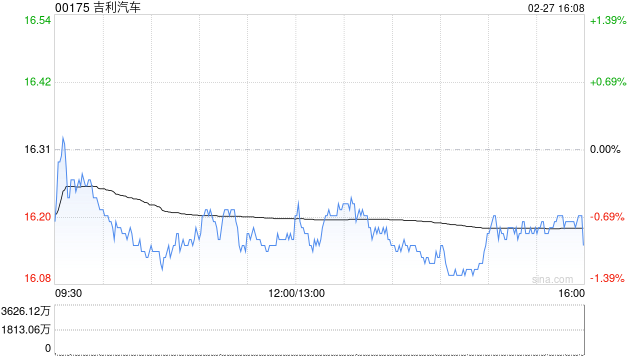
吉利汽车于2月27日斥资5943.27万港元回购367.3万股
Xin Lang Cai Jing· 2026-02-28 03:40
Group 1 - Geely Automobile (00175) announced a share buyback plan, intending to repurchase 3.673 million shares at a cost of HKD 59.4327 million [2] - The buyback is scheduled for February 27, 2026, indicating the company's strategy to enhance shareholder value [2] - This move reflects Geely's confidence in its long-term growth prospects and aims to stabilize its stock price [2]
极氪取得轮边阀及轮胎充放气系统专利
Sou Hu Cai Jing· 2026-02-28 02:41
Group 1 - Zhejiang Geely Holding Group Co., Ltd. and Zhejiang Zeekr Intelligent Technology Co., Ltd. have obtained a patent for a "wheel edge valve, tire inflation and deflation system, and vehicle," with the authorization announcement number CN119878876B, applied on October 2023 [1] - Zhejiang Zeekr Intelligent Technology Co., Ltd. was established in 2021, located in Ningbo, focusing on research and experimental development, with a registered capital of 1.3 billion RMB [1] - The company has invested in 10 enterprises, participated in 191 bidding projects, and holds 5,000 patent records, along with 4 administrative licenses [1] Group 2 - Zhejiang Geely Holding Group Co., Ltd. was founded in 2003, located in Hangzhou, primarily engaged in the automotive manufacturing industry, with a registered capital of 1.03 billion RMB [1] - The company has invested in 39 enterprises, participated in 506 bidding projects, and has 5,000 trademark records and 5,000 patent records, in addition to holding 275 administrative licenses [1]
六座SUV行业深度研究报告:六座SUV的蓝海机遇与红海竞争
Huachuang Securities· 2026-02-27 13:06
Investment Rating - The report maintains a recommendation for the six-seat SUV industry, highlighting both blue ocean opportunities and red ocean competition [2] Core Insights - The six-seat SUV market is expected to see the launch of five new models priced around 200,000 yuan in 2026, with top models potentially achieving monthly sales of 10,000 to 20,000 units [2][22] - The high-end six-seat SUV market is experiencing intense competition, with a significant increase in supply expected in 2026, outpacing market expansion [2][6] - The 200,000 yuan segment remains a potential blue ocean market, as current models often fail to meet consumer demands due to size and pricing issues [6][24] Summary by Sections Total Market Overview - The six-seat SUV market is projected to grow, with an estimated total of 150,000 units sold in 2025, reflecting a year-on-year increase of 21,000 units [13] - The market is expected to continue expanding with the introduction of new models, particularly in the 200,000 yuan segment [6][10] Blue Ocean Opportunities - The 200,000 yuan segment for six-seat SUVs is identified as a significant market opportunity, with current models not meeting consumer expectations in terms of size and pricing [6][22] - The report notes that the proportion of six-seat SUVs priced below 250,000 yuan is only 4.9%, compared to 28% for those above this price point, indicating room for growth [24] Red Ocean Competition - The high-end six-seat SUV market is set to intensify with 22 new models expected to launch in 2026, leading to fierce competition [2][6] - The report highlights a shift in product strategy from size combinations to price combinations, indicating evolving consumer preferences [2][10] Investment Recommendations - The report suggests focusing on companies like Leap Motor and Great Wall Motors, with specific models expected to drive significant sales growth [7][10] - Geely is also recommended due to its ongoing product cycle contributing to sales and profit increases [7][10]





吉利磷酸铁锂布局落下关键一子
高工锂电· 2026-02-27 12:29
Core Viewpoint - Geely is moving beyond the competition of complete vehicle products and entering the competition at the industrial chain level [3] Group 1: Geely's New Energy Strategy - Jiangxi Yiyuan New Energy Technology Co., Ltd. has officially completed the production of its lithium iron phosphate cathode material project, with a total investment of 2.5 billion yuan and an annual recycling capacity of 40,000 tons of lithium iron phosphate batteries [4] - The successful production of Yiyuan New Energy marks a key breakthrough for Geely in the core material segment of power batteries, facilitating cost control and supporting technological self-iteration [5] - The establishment of the lithium iron phosphate factory signifies Geely's transition from vehicle competition to industrial chain competition [5] Group 2: Competitive Landscape - Geely is not the first automaker to invest in upstream cathode materials, with BYD being the most advanced competitor, having established a closed-loop system from lithium resources to complete vehicles [6] - BYD has invested in various upstream lithium resources and has built multiple battery production bases, creating a controllable system from raw materials to complete vehicles [7] - In 2025, Geely's annual sales are projected to reach 3.02 million vehicles, a significant increase of 39% year-on-year, while BYD's retail sales are expected to decline by 6.3%, narrowing the sales gap between the two companies [8] Group 3: Sales Performance and Product Strategy - In January 2026, Geely surpassed BYD in total sales, reclaiming the title of sales champion [9] - Among Geely's projected sales of 3.02 million vehicles in 2025, 1.687 million will be new energy vehicles, with the Galaxy series accounting for 73.5% of new energy sales [10] - The Galaxy series, particularly the Xingyuan model, is a key player in the market, with sales of 460,000 units, making it the best-selling passenger car in China for 2025 [10] Group 4: Supply Chain and Material Strategy - The launch of the Yiyuan New Energy lithium iron phosphate project is a strategic move by Geely to enhance its supply chain and address its shortcomings in cathode materials [11] - The project aims to achieve comprehensive utilization of 40,000 tons of waste lithium iron phosphate batteries annually, ensuring local supply of raw materials and improving supply chain stability [13] - Geely's battery business is structured into three core segments, with significant production capacity planned across various bases [14] Group 5: Resource Acquisition and Future Outlook - Geely has systematically laid out its lithium resource strategy through equity cooperation and strategic investments, securing key raw materials for lithium iron phosphate production [15] - The completion of the Yiyuan project allows Geely to continue upgrading its material strategies, particularly in lithium iron phosphate and manganese lithium phosphate [16] - Geely's vertical integration strategy from vehicle manufacturing to battery production and material sourcing aims to create a robust competitive advantage in the face of rising raw material costs [16]
信义光能2025年收入逾208亿元 中创新航年度盈利同比增超140%
Xin Lang Cai Jing· 2026-02-27 12:13
Performance Summary - Xinyi Solar (00968.HK) reported a revenue of 20.861 billion yuan for 2025, a decrease of 4.8% year-on-year, with a net profit of 844.5 million yuan, down 16.2%, primarily due to a decline in average selling prices of solar glass products [2] - Zhongxin Innovation (03931.HK) expects a net profit of 2.025 billion to 2.193 billion yuan for 2025, an increase of approximately 140% to 160% compared to the previous year, driven by high growth in leading technology products across passenger, commercial, and energy storage sectors [2] - Rongchang Bio (09995.HK) anticipates a revenue of 3.251 billion yuan for 2025, an increase of 89.36% year-on-year, with a net profit of 709 million yuan, turning profitable due to increased sales of Tislelizumab and injection-use Vedolizumab [2] - Xinyi Energy (03868.HK) expects a revenue of 2.453 billion yuan for 2025, a slight increase of 0.53%, with a net profit of 1.011 billion yuan, up 27.79% [2] - Sihang Property (00083.HK) reported a revenue of 5.185 billion HKD for the six months ending December 31, 2025, an increase of 34.54%, while net profit decreased by 15.77% to 1.533 billion HKD [3] - Haohai Biological Technology (06826.HK) expects a revenue of approximately 2.473 billion yuan for 2025, a decrease of 8.33%, with a net profit of about 251 million yuan, down 40.3% [4] - Chunli Medical (01858.HK) anticipates a total revenue of approximately 1.044 billion yuan for 2025, a year-on-year increase of 29.52%, with a net profit of 272 million yuan, up 117.72% [5] - Baosheng International (03813.HK) issued a profit warning, expecting a net profit of approximately 211 million yuan for 2025, a decrease of about 57.1% [6] - Chip Intelligence Holdings (02166.HK) expects a net profit of approximately 140 million to 170 million HKD for 2025, an increase of about 40% to 70%, benefiting from the booming AI technology and increasing market demand [6] - Fengcai Technology (01304.HK) anticipates a total revenue of approximately 774 million yuan for 2025, a year-on-year increase of 28.91%, with a net profit of about 227 million yuan, up 1.92% [6] - Huayou Energy (01251.HK) issued a profit warning, expecting a loss of approximately 100 million to 150 million HKD for the 2025 fiscal year [7] - Zhoneng Group (00131.HK) reported a revenue of 272 million HKD for the six months ending December 31, 2025, an increase of 250.64%, with a net profit of 180 million HKD, turning profitable [8] - Fudan Zhangjiang (01349.HK) expects a revenue of approximately 686 million yuan for 2025, a decrease of 3.33%, with a net loss of approximately 157 million yuan, turning from profit to loss [9] Company News - Bay Area Development (00737.HK) reported that the total toll revenue for January from the Guangzhou-Shenzhen Expressway, Guangzhou-Zhuhai West Line Expressway, and the Shenzhen section of the Yangtze River Expressway was approximately 241 million, 105 million, and 75.169 million yuan, respectively, representing year-on-year growth of 15%, 17%, and 19% [10] - LeCang Logistics (02490.HK) plans to acquire two large container ships [10] - Innovent Biologics (01801) received approval for Jebatuzumab (Pimobendan) in China for the indication of relapsed or refractory chronic lymphocytic leukemia or small lymphocytic lymphoma [11] Buyback Activities - Xiaomi Group-W (01810.HK) repurchased 2.8582 million shares for a total of approximately 99.9973 million HKD, with a repurchase price ranging from 34.92 to 35.04 HKD per share [12] - Geely Automobile (00175.HK) repurchased 3.673 million shares for approximately 59.4327 million HKD, with a repurchase price between 16.1 and 16.3 HKD [13] - Miniso Group (09896.HK) repurchased approximately 0.0526 million shares for about 1.8893 million HKD, with a repurchase price ranging from 35.64 to 36.34 HKD [14] - NetEase Cloud Music (09899.HK) repurchased approximately 0.09715 million shares for about 14.9959 million HKD, with an average repurchase price of 154.36 HKD [14]

华润医药商业高层变动,郭霆正式出任董事长|大公司日报
Sou Hu Cai Jing· 2026-02-27 10:35
Consumption - Puma reported a Q4 revenue of €1.56 billion, a year-on-year decline of 27.2%, with a net loss of €337 million compared to a profit of €24.5 million in the same period last year [1] - Luckin Coffee announced a total net revenue of ¥49.288 billion for 2025, representing a year-on-year growth of 43%, with over 31,000 stores and more than 450 million cumulative transaction customers [1] - The Ministry of Commerce reported a 5.7% year-on-year increase in daily sales for key retail and catering enterprises during the Spring Festival, with inbound tourism orders growing by 18.4% [17][18] Travel - Lynk & Co's executive apologized for a car accident caused by a voice command that mistakenly turned off the headlights, stating that an optimization plan has been implemented to prevent such incidents in the future [2] - Geely Auto repurchased 3.841 million shares at approximately HK$63.12 million, with a weighted average price of HK$16.43 per share [2] Health - Sino Medical reported a 30-fold increase in net profit for 2025, while MaiDe Medical achieved a 63% revenue growth, marking a turnaround [4] - A new patent for Schisandra polysaccharides addresses the growing demand for gut health products, which is expected to reach over ¥120 billion, highlighting a significant market opportunity [19] Technology - Baidu's total revenue for 2025 reached ¥129.1 billion, with AI business revenue accounting for ¥40 billion, and Q4 revenue of ¥32.7 billion showing a 5% year-on-year increase [6] - JD.com launched a "Billion Supermarket" channel, planning to invest over ¥20 billion in product subsidies over the next three years to achieve an additional sales increment of ¥200 billion [7] - Meizu announced a halt to the development of new domestic smartphone products due to financial issues, reflecting broader challenges in the consumer electronics industry [15][16]




观车 · 论势 || 从“出海”合作看中国车企全球化底气
Zhong Guo Qi Che Bao Wang· 2026-02-27 10:24
Core Viewpoint - Geely is expanding its global strategy through potential collaboration with Ford, focusing on capacity sharing and technology cooperation, which aligns with its previous partnership with Renault, indicating a shift in Chinese automakers' approach to globalization from "market for technology" to "technology-driven cooperation" [1] Group 1: Geely and Ford Collaboration - Geely is negotiating with Ford to utilize Ford's existing factories in Europe for producing vehicles aimed at the European market, while also exploring a framework for vehicle technology sharing, particularly in autonomous driving [1] - The collaboration aims to enhance Ford's factory utilization in Europe and provide Geely with local production capabilities to avoid high tariffs on electric vehicles imposed by the EU [3] Group 2: Geely and Renault Partnership - The partnership between Geely and Renault has established a "technology-capital-market" cooperation system, allowing both companies to leverage each other's strengths, particularly in the Brazilian market where they formed a joint venture to introduce new energy vehicles [2] - This model has proven effective in addressing the challenges faced by traditional automakers in Europe and facilitating Chinese automakers' entry into overseas markets [2] Group 3: Broader Industry Trends - The collaboration model of capacity sharing is becoming a key strategy for Chinese automakers to navigate trade barriers and establish a sustainable presence in foreign markets, as building independent factories is costly and time-consuming [1][2] - Other Chinese automakers, such as Chery, are also adopting similar strategies, partnering with local firms to enhance their production capabilities and market presence in Europe [3] Group 4: Technological Empowerment - Chinese automakers are increasingly taking on the role of technology providers in partnerships, showcasing their technological advancements in the electric and intelligent vehicle sectors, which marks a significant shift from their previous passive roles [4] - This transition reflects the growing technical strength of Chinese automakers and is a crucial indicator of the rise of the Chinese automotive industry on the global stage [4] Group 5: Challenges Ahead - Despite the progress, Chinese automakers face challenges such as cultural differences, varying automotive standards, and geopolitical risks that need to be addressed as they expand globally [4] - Intellectual property issues, including standard essential patent litigation, pose additional risks in the globalization process for Chinese companies [4] Group 6: Future Outlook - The arrival of the electric and intelligent era has positioned Chinese automakers like Geely, Chery, Xpeng, and Leap Motor to take the initiative in global competition through capacity sharing, technology output, and ecosystem collaboration [5] - These strategies are gradually reshaping the competitive landscape of the global automotive industry, pushing it towards a new phase of deep collaboration in electrification and intelligence [5]

多品牌车主尝试语音关闭大灯:特斯拉、小米均无法实现
Feng Huang Wang· 2026-02-27 09:18
Core Viewpoint - Recent incidents involving Lynk & Co vehicles highlight a significant issue with voice command functionality, leading to safety concerns and prompting immediate responses from the company [1] Group 1: Incident Overview - Lynk & Co vehicles experienced a malfunction where voice commands inadvertently turned off headlights while driving, raising safety alarms [1] - Other brands, including Tesla and Xiaomi, were tested and found to have similar limitations, requiring vehicles to be in park mode to turn off headlights [1] - The issue was also reported by Zeekr owners, with some users sharing videos of the malfunction [1] Group 2: Company Response - Mu Jun, Vice President of Lynk & Co Sales, stated that the company has implemented a voice control optimization plan and pushed updates to prevent headlight shutdown while driving [1] - The company expressed gratitude for user feedback and apologized for the inconvenience caused by the incident [1]

吉利投资魅族或已失败,Flyme能否担当重任?
Sou Hu Cai Jing· 2026-02-27 09:10
Core Viewpoint - Meizu's mobile business is set to terminate, with a formal exit from the market in March 2026, highlighting the challenges faced by Geely Holdings in integrating Meizu into its broader automotive and consumer electronics ecosystem [1][2]. Group 1: Business Performance and Strategy - Geely acquired Meizu in 2022 with the intention of creating a "mobile-vehicle-home" ecosystem, but the mobile business has contracted significantly, with market share dropping below 1% and continuous losses reported [2][5]. - In 2025, Meizu's mobile sales plummeted to 980,000 units, a decline of over 40% year-on-year, resulting in a loss of 1.23 billion yuan, marking seven consecutive years of losses [2][6]. - The mobile business's operational challenges have led to a "death spiral" of declining sales, high costs, and increasing losses, with an average loss of 1,255 yuan per device sold [2][9]. Group 2: Financial Metrics - Geely's financial report for the first three quarters of 2025 shows a net profit of 13.11 billion yuan, while Meizu's ongoing losses have become a significant drag on overall performance [3]. - The smartphone market in China saw a slight decline in shipments, with major brands like Huawei, Apple, Vivo, Xiaomi, and OPPO capturing over 80% of the market share, leaving little room for smaller brands like Meizu [5][6]. Group 3: Supply Chain and Cost Issues - Meizu lacks bargaining power in the supply chain, facing component costs that are 15%-30% higher than leading brands, compounded by fixed expenses in R&D, channels, and marketing [9]. - The rising costs of smartphone components, including a 75% increase in memory prices in 2025, have severely impacted Meizu's profitability, leading to the cancellation of new product launches [6][9]. Group 4: Future Prospects - With the cessation of hardware development, Flyme is positioned as Meizu's core asset, with plans to transition it from a mobile OS to a smart cockpit system, aiming to leverage software capabilities to compensate for hardware losses [9][11]. - The future of Meizu is bifurcated into two potential paths: a successful transformation into a software service provider or a decline into a support role within Geely's automotive strategy, risking the loss of brand identity [12][13].