
CHINA RES BEER(00291)

Search documents
上半年啤酒股业绩分化局势复杂,业内忙出圈业外忙入局
Di Yi Cai Jing· 2025-08-19 10:44
Core Viewpoint - The domestic beer industry in China is experiencing a complex situation with performance divergence between domestic and foreign brands, as domestic companies continue to grow through premiumization while foreign brands face stagnation or decline [2][3]. Group 1: Performance of Domestic Beer Companies - China Resources Beer reported a revenue of 23.94 billion RMB, a year-on-year increase of 0.8%, and a net profit of 5.79 billion RMB, up 23% [3]. - The beer business revenue reached 23.16 billion RMB, growing by 2.6%, with premium and above beer sales increasing by over 10% [3]. - Yanjing Beer achieved a revenue of 8.56 billion RMB, a 6.4% increase, and a net profit of 1.1 billion RMB, up 45.5% [4]. Group 2: Performance of Foreign Beer Brands - Budweiser APAC saw a decrease in sales volume in China by 8.2%, with revenue and revenue per hectoliter down by 9.5% and 1.4%, respectively [3]. - Chongqing Beer reported a revenue of 8.839 billion RMB, a slight decline of 0.2%, and a net profit of 870 million RMB, down 4% [3]. Group 3: Market Trends and Consumer Behavior - The beer market is shifting from traditional social drinking to home consumption, with retail beer sales now accounting for over 60% of total beer consumption [5][6]. - The rise of e-commerce and instant retail has contributed to double-digit growth in new retail channels for beer [5][6]. - The beer industry is facing intense competition, with a reported 0.3% decline in production among large-scale breweries in the first half of 2025 compared to the previous year [8]. Group 4: Industry Diversification and New Entrants - Companies from other industries, such as Wuliangye and Three Squirrels, are entering the beer market, particularly in the craft beer segment, which is seen as a key area for future premiumization [7][8]. - Beer companies are diversifying their product offerings to include beverages and spirits to adapt to market changes and consumer preferences [8][9]. - The competitive landscape is evolving, with a focus on meeting diverse consumer needs through innovative and differentiated products [9].

华润物流与GKE合作的香港有色金属交割仓正式揭牌
Xin Hua Cai Jing· 2025-08-19 10:38
Core Viewpoint - The establishment of the London Metal Exchange (LME) delivery warehouses in Hong Kong marks a significant step in enhancing Hong Kong's role in the global commodities trading ecosystem, particularly in response to the growing demand for metals driven by the development of new energy and high-tech industries [1][2]. Group 1: Market Opportunities - The global demand for metals is expected to continue rising due to the booming new energy and high-tech industries, presenting substantial market opportunities [1]. - The integration of Hong Kong into the LME delivery network is seen as a crucial move to strengthen its position as an international financial and shipping center [1][2]. Group 2: Logistics and Infrastructure - The collaboration between China Resources Logistics and GKE Metal Logistics aims to provide comprehensive services for bulk metal trading, including warehousing, storage, and cross-border transportation [3]. - The successful completion of the first batch of LME deliveries, including copper, nickel, and tin, is expected to reduce delivery times and optimize logistics costs for market participants [3]. Group 3: Economic Integration - The Hong Kong government emphasizes the importance of integrating commodity economics with financial services, such as insurance and financing, to enrich the overall commodities trading ecosystem [2]. - The establishment of the LME warehouses is anticipated to attract more enterprises to participate in Hong Kong's commodities industry chain, thereby enhancing its market construction [2].
华润啤酒(00291):高端化持续兑现,毛利率创历史新高
GOLDEN SUN SECURITIES· 2025-08-19 10:37
Investment Rating - The report maintains a "Buy" rating for China Resources Beer [5] Core Views - The company continues to achieve high-end product growth, with a historical high gross margin of 48.9% in H1 2025, driven by the high-end strategy and cost savings in raw material procurement [2][4] - The beer business shows balanced growth across regions, with revenue of 23.16 billion RMB in H1 2025, up 2.6% year-on-year, and sales volume of 6.487 million kiloliters, up 2.2% year-on-year [1][2] - The white liquor business faces industry pressure, with revenue declining by 33.7% year-on-year to 0.781 billion RMB in H1 2025, prompting the company to implement management measures to drive development [2] Summary by Sections Beer Business - Revenue reached 23.16 billion RMB in H1 2025, a 2.6% increase year-on-year - Sales volume was 6.487 million kiloliters, up 2.2% year-on-year - Average selling price increased by 0.4% year-on-year - High-end beer products saw significant growth, with premium and above beer sales increasing by 10% year-on-year [1][2] White Liquor Business - Revenue fell to 0.781 billion RMB in H1 2025, a decrease of 33.7% year-on-year - Major single products contributed nearly 80% of revenue - The company is focusing on management initiatives to drive business development [2] Financial Performance - Gross margin reached a historical high of 48.9%, up 2.0 percentage points year-on-year - The beer business gross margin was 48.3%, up 2.5 percentage points year-on-year - The net profit margin increased by 4.4 percentage points year-on-year to 24.2% [2][4] Future Outlook - The company aims to continue its high-end development strategy, with expectations for net profit growth of 27.7%, 6.9%, and 9.2% for 2025, 2026, and 2027, respectively [2][4]
华润啤酒发布2025年中期业绩 高端化战略成效显著
Zhong Guo Jing Ji Wang· 2025-08-19 10:18
Core Insights - China Resources Beer Holdings Company Limited reported an unaudited revenue of RMB 23.942 billion for the first half of 2025, representing a year-on-year growth of 0.8% [1] - The company's gross profit margin increased by 2.0 percentage points to 48.9%, achieving a historical high due to the ongoing high-end strategy and effective cost control [1] - The unaudited profit before interest and tax reached RMB 7.691 billion, while the profit attributable to shareholders was RMB 5.789 billion, marking year-on-year increases of 20.8% and 23.0% respectively [1] Beer Business Performance - The beer segment achieved a sales volume of approximately 6.487 million kiloliters, a year-on-year increase of 2.2% [1] - High-end products showed significant growth, with mid to high-end beer sales increasing by a mid to high single-digit percentage, and premium and above beer sales growing by over 10% [1] - Specific brands like "Heineken" saw over 20% growth, "Snow" experienced over 70% growth, and "Red Baron" sales doubled, indicating strong product competitiveness [1] Production and Innovation - As of June 30, 2025, the company operated 60 breweries in China with an annual production capacity of approximately 19.2 million kiloliters [2] - The company launched various innovative products, including German-style wheat beer and specialty beers, to meet personalized consumer demands [2] - The high-end product "Ken 14" was introduced, exploring new barley varieties cultivated in China [2] White Spirit Business - The white spirit segment reported an unaudited revenue of RMB 0.781 billion, with a major product contributing nearly 80% of the revenue [2] - The white spirit business maintained a stable gross profit margin, with an unaudited profit before interest, tax, depreciation, and amortization of RMB 0.218 billion [2] Strategic Outlook - The company aims to continue its high-quality and high-end development strategy, enhancing the "beer + white spirit" dual empowerment model [2] - The management expressed commitment to the "decisive victory in high-end and excellent development" strategy, focusing on consumer trends and innovative marketing to enhance competitiveness [2] - The long-term vision is to become a world-class liquor enterprise [2]
半年盘点|上半年啤酒股业绩分化局势复杂,业内忙出圈业外忙入局
Di Yi Cai Jing· 2025-08-19 10:08
Core Insights - The domestic beer industry is experiencing a complex and differentiated landscape in the first half of 2025, with domestic companies showing rapid profit growth while foreign brands face stagnation or decline [1][2] - The growth in the beer market is primarily driven by the high-end product upgrade, with domestic brands continuing to expand in this segment [2][4] Financial Performance - China Resources Beer reported a revenue of 23.94 billion RMB, a year-on-year increase of 0.8%, and a net profit of 5.79 billion RMB, up 23% [2] - The beer business revenue reached 23.16 billion RMB, growing by 2.6%, with high-end beer sales increasing by over 10% [2] - Budweiser APAC saw a sales decline of 8.2% in the Chinese market, with revenue per hectoliter decreasing by 9.5% [4] Market Trends - The beer consumption landscape is shifting from traditional social drinking to home consumption, with retail channels now accounting for over 60% of beer sales [5][6] - The rise of e-commerce and instant retail has contributed to double-digit growth in beer sales through new retail channels [5][6] Competitive Landscape - The beer industry is facing intense competition, with a reported 0.3% decline in production among large-scale breweries in the first half of 2025 compared to the previous year [6] - Domestic companies are increasingly focusing on high-end product offerings, while foreign brands are losing their competitive edge in this segment [5][6] Strategic Adjustments - Companies are diversifying their product lines to include beverages and enter the liquor market to adapt to market changes [6][7] - China Resources Beer is accelerating the launch of craft and specialty products to meet diverse consumer preferences [7]



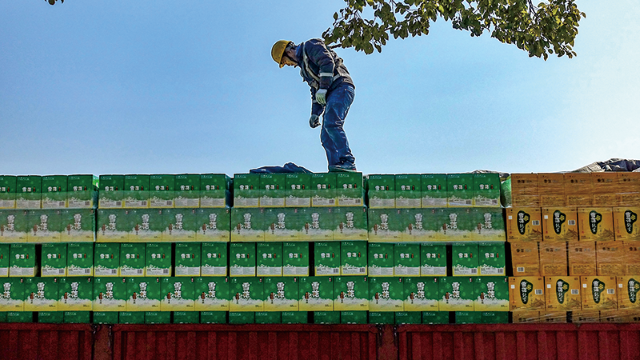
华润啤酒(00291):啤酒业务利润率持续提升,白酒业务承压
Shenwan Hongyuan Securities· 2025-08-19 09:45
Investment Rating - The investment rating for China Resources Beer is maintained as "Buy" [2][7][17] Core Views - The report highlights that the beer business is experiencing continuous improvement in profit margins, while the liquor business is under pressure due to weak demand [1][7] - The company reported a revenue of HKD 23.942 billion for H1 2025, a year-on-year increase of 0.8%, and a net profit attributable to shareholders of HKD 5.789 billion, up 23.04% year-on-year [7] - The report anticipates a continued increase in net profit margins driven by product structure upgrades and cost advantages in the beer segment [7] Financial Data and Profit Forecast - Revenue projections for the company are as follows: - 2023: HKD 38,932 million - 2024: HKD 38,635 million - 2025E: HKD 38,360 million - 2026E: HKD 39,036 million - 2027E: HKD 39,626 million - Net profit attributable to shareholders is forecasted as: - 2023: HKD 5,153 million - 2024: HKD 4,739 million - 2025E: HKD 5,633 million - 2026E: HKD 5,690 million - 2027E: HKD 6,111 million - The report indicates a projected net profit growth of 19% in 2025, followed by 1% and 7% in 2026 and 2027 respectively [6][8] Business Performance - The beer segment achieved a revenue of HKD 23.161 billion in H1 2025, with a year-on-year growth of 2.6% and a sales volume of 6.49 million tons, up 2.2% [7] - The average price per ton of beer was HKD 3,570, reflecting a 0.4% increase year-on-year [7] - The gross margin for the beer business improved to 48.3%, an increase of 2.5 percentage points year-on-year [7] - The liquor business reported a revenue of HKD 781 million in H1 2025, a decline of 33.7% year-on-year, primarily due to weak business demand [7]
大摩:华润啤酒(00291.HK)中期销售与经常性EBIT符预期 毛利率高预期
Sou Hu Cai Jing· 2025-08-19 09:00
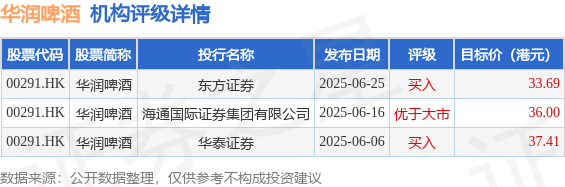
摩根士丹利发布研报称,华润啤酒(00291.HK)中午公布今年中期业绩,销售与经常性EBIT符合预期, 总销售额同比增长1%,符合该行与市场共识预期,啤酒销售同比增长3%,白酒销售同比下降34%。啤 酒经常性EBIT同比增长14%。经常性EBIT为71亿元人民币同比升11%符合预期,一次性项目包括出售 土地予合资公司获利约8.27亿元人民币,以及产能优化成本2.41亿元人民币。公司期内净利润为57.9亿 元;经常性净利润为53.5亿元同比升13%。 截至2025年8月19日收盘,华润啤酒(00291.HK)报收于28.28港元,上涨6.24%,成交量3982.97万股,成 交额11.12亿港元。投行对该股的评级以买入为主,近90天内共有2家投行给出买入评级,近90天的目标 均价为35.7港元。东方证券最新一份研报给予华润啤酒买入评级,目标价33.69港元。 机构评级详情见下表: | 股票代码 股票简称 | 投行名称 | 发布日期 | 评级 | 目标价 (港元) | | | --- | --- | --- | --- | --- | --- | | 00291.HK 华润啤酒 | 东方证券 | 2025-06- ...
港股收盘(08.19) | 恒指收跌0.21% AI应用方向逆市走高 东方甄选(01797)“高台跳水”跌超20%
智通财经网· 2025-08-19 08:49
Market Overview - Hong Kong stocks experienced volatility, with the Hang Seng Index closing down 0.21% at 25,122.9 points and a total turnover of 278.2 billion HKD [1] - The Hang Seng China Enterprises Index fell 0.3% to 9,006.23 points, while the Hang Seng Tech Index decreased by 0.67% to 5,542.03 points [1] Blue Chip Performance - China Resources Beer saw a significant increase of 6.24%, closing at 28.28 HKD, contributing 4.24 points to the Hang Seng Index [2] - The company reported a revenue of 23.942 billion RMB, a year-on-year increase of 0.83%, and a net profit attributable to shareholders of 5.789 billion RMB, up 23.04% [2] - Other notable blue chips included Zhongsheng Holdings, which rose 8.29%, and Hansoh Pharmaceutical, which increased by 4.75% [2] Sector Performance - Large tech stocks showed mixed results, with Tencent up 0.94% and Alibaba down 0.25% [3] - AI application stocks performed well, with Zhihu-W rising 23% and Fenbi increasing by nearly 14% [3] - The property management sector was active, with Wanwu Cloud rising 7.19% and Sunac Services increasing by 5.18% [4][5] Earnings Reports - Wanwu Cloud reported a revenue of 18.14 billion RMB, a 3.1% year-on-year increase, and a core net profit of 1.32 billion RMB, up 10.8% [5] - Kancheng Pharmaceutical reported a revenue of 1.569 billion RMB, a 23.7% increase, and a net profit of 498 million RMB, up 24.6% [8] - Li Auto announced a revenue of 24.25 billion RMB, a 174% increase, with a gross margin of 14.1% [9] Notable Stock Movements - Dongfang Zhenxuan experienced a significant drop of 20.89%, closing at 34.32 HKD, following rumors regarding its CEO [12] - Gilead Sciences saw a decline of 15.01% after announcing a share placement and a new share subscription at a discount [13]

大摩:华润啤酒中期销售与经常性EBIT符预期 毛利率高预期
Zhi Tong Cai Jing· 2025-08-19 08:11
该行指,华润啤酒的普高档及以上啤酒销量同比升10%(预期升9%),占总量约25%。喜力同比升20%, 中期股息派息率为26%,与去年同期相同。大摩指华润啤酒毛利率上升2个百分点至48.9%,高于预期的 48.1%。受益于高端化与原材料成本下降,啤酒业务毛利率提升2.5个百分点至48.3%。 摩根士丹利发布研报称,华润啤酒(00291)中午公布今年中期业绩,销售与经常性EBIT符合预期,总销 售额同比增长1%,符合该行与市场共识预期,啤酒销售同比增长3%,白酒销售同比下降34%。啤酒经 常性EBIT同比增长14%。经常性EBIT为71亿元人民币同比升11%符合预期,一次性项目包括出售土地 予合资公司获利约8.27亿元人民币,以及产能优化成本2.41亿元人民币。公司期内净利润为57.9亿元;经 常性净利润为53.5亿元同比升13%。 ...
高盛:华润啤酒(00291)中期纯利胜市场预期 维持“买入”评级
智通财经网· 2025-08-19 08:08
智通财经APP获悉,高盛发布研报称,维持华润啤酒(00291)"买入"评级及目标价35港元,相当于明年预 测市盈率19倍。 公司宣布中期股息每股人民币0.464元,同比增长24.4%,股息支付率约26%,与去年持平。该行指,润 啤期内普高档及以上产品销量增长逾10%,其中"喜力"增长20%以上,"老雪"增长70%, Amstel(红爵) 增长100%。普高档及以上啤酒销量亦录得中单位数至高单位数增长。集团毛利率提升2个百分点至 48.9%,创历史新高。 华润啤酒上半年合并销售额达239亿人民币同比增长0.8%,与市场预期基本一致,合并经常性息税前利 润71亿人民币,剔除土地出售收益(8.27亿人民币)及一次性支出(2.41亿人民币)后,同比增约11%,与该 行预期相符。期内合并息税前利润为76.9亿人民币同比增长21%,超过市场预期(73.2亿人民币,增长 15%)。净利润为57.9亿人民币,同比增长23%,超过市场预期(54.4亿人民币,增长15.6%)。 ...