
TENCENT(00700)

Search documents
微信“大义灭亲”封禁元宝,AI红包战玩不转了吗
21世纪经济报道· 2026-02-05 14:17
Core Viewpoint - Tencent's internal conflict is highlighted by the abrupt termination of the Yuanbao red envelope activity by WeChat, showcasing the complexities of internal collaboration within large companies [1][2]. Group 1: Event Overview - The Yuanbao red envelope activity launched on February 1, aiming to distribute 1 billion yuan in cash, quickly gained popularity but was halted within 72 hours due to WeChat's intervention [1]. - WeChat issued a warning against the Yuanbao links, citing violations of its rules against "inducement sharing" to maintain user experience [1][2]. Group 2: Internal Dynamics - The internal discussion at Tencent indicated that the Yuanbao team believed the activity was a "no-threshold" initiative, not maliciously inducing users to share [2]. - The conflict arose between the growth-focused Yuanbao team and the platform-oriented WeChat team, emphasizing the need for a clean user experience on WeChat [2]. Group 3: Market Reaction - Following the ban on Yuanbao, Tencent's stock price fell, reflecting market concerns over the company's internal coordination and decision-making processes [3]. Group 4: Industry Implications - The incident illustrates a shift in internet competition from a "traffic desert" era to an "ecosystem cultivation" era, where platforms like WeChat require careful maintenance [3][4]. - The limitations on promotional tactics like red envelopes suggest that future growth for AI applications will depend more on their inherent capabilities rather than aggressive marketing strategies [4].



北水成交净买入249.77亿 内资大举抢筹科网股及港股ETF 全天加仓腾讯超55亿港元
Zhi Tong Cai Jing· 2026-02-05 13:49
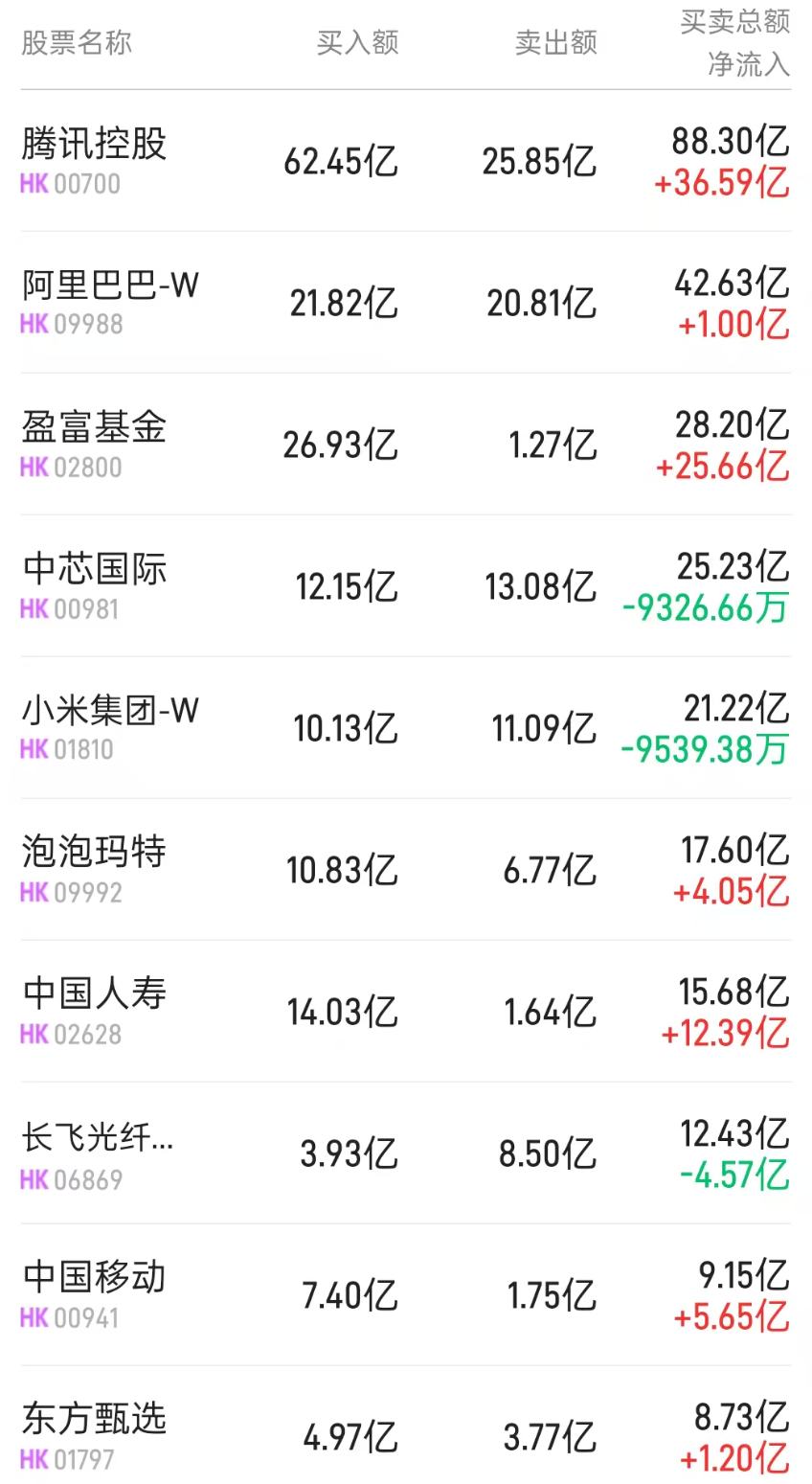
Core Viewpoint - The Hong Kong stock market experienced significant net inflows from northbound trading, with notable buying in technology stocks like Tencent and Alibaba, while semiconductor stocks faced selling pressure. Group 1: Northbound Trading Activity - Northbound trading recorded a net inflow of HKD 249.77 billion, with HKD 124.81 billion from the Shanghai Stock Connect and HKD 124.96 billion from the Shenzhen Stock Connect [2] - The most bought stocks included Tencent (00700) with a net inflow of HKD 62.45 billion, Alibaba-W (09988) with HKD 21.82 billion, and the Tracker Fund of Hong Kong (02800) with HKD 26.93 billion [3][6] - The most sold stocks were Longi Green Energy (601869) and Huahong Semiconductor (01347), with net outflows of HKD 4.56 billion and HKD 3.62 billion respectively [8] Group 2: Company-Specific Insights - China Life (601628) received a net inflow of HKD 12.39 billion, with reports indicating a government plan to issue special bonds worth approximately HKD 200 billion to inject capital into major insurance companies [7] - China Mobile (600941) saw a net inflow of HKD 5.64 billion, with Morgan Stanley projecting that the company will be less impacted by the VAT rate increase due to its higher profit margins [7] - Semiconductor stocks, particularly Huahong Semiconductor and SMIC (00981), faced selling pressure, with net outflows of HKD 3.62 billion and HKD 3.08 billion respectively, despite AMD's strong quarterly performance [8]

昨晚有三条评论,让我差点哭出声来
表舅是养基大户· 2026-02-05 13:34
Group 1 - The article discusses the phenomenon of premium pricing in the A-share market, highlighting that many stocks are priced significantly higher than their actual value, with examples like SMIC showing an 80% premium compared to Hong Kong stocks [1] - It emphasizes the importance of understanding market realities and warns against emotional reactions to losses, suggesting that investors should avoid engaging in collective emotional outbursts after losing money [3] - The article reflects on the challenges faced by wealth management professionals, noting that many clients only learn valuable lessons after experiencing losses, and stresses the importance of selecting quality investment advisors [5] Group 2 - The market is currently facing three key highlights, two of which are negative, including significant volatility in the precious metals sector, with gold dropping by $200 and silver experiencing a 20% decline over two days [9][10][11] - Another negative factor is the global tech sector's decline, with major companies like AMD and Nvidia experiencing substantial drops, leading to the largest single-day decline in tech stocks in 26 years [18][19][20] - On a positive note, there is a significant influx of capital into Tencent, with net purchases of nearly 25 billion HKD, marking the highest single-day inflow since August 2022, indicating strong market interest in the stock [23][25][26] Group 3 - The article mentions the recent volatility in the solar energy sector, particularly related to speculative investments linked to Elon Musk, which resulted in significant declines across various related stocks [36][39] - It also highlights a concerning trend of net selling in margin financing, with a record net sell-off of 14 billion RMB, indicating a potential cooling in market enthusiasm and a need for caution in crowded investment areas [42][44] - The article encourages maintaining a balanced portfolio and not being overly affected by the performance of individual sectors, suggesting that investors should focus on the overall market trend rather than specific downturns [33]

全面AI化,腾讯C端超级入口争夺战大反击
2 1 Shi Ji Jing Ji Bao Dao· 2026-02-05 13:18
Core Insights - Tencent is launching a significant initiative in AI, emphasizing its strategic importance within the company [1][3] - The company is actively promoting its AI application "Yuanbao" through a large-scale marketing campaign, including a cash red envelope initiative during the Spring Festival [2][4] Group 1: AI Strategy and Initiatives - Tencent's AI strategy is gaining momentum, with "Yuanbao" becoming a central focus for consumer-facing AI applications [2][4] - The Spring Festival campaign aims to replicate the success of the WeChat red envelope phenomenon, leveraging social media to drive user engagement [4] - "Yuanbao" has quickly risen to the top of the App Store rankings, indicating effective market penetration [4] Group 2: Competitive Landscape - Tencent faces stiff competition from ByteDance's "Doubao" and other emerging AI applications, which are rapidly gaining user traction [9] - As of September 2025, "Doubao" has reached approximately 172 million monthly active users, surpassing Tencent's offerings [9] Group 3: Product Development and Features - The "Yuanbao" application has introduced new features like "Yuanbao Pai," which enhances group interactions using AI capabilities [4] - Another AI application, "ima," targets knowledge-intensive scenarios and has been integrated with DeepSeek technology, showcasing Tencent's commitment to diverse AI applications [5][6] Group 4: Infrastructure and Investment - Tencent is investing heavily in AI infrastructure, with capital expenditures reaching a historical high of 76.7 billion yuan in 2024, accounting for 12% of total revenue [12] - The company is also focusing on building partnerships and investing in AI chip startups to enhance its technological capabilities [13] Group 5: Future Outlook and Challenges - Tencent is exploring the integration of AI into its flagship WeChat application, aiming to create a unique AI agent that enhances user experience [14] - Despite the potential, challenges remain, including privacy concerns and the need for significant investment in AI capabilities [14][15]
21评论|腾讯元宝被微信封禁:AI社交产品到底该怎么做?
2 1 Shi Ji Jing Ji Bao Dao· 2026-02-05 13:10
一个顶尖的产品生态,最核心的竞争力在于其公平性与确定性。如果因为元宝是"自家人"就可以在大群 里肆无忌惮地投放诱导链接,而普通创业者的应用却要被封禁,那么微信赖以生存的规则底座就会崩 塌。更何况,千问、文心等AI应用也都在虎视眈眈。 从这个角度来说,懂得如何通过维护规则来保护社交的边界——这种对产品边界的坚守,正是腾讯在移 动互联网时代能够长盛不衰的根源所在。 特约评论员 陈白 主打AI社交的腾讯AI应用元宝的春节红包营销推广活动,却在自家微信上被判定违规。 2月4日上午,有用户发现,点击被分享至群聊中的元宝红包链接后,显示"网页包含诱导分享、关注等 行为内容,请长按网址复制后使用浏览器访问",这意味着元宝红包的社交推广方式已被微信"封禁"。 随后,微信官方"微信派"发布公告,就针对"元宝"APP的治理措施作出说明。微信方面表示,此类行为 干扰了平台生态秩序,影响用户体验,对用户造成骚扰,因此对元宝违规链接进行处置,限制在微信内 直接打开。 这一幕的出现,在外界看来或许带有某种荒诞的戏剧感:在腾讯这个庞大的互联网帝国里,左手竟然砍 掉了右手的延伸。但如果我们将视线从企业内部竞争视角移开,回到产品本身就会发现, ...
48亿红包大战,谁赢谁输?
3 6 Ke· 2026-02-05 13:04
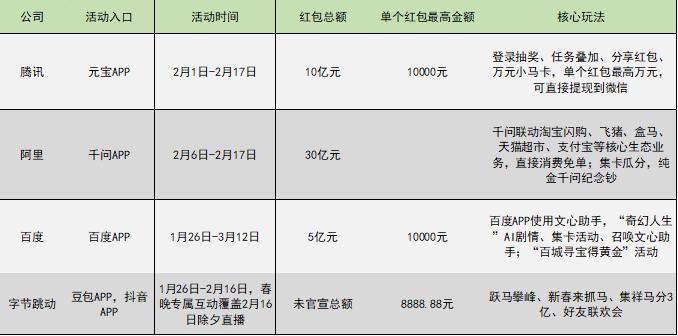
Core Insights - The 2026 Spring Festival "Red Packet War" marks a significant moment in the history of the internet, evolving from a traditional celebration into a fierce commercial competition among major tech giants [1] - The total amount of red packets distributed by the "BATZ" companies reached nearly 5 billion yuan, indicating a strategic battle for user engagement and AI application dominance [1][2] Group 1: Company Strategies - Tencent's strategy involved a "social裂变式" approach, leveraging WeChat for viral sharing, which led to a rapid rise in app downloads but faced backlash from users [3][4] - Alibaba adopted a "场景闭环式" strategy, integrating its various platforms to drive real-world usage of its services, with a significant investment of 3 billion yuan in red packets [4] - ByteDance focused on "内容互动式" strategies, using entertainment and social engagement to promote its AI applications, capitalizing on its strong content creation capabilities [4] - Baidu's approach was more traditional, embedding red packets within AI features, but faced challenges in user retention due to complex processes [4] Group 2: AI Product Development - All major companies are still in the exploratory phase of AI product development, with no clear market leader yet, but differentiation is beginning to emerge [8] - Tencent's AI product, Yuanbao, is positioned as a social tool but lacks strong retention outside social contexts [9] - Alibaba's Qianwen offers a comprehensive service but faces challenges due to its complex user journey [10] - ByteDance's Doubao is recognized for its innovative content and interaction, appealing to younger users [10] - Baidu's Wenxin Assistant has a solid foundation in search but struggles with user perception as merely a search tool [10] Group 3: Financial Investments and Performance - ByteDance leads in profitability and aggressive investment plans, with projected capital expenditures reaching 160 billion yuan in 2026 [12][13] - Alibaba plans to invest between 380 billion to 480 billion yuan in AI and cloud infrastructure over the next three years, but faces cash flow challenges [13] - Tencent reported a profit of over 30 billion USD in the first three quarters of 2025, supported by strong revenue from gaming and finance [13] - Baidu's financial structure is more reliant on search advertising, necessitating proof of commercial viability in AI investments [13] Group 4: AI Capabilities and Technology - Tencent's AI capabilities are currently lagging behind competitors, with a focus on restructuring and enhancing its data infrastructure [14][15] - Alibaba has a robust self-developed chip and a strong open-source ecosystem, enhancing its AI capabilities [15][16] - Baidu's Wenxin model is positioned as a leader in search and AI integration, with significant long-term investments [15][17] - ByteDance's Doubao model is recognized for its advanced multi-modal capabilities and high processing capacity [15][17] Group 5: Leadership and Strategic Focus - Founders' involvement is crucial during this transformative period, with Tencent's Ma Huateng acknowledging the need for faster action in AI [18][19] - Alibaba's leadership is heavily invested in AI, with Ma Yun personally overseeing strategic initiatives [19][20] - ByteDance's Zhang Yiming emphasizes the importance of AI as a core strategic focus, reflecting a unified vision within the company [19][20] - Baidu's Li Yanhong stresses the significance of AI for the company's future, positioning it as a critical area for growth [19][20] Group 6: Internal Collaboration and Challenges - Effective internal collaboration is essential for success in the AI super entrance competition, with varying degrees of synergy among companies [21][22] - Tencent faces challenges in cross-departmental cooperation, which has led to data issues in its AI initiatives [22][23] - Alibaba's organizational strength is high, but the complexity of integrating various business units poses risks to user experience [23] - ByteDance's internal competition and resource allocation issues could hinder its overall strategy [23] Group 7: User Engagement and Retention - Companies are exploring ways to convert existing high-activity users into AI product users, with varying success rates [24][25] - ByteDance's Doubao achieved over 100 million daily active users by the end of 2025, establishing a significant user base [25][26] - Tencent's Yuanbao saw rapid growth in active users but needs to validate long-term retention [26] - Alibaba's Qianwen quickly reached over 30 million monthly active users, but its sustainability outside promotional activities remains uncertain [26] - Baidu's Wenxin Assistant has a solid user base but requires improvements in engagement and retention [26]

腾讯元宝被微信封禁:AI社交产品到底该怎么做?
2 1 Shi Ji Jing Ji Bao Dao· 2026-02-05 13:03
特约评论员 陈白 主打AI社交的腾讯AI应用元宝的春节红包营销推广活动,却在自家微信上被判定违规。 只有真正尊重用户、理解社交本质的产品,才配拥有AI时代的真正门票。 社交的本质是人与人的连接,是情感的交换,是基于信任的信息流动。如果一个所谓的AI社交产品, 其获取用户的方式依然停留在利用红包诱导、利用社交压力进行裂变的传统套路上,那它其实既不够 AI,也不够社交友好。 一个顶尖的产品生态,最核心的竞争力在于其公平性与确定性。如果因为元宝是"自家人"就可以在大群 里肆无忌惮地投放诱导链接,而普通创业者的应用却要被封禁,那么微信赖以生存的规则底座就会崩 塌。更何况,千问、文心等AI应用也都在虎视眈眈。 从这个角度来说,懂得如何通过维护规则来保护社交的边界——这种对产品边界的坚守,正是腾讯在移 动互联网时代能够长盛不衰的根源所在。 回头来看元宝,这款被寄予厚望的AI产品,在这次风波中则暴露出其产品成熟度上的短板。不可否 认,元宝在功能迭代上也展现了追赶者的姿态,但在技术能力上,元宝距离ChatGPT、Gemini等全球第 一梯队的AI产品还有很长一段路要走。 真正的AI应用,应该通过解决用户痛点、创造全新交互价值 ...
微信“大义灭亲”封禁元宝,AI红包战玩不转了?
2 1 Shi Ji Jing Ji Bao Dao· 2026-02-05 12:55
最近腾讯自家上演了一出"大义灭亲"的精彩戏码。 这最近刚火起来的元宝红包,发了三天,就被它的兄弟部门——微信,亲手给掐断了链接!这波操作, 堪称春节档最迷惑的商业大戏。这到底是怎么一回事呢? 2月1日,腾讯元宝正式上线春节红包活动,口号是"瓜分10亿现金",无数红包链接瞬间挤爆了微信群和 朋友圈,元宝APP也迅速冲上了应用商店免费榜榜首。 但狂欢才持续了72个小时,用户们突然发现,点开元宝红包链接,微信会弹出一个警告,说网页包 含"诱导分享"内容,禁止直接打开。 微信随后发了公告,说得很官方:为了打击春节期间的过度营销和诱导分享,维护良好的用户体验,所 以对违规链接进行了处理。简单说就是,元宝的红包活动,因为"利诱"用户分享,踩到了微信生态规则 的"红线"。 诶,等等?这规则难道不是腾讯自己定的吗?怎么打起自己人来了? 这就要说到一个非常微妙的点。这事儿在腾讯内部其实有过讨论。活动开始前,元宝团队是跟法务、公 关等部门通过气的。当时内部的判断是:这个红包是"无门槛领取",用户点开就能拿钱,这属于"普惠 活动",不是"恶意诱导"。 内部觉得没问题,但用户真实的群聊体验是另一回事。当海量的红包链接在短时间内涌入, ...
微信“大义灭亲”封禁元宝,AI红包战玩不转了?|财经早察
2 1 Shi Ji Jing Ji Bao Dao· 2026-02-05 12:52
Core Viewpoint - Tencent's internal conflict is highlighted by the abrupt termination of the Yuanbao red envelope activity by WeChat, showcasing the complexities of internal collaboration within large companies [1][3]. Group 1: Event Overview - The Yuanbao red envelope activity launched on February 1, aiming to distribute 1 billion yuan in cash, quickly gained popularity but was halted after 72 hours due to WeChat's intervention [1]. - WeChat issued a statement citing the need to combat excessive marketing and maintain user experience, leading to the blocking of links associated with the Yuanbao activity [1][2]. Group 2: Internal Dynamics - The decision to launch the Yuanbao red envelope was internally debated, with the team believing it was a "no-threshold" activity and not maliciously inducing users to share [2]. - The conflict arose between the growth-oriented Yuanbao team and the platform-focused WeChat team, emphasizing the importance of user experience and adherence to internal rules [3][4]. Group 3: Market Reaction - Following the news of the internal conflict, Tencent's stock price fell, indicating market concerns regarding the company's internal collaboration and decision-making processes [5]. Group 4: Industry Implications - The incident reflects a shift in internet competition from a "traffic desert" era to an "ecosystem cultivation" era, where platforms like WeChat require careful maintenance [6]. - The restriction on the red envelope strategy suggests that relying solely on financial incentives and traffic tactics is insufficient in the current market landscape, indicating a return to focusing on technological capabilities for growth [7].
智通港股解盘 | 互联网巨头底部开启反击 消费新老龙头齐发力
Zhi Tong Cai Jing· 2026-02-05 12:29
Market Overview - The Hang Seng Index opened lower but managed to close up by 0.14% [1] - The geopolitical situation remains stable, with Iran set to negotiate nuclear issues with the U.S. on February 6 [1] - Gold and silver prices fell significantly, with silver dropping over 14% and gold falling more than 2% to below $4,900 per ounce [1] International Relations - Russian President Putin plans to visit China in the first half of 2026 following a video call with Chinese leaders [2] - U.S. and Chinese leaders had a positive discussion regarding regional issues and economic cooperation, with a planned visit by Trump to China in April [2] - China has requested state-owned enterprises to pause new investment projects in Panama [2] Technology Sector - Despite declines in U.S. tech stocks, some Chinese tech companies like Naxin Micro (02676) reported strong earnings and plan to raise product prices by 10%-25% [3] - Baidu (09888) announced a stock buyback plan of up to $5 billion and plans to introduce a dividend policy by 2026, leading to a nearly 3% increase in its stock price [3] - Xiaomi (01810) repurchased shares worth HKD 146 million, also seeing a nearly 3% rise [3] - Tencent (00700) is expected to maintain double-digit growth in its gaming business by 2026, with advertising revenue projected to grow around 20% [3] Consumer Sector - Kweichow Moutai (600519.SH) has shown strong performance, boosting consumer valuations [4] - Oriental Selection (01797) surged over 10% due to its unique brand and membership model [4] - Pop Mart (09992) reported significant demand for its new products, with resale prices on secondary markets showing substantial premiums [4] Restaurant Sector - Yum China (09987) reported total revenue of $11.797 billion for 2025, a 4% increase year-on-year, with net profit rising by 2% [5] - Haidilao (06862) is seeing positive impacts from the return of its founder, with plans for expansion and new brand growth [5] - Brainstorm Aurora-B (06681) announced a strategic partnership to promote digital health products in Southeast Asia, with a significant stock price increase of over 15% [6] Energy Sector - The U.S. is experiencing a surge in natural gas power generation capacity, with over 29 GW under construction, but many projects may face delays due to a lack of available gas turbines [7] - Companies like Eagle Precision (01286) and Dongfang Electric (01072) are positioned to benefit from this trend, with expectations of increased demand for gas turbine components [7] Aviation Sector - Cirrus Aircraft (02507) launched the new G3 Vision Jet, enhancing its product line and expected to improve profit margins [8] - The new jet model is designed for private and corporate users, featuring significant upgrades in safety and comfort [8] - Cirrus is projected to deliver approximately 800 aircraft in 2025, with new orders expected to reach around 600 units [9]