LI AUTO-W(02015)

Search documents
理想调整基座模型业务:詹锟接手,VLA 研发整合
Xin Lang Cai Jing· 2026-01-15 02:34
Core Viewpoint - The appointment of Zhan Kun as the head of the foundational model business at Li Auto signifies a strategic shift in the company's approach to developing its VLA (Vision-Language-Action) foundational model, integrating technology teams to support autonomous driving, smart cockpit, and potential future robotics initiatives [1] Group 1 - Zhan Kun will oversee the development of the VLA foundational model and will integrate related technology research teams [1] - Zhan Kun's reporting structure has changed; he will now report to the CTO and head of the Systems and Computing Group, Xie Yan, instead of the Senior Vice President of Autonomous Driving R&D, Lang Xianpeng [1] - Zhan Kun will continue to be responsible for the engineering and platformization of the smart driving VLA model [1] Group 2 - The current head of the foundational model, Chen Wei, may join an entrepreneurial venture [1]

车企自研、第三方合作“双轮驱动”,城市NOA规模化加速
Zhong Guo Jing Ji Wang· 2026-01-15 02:12
Core Insights - 2025 is identified as a critical year for the commercialization of urban NOA (Navigation Assisted Driving) in China, with a projected market scale growth [1] - The report indicates that from January to November 2025, the cumulative sales of passenger cars equipped with urban NOA reached 3.129 million units, with a penetration rate of 15.1%, an increase of 5.6 percentage points compared to the entire year of 2024 [1] Industry Background - NOA technology is seen as a key driver for smart connected vehicles, bridging advanced driver assistance and fully autonomous driving, which is crucial for enhancing user travel experience and asserting China's competitive voice in the global automotive industry [3] - The report highlights that among the passenger cars sold with urban NOA, domestic brands accounted for 2.5373 million units, representing 81.1% of the total, showcasing innovation and competitiveness in the smart connected vehicle sector [3] Market Dynamics - The current market for urban NOA is characterized by a dual-driven model of self-research by car manufacturers and collaboration with third-party suppliers [5] - Major players in self-research include Tesla, NIO, Xpeng, Li Auto, Xiaomi, and others, while approximately 29 brands collaborate with third-party suppliers [5] - The third-party supplier market is dominated by two key players, Momenta and Huawei, which together hold about 80% market share; Momenta's urban NOA installations reached 414,400 units, accounting for 61.06% of third-party suppliers, while Huawei's HI model accounted for 19.76% with 134,100 units [5] Technological Advancements - The rapid iteration of technology and market competition is driving systemic changes in smart driving technology, core architecture, and industrial ecology [9] - The report emphasizes that end-to-end large models are becoming the core engine for NOA technology iteration, facilitating a shift from modular architecture to integrated systems [10] - New energy vehicle manufacturers are building technological barriers through full-stack self-research, while traditional automakers are accelerating technology deployment through partnerships with third-party suppliers [10] Future Outlook - The report anticipates that by 2030, urban NOA will become a mainstream feature in both assisted and autonomous driving [10] - Recommendations for enhancing the high-quality development of NOA include improving top-level design, strengthening technological innovation, enhancing industry collaboration, and exploring global competitiveness for supply chain enterprises [11]


纳指收跌1%,甲骨文、博通跌超4%
Mei Ri Jing Ji Xin Wen· 2026-01-15 00:10
Market Overview - The three major U.S. stock indices closed lower, with the Dow Jones down 0.08%, the Nasdaq down 1.00%, and the S&P 500 down 0.53% [2] - Technology stocks experienced widespread declines, with Oracle and Broadcom falling over 4%, and Amazon, Microsoft, and Meta dropping over 2% [2] - Notably, Intel saw a contrary increase, rising over 3% [2] Chinese Stocks Performance - The Nasdaq Golden Dragon China Index decreased by 0.23%, with significant declines in several Chinese companies [2] - Ctrip fell over 17%, Pinduoduo dropped nearly 4%, and electric vehicle manufacturers such as Li Auto, NIO, and Xpeng, along with Bawang Tea, all declined over 2% [2] - In contrast, Bilibili experienced a rise of over 6% [2]


汽车冲焊零部件核心供应商 理想汽车“小伙伴”今日上市 | 打新早知道
2 1 Shi Ji Jing Ji Bao Dao· 2026-01-14 23:10
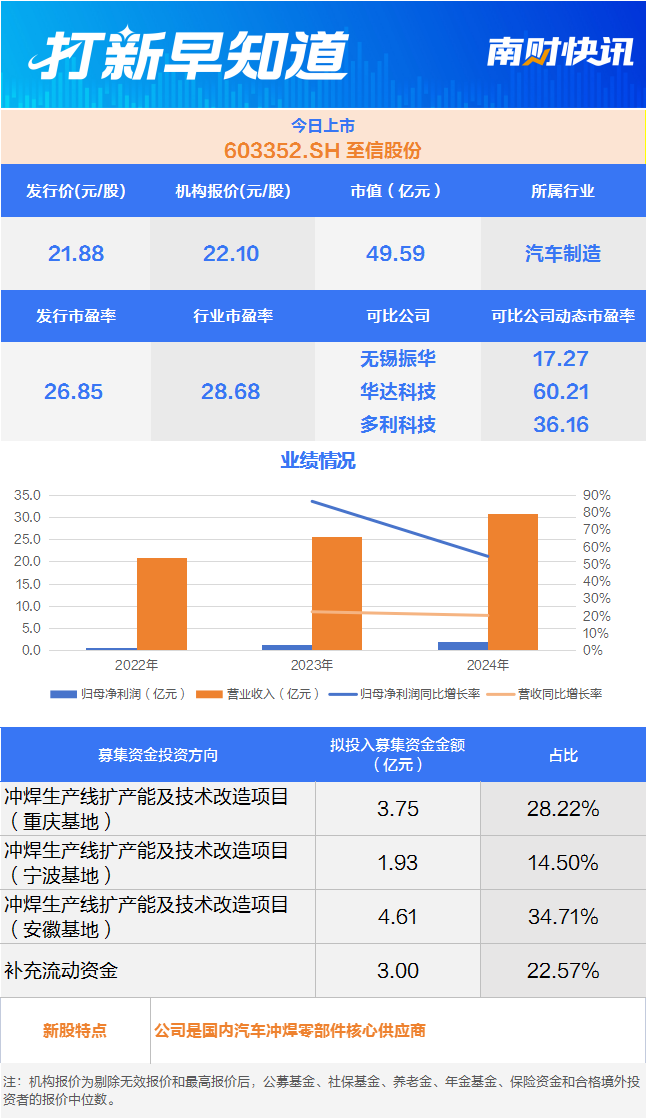
Group 1 - The core viewpoint of the article is the listing of Zhixin Co., Ltd. (603352.SH) on the Shanghai Stock Exchange, focusing on its business in automotive stamping parts and related molds [1][2]. - Zhixin Co., Ltd. was established in 1995 and is headquartered in Chongqing Liangjiang New Area, specializing in the development, processing, production, and sales of automotive stamping parts, including cold stamping parts, hot-formed parts, welding assemblies, and molds [1][2]. - The company has a market capitalization of 4.959 billion yuan and an issuance price of 21.88 yuan per share, with an issuance price-to-earnings ratio of 26.85, compared to the industry average of 28.68 [2]. Group 2 - The company plans to invest a total of 10.29 billion yuan in expanding production capacity and technological upgrades for its stamping production lines across various bases, including Chongqing, Ningbo, and Anhui [4]. - Zhixin Co., Ltd. has established itself as a significant player in the automotive parts sector in Southwest China, with a competitive edge in the market [8]. - The company is actively expanding its business in the new energy vehicle sector, collaborating with traditional clients like Changan Automobile and Geely, as well as new brands such as BYD and NIO [8]. Group 3 - The company has a high customer concentration risk, with sales to its top five customers accounting for 73.86%, 79.77%, 74.82%, and 68.00% of its revenue from 2022 to the first half of 2025 [9].
汽车冲焊零部件核心供应商,理想汽车“小伙伴”今日上市 | 打新早知道
2 1 Shi Ji Jing Ji Bao Dao· 2026-01-14 23:07
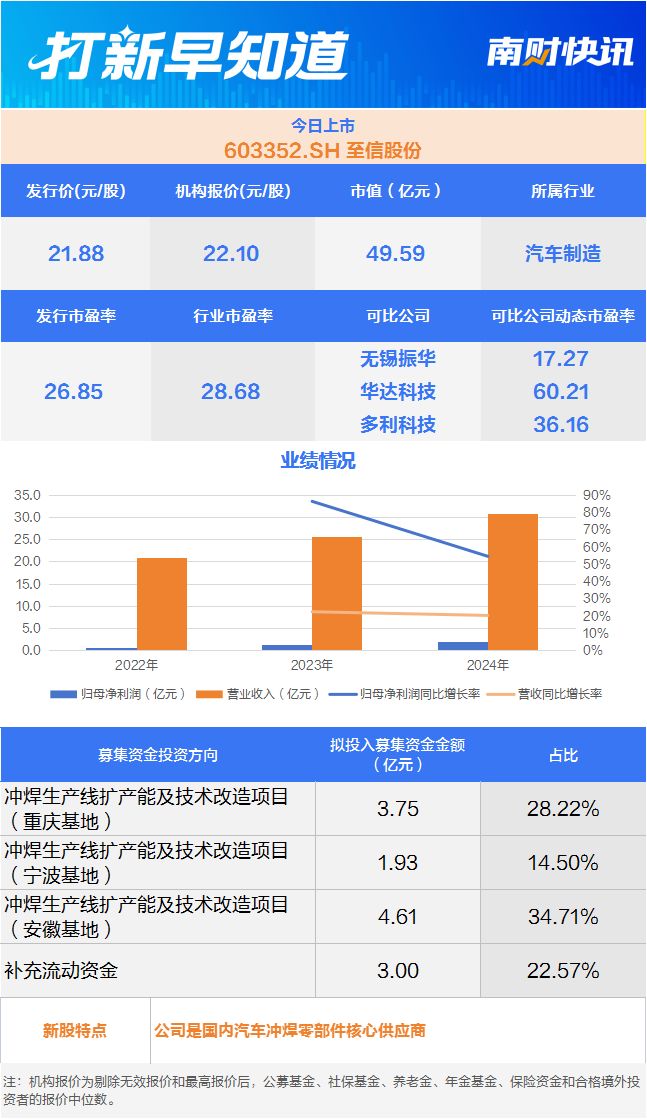
Core Viewpoint - Zhixin Co., Ltd. (603352.SH) has been listed on the Shanghai Stock Exchange, focusing on the development, processing, production, and sales of automotive stamping parts and related molds, with a significant market presence in the southwest region of China [1][4]. Company Overview - Established in 1995 and headquartered in Chongqing Liangjiang New Area, Zhixin Co., Ltd. specializes in cold stamping parts, hot-formed parts, welding assemblies, and molds [1]. - The company has become one of the larger private automotive parts manufacturers in southwest China, with a strong competitive position in the automotive stamping parts sector [4]. Financial Information - The initial public offering (IPO) price was set at 21.88 yuan per share, with an institutional offering price of 22.10 yuan per share, resulting in a market capitalization of 4.959 billion yuan [2]. - The company's earnings per share (EPS) is projected with a price-to-earnings (P/E) ratio of 26.85, compared to comparable companies such as Wuxi Zhenhua (17.27) and Huada Technology (60.21) [2]. Market Position and Growth - By mid-2025, Zhixin Co., Ltd. is expected to capture market shares of 6.21%, 4.85%, and 4.59% in cabin, side, and floor products, respectively [4]. - The company has actively expanded into the new energy vehicle (NEV) sector, collaborating with traditional clients like Changan Automobile and Geely, as well as new brands such as BYD and NIO [4]. Client Concentration Risk - The company faces a significant client concentration risk, with sales to its top five customers amounting to 1.544 billion yuan, 2.045 billion yuan, 2.310 billion yuan, and 1.091 billion yuan from 2022 to the first half of 2025, representing 73.86%, 79.77%, 74.82%, and 68.00% of total revenue, respectively [5].
詹锟本次人事调整标志着理想具身智能战略是动真格的
理想TOP2· 2026-01-14 16:27
Core Viewpoint - The article emphasizes the distinction between two approaches to vehicle development: one centered on autonomous driving and the other on embodied intelligence. The founder of the company has shifted from viewing autonomous driving as the ultimate goal to recognizing embodied intelligence as the core focus, with autonomous driving being a subset of this broader concept [2]. Group 1: Company Strategy - The company plans to build a complete agent system based on VLA, positioning vehicles as the largest embodied intelligence terminals in the coming years [2]. - The company has undergone a management shift, returning to a startup model from a professional manager model, which is deemed more suitable given the current industry dynamics [4]. - The management approach will focus on deeper dialogues, user value, efficiency, and identifying key issues rather than creating information asymmetry [4]. Group 2: Product Development - The future of valuable products in the next decade will be vehicles that possess both autonomous and proactive capabilities, offering premium services akin to first-class airline experiences [5]. - The company aims to eliminate traditional vehicle cockpit systems, focusing instead on a vehicle that integrates autonomous driving, spatial intelligence, and embodied control [3]. Group 3: Technological Advancements - The company identifies a critical need for advancements in perception technology, aiming to enhance effective 3D perception distance from over 100 meters to 200-300 meters, which would significantly improve common issues in assisted driving [6]. - Current computational models are limited, with a 40 billion parameter model running at only 10 Hz. Enhancements in model performance are necessary to address comfort and responsiveness issues in assisted driving [6]. - The response time for human braking and steering is around 450 milliseconds, while the complete chain for autonomous driving is currently at 550 milliseconds. The company aims to reduce this to 350 milliseconds through a line control system, potentially halving accident rates [7].
晚点说詹锟接手理想基座模型业务向CTO汇报, 不向郎咸朋汇报
理想TOP2· 2026-01-14 14:55
Core Viewpoint - The article discusses the restructuring of the base model business at Li Auto, with Zhan Kun taking over the VLA base model development, which will support autonomous driving, smart cockpit, and potentially robotics in the future [1] Group 1: Leadership Changes - Zhan Kun will report to CTO Xie Yan instead of Senior Vice President of Autonomous Driving R&D, Lang Xianpeng [1] - Zhan Kun will continue to be responsible for the engineering and platformization of the intelligent driving VLA model [1] Group 2: Strategic Direction - The VLA has been upgraded from a single project to a company-level base model, indicating a clear organizational focus on AI strategy centered around VLA [1] - Resources will be further concentrated on embodied intelligence, with the core objective being the construction of a complete Agent system based on VLA [1] Group 3: Industry Connections - Individuals who have left companies like Weita Power and Zhijian Power, such as Zhao Zhelun and Jia Peng, maintain close communication with Li Xiang and will share industry insights at Li Auto's AI meetings [1]
小米潘九堂:小米如果未来做增程,一定会借鉴理想
Jin Rong Jie· 2026-01-14 08:34
Core Viewpoint - Xiaomi is planning to leverage the experience of other companies, particularly in the range-extended electric vehicle (REEV) segment, while maintaining transparency about its learning process [1][3]. Group 1: Product Development - Xiaomi's automotive division is set to launch four new models by 2026, including two versions of the SU7 and two range-extended models: a five-seat SUV and a seven-seat SUV [3]. - The seven-seat SUV, codenamed "Kunlun," will compete with models like Li Auto's L9 and Aito's M9, featuring a large battery range-extended technology with an electric range of 400-500 km [3]. Group 2: Market Trends - Despite the growing interest in range-extended technology, the sales growth rate has been slowing down. Data from the China Passenger Car Association indicates that the share of pure electric vehicles in wholesale sales increased by 4% to 62%, while the share of narrow-sense plug-in hybrid vehicles decreased by 2.9% to 29%, and range-extended vehicles saw a decline of 1.1% to 9% [5]. - Xiaomi aims to deliver 410,000 vehicles in 2025, surpassing its initial target of 300,000, and is targeting an ambitious goal of 550,000 units in 2026 [5].

2025年我国新能源汽车出口达261.5万辆,出口规模再上新台阶
Xin Lang Cai Jing· 2026-01-14 07:19
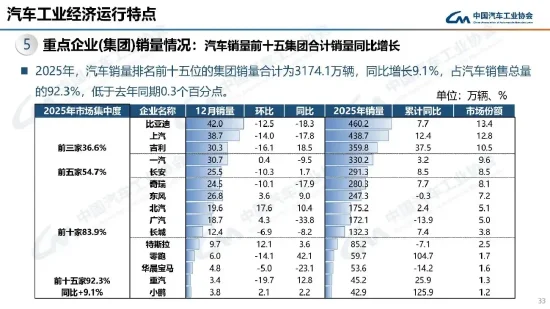
Core Insights - The Chinese automotive industry is projected to achieve record production and sales figures of 34.53 million and 34.40 million vehicles respectively in December 2025, maintaining its position as the world's largest market for 17 consecutive years [1][4]. Group 1: Market Performance - The passenger vehicle market is experiencing steady growth, significantly contributing to the overall automotive market expansion [5]. - The commercial vehicle market is recovering, with production and sales increasing by over 10%, surpassing 4 million units [5]. - New energy vehicles (NEVs) are leading the market, with production and sales exceeding 16 million units, accounting for over 50% of domestic new car sales [5]. Group 2: Export and Trade - The automotive export market shows strong resilience, with total exports exceeding 7 million vehicles, including 2.615 million NEVs, marking a new high in export scale [5]. Group 3: Market Concentration - The top fifteen automotive groups sold a total of 31.741 million vehicles, reflecting a year-on-year growth of 9.1%, which constitutes 92.3% of total vehicle sales, slightly down by 0.3 percentage points from the previous year [5][7]. - The top three groups, BYD, SAIC, and Geely, accounted for 36.6% of total vehicle sales [5][7]. - In the NEV segment, the top fifteen groups sold 15.669 million units, a year-on-year increase of 29.2%, representing 95% of total NEV sales, up by 0.7 percentage points from the previous year [5][7].



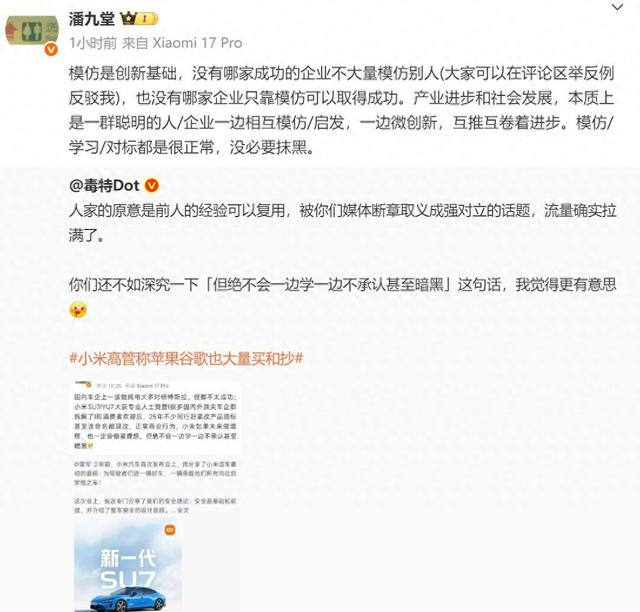
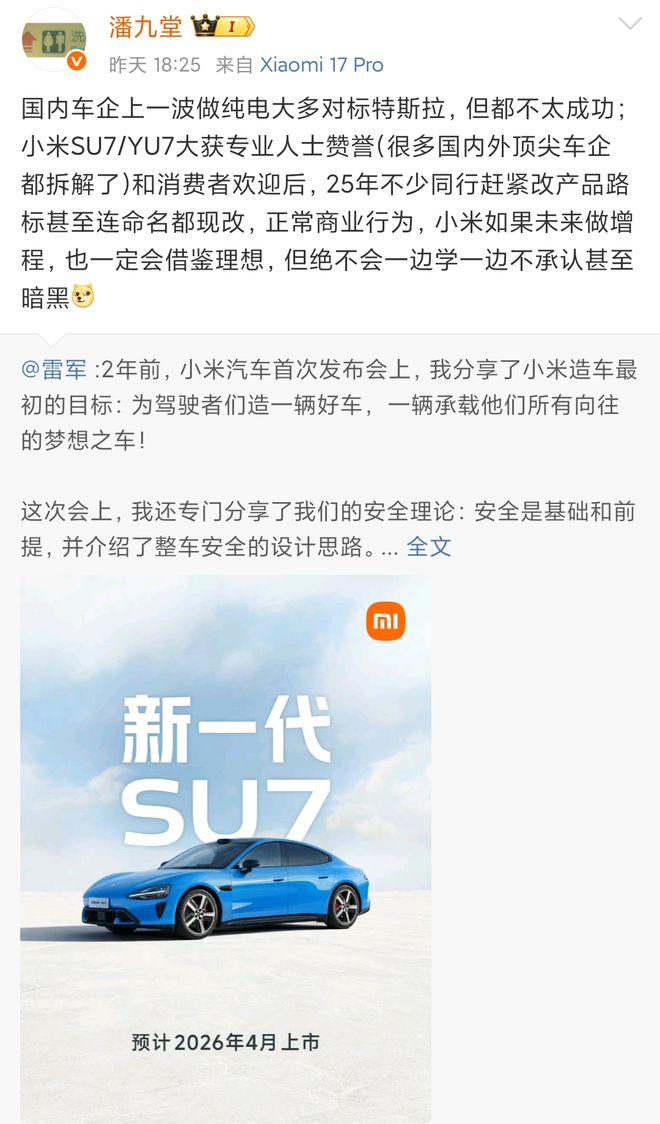
潘九堂:模仿是创新的基础,小米汽车如果未来做增程一定会借鉴理想
Huan Qiu Wang· 2026-01-14 06:52
Core Viewpoint - The commentary by Xiaomi's investment partner, Pan Jiutang, highlights the evolving landscape of the domestic electric vehicle (EV) industry, emphasizing that while many companies previously benchmarked against Tesla, the results have been limited. Xiaomi's SU7 and YU7 models have gained significant consumer recognition and attracted attention from leading domestic and international automakers [1][6]. Group 1 - Pan Jiutang noted that many car manufacturers are rapidly adjusting their product plans and even changing model naming strategies in response to Xiaomi's successful product launches, which he describes as a normal business reaction [6]. - He emphasized that if Xiaomi were to pursue an extended-range technology route in the future, it would carefully consider the experiences of Li Auto, while maintaining a respectful approach without denigrating competitors [6]. Group 2 - Pan Jiutang elaborated on the relationship between "imitation" and "innovation," asserting that imitation is a crucial foundation for innovation. He stated that no successful company has achieved its status without extensively learning from others [6]. - He argued that relying solely on imitation cannot lead to long-term success, and that industry progress and social development stem from a collaborative environment where companies inspire and push each other through micro-innovations [6]. - Pan Jiutang called for a rational perspective on benchmarking and learning behaviors within the industry, asserting that imitation, learning, and benchmarking are normal business practices that should not be stigmatized [6].