
GCL TECH(03800)

Search documents
港股通7月8日成交活跃股名单
Zheng Quan Shi Bao Wang· 2025-07-08 14:44
Market Overview - On July 8, the Hang Seng Index rose by 1.09%, with southbound funds totaling HKD 113.64 billion in trading volume, comprising HKD 57.01 billion in buying and HKD 56.63 billion in selling, resulting in a net buying amount of HKD 0.39 billion [1] Southbound Trading Activity - The southbound trading through Stock Connect (Shenzhen) recorded a total trading volume of HKD 39.21 billion, with net buying of HKD 0.63 billion, while the Shanghai Stock Connect saw a total trading volume of HKD 74.44 billion, resulting in a net selling of HKD 0.24 billion [1] - The most actively traded stock by southbound funds was Guotai Junan International, with a total trading volume of HKD 135.61 billion, followed by Alibaba-W and Meituan-W with trading volumes of HKD 46.17 billion and HKD 36.77 billion respectively [1] Net Buying and Selling Analysis - Among the stocks with net buying, Alibaba-W led with a net buying amount of HKD 14.11 billion, closing up by 1.52%, followed by Meituan-W with HKD 11.31 billion and China Construction Bank with HKD 3.94 billion [1] - The stock with the highest net selling was the Tracker Fund of Hong Kong, with a net selling amount of HKD 9.81 billion, while Tencent Holdings and Hang Seng China Enterprises experienced net selling of HKD 6.22 billion and HKD 5.45 billion respectively [1] Continuous Net Buying Stocks - Three stocks have seen continuous net buying for more than three days, with SMIC leading at 13 days, followed by China Construction Bank at 4 days and Guotai Junan International at 3 days [2] - The total net buying amount for SMIC was HKD 77.95 billion, followed by China Construction Bank with HKD 12.43 billion and Guotai Junan International with HKD 5.90 billion [2]
智通港股通活跃成交|7月8日





智通财经网· 2025-07-08 11:10
2025年7月8日当天,国泰君安国际(01788)、阿里巴巴-W(09988)、美团-W(03690)位居沪港通(南向) 成交额前3位,成交额分别为100.24 亿元、29.54 亿元、26.35 亿元;国泰君安国际(01788)、阿里巴巴- W(09988)、腾讯控股(00700) 位居深港通(南向)成交额前3位,成交额分别为35.37 亿元、16.62 亿 元、12.70 亿元。 深港通(南向)十大活跃成交公司 | 公司名称 | 成交金额 | 净买入额 | | --- | --- | --- | | 国泰君安国际(01788) | 35.37 亿元 | +1.67 亿元 | | 阿里巴巴-W(09988) | 16.62 亿元 | +5.56 亿元 | | 腾讯控股(00700) | 12.70 亿元 | -2.11 亿元 | | 中芯国际(00981) | 12.40 亿元 | +1.04 亿元 | | 小米集团-W(01810) | 12.29 亿元 | -2425.57 万元 | | 美团-W(03690) | 10.42 亿元 | +2.08 亿元 | | 协鑫科技(03800) | 8.74 亿 ...
南向资金7月8日净买入超3亿港元:加仓阿里巴巴-W14.11亿港元

Jin Rong Jie· 2025-07-08 10:11
交易所数据显示,7月8日南向资金动向: 大幅净买入:阿里巴巴-W(09988.HK)14.11亿港元、美团-W(03690.HK)11.31亿港元、建设银行 (00939.HK)3.94亿港元、协鑫科技(03800.HK)2.35亿港元、国泰君安国际(01788.HK)1.94亿港元、快手- W(01024.HK)1.61亿港元。 7月8日消息,南向资金今日成交1136.41亿港元,净流入约3.87亿港元。其中沪港股通净流出约2.38亿港 元,深港股通净流入约6.25亿港元 协鑫科技今日涨10.81%,沪港股通净买入3.08亿港元,深港股通净卖出7297.44万港元。 国泰君安国际今日涨28.54%,沪港股通净买入2726.30万港元,深港股通净买入1.67亿港元。 快手W今日涨5.16%,深港股通净买入1.61亿港元。 盈富基金今日涨1.15%,沪港股通净卖出98098.69万港元。 腾讯控股今日涨0.50%,沪港股通净卖出41090.64万港元,深港股通净卖出21076.07万港元。 大幅净卖出:盈富基金(02800.HK)98098.69万港元、腾讯控股(00700.HK)62166.71万港元、恒生中 ...
港股午评|恒生指数早盘涨0.78% 稳定币概念股继续攀升
智通财经网· 2025-07-08 04:05
Group 1 - The Hang Seng Index rose by 0.78%, gaining 185 points to close at 24,073 points, while the Hang Seng Tech Index increased by 1.29% [1] - The trading volume in Hong Kong reached HKD 117.2 billion in the morning session [1] - Stablecoin-related stocks surged, with Guotai Junan International rising by 16%, Multi-Point Smart increasing by 8%, and OSL Group also up by 8% [1] Group 2 - Jinyong Investment experienced a 150% surge due to a strategic partnership with AnchorX to explore stablecoin applications [2] - Kuaishou-W saw a 3% increase, with institutions expecting the company's Q2 performance to meet market expectations [2] - Gold stocks rebounded in the morning session, with Tongguan Gold rising by 6% and China Gold International increasing by 3.82% [2] Group 3 - Huitongda Network rose over 7% after applying for full circulation of H-shares, which is expected to enhance stock liquidity and investment attractiveness [3] Group 4 - Basestone Pharmaceuticals-B increased by over 4% after granting commercialization rights for Sugli to Gentili in Western Europe and the UK [4] Group 5 - GCL-Poly Energy rose over 9%, with the polysilicon segment potentially becoming a breakthrough point for reversing internal competition, and the company is expected to achieve profitability [5] Group 6 - China Rare Earth Holdings rose over 7% after a failed transaction involving the sale of an Australian gold mine, and plans to spin off its business through an introduction [6] Group 7 - Hon Teng Precision rose by 8.8%, driven by strong performance in AI servers and iPhone business, with Foxconn showing steady growth in Q2 [7] Group 8 - Zhaoyan New Drug increased by over 10%, assisting in the approval of the restructuring of human coagulation factor VIIa for Chengdu Tianqing [8] Group 9 - Steel stocks saw a midday rally, with Chongqing Steel rising by 11%, as institutions expect improvements in industry supply and demand [9]
新能源+AI周报:重视新能源供给侧的进化-20250707
Tai Ping Yang Zheng Quan· 2025-07-07 15:28
Investment Rating - The report does not provide specific investment ratings for the industry segments [2]. Core Insights - The overall strategy emphasizes the evolution of the supply side in the new energy sector, focusing on innovation and avoiding "involution" in the market [3][5]. - The new energy vehicle supply chain is entering a new cycle, with companies like CATL benefiting from collaborations with tech giants like Xiaomi and Huawei [3][21]. - The lithium battery sector is expected to see a positive outlook, with production forecasted to exceed 130 GWh in July, marking a nearly 40% year-on-year increase [4][35]. - The photovoltaic industry is facing challenges due to overcapacity and competition, but recent government measures aim to optimize supply and stabilize the market [5][25]. Summary by Sections New Energy Vehicle Supply Chain - The downstream landscape is evolving, with companies like CATL collaborating with automakers to enhance production efficiency and shorten delivery times [3][27]. - The launch of Xiaomi's YU7 has exceeded expectations, indicating a shift in consumer behavior towards valuing emotional and intelligent experiences in vehicles [21][22]. Lithium Battery Sector - The lithium battery production is projected to grow, with significant investments in high-end products and solid-state technologies [4][35]. - Companies like Fulin Precision and Enjie are expanding their production capabilities, focusing on high-performance lithium iron phosphate and solid-state battery materials [4][31]. Photovoltaic Industry - The photovoltaic sector is expected to confirm a mid-term bottom as supply-side optimization measures are implemented [5][25]. - Major glass manufacturers in the photovoltaic industry plan to reduce production by 30% starting in July to address overcapacity issues [5][25]. Offshore Market Opportunities - Leading companies like EVE Energy are investing in overseas projects, such as a new energy storage project in Malaysia worth up to 8.654 billion yuan [4][22]. - The establishment of independent pricing systems and production capacities in overseas markets is seen as a strategy to enhance profitability [4][22]. AI and New Energy Integration - The integration of AI with new energy sectors is highlighted, with companies exploring innovative applications and market breakthroughs [8][21]. - The report notes the acceleration of controlled nuclear fusion technology, with companies like CFS partnering with Google for future energy supply [8][34].






光伏“主旋律”,仍是反“内卷”
Tai Mei Ti A P P· 2025-07-03 03:41
Core Viewpoint - The photovoltaic industry is experiencing a downturn after a brief surge in demand due to policy incentives, with prices declining significantly across the supply chain [2][12]. Group 1: Market Trends - In the first half of the year, the photovoltaic industry saw a "rush to install" driven by policies like the "136 Document," but this has since subsided, leading to a decline in prices [2]. - As of July 2, the average trading price of dense silicon material is approximately 35 yuan/kg, down 2.7% month-on-month and over 10% compared to the beginning of the year, with a year-on-year decline of 46.2% [3]. - The average trading price of N-type 182-183.75mm silicon wafers is currently 0.88 yuan/piece, down 7.4% month-on-month and 58% compared to the beginning of the year [5][6]. Group 2: Supply Chain Dynamics - Major silicon material manufacturers are struggling to secure orders due to low prices, leading to a continuous decline in market averages [5]. - The "six giants" in the silicon material sector are reportedly considering a special fund to consolidate existing production capacity, indicating some progress in industry integration [5]. - The average trading price of N-type 182-183.75mm TOPCon battery cells is 0.23 yuan/W, reflecting an 8% month-on-month drop and a 51.1% decline since the beginning of the year [10]. Group 3: Industry Challenges - The photovoltaic industry is facing significant challenges, including overcapacity and a lack of clear policies following the "531 rush," which has led to a pessimistic outlook for downstream investment [12][14]. - The Central Financial Committee has emphasized the need to regulate low-price competition and promote the exit of outdated production capacity [14]. - The industry is urged to break the "involution" cycle to achieve high-quality development, as highlighted in recent discussions and reports [13][14].


看好反内卷政策下光伏中长期利润中枢修复 - 光伏硅料大会见闻分
2025-07-01 00:40
Summary of the Conference Call on the Photovoltaic Industry Industry Overview - The conference call focuses on the photovoltaic (PV) industry, particularly the challenges and opportunities arising from recent policy changes and market dynamics [1][2][3]. Key Points and Arguments 1. **Market Sentiment Shift**: Recent articles from the People's Daily have shifted market sentiment from skepticism to optimism regarding long-term policy effects in the PV sector, leading to a rise in stock prices [2][6][8]. 2. **Challenges Faced**: The PV industry is currently facing multiple challenges, including external disturbances, weak domestic demand, and local protectionism, which have resulted in severe competition and impacted profitability across the supply chain [3][11]. 3. **Policy Measures for Mergers and Acquisitions**: The government is expected to implement policies that encourage leading PV companies to acquire the capacities of less competitive firms, with a focus on restructuring the industry to address losses across the supply chain [5][9]. 4. **Inventory and Supply Dynamics**: There is significant inventory pressure in the silicon material segment, with expectations of increased production leading to potential price declines. The industry may need to collaborate on production cuts to manage inventory levels effectively [10][11]. 5. **Future Policy Implementation**: Policies aimed at addressing the industry's challenges are anticipated to be introduced around August or September 2025, with execution expected in early 2026 [9][14]. 6. **Profitability Outlook**: The most competitive companies in the industry have cash costs around 30,000 CNY per ton. If silicon prices rebound to 60,000 CNY per ton, these companies could see substantial profit elasticity [3][15]. Additional Important Insights - **Investor Confidence**: The market's confidence has been restored following the People's Daily's acknowledgment of the industry's issues and the government's commitment to addressing them, which is crucial for long-term investment evaluations [6][7][8]. - **Operational Strategies**: The acquisition of less competitive firms will involve financial restructuring, including extending bank loans and joint investments from leading companies, with operational costs potentially passed on to end customers [9][10]. - **Technological Innovations**: New technologies in the PV sector, such as BC technology and high-efficiency Topcon technology, are highlighted as areas of potential growth and investment [15]. Conclusion The PV industry is at a critical juncture, with significant policy changes on the horizon that could reshape the competitive landscape. Stakeholders are advised to monitor the developments closely, particularly regarding policy implementation and market responses in the coming years [14][15].



开“卷”?能源巨头涌入钙钛矿
经济观察报· 2025-06-24 11:10
Core Viewpoint - The enthusiasm for perovskite technology among companies stems from the realization that investments in crystalline silicon are often unprofitable, while the photovoltaic market presents significant opportunities, making perovskite the "only choice" [1][4]. Industry Trends - In the past three years, major photovoltaic companies and energy firms have entered the perovskite sector, with expectations for mass production to begin in 2025 [7]. - Companies like GCL-Poly and several startups are building gigawatt-level production lines, indicating a strong commitment to perovskite technology [3][8][9]. - Leading crystalline silicon manufacturers, including LONGi Green Energy and Trina Solar, have also invested in perovskite-silicon tandem cell research, with some already establishing hundred-megawatt production lines [10]. Market Space - Many domestic perovskite companies are targeting applications in areas like streetlights and carports, aiming to penetrate markets that crystalline silicon cannot easily cover [14]. - GCL-Poly has opted to replace crystalline silicon components directly in photovoltaic power plants, indicating a strategic focus on larger-scale applications [15]. - The efficiency of perovskite-silicon tandem cells is projected to reach up to 43%, significantly higher than current crystalline silicon efficiencies, which have not surpassed 26% [18][10]. Technological Complexity - Perovskite technology is considered more complex than crystalline silicon, which may delay the onset of competitive "involution" seen in the crystalline silicon market [5][24]. - The production of perovskite involves significant material innovations, requiring flexible manufacturing capabilities to adapt to new formulations [25][26]. - The transition from single-junction to tandem cells is crucial, as tandem cells can achieve higher efficiencies, but they also present additional technical challenges [28][29]. Future Outlook - The perovskite sector is expected to evolve significantly over the next decade, with the potential for substantial growth and innovation, unlike the stagnation seen in the crystalline silicon market [31].



出清“破题”,哪几家硅料龙头将率先走出光伏寒冬?
3 6 Ke· 2025-06-23 02:22
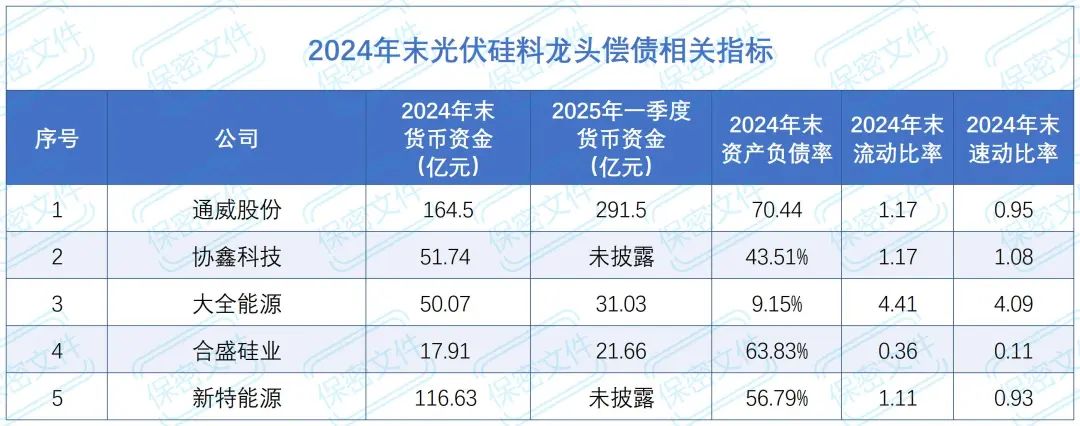
Core Viewpoint - The photovoltaic industry faced unprecedented challenges in 2024, including price drops, overcapacity, and weak demand, leading to significant losses for many companies [1][2]. Industry Overview - In 2024, 24 photovoltaic companies collectively lost over 28.6 billion yuan, with leading firms experiencing the largest losses [2]. - The demand for photovoltaic products is expected to surge in the first half of 2025 due to policy changes, but this may lead to a mismatch between supply and demand later in the year [2]. Company Performance Silicon Material Segment - In 2024, China's polysilicon production reached 1.82 million tons, a year-on-year increase of 23.6%, but market demand did not grow correspondingly, causing silicon prices to plummet [3]. - The average price of polysilicon fell from 58,100 yuan per ton at the beginning of the year to 36,500 yuan by year-end, putting financial pressure on many silicon material companies [3]. Financial Metrics of Leading Companies - **Tongwei Co., Ltd.**: - End of 2024 cash reserves: 16.45 billion yuan; Q1 2025 cash reserves: 29.15 billion yuan; asset-liability ratio: 70.44% [4]. - 2024 revenue: 91.99 billion yuan, down 33.87%; net loss: 7.04 billion yuan, down 151.86% [11][12]. - **GCL-Poly Energy Holdings**: - Asset-liability ratio: 43.51%, showing improvement from previous years [8]. - 2024 revenue: 15.1 billion yuan, down 55.2%; net loss: 4.75 billion yuan, down 289.25% [11][12]. - **Daqo New Energy Corp**: - Asset-liability ratio: 9.15%, with no short-term or long-term debt reported [8][10]. - 2024 revenue: 7.41 billion yuan, down 54.62%; net loss: 2.72 billion yuan, down 147.17% [11][12]. - **Hoshine Silicon Industry**: - Asset-liability ratio: 63.83%, with a slight improvement in Q1 2025 [6]. - 2024 revenue: 26.69 billion yuan, a slight increase of 0.41%; net profit: 1.74 billion yuan, down 33.64% [11][12]. - **Xinte Energy**: - Asset-liability ratio: 56.79% [8]. - 2024 revenue: 21.21 billion yuan, down 31.02%; net loss: 3.90 billion yuan, a significant drop from previous profits [11][12]. Strategic Adjustments - Tongwei is exploring new projects to reduce production costs and improve profitability despite high debt levels [5]. - Daqo New Energy has maintained a conservative financial strategy, resulting in a low asset-liability ratio and significant cash reserves [10]. Conclusion - The photovoltaic industry is currently in a challenging phase, with varying financial health among leading companies. Tongwei holds the highest cash reserves but also the highest debt, while Daqo stands out for its low debt levels but declining profitability. GCL-Poly and Hoshine are also facing significant challenges, while Xinte's future depends on market conditions and its operational strength [14].

协鑫科技20250622
2025-06-23 02:09
Summary of the Conference Call on GCL-Poly Energy Holdings Limited Industry Overview - The photovoltaic (PV) industry is undergoing a supply-side adjustment, with overcapacity becoming a core issue. GCL-Poly and other companies are actively promoting capacity integration to address supply-demand imbalances and seek policy support [2][3][4]. Key Points and Arguments - **Supply-Side Adjustments**: The importance of supply-side changes is emphasized, as the industry has shifted focus from demand-side issues to addressing overcapacity starting in 2024. The current focus is on resolving supply-demand imbalances [5][6]. - **Debt Restructuring**: The industry faces significant funding challenges, particularly in debt financing, which is primarily concentrated in banks. Debt restructuring is being pursued to convert bad assets into good ones, with financial institutions actively participating to mitigate bad debt risks [2][8][21]. - **Capacity Integration Consensus**: A consensus on capacity integration has been reached, and discussions with relevant national departments are ongoing to secure policy support. The integration process is voluntary, requiring companies to take responsibility and assess their debt repayment capabilities [2][9][12]. - **Exit Strategy for Non-viable Companies**: Companies unable to bear responsibilities will exit the market through compensation mechanisms, reducing resource consumption. It is estimated that over one million tons of outdated capacity will need to exit the market [16][15]. - **New Coordination Mechanism**: A new coordination mechanism is proposed to ensure that production decision-making authority is transferred to a third-party supervisory body, such as financial institutions, to ensure effective execution [18][19]. Financial Aspects - **Funding Scale for Integration**: The capacity integration is expected to involve hundreds of billions in funding, potentially exceeding 50 billion, although specific figures are still being clarified [3][22]. - **Current Financial Health**: Many companies are in a net debt state, with a low debt burden allowing them to take on some equity responsibilities. The focus is on debt management to meet repayment goals [10][11]. Market Dynamics - **Current Market Pressures**: The PV industry is experiencing short-term pressures from declining demand and downward pressure on upstream industrial silicon prices, particularly after a phase of rush installations [4][5]. - **Price Adjustments**: The current price of silicon materials is around 30 yuan, with no immediate signs of rebound. A target price of over 60 yuan is necessary for achieving marginal profits [20][24]. Future Plans - **Timeline for Debt Restructuring and Capacity Integration**: The goal is to finalize the debt restructuring plan by the end of 2025 and begin implementation in 2026 [3][26]. - **Legislative Support**: All funding and acquisition agreements for the PV industry have been signed, and relevant legislation is being drafted to support the integration process [27]. Additional Considerations - **Role of Local Governments**: The current plan does not involve local government subsidies for electricity prices, as the focus is on maximizing compatibility of interests among stakeholders [28][30]. - **Long-term Industry Viability**: The industry must move away from reliance on subsidies to ensure sustainable growth and competitiveness, allowing for natural market dynamics to foster strong enterprises [31][32]. Conclusion - The PV industry is at a critical juncture, with significant efforts underway to address overcapacity and financial challenges through capacity integration and debt restructuring. The success of these initiatives will depend on effective coordination among stakeholders and the establishment of a robust supervisory framework.