GREENTOWN CHINA(03900)

Search documents
港股内房股多数上涨,融创中国、碧桂园涨超3%
Mei Ri Jing Ji Xin Wen· 2025-09-24 02:19
Group 1 - The core viewpoint of the article highlights that the majority of Hong Kong's property stocks experienced an increase, with notable gains from companies such as Sunac China and Country Garden, which rose over 3% [1] - Other companies in the sector, including New World Development, China Overseas Land & Investment, Vanke, and Greentown China, also saw increases exceeding 2% [1]



专题 | 房企好房子体系和产品趋势研究
克而瑞地产研究· 2025-09-21 01:50
Core Viewpoint - The construction of "good houses" is a strategic development direction for residential products, transitioning from policy concepts to industry practices, and is expected to become a long-term trend in the real estate market [1][3]. Group 1: Development and Policy Background of "Good Houses" - The demand for "good houses" is driven by urbanization and a shift in consumer expectations from merely having a house to living in a quality home [3][5]. - The industry's transformation is influenced by policies such as "housing is for living, not for speculation," leading to price control measures that have impacted profit margins for real estate companies [4][5]. - As quality issues in housing become more prominent, the industry is shifting focus from scale to quality, making "good houses" a consensus and development direction [6][5]. Group 2: Real Estate Companies' "Good House" Strategies and Case Studies - Leading real estate companies like Poly, China Overseas, and China Resources are launching "good house" strategies focusing on safety, comfort, green living, and smart technology [7][8]. - Companies are establishing comprehensive technical standards that cover the entire lifecycle from design to service, reflecting a shift towards refined management [8][9]. - The strategies are transitioning from qualitative claims to quantifiable controls, with companies like China Overseas achieving measurable improvements in sound insulation and pollution reduction [8][9]. Group 3: Five Dimensions of "Good House" Product Practices - Safety performance is emphasized as the first guarantee of quality living [30]. - Comfort and livability have evolved from merely increasing physical space to optimizing space efficiency and human-centered design [31][32]. - Health environment assurance has shifted from basic physical indicators to a multi-dimensional approach that includes sound, light, air, and water quality [44][45]. - Green and low-carbon initiatives are integrated into daily life through innovative designs and technologies [52]. - Smart technology is advancing from passive control to proactive service, enhancing user experience through intelligent systems [53][59]. Group 4: Future Outlook for "Good Houses" - The construction of "good houses" will be a continuous process of deepening and refining, with policies expected to become more detailed and standardized [70]. - The industry will continue to transition from traditional scale expansion to quality enhancement, focusing on the four dimensions of safety, comfort, green living, and smart technology [70].






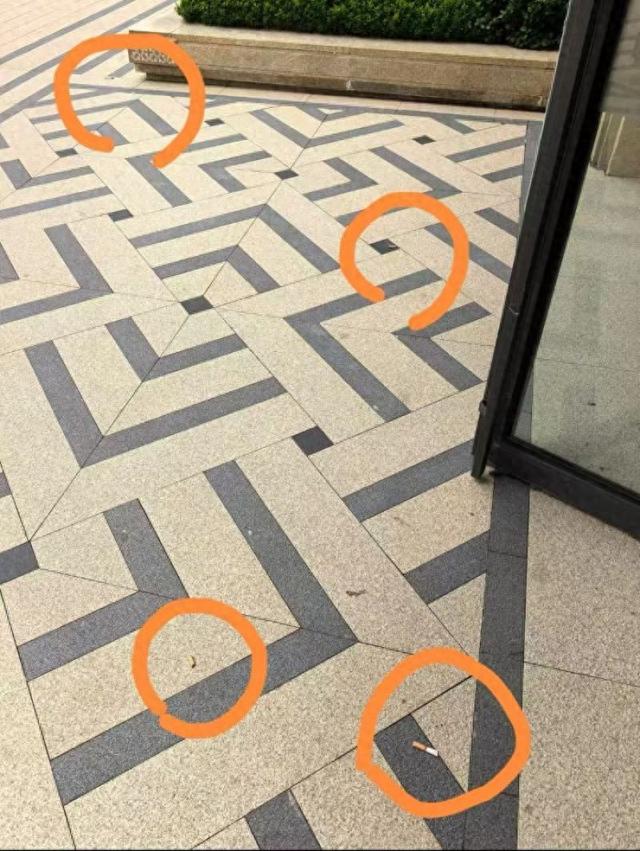
被指“8元物业费却现多处烟头”,实探绿城晓风印月:口碑销售夹击下的“灰色时刻”
Hua Xia Shi Bao· 2025-09-20 08:42
Core Viewpoint - The "Green City Xiaofeng Yinyue" project has faced significant challenges in reputation and sales, primarily due to subpar property management and aesthetic criticisms, leading to a decline in market visibility and competitiveness [2][3][11]. Property Management Issues - Residents have reported dissatisfaction with property management, citing a monthly fee exceeding 8 yuan per square meter while receiving inadequate services, including uncleaned litter and poor maintenance of common areas [2][8][10]. - The property management has acknowledged these issues and stated that they are being addressed, including agreements with tenants of affordable rental housing to maintain the community environment [3][10]. Sales Performance - As of mid-September, "Green City Xiaofeng Yinyue" still has over 200 unsold units, with only about 300 of the 600 available units sold since its launch [11][12]. - The average selling price has decreased by over 10,000 yuan per square meter from its initial launch price of 88,000 yuan per square meter, reflecting a broader trend of declining property values in the area [11][12]. Market Context - The overall market for new homes in the Chaoyang District, where the project is located, is under pressure, with a significant inventory of unsold properties [15][16]. - Recent policy changes in Beijing aimed at stimulating the housing market may not significantly impact the sales of "Green City Xiaofeng Yinyue," as potential buyers remain hesitant [16]. Competitive Landscape - Compared to other projects in the same area, "Green City Xiaofeng Yinyue" is perceived as less competitive in terms of price-to-value ratio, with other developments offering better designs and pricing [12][13]. - The project was initially well-received due to its brand image from previous successful developments by Green City Group, but current performance indicates a shift in market perception [7][11].
投资分化 | 2025年9月房地产企业新增土地储备报告
Sou Hu Cai Jing· 2025-09-19 11:46
Core Insights - The report indicates a seasonal decline in land acquisition by real estate companies, with a focus on core cities and risk control strategies [6][10][14] - The land supply in second and third-tier cities is rebounding, with an emphasis on revitalizing idle land through market-oriented methods [16][19][20] Group 1: Land Acquisition Trends - In the first eight months of 2025, the top 50 real estate companies added a total of 3,624.23 million square meters of land, a year-on-year increase of 7.19% [10][13] - The monthly land acquisition area for the top 50 companies in August was 225.64 million square meters, a month-on-month decrease of 54.03% [10][14] - Major players like China Overseas Land & Investment, China Merchants Shekou, and Poly Developments led in land reserves, with respective areas of 309.37 million, 275.64 million, and 267.19 million square meters [13][14] Group 2: Market Dynamics - The supply of residential land in first, second, and third-tier cities reached 577 plots, with a total planned building area of 3,748.90 million square meters, a month-on-month increase of 43.52% [16][18] - The starting floor price for supplied land was 3,709 yuan per square meter, down 5.64% month-on-month [16][19] - The average premium rate for land transactions was 4.76%, indicating a competitive but cautious market environment [24][28] Group 3: Policy and Market Response - Local governments are encouraged to adopt market-oriented approaches to activate idle land, with a focus on improving land utilization efficiency [19][20][39] - The issuance of local government bonds reached 9,776 billion yuan in August, slightly down from previous months, indicating ongoing financial support for land acquisition and urban development [20][23] - The trend of "direct repurchase" of land plots is gaining traction, providing stability for real estate companies amid market fluctuations [24][28]
国联民生证券:25H1地产行业利润率改善拐点或现曙光 调结构优土储成主流
智通财经网· 2025-09-19 06:38
Core Viewpoint - The real estate industry is experiencing a divergence in performance among different types of companies, with state-owned enterprises showing resilience while private and mixed-ownership firms face significant losses. The industry is expected to enter a bottoming phase after a rapid decline in gross profit margins [1][2]. Performance Analysis - In the first half of 2025, the 50 sample real estate companies reported total revenue of 1,204.9 billion yuan, a year-on-year decrease of 16.1%. State-owned enterprises saw a revenue increase of 4.9%, while private and mixed-ownership firms experienced declines of 32.1% and 26.1%, respectively [1]. - The net profit attributable to shareholders was a loss of 87 billion yuan, representing a 39% increase in losses year-on-year. State-owned enterprises maintained positive profitability, while private firms reported losses of 97.7 billion yuan and mixed-ownership firms lost 9.8 billion yuan [1]. - The gross profit margin stood at 11.68%, down 0.29 percentage points from the full year of 2024, indicating that the industry may have exited the rapid decline phase and is now stabilizing [1]. - The selling and administrative expense ratio was 4.89%, a decrease of 0.62 percentage points compared to 2024, reflecting ongoing cost reduction efforts [1]. Sales and Investment Trends - In the first half of 2025, the total sales amount for the top 100 real estate companies was 1,782 billion yuan, down 11% year-on-year. However, leading improvement-focused firms like China Jinmao and CIFI Holdings showed positive growth [2]. - The number of private enterprises in the top 30 decreased from 21 in 2020 to 7 in the first half of 2025, indicating a consolidation trend [2]. - Real estate companies are adopting a sales-driven investment strategy, focusing on core cities and regions, with land acquisition intensity showing signs of recovery. The land acquisition intensity for 14 typical firms from 2021 to the first half of 2025 averaged between 0.21 and 0.47, with some firms exceeding 0.6 [2]. Asset Management - In the first half of 2025, 16 typical real estate companies reported total assets of 10,187.5 billion yuan, a decrease of 2.9% from the end of 2024. The interest-bearing debt increased by 0.4% to 2,714.6 billion yuan, while the asset-liability ratio decreased by 0.8 percentage points to 71.5% [3]. - Short-term debt remains a concern, with 30.4% of total interest-bearing debt being short-term, down 1.8 percentage points from the end of 2024 [3]. - The average financing cost was 3.63%, a decrease of 30 basis points compared to the full year of 2024, with several firms achieving the lowest financing costs in the industry [3]. - Improvement-focused firms demonstrated higher asset liquidity, with companies like CIFI Holdings and China Jinmao having less than 15% of their total inventory as completed stock [3]. Investment Recommendations - The current real estate market shows a divergence between new and second-hand housing, with quality new projects in core cities performing well. Companies are encouraged to actively reduce old inventory and enhance liquidity through quality land reserves [4]. - In the context of a transitioning housing market, competition among firms will focus on asset quality, product quality, service, and brand influence. Recommendations include leading firms that continue to acquire land in core urban areas, such as Greentown China, CIFI Holdings, and China Overseas Land & Investment [4].



资源整合与战略协同:中交地产轻资产转型的央企优势
Bei Jing Shang Bao· 2025-09-18 08:02
Core Viewpoint - China Communications Real Estate has completed a significant asset restructuring, marking its full transition to a light asset operation model, which is representative of the broader industry trend towards light asset strategies in the real estate sector [1][2] Industry Trends - The real estate industry is undergoing a paradigm shift, moving away from high-leverage, rapid turnover models to a focus on management and operational service profits, with light asset operations becoming essential for long-term survival [2] - Numerous companies, including Huayuan Real Estate and Midea Real Estate, are announcing strategic transformations to reduce heavy asset investments and expand into light asset businesses such as property management and commercial operations starting in 2024 [2] Company Strategy - China Communications Real Estate's transition is supported by its parent company, China Communications Group, which is a leading global infrastructure service provider, giving it unique advantages over other real estate firms [2][3] - The restructuring aims to enhance business synergy within the group, with China Communications Real Estate focusing on operational services while China Communications Real Estate Group handles property development, creating a closed loop of "development - operation" [4][5] Operational Synergy - The restructuring enhances operational synergy, allowing projects developed by China Communications Real Estate Group and Greentown China to be managed by China Communications Real Estate, ensuring a stable source of quality business [5] - The separation of development and operational services at the corporate level helps mitigate risk transfer between business units, strengthening the overall risk resistance of the listed company [5] Light Asset Development - China Communications Real Estate is not starting from scratch in its light asset strategy, as it has already established professional companies under China Communications Real Estate Group that cover various fields, providing a solid foundation for its transition [6] - In the first half of 2025, the light asset business showed strong performance, with property management revenue reaching 485 million yuan and managed area totaling 55.7669 million square meters [6] Future Outlook - The company aims to further explore value-added services within its existing managed area and expand into community retail, home care, and asset management, while also actively seeking third-party property management projects [7] - Leveraging China Communications Group's technological expertise in smart cities and new infrastructure, the company plans to accelerate its transformation into a "smart city service provider" [7] - The transition of China Communications Real Estate serves as a valuable model for other enterprises, particularly state-owned and central enterprises, on how to utilize their advantages and innovate in response to industry trends [7]

2025房地产企业品牌价值50强揭晓 “好房子”建设成新趋势
Zhong Guo Jin Rong Xin Xi Wang· 2025-09-18 03:52
Core Insights - The overall performance of real estate companies is stabilizing in the first half of 2025, with improved buyer confidence and expectations [1] - Brand recognition remains high among leading real estate firms, which are focusing on financial stability, core city strategies, and improved product offerings [1] Group 1: Brand Value and Market Position - The top three companies in brand value are China Overseas, Poly Developments, and China Resources, with values of 85.8 billion yuan, 61.4 billion yuan, and 58.3 billion yuan respectively [1] - The average sales premium rate for the top 10 brand companies in key cities is primarily in the range of 0% to 5%, with an average of 1.32% in 2024, down by 0.10 percentage points from the previous year [1] Group 2: Consumer Behavior and Brand Importance - In 2025, 55.72% of consumers consider brand importance as very significant, while 40.56% view it as important, reflecting a 0.30 percentage point increase from the previous year [2] - 65.18% of consumers are willing to pay a premium for reputable brands, an increase of 3.11 percentage points from the previous year, with the highest willingness to pay a premium of 0% to 10% [2] Group 3: Business Strategies and Trends - Brand companies are diversifying their business models to navigate market cycles, with a focus on stable revenue from operational businesses [3] - The concept of "good housing" is emerging as a new trend, with companies developing comprehensive product systems to meet national standards [3] - AI technology is increasingly being integrated into various stages of the real estate industry, enhancing operational efficiency and providing new cost-reduction pathways [3]

房地产行业最新观点及25年1-8月数据深度解读:销售及新开工等数据承压,关注巩固房地产市场止跌回稳的有力措施-20250917
CMS· 2025-09-17 14:30
Investment Rating - The report maintains a recommendation for the real estate industry, indicating a cautious outlook with potential for stabilization in the market [2][6][41]. Core Insights - The real estate market continues to face pressure, with new construction and sales data showing significant declines. The report highlights a downward trend in new construction area, with an August year-on-year decrease of 20.3%, reflecting a 4.8 percentage point reduction from the previous month [2][42]. - Development investment also remains under pressure, with an August year-on-year decline of 19.5%, indicating that construction intensity is weak due to ongoing challenges in the sales market [2][42]. - The report suggests that the overall investment in construction may exhibit a "W-shaped" fluctuation pattern, with a short-term expectation of no V-shaped recovery [2][42]. Summary by Sections Sales Data - In August, the year-on-year growth rate of sales area adjusted for the base period was -10.6%, a decrease of 2.7 percentage points from the previous month. The overall new housing market has shown low-level fluctuations since May [6][15]. - Cumulatively, from January to August, the sales area reached 573 million square meters, with a year-on-year decline of 4.7% [9][16]. Construction Data - The new construction area in August saw a year-on-year decline of 20.3%, continuing a downward trend. The report anticipates that new construction will show a pattern of rising and then falling in the second half of the year [2][42]. - The completion area in August also experienced a year-on-year decrease of 21.4%, although it showed a slight recovery from the previous month [2][42]. Investment and Funding - The total development investment from January to August was 6 trillion yuan, reflecting a year-on-year decline of 12.9% [9][16]. - Funding sources for real estate projects showed a year-on-year decrease of 8.0% in August, indicating ongoing challenges in the financial landscape for real estate companies [7][9]. Market Trends - The report notes that the average price of new homes in August was 9,601 yuan per square meter, with a year-on-year decline of 2.7% [9][16]. - The report emphasizes the importance of monitoring the gap between net rental yields and mortgage rates as a key factor influencing total demand in the housing market [41].

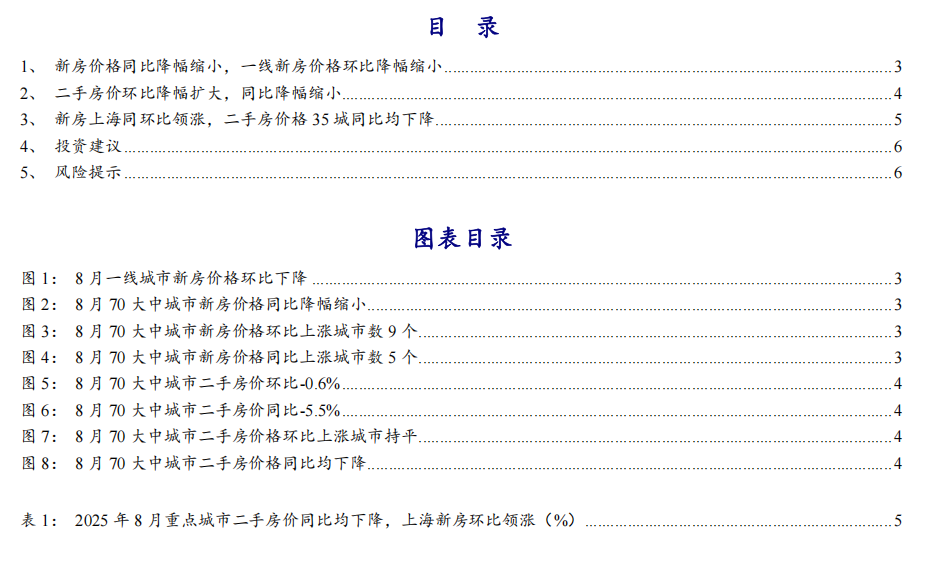
【开源地产|行业点评】新房上海持续领涨,二手房价格同比降幅缩小
Xin Lang Cai Jing· 2025-09-16 15:13
Group 1 - New housing prices in first-tier cities have seen a reduction in the rate of decline both month-on-month and year-on-year, with overall new housing prices in 70 cities showing a year-on-year decline narrowing to 3.0% [1][10][24] - The number of cities with rising new housing prices month-on-month increased to 9 in August, compared to 6 in July, while the number of cities with year-on-year price increases remained at 5 [1][14][24] - In August, Shanghai led the new housing price increases with a month-on-month rise of 0.4% and a year-on-year increase of 5.9%, making it the only first-tier city to achieve growth in both metrics [3][20][23] Group 2 - Second-hand housing prices in 70 cities experienced a month-on-month decline of 0.6%, with the rate of decline expanding by 0.1 percentage points [2][15][19] - Year-on-year, second-hand housing prices decreased by 5.5%, with the decline narrowing by 0.4 percentage points, while first-tier cities showed mixed results in their year-on-year performance [2][15][19] - In August, only one city, Changchun, saw a month-on-month increase in second-hand housing prices, while all cities experienced year-on-year declines [2][19][20] Group 3 - The overall real estate market in China is moving towards stabilization, with expectations for continued small fluctuations in housing prices amid supportive fiscal and monetary policies [4][24] - Recommended investment targets include strong credit real estate companies that can cater to improving customer demand, as well as firms benefiting from both residential and commercial real estate recovery [4][24]
土拍速递|杭州运河新城宅地溢价 25.5%,楼板价超西侧绿城汀岸印月轩3727元/㎡
克而瑞地产研究· 2025-09-16 02:48
Core Viewpoint - The article discusses the recent land sales in Hangzhou, highlighting the competitive bidding and the implications for the real estate market in the region, particularly in the low-density residential sector [2][5][12]. Group 1: Land Sales Overview - On September 16, two low-density residential plots were sold in Hangzhou, with the Gongshu District plot sold for 1.33 billion yuan, won by Yuexiu Property at a 25.5% premium [2][5]. - The Qiantang District plot was sold for 790 million yuan, with a 1.28% premium, won by Xingyao Property [2][5]. Group 2: Detailed Land Information - The Gongshu District plot has an area of 34,165 m² and a planned building area of 64,913.5 m², with a starting price of 1.06 billion yuan and a final price of 1.33 billion yuan, resulting in a floor price of 20,490 yuan/m² [5][6]. - The Qiantang District plot covers 38,629 m² with a planned building area of 81,120.9 m², starting at 780 million yuan and selling for 790 million yuan, leading to a floor price of 9,773 yuan/m² [5][6]. Group 3: Market Dynamics - The Gongshu District plot is located in a prime area with good transportation links and strong educational and medical facilities, contributing to its high demand and rapid sales [5][10]. - The surrounding new housing market has shown strong performance, with recent projects achieving 100% sales on the day of launch, indicating a robust demand in the area [10][14]. Group 4: Price Trends - In August, Hangzhou's new home prices saw a month-on-month increase of 0.4%, ranking first nationally, while the second-hand home price index was at 99.9, second only to Changchun [12][14]. - The article notes that over the past year, the new home absorption cycle in the area has remained around one month, with all projects selling out within the launch month [14][15].