CICC(03908)

Search documents
诚邀体验 | 中金点睛数字化投研平台
中金点睛· 2026-01-11 01:04
Core Viewpoint - The article emphasizes the establishment of a digital research platform by CICC, aimed at providing efficient, professional, and accurate research services through the integration of insights from over 30 specialized teams and a comprehensive coverage of more than 1,800 stocks [1]. Group 1: Research Services - CICC's digital research platform, "CICC Insight," offers a one-stop service that includes research reports, conference activities, fundamental databases, and research frameworks [1]. - The platform utilizes advanced model technology to enhance the research experience for clients [1]. Group 2: Research Content - Daily updates on research focus and timely article selections are provided through the "CICC Morning Report" [4]. - The platform features live broadcasts where senior analysts interpret market hotspots [4]. Group 3: Data and Frameworks - CICC Insight includes over 160 industry research frameworks and more than 40 premium databases, along with a comprehensive data dashboard [10]. - The platform also offers AI search capabilities for efficient information retrieval and intelligent Q&A features [10].


中金公司彭文生:中国绿色产业规模经济是对全球经济的重大贡献
Xin Lang Cai Jing· 2026-01-10 03:02
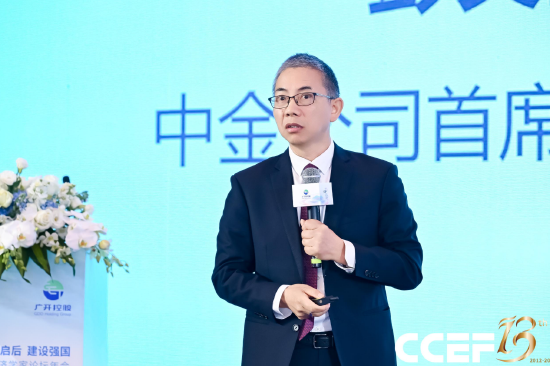
专题:2026中国首席经济学家论坛年会 2026年中国首席经济学家论坛年会于1月10-11日在上海举行,主题为"棋至中局:承前启后 建设强国"。 中金公司首席经济学家彭文生出席并演讲。 专题:2026中国首席经济学家论坛年会 2026年中国首席经济学家论坛年会于1月10-11日在上海举行,主题为"棋至中局:承前启后 建设强国"。 中金公司首席经济学家彭文生出席并演讲。 彭文生表示,应对中国绿色转型和产业发展抱有充分信心,全球尤其是新兴市场国家得益于中国绿色产 业发展,绿色能源成本快速下降。 他指出,化石能源是垄断行业,绿色产业是充分竞争行业,竞争意味着有规模且充分竞争时所有人都受 益。中国绿色产业规模经济是对全球经济的重大贡献。 新浪声明:所有会议实录均为现场速记整理,未经演讲者审阅,新浪网登载此文出于传递更多信息之目 的,并不意味着赞同其观点或证实其描述。 责任编辑:王翔 彭文生表示,应对中国绿色转型和产业发展抱有充分信心,全球尤其是新兴市场国家得益于中国绿色产 业发展,绿色能源成本快速下降。 他指出,化石能源是垄断行业,绿色产业是充分竞争行业,竞争意味着有规模且充分竞争时所有人都受 益。中国绿色产业规模经 ...

2026年证券行业策略报告:券商新周期:盈利上行、格局进化与低估值修复-20260109
Hua Yuan Zheng Quan· 2026-01-09 13:50
Core Insights - The report maintains a positive outlook on the securities industry, highlighting a phase of profit growth, structural evolution, and valuation recovery for 2026 [1] Industry Performance Overview - The overall industry performance is expected to see significant growth in 2025, with a mismatch between valuation and performance [4] - From January to November 2025, the Securities II (Shenwan) index increased by 5.6%, underperforming the CSI 300, while the Hong Kong Chinese securities index rose by 42.7%, outperforming the Hang Seng index by 10.9 percentage points [6] - In the first three quarters of 2025, 42 listed securities firms reported a combined revenue and net profit increase of 43% and 62% year-on-year, respectively, with an annualized ROE increase of 2.5 percentage points to 7.3% [6] Business Review and Outlook - **Brokerage Business**: The brokerage business is expected to benefit from increased trading volumes, with significant revenue growth anticipated in 2025. However, a decline in commission rates may limit profitability in traditional channel businesses [8] - **Proprietary Trading**: The contribution of proprietary trading to industry performance has significantly increased, with differentiation among firms based on investment capabilities and equity positions. Leading firms are expected to see stable returns, while smaller firms may experience higher volatility [9] - **Asset Management**: The asset management sector is entering a recovery phase driven by public fund transformation, with expected revenue growth of 33% year-on-year in 2026 [10] - **Investment Banking**: The investment banking sector is anticipated to enter a recovery cycle in 2026, supported by improved market conditions and policy incentives [10] Investment Themes for 2026 - The securities sector is positioned as a cost-effective investment opportunity due to its low valuation and performance recovery phase. Key factors include a clear trend of asset allocation towards equities, a recovery in multiple business lines, and supportive policies [12] - Recommended focus on leading securities firms with stable ROE, such as CITIC Securities, Huatai Securities, and GF Securities, which are expected to achieve ROE of 10.1%, 9.4%, and 9.4% in 2026, respectively [12] - Attention should also be given to firms with distinctive asset management and investment banking capabilities, such as Industrial Securities and China International Capital Corporation, which are well-positioned to benefit from ongoing market trends [12] Policy Environment - The report outlines a clear policy direction for the securities industry, emphasizing a shift from scale expansion to functional positioning and high-quality development. This includes a focus on value competition and the optimization of risk control indicators for leading firms [30][32] - The regulatory framework is evolving to support differentiated capabilities and strategic positioning among firms, with an emphasis on enhancing professional services and internationalization [32][34]



破局2.5万亿!中国并购市场:存量洗牌下的产业重构与科技突围
Zhong Guo Jing Ying Bao· 2026-01-09 12:53
Core Insights - The Chinese M&A market experienced significant growth in 2025, with a total of 8,151 disclosed transactions and a transaction volume of approximately 25,894 billion yuan, representing a year-on-year increase of about 16.12% [1] - The recovery of the M&A market is attributed to a combination of policy, industry, and capital resonance, marking a shift in China's economic development from "quantity increase" to "quality improvement" [1][3] - The trend indicates a transition in the regulatory framework from "fatherly" control to a "market-friendly" service model, significantly reducing institutional transaction costs and enhancing market vitality [1][3] Regional Distribution - Beijing led the M&A market with a transaction volume of 10,930 billion yuan, up 48.59% year-on-year; Shanghai followed with 6,092 billion yuan, down 14.92%; and Guangdong ranked third with 4,593 billion yuan, down 17.89% [2] - There were 28 M&A events exceeding 100 billion yuan, with notable transactions including China Shenhua's acquisition of Guoyuan Power at 1,335.98 billion yuan, and CICC's mergers with Dongxing Securities and Xinda Securities at 1,142.75 billion yuan [2] Industry Distribution - The industrial sector led M&A activity with a transaction volume of 7,605 billion yuan, up 11.67% year-on-year; the real estate sector saw a remarkable increase of 549.36% to 4,443 billion yuan; and the information technology sector reached 2,855 billion yuan, up 35.84% [2][3] - The significant growth in the real estate sector is attributed to necessary asset-liability restructuring, with many transactions aimed at project clearance and risk mitigation [3] M&A Trends and Strategies - The industrial sector's M&A activity reflects a shift from "spreading out" to "stepping up," focusing on enhancing supply chain resilience and precision [3][4] - Horizontal integration M&A events accounted for 5,966 billion yuan, representing 22.70% of total transaction volume, indicating a deep structural phase of "stock reshuffling" across various industries [4] - Companies are increasingly pursuing "structural power" through horizontal mergers, aiming to establish stronger competitive barriers and enhance management efficiency and technological innovation [4] Future Outlook - In 2026, two key areas of focus are expected: strategic acquisitions in hard technology industries, particularly in semiconductors and industrial software, and professional integration led by state-owned enterprises in sectors like new energy and high-end equipment [5] - Cross-border M&A in the high-tech sector is anticipated to gain momentum as Chinese companies seek to acquire advanced technologies and talent globally, enhancing their position in the global tech supply chain [5][6]



千方科技:接受中金公司等投资者调研
Mei Ri Jing Ji Xin Wen· 2026-01-09 09:45
Group 1 - Qianfang Technology announced that on January 8, 2026, it will accept an investor survey conducted by CICC, with participation from the company's Chairman and General Manager, Xia Shudong, who will address investor questions [1] - The company is engaging with investors to enhance transparency and communication regarding its operations and future prospects [1] Group 2 - The article features an exclusive interview with a Tesla FSD (Full Self-Driving) user who completed a 4,400-kilometer journey without any manual intervention, highlighting advancements in autonomous driving technology [1] - The interview discusses the user's perspective on Tesla's "pure vision" approach to self-driving technology, contrasting it with the laser radar sales perspective [1]

中金快讯 | 中金公司牵头保荐全球领先的AI大模型企业「MiniMax」完成港股IPO
Sou Hu Cai Jing· 2026-01-09 08:46
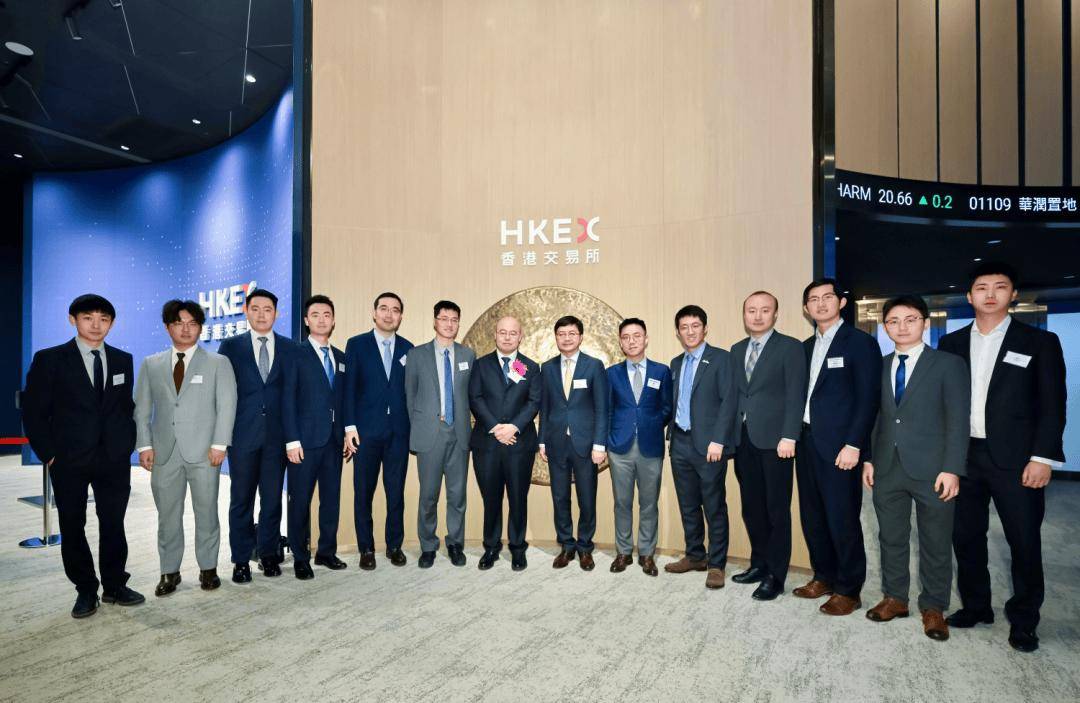
Group 1 - MiniMax Group Inc. officially listed on the Hong Kong Stock Exchange on January 9, with a pre-green shoe offering size of approximately $619 million and a post-green shoe size of about $712 million assuming full exercise of the green shoe option [2] - CICC served as the lead sponsor and played a crucial role in project execution, ensuring the successful completion of the listing timeline and attracting over 100 opinion leader investors globally [3] - The project is a significant case of CICC's support for the AI industry, showcasing the ability to attract global capital attention to Chinese tech companies [3] Group 2 - MiniMax is a leading general artificial intelligence technology company, established in early 2022, with a mission to advance AI technology and achieve general artificial intelligence [4] - The company is the only independent AI large model company in China with multimodal models ranked in the top tier globally, offering a range of AI-native products and an open platform for enterprises and developers [4] - MiniMax has served over 212 million individual users from more than 200 countries and regions, as well as over 100,000 enterprise clients and developers from more than 100 countries and regions [4] Group 3 - This IPO is the largest for an AI large model company to date and represents the largest AI company IPO globally in the past four years [5] - MiniMax achieved the fastest listing from establishment to IPO among AI large model companies [5] - The international placement was oversubscribed by 36.8 times, indicating strong interest from sovereign funds and long-term investors [5]
智通AH统计|1月9日
智通财经网· 2026-01-09 08:21
Group 1 - The article highlights the top three companies with the highest AH premium rates as Northeast Electric (00042) at 785.25%, Zhejiang Shibao (01057) at 448.59%, and Nanjing Panda Electronics (00553) at 286.79% [1] - The bottom three companies with the lowest AH premium rates are CATL (03750) at -10.95%, China Merchants Bank (03968) at -1.58%, and Heng Rui Medicine (01276) at -0.35% [1] - The article provides a detailed ranking of the top ten and bottom ten AH stocks based on their premium rates and deviation values, indicating significant disparities in market valuations between A-shares and H-shares [1][2] Group 2 - The deviation values for the top three companies are led by Zhejiang Shibao (01057) at 113.76%, Nanjing Panda Electronics (00553) at 79.68%, and Goldwind Technology (02208) at 69.37% [1] - The companies with the lowest deviation values include Northeast Electric (00042) at -93.22%, Chenming Paper (01812) at -28.66%, and CICC (03908) at -22.09% [1][2] - The article notes that the deviation value represents the difference between the current premium rate and the average premium rate over the past 30 days, providing insights into market trends [2]

2025年A股IPO市场量稳质升,中金公司凭头部项目储备占得2026年发展先机
Cai Jing Wang· 2026-01-09 07:14
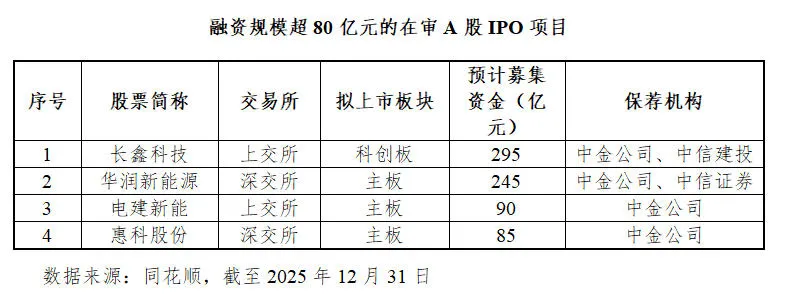
Core Insights - The A-share IPO market is showing signs of recovery in 2025, supported by new policies and improved market confidence, leading to a notable increase in both the number of listings and the total amount of financing [1][2]. Group 1: Market Performance - The number of new A-share listings reached 116 by December 31, 2025, with total financing amounting to 131.8 billion yuan, reflecting a 16% increase in listings and a 96% increase in financing compared to the same period in 2024 [1]. - The average fundraising amount per IPO increased to 113.6 million yuan, indicating heightened market activity and investor confidence [1]. Group 2: IPO Quality - In 2025, no new IPOs experienced a price drop below their issue price, demonstrating the effectiveness of the stringent review process and the high quality of new listings [1]. - The significant reduction in the number of IPOs that were terminated during the review process highlights the improved entry standards [1]. Group 3: Financing Structure - The top ten A-share IPO projects collectively raised 56.3 billion yuan, accounting for 43% of the total market financing, which is a 15 percentage point increase from 2024 [2]. - The successful IPO of Huadian New Energy, which raised 18.171 billion yuan, marked the first IPO exceeding 10 billion yuan under the new registration system, showcasing the leading role of top-tier brokers like CICC [2]. Group 4: Project Pipeline and Competitive Edge - CICC is leading the market with four major IPO projects under review, each exceeding 8 billion yuan, indicating its strong position in the current market landscape [3]. - The firm has established a robust project reserve system with 84 projects in various strategic emerging sectors, providing a solid foundation for future growth [6].
上证指数站上4100点
Sou Hu Cai Jing· 2026-01-09 06:39
Core Viewpoint - Goldman Sachs predicts that the MSCI China Index and the CSI 300 Index will rise by 20% and 12% respectively by 2026 [6] Group 1: Market Performance - On January 9, 2026, the Shanghai Composite Index broke through the 4100-point mark, marking a significant milestone not seen in ten years [3] - The Shanghai Composite Index achieved a fifteen-day consecutive rise, reaching a high of 4095.33 points, up 0.30% on January 9 [3] - The market showed strong trading activity with a half-day turnover exceeding 2 trillion yuan [3] Group 2: Factors Driving Market Growth - The recent rise in A-shares is attributed to a combination of positive factors, including high liquidity, favorable policy expectations, and investor sentiment [4] - The liquidity outlook improved due to anticipated interest rate cuts by the Federal Reserve and a dual easing monetary policy set by the domestic central economic work conference [4] - The central economic work conference emphasized expanding domestic demand and technological innovation as key focuses for 2026, providing structural investment opportunities [4] Group 3: Institutional Outlook - Citic Securities forecasts a continued bull market in 2026, driven by policy shifts and improved liquidity, alongside a focus on technology sector growth [5] - The investment community is optimistic about the Chinese market, with Goldman Sachs maintaining an overweight rating on A-shares and H-shares [6] - Morgan Stanley also raised its rating on the Chinese market to "overweight," citing reasonable valuations and light positioning by international investors [6] Group 4: Earnings Growth Expectations - Goldman Sachs anticipates that corporate earnings in China will grow by 14% and 12% in 2026 and 2027 respectively, with overseas revenue growth contributing to performance [6] - UBS projects that the overall A-share earnings growth rate will increase from 6% in 2025 to 8% in 2026, driven by GDP growth and supportive policies [7]



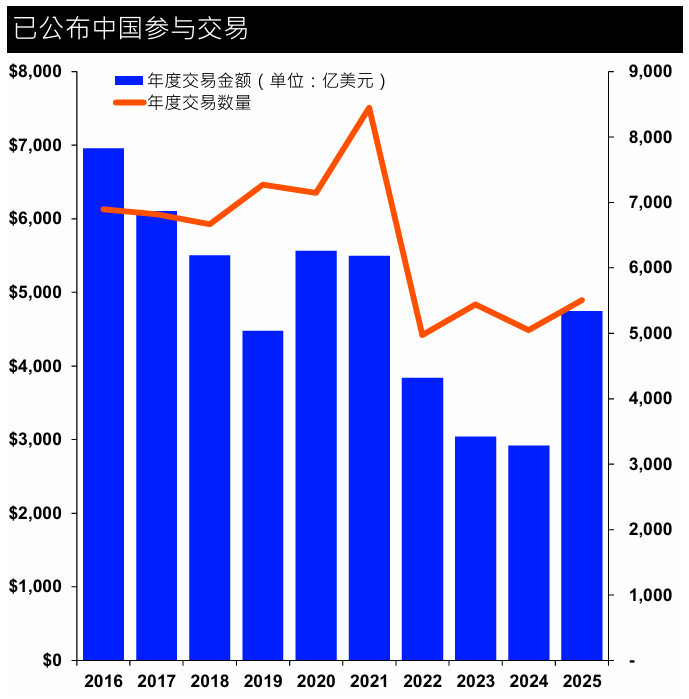
LSEG:2025年度全球涉及中国内地的并购交易总额达4743亿美元 同比增长62.6%
智通财经网· 2026-01-09 06:37
Group 1: Overall M&A Trends - In 2025, the total value of M&A transactions involving mainland China reached $474.3 billion, representing a year-on-year increase of 62.6% and a quarter-on-quarter increase of 81.1% [1] - The number of announced transactions was 5,504, which is a 9.1% increase year-on-year and a 12.4% increase quarter-on-quarter [1] Group 2: Domestic and Foreign M&A Activity - The total value of outbound M&A transactions from mainland China was $24.4 billion, showing a year-on-year growth of 5.2% [3] - The value of foreign acquisitions of mainland Chinese companies was $24 billion, which is a slight decline of 0.7% year-on-year [3] - Domestic M&A transactions in mainland China reached $412.1 billion, marking a significant year-on-year increase of 82.8% [3] Group 3: Sector-Specific Insights - The financial sector dominated M&A transactions, accounting for 22.62% of the market share with a total transaction value of $107.3 billion, which surged by 121% year-on-year [5] - The raw materials sector ranked second with a market share of 16.39%, experiencing a year-on-year growth of 158.2% [5] - The high-tech sector ranked third, holding a market share of 15.26% and a transaction value of $72.4 billion, reflecting a year-on-year increase of 77.3% [5] Group 4: Financial Advisors and Rankings - In 2025, China International Capital Corporation (CICC) topped the financial advisor rankings for announced M&A transactions involving mainland China, with a market share of 18.91% and a transaction value of $89.7 billion [9] - CITIC Securities ranked second with a market share of 15.12%, while Goldman Sachs ranked third with a market share of 9.69% [9] - By transaction volume, the top three financial advisors were Industrial and Commercial Bank of China (ICBC), CITIC Securities, and CICC [10] Group 5: Legal Advisors and Rankings - The top three legal advisors by transaction value in 2025 were King & Wood Mallesons, AllBright Law Offices, and Zhong Lun Law Firm, with respective market shares of 16.1%, 10.9%, and 9.8% [11] - By transaction volume, the leading legal advisors were Fangda Partners, King & Wood Mallesons, and Zhong Lun Law Firm [11]