XPENG-W(09868)

Search documents
小鹏集团-W(09868) - 截至二零二五年十一月三十日止之股份发行人的证券变动月报表
2025-12-05 00:10
股份發行人及根據《上市規則》第十九B章上市的香港預託證券發行人的證券變動月報表 截至月份: 2025年11月30日 狀態: 新提交 致:香港交易及結算所有限公司 公司名稱: 小鵬汽車有限公司(於開曼群島註冊成立以不同投票權控制的有限公司) 呈交日期: 2025年12月5日 I. 法定/註冊股本變動 | 1. 股份分類 | 不同投票權架構公司普通股 | 股份類別 A | | | 於香港聯交所上市 (註1) | | 是 | | | --- | --- | --- | --- | --- | --- | --- | --- | --- | | 證券代號 (如上市) | 09868 | 說明 | A類普通股 | | | | | | | | | 法定/註冊股份數目 | | | 面值 | | 法定/註冊股本 | | | 上月底結存 | | | 9,250,000,000 | USD | 0.00001 | USD | | 92,500 | | 增加 / 減少 (-) | | | 0 | | | USD | | | | 本月底結存 | | | 9,250,000,000 | USD | 0.00001 | USD | | ...
隔夜欧美·12月5日
Sou Hu Cai Jing· 2025-12-04 23:38
Market Performance - The three major US stock indices closed mixed, with the Dow Jones down 0.07% at 47,850.94 points, the S&P 500 up 0.11% at 6,857.12 points, and the Nasdaq up 0.22% at 23,505.14 points [1] - Popular tech stocks showed mixed performance, with Meta rising over 3% and Nvidia up over 2%, while Amazon and Apple fell over 1% [1] - Popular Chinese concept stocks also had mixed results, with NIO up over 4% and XPeng up over 3%, while Baidu and Bilibili rose over 1%, and Miniso and Yum China fell over 1% [1] - European stock indices all closed higher, with Germany's DAX up 0.87% at 23,899.33 points, France's CAC40 up 0.43% at 8,122.03 points, and the UK's FTSE 100 up 0.19% at 9,710.87 points [1] Commodity Prices - US oil main contract rose 1.27% to $59.7 per barrel, while Brent crude main contract increased 1.04% to $63.32 per barrel [1] - International precious metal futures closed mixed, with COMEX gold futures up 0.13% at $4,237.9 per ounce, and COMEX silver futures down 1.86% at $57.53 per ounce [1] - London base metals showed mixed results, with LME lead up 0.85% at $2,016.00 per ton, LME zinc up 0.65% at $3,085.00 per ton, and LME nickel up 0.08% at $14,885.00 per ton, while LME aluminum down 0.33% at $2,887.50 per ton, LME copper down 0.47% at $11,434.00 per ton, and LME tin down 0.59% at $40,540.00 per ton [1] Bond Yields - US Treasury yields collectively rose, with the 2-year yield up 3.71 basis points at 3.521%, the 3-year yield up 4.78 basis points at 3.545%, the 5-year yield up 4.51 basis points at 3.673%, the 10-year yield up 3.48 basis points at 4.098%, and the 30-year yield up 2.39 basis points at 4.755% [1] - European bond yields mostly increased, with the UK 10-year yield down 1.3 basis points at 4.433%, Germany's 10-year yield up 2.4 basis points at 2.769%, Italy's 10-year yield up 2.2 basis points at 3.466%, and Spain's 10-year yield up 2.6 basis points at 3.243% [1]


年终行情悬而未决 “后补贴时代”车市淘汰赛鸣笛
Zheng Quan Shi Bao· 2025-12-04 22:21
Core Viewpoint - The Chinese automotive market faces uncertainty as it transitions into the "post-subsidy era," with increased competition and policy changes impacting sales expectations for the end of 2025 [1][2]. Group 1: Market Dynamics - Many car manufacturers are uncertain about their sales expectations for December, with some indicating a lack of preparedness for the end-of-year sales push [2]. - The withdrawal of local trade-in subsidies and the adjustment of the new energy vehicle purchase tax from full exemption to a 50% reduction are significant factors affecting consumer purchasing decisions [2][3]. - The market is moving away from reliance on policy support, entering a phase where product quality and user experience will be the primary competitive factors [1][6]. Group 2: Competitive Landscape - The competition among car manufacturers is expected to intensify, with a focus on product strength, cost control, and user experience as key differentiators [1][9]. - Smaller brands may struggle to absorb increased sales costs associated with "bottom-line" subsidy schemes, leading to potential operational challenges [4][9]. - The market is predicted to undergo significant differentiation, with leading companies leveraging scale and brand influence to maintain competitiveness [8][10]. Group 3: Industry Trends - The automotive industry is witnessing a shift towards a more transparent and direct competition environment, with a potential "淘汰赛" (elimination race) for less competitive players [10][11]. - Companies that can innovate and maintain service quality are likely to thrive, while those lacking core technology and cost control may face difficulties [10][11]. - The overall sentiment indicates that the automotive market will see a consolidation of strong brands, with predictions that only a few dominant players will remain in the long term [11].


港股通成交活跃股追踪 三花智控近一个月首次上榜





Zheng Quan Shi Bao Wang· 2025-12-04 13:39
Core Insights - On December 4, 2023, Sanhua Intelligent Control made its debut on the Hong Kong Stock Connect active trading list for the first time in a month, with a trading volume of 0.853 billion HKD and a net sell of 0.057 billion HKD, closing up by 7.70% [1] Trading Activity Summary - The total trading volume of active stocks on the Hong Kong Stock Connect on December 4 was 28.218 billion HKD, accounting for 37.28% of the day's total trading amount, with a net buying amount of 1.402 billion HKD [1] - Alibaba-W led the trading volume with 5.318 billion HKD, followed by Tencent Holdings and Xiaomi Group-W with trading amounts of 5.271 billion HKD and 4.995 billion HKD, respectively [1] - The most frequently listed stocks in the past month were Alibaba-W and Tencent Holdings, each appearing 22 times, indicating strong interest from Hong Kong Stock Connect investors [1] Individual Stock Performance - Sanhua Intelligent Control's trading details on December 4 included a trading volume of 0.853 billion HKD, a net sell of 0.057 billion HKD, and a closing price of 34.960 HKD, reflecting a daily increase of 7.70% [1] - Other notable stocks included: - Tencent Holdings: Trading volume of 5.271 billion HKD, net sell of 1.346 billion HKD, closing price of 612.000 HKD, daily increase of 0.16% [1] - Xiaomi Group-W: Trading volume of 4.995 billion HKD, net buy of 0.232 billion HKD, closing price of 41.980 HKD, daily increase of 4.38% [1] - Alibaba-W: Trading volume of 5.318 billion HKD, net sell of 0.010 billion HKD, closing price of 154.400 HKD, daily increase of 0.52% [1]
12月4日港股通净买入14.80亿港元
Zheng Quan Shi Bao Wang· 2025-12-04 13:34
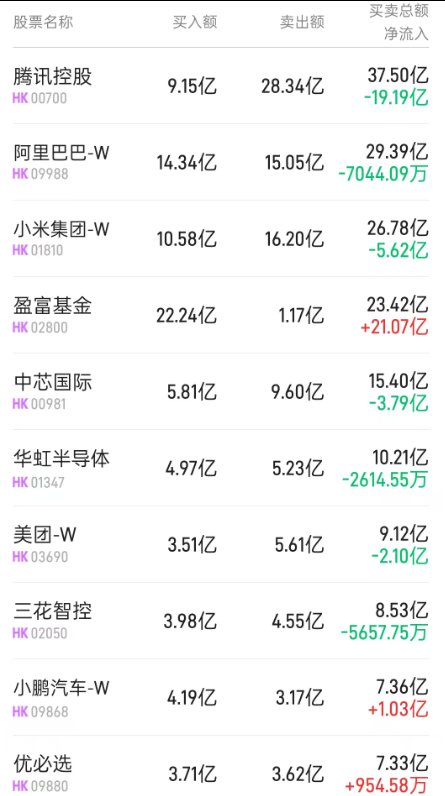
Group 1 - The Hang Seng Index rose by 0.68% to close at 25,935.90 points on December 4, with a net inflow of HKD 1.48 billion through the southbound trading channel [1] - The total trading volume for the southbound trading on December 4 was HKD 75.688 billion, with a net buy of HKD 1.48 billion [1] - In the Shanghai-Hong Kong Stock Connect, the trading volume was HKD 46.347 billion with a net sell of HKD 1 billion, while the Shenzhen-Hong Kong Stock Connect had a trading volume of HKD 29.341 billion with a net buy of HKD 2.481 billion [1] Group 2 - In the top ten active stocks for the Shanghai-Hong Kong Stock Connect, Tencent Holdings had the highest trading amount of HKD 37.50 billion, followed by Alibaba-W and Xiaomi Group-W with HKD 29.39 billion and HKD 26.78 billion respectively [1] - The stock with the highest net buy was the Tracker Fund of Hong Kong (盈富基金) with a net buy of HKD 2.107 billion, closing up by 0.77% [1] - Tencent Holdings had the highest net sell amount of HKD 1.919 billion, closing up by 0.16% [1] Group 3 - In the Shenzhen-Hong Kong Stock Connect, Alibaba-W led with a trading amount of HKD 23.79 billion, followed by Xiaomi Group-W and Tencent Holdings with HKD 23.16 billion and HKD 15.21 billion respectively [2] - The stock with the highest net buy in the Shenzhen-Hong Kong Stock Connect was Xiaomi Group-W with a net buy of HKD 0.794 billion, closing up by 4.38% [2] - The stock with the highest net sell in the Shenzhen-Hong Kong Stock Connect was Kuaishou-W with a net sell of HKD 0.094 billion, closing up by 0.15% [2]


港股通12月4日成交活跃股名单
Zheng Quan Shi Bao Wang· 2025-12-04 13:31
Market Overview - On December 4, the Hang Seng Index rose by 0.68%, with southbound funds totaling HKD 756.88 billion in trading volume, including HKD 385.84 billion in buying and HKD 371.04 billion in selling, resulting in a net buying amount of HKD 14.80 billion [1] Southbound Trading Activity - The southbound trading through Stock Connect (Shenzhen) had a cumulative trading volume of HKD 293.41 billion, with net buying of HKD 24.81 billion, while the Stock Connect (Shanghai) recorded a cumulative trading volume of HKD 463.47 billion, resulting in a net selling of HKD 10.00 billion [1] Active Stocks - Alibaba-W had the highest trading volume among southbound funds at HKD 53.18 billion, followed closely by Tencent Holdings at HKD 52.71 billion and Xiaomi Group-W at HKD 49.95 billion [1] - The top net buying stocks included the Tracker Fund of Hong Kong (盈富基金) with a net buying amount of HKD 26.06 billion, followed by WuXi Biologics (药明生物) with HKD 3.16 billion and Xiaomi Group-W with HKD 2.32 billion [1] Continuous Net Buying and Selling - Three stocks experienced continuous net buying for more than three days, with Meituan-W leading at six days, followed by Xiaomi Group-W at five days and Xpeng Motors-W at three days. The total net buying amounts were HKD 22.89 billion for Meituan-W, HKD 20.53 billion for Xiaomi Group-W, and HKD 1.67 billion for Xpeng Motors-W [2] - The stocks with the highest net selling included Semiconductor Manufacturing International Corporation (中芯国际) and Tencent Holdings, with total net selling amounts of HKD 34.49 billion and HKD 24.60 billion, respectively [2] Summary of Active Stocks on December 4 - The following table summarizes the active stocks with their trading amounts, net buying/selling, and daily price changes: | Code | Name | Trading Amount (HKD million) | Net Buying (HKD million) | Daily Change (%) | |-------|--------------------|------------------------------|--------------------------|-------------------| | 02800 | Tracker Fund | 284623.16 | 260585.86 | 0.77 | | 02269 | WuXi Biologics | 51978.36 | 31558.31 | 7.09 | | 01810 | Xiaomi Group-W | 499493.94 | 23169.32 | 4.38 | | 09868 | Xpeng Motors-W | 73564.27 | 10257.11 | 1.06 | | 01347 | Hua Hong Semiconductor | 159937.95 | 5363.70 | 3.11 | | 00883 | CNOOC | 47173.84 | 3007.07 | 0.92 | | 09880 | UBTECH Robotics | 73333.99 | 954.58 | 3.66 | | 03690 | Meituan-W | 171510.39 | 856.38 | 2.29 | | 09988 | Alibaba-W | 531828.80 | -117.31 | 0.52 | | 02050 | Sanhua Intelligent Control | 85349.48 | -5657.75 | 7.70 | | 01024 | Kuaishou-W | 54889.05 | -9372.22 | 0.15 | | 00981 | Semiconductor Manufacturing International | 260990.47 | -45829.01 | 3.87 | | 00700 | Tencent Holdings | 527122.94 | -134592.99 | 0.16 |
汽车股普遍下滑 广汽集团(02238)跌3.86% 市场对行业短期前景愈发谨慎
Xin Lang Cai Jing· 2025-12-04 11:25
Core Viewpoint - The automotive sector is experiencing a general decline, with several major companies reporting significant stock price drops, indicating a cautious outlook for the industry's short-term prospects due to unexpectedly rapid weakening of market demand and increasing risk signals for 2026 [1] Group 1: Stock Performance - GAC Group (02238) fell by 3.86% - Li Auto-W (02015) decreased by 3.37% - NIO-SW (09866) dropped by 2.41% - Beijing Automotive (01958) declined by 2.34% - Xpeng Motors-W (09868) saw a decrease of 2.25% - Leap Motor (09863) fell by 1.23% - Seres (09927) decreased by 1.12% [1] Group 2: Industry Outlook - There is an increasing caution regarding the short-term outlook for the automotive industry due to a faster-than-expected decline in market demand - According to CMB International, after a concentrated release in Q4, the first quarter of 2026 may return to a seasonal low, suggesting investors should navigate structural market conditions while remaining cautious and attentive to short-term fluctuations [1]

智通港股通活跃成交|12月4日
智通财经网· 2025-12-04 11:06
Core Insights - On December 4, 2025, Tencent Holdings (00700), Alibaba-W (09988), and Xiaomi Group-W (01810) were the top three companies by trading volume in the southbound trading of the Stock Connect, with trading amounts of 3.75 billion, 2.939 billion, and 2.678 billion respectively [1] - In the southbound trading of the Shenzhen-Hong Kong Stock Connect, Alibaba-W (09988), Xiaomi Group-W (01810), and Tencent Holdings (00700) also ranked as the top three, with trading amounts of 2.379 billion, 2.316 billion, and 1.521 billion respectively [1] Southbound Trading Highlights - **Top Active Companies in Southbound Trading (Hong Kong Stock Connect)** - Tencent Holdings (00700): Trading amount of 3.75 billion, net buy of -1.919 billion - Alibaba-W (09988): Trading amount of 2.939 billion, net buy of -70.44 million - Xiaomi Group-W (01810): Trading amount of 2.678 billion, net buy of -562 million - Other notable companies include Yingfu Fund (02800) with a trading amount of 2.342 billion and a net buy of 2.107 billion [2] - **Top Active Companies in Southbound Trading (Shenzhen-Hong Kong Stock Connect)** - Alibaba-W (09988): Trading amount of 2.379 billion, net buy of 69.27 million - Xiaomi Group-W (01810): Trading amount of 2.316 billion, net buy of 794 million - Tencent Holdings (00700): Trading amount of 1.521 billion, net buy of 573 million - Other notable companies include SMIC (00981) with a trading amount of 1.07 billion and a net buy of -79.37 million [2]
港股汽车股集体走低,广汽集团跌超4%
Mei Ri Jing Ji Xin Wen· 2025-12-04 10:25
Group 1 - The core viewpoint of the article indicates a collective decline in Hong Kong automotive stocks, with significant drops observed in major companies [1] Group 2 - GAC Group experienced a decline of over 4% [1] - Li Auto saw a decrease of over 3% [1] - NIO and Xpeng Motors both fell nearly 3% [1]
北水动向|北水成交净买入14.8亿 内资抢筹盈富基金(02800)超26亿港元
智通财经网· 2025-12-04 09:57
Summary of Key Points Core Viewpoint - The Hong Kong stock market experienced significant net inflows from northbound trading, with a total net buy of 14.8 billion HKD on December 4, 2023, indicating strong investor interest in certain stocks while others faced net selling pressure [1]. Group 1: Stock Performance - The top net bought stocks included 盈富基金 (02800) with a net buy of 26.05 billion HKD, 药明生物 (02269) with a net buy of 3.15 billion HKD, and 小米集团-W (01810) with a net buy of 2.31 billion HKD [4][5]. - The stocks with the highest net selling included 腾讯 (00700) with a net sell of 13.45 billion HKD, 中芯国际 (00981) with a net sell of 4.58 billion HKD, and 三花智控 (02050) with a net sell of 5657.75 million HKD [5][6]. Group 2: Market Insights - 中金公司 suggests that the upcoming US-China meetings may support risk assets, recommending an overweight position in Chinese stocks ahead of the meetings [4]. - 浦银国际 expresses optimism for the CXO sector by 2026, citing potential growth in overseas biopharmaceutical financing due to anticipated interest rate cuts [4]. - The semiconductor industry shows divergence, with 华虹半导体 (01347) receiving a net buy of 5363 million HKD, while 中芯国际 (00981) faced significant net selling [5]. Group 3: Company Developments - 小米集团's president announced significant investments in AI, indicating progress beyond expectations in AI models and applications [5]. - 优必选 (09880) signed a strategic cooperation agreement with 卓世科技, aiming for the deployment of 10,000 robots over the next five years [6]. - 中海油 (00883) reported the production commencement of a new oil field project, expecting peak production of approximately 16,900 barrels of oil equivalent per day by 2026 [5].