
MNSO(09896)

Search documents
从“持久战”到“闪电战”:中国品牌出海的速度革命靠什么?
Guo Ji Jin Rong Bao· 2026-01-27 07:31
"中国品牌出海正迎来一场前所未有的'速度革命'。" 近日,全球管理咨询公司科尔尼发布报告称,以往,一个中国品牌在海外建立知名度往往需要10年甚至更长时间,而如今,这一周期正被大幅压缩至3 至5年。这场变化并非偶然,而是由跨境电商、社交媒体以及高度成熟的供应链体系共同催化的结构性转折。 报告还指出,近年来,泡泡玛特旗下Labubu系列等多个IP在全球市场持续掀起消费热潮。这股热潮折射了中国消费品出海范式的变革。 从"卖产品"到"建生态",从贸易出海到供应链与资产出海,从依赖平台到构建全渠道体系。围绕中国品牌出海的变化,《国际金融报》记者近日专访了 科尔尼董事陈沛祎,试图还原这场"速度革命"背后的真实路径与隐性挑战。 外部不确定下的路径转变 当前全球经贸环境正经历深刻重塑,地缘政治、贸易摩擦与本土保护主义抬头,显著提高了中国企业全球化的不确定性。 面对这一复杂局面,陈沛祎明确指出:"外部不确定性已成为当前中国品牌出海的'新常态',但这不会改变出海的基本方向,而是深刻改变了出海的路 径选择与成功逻辑。" 她进一步阐释了这种路径转变的具体内涵:"过去出海主要利用中国供应链成本优势;而现在,为规避关税,已从'产品出海' ...




名创优品1月26日斥资24.65万美元回购5.13万股
Zhi Tong Cai Jing· 2026-01-27 05:36
Core Viewpoint - Miniso (09896) announced a share buyback plan, indicating confidence in its stock value and future growth potential [1] Group 1: Company Actions - The company plans to repurchase 51,300 shares at a total cost of $246,500 [1]
名创优品(09896)1月26日斥资24.65万美元回购5.13万股
Zhi Tong Cai Jing· 2026-01-27 04:24
智通财经APP讯,名创优品(09896)发布公告,于2026年1月26日,该公司斥资24.65万美元回购5.13万 股。 ...
名创优品(09896.HK)1月26日耗资24.65万美元回购5.13万股
Ge Long Hui· 2026-01-27 04:18
格隆汇1月27日丨名创优品(09896.HK)发布公告,2026年1月26日耗资24.65万美元回购5.13万股。 ...
名创优品(09896) - 翌日披露报表
2026-01-27 04:04
FF305 翌日披露報表 (股份發行人 ── 已發行股份或庫存股份變動、股份購回及/或在場内出售庫存股份) 表格類別: 股票 狀態: 新提交 FF305 第 2 頁 共 7 頁 v 1.3.0 FF305 公司名稱: 名創優品集團控股有限公司 呈交日期: 2026年1月27日 如上市發行人的已發行股份或庫存股份出現變動而須根據《香港聯合交易所有限公司(「香港聯交所」)證券上市規則》(「《主板上市規則》」)第13.25A條 / 《香港聯合交易所有限公司GEM證券 上市規則》(「《GEM上市規則》」)第17.27A條作出披露,必須填妥第一章節 。 | 第一章節 | | | | | | | | | | --- | --- | --- | --- | --- | --- | --- | --- | --- | | 1. 股份分類 | 普通股 | 股份類別 | 不適用 | | | 於香港聯交所上市 | 是 | | | 證券代號 (如上市) | 09896 | 說明 | | | | | | | | A. 已發行股份或庫存股份變動 | | | | | | | | | | | | | 已發行股份(不包括庫存股份)變動 | | ...
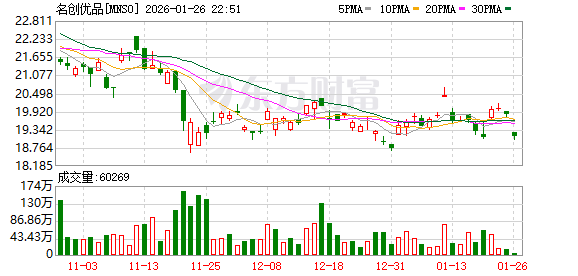
MINISO Group Holding Limited Unsponsored ADR (MNSO) Stock Slides as Market Rises: Facts to Know Before You Trade
ZACKS· 2026-01-26 23:50
Core Viewpoint - MINISO Group Holding Limited Unsponsored ADR (MNSO) is experiencing a decline in stock price, with a recent trading session closing at $19.13, reflecting a -3.58% change from the previous day, which is underperforming compared to the S&P 500 and other indices [1] Company Performance - The upcoming earnings disclosure is anticipated to show revenue of $859.03 million, representing a 33.05% increase from the prior-year quarter [2] - Full-year estimates project earnings of $1.35 per share and total revenue of $3 billion, indicating year-over-year changes of +17.39% for earnings and 0% for revenue [2] Analyst Estimates - Recent adjustments to analyst estimates for MINISO are being monitored closely, as these revisions reflect short-term business trends and a favorable outlook on the company's health and profitability [3] - The Zacks Rank system, which integrates estimate changes, currently ranks MINISO as 3 (Hold), indicating a neutral outlook [5] Valuation Metrics - MINISO is trading at a Forward P/E ratio of 12.64, which is below the industry average of 18.63, suggesting that the stock may be undervalued [6] - The company has a PEG ratio of 1.31, compared to the industry average of 2.09, indicating a more favorable growth expectation relative to its price [7] Industry Context - The Retail - Apparel and Shoes industry, which includes MINISO, holds a Zacks Industry Rank of 50, placing it in the top 21% of over 250 industries, suggesting strong performance potential [8]

纳斯达克中国金龙指数跌超0.5%,名创优品跌4.08%
Mei Ri Jing Ji Xin Wen· 2026-01-26 14:51
Group 1 - The Nasdaq China Golden Dragon Index fell by over 0.5% on January 26 [2] - Miniso Group saw a decline of 4.08% [2] - Zai Lab Limited experienced a drop of 4.36% [2] - Daqo New Energy Corp decreased by 2.80% [2] - Xpeng Motors fell by 2.70% [2] - Baidu Inc. declined by 2.51% [2]


名创优品(09896.HK)1月26日耗资197.07万港元回购5.26万股
Ge Long Hui· 2026-01-26 09:45
Core Viewpoint - Miniso (09896.HK) announced a share buyback on January 26, 2026, spending HKD 1.9707 million to repurchase 52,600 shares at a price range of HKD 37.08 to 38 per share [1] Group 1 - The total expenditure for the share buyback was HKD 1.9707 million [1] - The number of shares repurchased was 52,600 [1] - The price range for the repurchase was between HKD 37.08 and 38 per share [1]
名创优品(09896)1月26日斥资197.07万港元回购5.26万股
智通财经网· 2026-01-26 09:42
Core Viewpoint - Miniso Group (09896) announced a share buyback plan, indicating confidence in its stock value and future prospects [1] Group 1 - The company will repurchase 52,600 shares at a total cost of HKD 1.9707 million [1] - The buyback price per share ranges from HKD 37.08 to HKD 38.00 [1]
名创优品(09896) - 翌日披露报表
2026-01-26 09:38
FF305 翌日披露報表 (股份發行人 ── 已發行股份或庫存股份變動、股份購回及/或在場内出售庫存股份) 表格類別: 股票 狀態: 新提交 公司名稱: 名創優品集團控股有限公司 呈交日期: 2026年1月26日 如上市發行人的已發行股份或庫存股份出現變動而須根據《香港聯合交易所有限公司(「香港聯交所」)證券上市規則》(「《主板上市規則》」)第13.25A條 / 《香港聯合交易所有限公司GEM證券 上市規則》(「《GEM上市規則》」)第17.27A條作出披露,必須填妥第一章節 。 | 第一章節 | | | | | | | | | --- | --- | --- | --- | --- | --- | --- | --- | | 1. 股份分類 | 普通股 | 股份類別 | 不適用 | | 於香港聯交所上市 | 是 | | | 證券代號 (如上市) | 09896 | 說明 | | | | | | | A. 已發行股份或庫存股份變動 | | | | | | | | | | | | 已發行股份(不包括庫存股份)變動 | | 庫存股份變動 | | | | | 事件 | 已發行股份(不包括庫存股份)數 目 | | 佔 ...